
The U.S. government currently holds up to $175 billion in tariff refunds that belong to businesses like yours, yet much of this capital remains unclaimed due to the high cost of legal entry. You've likely felt the sting of Section 301 and IEEPA duties on your bottom line, but the prospect of paying a consultant for a claim that might get denied is a risk your budget can't justify. This is why partnering with a zero upfront fee tariff consultant is the only logical path forward. This performance-based model shifts the financial burden away from your balance sheet, ensuring that professional expertise is accessible without the weight of initial retainers or hourly fees.
It's understandable to feel overwhelmed by the complexity of the new CAPE portal and the shifting landscape of U.S. trade law. You shouldn't have to navigate federal bureaucracy alone or risk capital to recover capital. In this guide, we'll explain how you can secure a risk-free audit of your tariff history and successfully reclaim your Section 301 and IEEPA payments. We’ll walk through the process of professional documentation management and show you how a results-oriented partnership can restore your liquidity without any financial exposure.
Key Takeaways
- Understand how a specialized audit identifies specific HTS codes eligible for Section 301 and IEEPA refunds within your historical import data.
- Discover why hiring a zero upfront fee tariff consultant protects your cash flow by eliminating hourly billing, retainers, and administrative overhead.
- Learn why the 2026 deadline creates a critical window to act before the three-year lookback period for List 3 and List 4a claims expires.
- Compare the high-risk hourly fee model against a performance-based contingency structure where you only pay when capital is successfully recovered.
- Identify the necessary steps to navigate the CAPE portal and manage complex customs documentation without diverting your internal resources.
What is a Zero Upfront Fee Tariff Consultant?
A zero upfront fee tariff consultant is a specialized trade advocate who operates exclusively on a performance basis to recover overpaid import duties. Unlike traditional customs brokers or general legal counsel who often require substantial retainers, this type of consultant assumes the entire financial risk of the recovery process. Their primary objective is to identify, document, and file claims for refunds on Section 301 and IEEPA duties that were either misclassified or ruled illegal by recent judicial decisions. In an environment where the U.S. government potentially owes importers up to $175 billion, this model provides a pathway to liquidity that doesn't compete with your existing operational budget.
The core value proposition is built on absolute financial transparency. There are no hourly billing cycles, no administrative filing fees, and no hidden research costs. You only pay a percentage of the capital that is successfully returned to your accounts. It's a significant departure from the "pay-to-play" nature of corporate law. This distinction is vital as businesses navigate the complexities of the CAPE portal, launched by U.S. Customs and Border Protection in April 2026. While many firms offer a "free assessment" to lure in clients only to charge for the actual filing, a true zero upfront fee tariff consultant handles the entire lifecycle of the claim, from initial audit to final disbursement, without asking for a single dollar out of pocket.
The Performance-Based Partnership
This arrangement utilizes a contingency fee model to align the consultant's incentives directly with your financial recovery. When a consultant’s profit depends entirely on the size of the refund, they're naturally driven to leave no stone unturned during the audit phase. They'll scrutinize every HTS code and entry line to maximize the total recovery amount. This shift from traditional legal retainers to results-oriented trade recovery ensures that you aren't just another billable hour; you're a partner in a high-stakes financial reclamation. If the government denies the claim, the consultant absorbs the cost of the labor and resources expended, leaving your capital untouched.
Who Benefits Most from This Model?
While any importer can utilize these services, certain sectors find the contingency model particularly transformative. Manufacturers who have maintained high-volume imports from China under Section 301 are often sitting on millions in recoverable duties. Similarly, retailers facing extreme margin compression find that these refunds provide a much-needed cash infusion without increasing their debt load. For companies with sprawling, global supply chains, a deep audit of IEEPA eligibility is often too complex for internal teams to handle. These organizations benefit from an external "insider" who possesses the technical expertise to navigate federal bureaucracy while removing all financial barriers to entry.
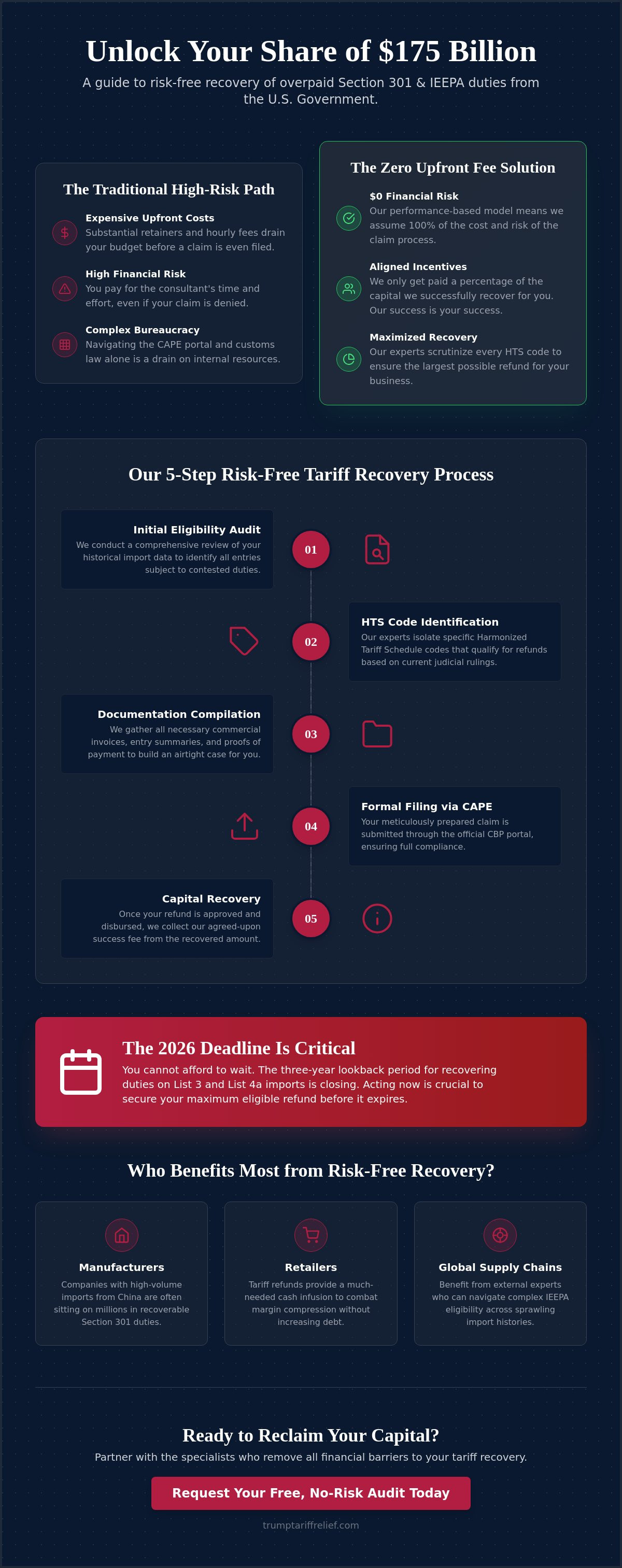
The 5-Step Process to Risk-Free Tariff Recovery
Recovering capital from the federal government requires a methodical approach that balances technical precision with legal strategy. A zero upfront fee tariff consultant manages this entire lifecycle to ensure that your internal teams remain focused on core operations while we handle the heavy lifting of the reclamation. The process is designed to be entirely risk-free, moving from a preliminary data scan to the final disbursement of funds.
- Step 1: Initial Eligibility Audit. We conduct a comprehensive review of your historical import data to pinpoint every entry that was subject to contested duties.
- Step 2: HTS Code Identification. Experts isolate specific Harmonized Tariff Schedule codes that qualify for IEEPA or Section 301 refunds based on current judicial rulings.
- Step 3: Documentation Compilation. We gather all necessary commercial invoices, entry summaries, and proof of payment to build an airtight case.
- Step 4: Formal Filing. Your claim is submitted through the Consolidated Administration and Processing of Entries (CAPE) portal, which CBP launched on April 20, 2026.
- Step 5: Capital Recovery. Once the refund is approved and disbursed, the agreed-upon success fee is paid from the recovered amount.
Step 1-2: The Eligibility Assessment
The foundation of a successful claim lies in a rigorous tariff refund assessment. Many importers are unaware that their past entries contain "hidden" opportunities for recovery, particularly following the Supreme Court's invalidation of specific IEEPA-based tariffs. Our experts scan your past entries to identify these discrepancies. While some firms might charge for a feasibility study, a legitimate contingency partner provides this analysis for free. Importers must understand that while the federal government maintains a Covenant Against Contingent Fees for securing government contracts, this restriction does not apply to private sector consultants helping you reclaim your own overpaid taxes. You shouldn't pay a dime until the eligibility of your claim is verified and the path to recovery is clear.
Step 3-5: Filing and Reclaiming Capital
Managing the bureaucracy of U.S. Customs and Border Protection is where most internal claims fail. Effective customs documentation management is the primary driver of claim approval. Your consultant handles all government inquiries, providing the technical evidence required to satisfy CBP auditors. Once the filing is submitted via the CAPE portal, the timeline for recovery typically depends on the volume of current claims. However, having a partner who understands the "if-then" logic of regulatory frameworks ensures your application moves through the system without unnecessary delays. If you're ready to see what your business is owed, you can start your preliminary assessment today to secure your place in the recovery queue.
Contingency Fees vs. Hourly Rates: A Financial Comparison
Choosing the right partner for tariff recovery is a decision that directly impacts your company's liquidity and risk profile. Traditional trade attorneys and consultants typically operate on hourly billing structures, which creates an immediate drain on corporate resources before a single dollar is recovered. By contrast, a zero upfront fee tariff consultant eliminates the financial barrier to entry, shifting the risk from your balance sheet to their expertise. If the government denies a claim, your business pays nothing, ensuring that your capital remains focused on growth rather than legal speculation.
Hourly consultants often present "hidden costs" that aren't apparent during the initial pitch. These expenses can include:
- Research Time: Paying for an associate to scan thousands of entry lines for eligibility.
- Administrative Overhead: Charges for document preparation, filing fees, and government correspondence.
- Trust Account Retainers: Tying up tens of thousands of dollars in a law firm’s account for months or years.
When you calculate the Total Cost of Recovery (TCR), the contingency model often yields a higher net return. While a success fee might seem higher on paper than an hourly rate, the hourly model offers no protection against a $0 recovery. If you spend $50,000 on legal fees for a claim that is ultimately rejected by CBP, that capital is gone forever. The contingency model serves as a performance guarantee; the consultant only profits when you successfully reclaim your capital.
Why CFOs Prefer the Success-Fee Model
Financial leaders prioritize predictability and the elimination of "budget surprises." Under a performance-based arrangement, the recovery fee is treated as a cost of sales rather than a fixed legal expense. This categorization often bypasses the need for complex departmental approvals because the fee only triggers once new revenue is secured. There is also a significant psychological and operational benefit to this alignment. When a consultant’s compensation is tied to the total refund amount, they are highly motivated to identify every eligible HTS code and fight for every penny, whereas an hourly consultant is paid regardless of the final outcome.
Calculating the Net Benefit
A contingency fee protects the bottom line even in complex litigation. When comparing a success fee against a standard $400/hr legal retainer, the value of cash flow protection becomes clear. You aren't just paying for a service; you're buying an "insider" advocate who assumes all the liability. This "no-win, no-fee" guarantee acts as a litmus test for consultant confidence. If a consultant isn't willing to put their own skin in the game, it suggests they may not be fully confident in the eligibility of your IEEPA or Section 301 claims. If you have questions about how these structures differ in practice, reviewing our frequently asked questions can help clarify the specific protections afforded by a contingency-based partnership.
The Urgency of 2026: Why You Cannot Afford to Wait
The clock is ticking on billions of dollars in potential refunds. For importers who paid Section 301 and IEEPA duties, 2026 represents a definitive threshold. The Supreme Court's invalidation of tariffs enacted under the International Emergency Economic Powers Act has opened a massive recovery window, but this opportunity is not permanent. Understanding the tariff refund statute of limitations is critical for any business that imported goods under List 3 or List 4a. As the three-year lookback period begins to sunset for these specific entries, the chance to reclaim your capital vanishes.
A zero upfront fee tariff consultant is your most effective tool for meeting these deadlines. Because there are no initial costs or budget approvals required, you can bypass the standard corporate procurement cycles that often delay critical legal actions. You don't have to wait for the next fiscal year to start your recovery. You can act today, ensuring your claims are filed before the administrative window slams shut. This model removes the friction of financial risk, allowing you to prioritize speed and precision in a high-stakes environment.
Navigating Deadlines and Statutes
The regulatory landscape is governed by two distinct timelines. There is the standard 180-day protest window for individual entries, and then there is the broader, multi-year IEEPA litigation timeline. Navigating these requires a dual strategy. Filing "protective protests" is essential for 2026. This legal maneuver preserves your right to a refund even while broader court cases are still being decided. Leaving capital on the table due to administrative procrastination is a choice your balance sheet can't afford. If you miss these filing dates, the government is under no obligation to return your funds, regardless of whether the original tariff was illegal.
The "First-Mover" Advantage in Tariff Recovery
Early filers are already seeing the benefits of the new Consolidated Administration and Processing of Entries (CAPE) portal. On April 20, 2026, CBP launched this portal to handle the surge in refund requests. As of April 9, 2026, over 56,000 U.S. importers had already registered to receive their refunds. As the final 2026 deadlines approach, the system will inevitably face a "filing rush" that could lead to significant processing delays. Leveraging professional tariff recovery for importers allows you to bypass the steep learning curve of federal bureaucracy. Our experts ensure your documentation is perfect the first time, avoiding the back-and-forth inquiries that slow down the recovery of your capital.
Don't let your capital remain in government accounts while the clock runs out. Request your tariff eligibility assessment now to ensure your business is positioned at the front of the recovery line.
Partnering with Trump Tariff Relief for Maximum Recovery
Trump Tariff Relief stands as a high-performing partner for importers who refuse to let their capital sit idle in government accounts. Our approach is defined by a 100% contingency-based model. We only win when you win. This ensures that every IEEPA Tariff Refund Recovery effort we undertake is backed by significant skin in the game. As a specialized zero upfront fee tariff consultant, we assume the full weight of the bureaucratic burden, allowing your logistics and finance teams to remain focused on your primary business objectives. We don't just provide a service; we act as a protective strength for your balance sheet.
Our national reach allows us to serve U.S. importers across all industries, from high-volume manufacturers to specialized retailers. We understand that the fear of paying for a denied claim is a major barrier for many businesses. By eliminating all out-of-pocket costs, we provide an elite level of advocacy that was previously reserved for only the largest corporations. Whether you are dealing with complex supply chains or straightforward import histories, our team provides the sophisticated navigation required to win against federal bureaucracy.
Why Our Success-Based Model is Different
Our methodology goes beyond simple data entry. We utilize proprietary audit technology to scan your historical imports, identifying missed refund opportunities that traditional customs brokers often overlook. We have deep expertise in Section 301 refund litigation and the specific Supreme Court rulings that invalidated previous IEEPA-based duties. Throughout the recovery process, we maintain a policy of transparent communication. You stay informed as we navigate the CAPE portal, handle your Customs Documentation Management, and push your claim toward final approval. This no-nonsense approach ensures efficiency over fluff, building the trust necessary for a long-term partnership.
Start Your No-Risk Assessment Today
Securing your capital begins with a confidential Tariff Eligibility Assessment. The process is streamlined for maximum efficiency. You simply provide access to your historical import data, and our team handles the rest of the heavy lifting. Within the first 48 hours of partnering with us, you'll receive a preliminary report detailing the potential recovery amount and the specific HTS codes involved. There is no guesswork and no hidden fees. We provide a clear shortcut through a complex system, acting as a seasoned mentor for your financial restoration.
The 2026 window is closing fast. Every day you wait is a day closer to the statute of limitations expiring on your List 3 and List 4a claims. Don't let administrative inertia cost your business millions in lost liquidity. Partner with a zero upfront fee tariff consultant who has the technical expertise and the motivation to reclaim what is rightfully yours. Reach out today to begin your recovery before the opportunity vanishes forever.
Secure Your Financial Restoration Before the 2026 Deadlines
The opportunity to reclaim overpaid duties is a high-stakes race against federal statutes of limitations. By now, the path is clear: the performance-based model eliminates the financial barriers that once made tariff recovery a luxury for the few. You've seen how a zero upfront fee tariff consultant shifts the risk away from your corporate budget, ensuring that professional advocacy is accessible without the burden of hourly retainers. With the 2026 deadlines approaching for List 3 and List 4a claims, the time for administrative hesitation has passed.
Our team of legal and trade experts specializes in the complexities of IEEPA and Section 301 refund claims, managing the entire documentation and filing process on your behalf. We operate on a strict contingency basis, meaning you pay nothing unless we successfully recover your money. Don't let your company's liquidity remain in government accounts when a risk-free solution is available today. Take the first step toward reclaiming what belongs to your business and strengthening your bottom line for the years ahead.
Get Your Free Tariff Refund Assessment and start your recovery journey with a partner who only wins when you do.
Frequently Asked Questions
Is the China tariff refund real and legitimate?
China tariff refunds are absolutely legitimate and are facilitated by the U.S. Customs and Border Protection's CAPE portal. This system was established following a Supreme Court ruling that invalidated specific duties imposed under the International Emergency Economic Powers Act. The government currently faces potential liabilities of up to $175 billion. This isn't a government handout; it's the restoration of capital that was collected under a regulatory framework later deemed unlawful.
What is the standard contingency fee for a tariff consultant?
Contingency fees are typically calculated as a percentage of the total capital successfully recovered from the government. While specific rates depend on the complexity and volume of the claim, the defining feature is that the fee is only due after you receive your refund check. This structure ensures that your consultant is financially incentivized to maximize your recovery. It eliminates the risk of paying for legal research that doesn't yield a tangible financial result.
How long does it take to receive a refund after filing?
The timeline for receiving a refund depends on the current processing volume at the CAPE portal and the complexity of your specific entries. Since the portal launched on April 20, 2026, thousands of importers have filed claims, creating a queue for administrative review. While some claims move quickly, others requiring detailed HTS code verification may take longer. Your consultant manages all government inquiries during this period to prevent unnecessary delays in your disbursement.
What happens if my tariff refund claim is denied?
If your claim is denied, you're not responsible for any costs or fees under a performance-based agreement. A zero upfront fee tariff consultant absorbs the entire cost of the audit, documentation, and filing labor. This protection is the cornerstone of our partnership. It ensures that your business doesn't suffer a secondary financial loss if the government rejects the eligibility of certain historical entries. You only share a portion of the win.
Are there any hidden costs in a zero upfront fee model?
There are no hidden administrative or filing costs in a legitimate contingency model. A true zero upfront fee tariff consultant covers the expenses associated with data analysis and government correspondence. You won't see separate line items for research hours or portal registration fees. The only financial transaction occurs after the capital is returned to your business. This transparency allows CFOs to pursue recovery without needing to secure new departmental budget approvals.
Can I file for a tariff refund on my own without a consultant?
You can technically file for a refund on your own through the CAPE portal, but the burden of proof is high. Importers must provide precise documentation and technical justifications for every contested entry. Most businesses find that the complexity of HTS code classification and the risk of administrative errors make professional management a more efficient choice. A consultant's expertise often identifies recovery opportunities that internal logistics teams might overlook during a standard audit.
What documents do I need to start a no-risk assessment?
To begin a no-risk assessment, you primarily need your historical import data and entry summaries. These documents allow us to isolate the specific duties paid under Section 301 or IEEPA. We'll also require proof of payment to verify that the capital was successfully disbursed to CBP. Once this data is provided, our team handles the heavy lifting of identifying eligibility and preparing the formal filing for the CAPE portal.
Does the zero upfront fee model apply to all types of tariffs?
The zero upfront fee model is specifically designed for tariff categories with established legal precedents for recovery, such as Section 301 and IEEPA duties. While other tariffs like Section 232 on steel and aluminum have seen recent modifications, they may follow different administrative processes. Our focus remains on the $175 billion in contested capital where the "no-win, no-fee" structure provides the most significant advantage for the importer.
Ready to find out what your business may be owed?
Check My Eligibility