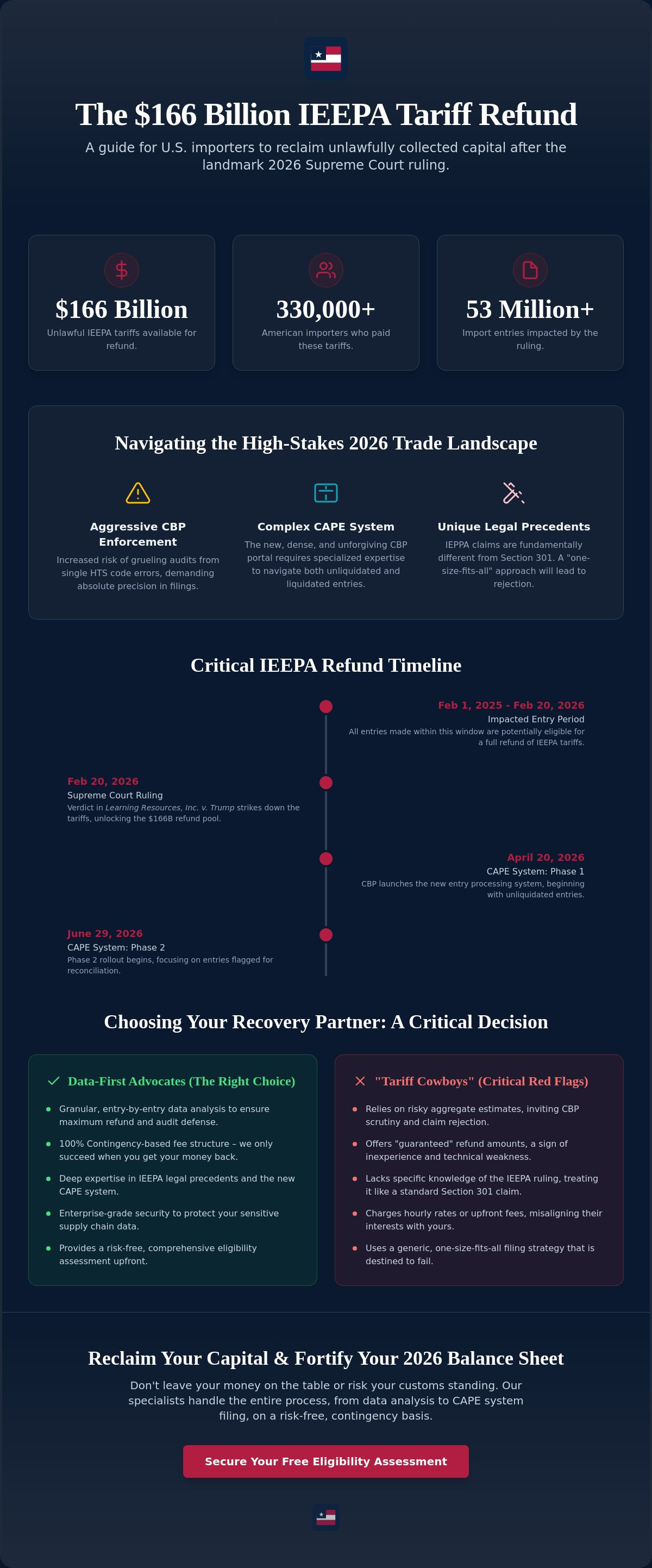
Over 330,000 importers paid a staggering $166 billion in IEEPA tariffs that the Supreme Court recently ruled unlawful, yet the majority of these businesses hesitate to claim what's theirs. You're likely feeling the pressure of this fleeting window while simultaneously fearing that a single HTS code error could trigger a grueling Customs and Border Protection (CBP) audit. It's a valid concern. The surge in new enforcement measures and the suspension of the de minimis exemption prove that the regulatory environment has never been more aggressive. That's why choosing a tariff recovery partner isn't just about finding someone to file paperwork; it's about securing a sophisticated advocate who understands the high stakes of 2026 trade law.
You deserve to reclaim your capital and improve your 2026 balance sheet without the administrative burden or the legal risk. If you are overwhelmed by the volume of historical entry data, then you need a partner who handles the entire documentation process through the CAPE system. This article will show you how to identify a high-performing expert who provides a risk-free eligibility assessment. We'll explore five critical factors to help you distinguish between "tariff cowboys" and the data-first advocates who will protect your customs standing while winning back your money.
Key Takeaways
- Understand the technical complexity of the CAPE portal and why the 2026 trade landscape requires specialized expertise to navigate both unliquidated and liquidated entries.
- Learn the essential criteria for choosing a tariff recovery partner, including their ability to perform granular, entry-by-entry data analysis instead of relying on risky aggregate estimates.
- Discover why a contingency-based fee structure is the most secure financial model, aligning your partner's success directly with your capital restoration.
- Identify critical red flags, such as "guaranteed" refund amounts, that signal a lack of technical depth and could potentially trigger a CBP audit.
- Position your business for a risk-free eligibility assessment to ensure your 2026 balance sheet benefits from the $166 billion refund pool without the administrative burden.
The Landmark IEEPA Ruling: Why You Need a Specialized Recovery Partner
On February 20, 2026, the U.S. Supreme Court delivered a historic verdict in Learning Resources, Inc. v. Trump. This ruling didn't just strike down unlawful trade barriers; it unlocked a $166 billion refund pool for over 330,000 American importers. To understand what are tariffs in this specific legal context, you must view them as capital that was essentially seized without proper statutory authority. Reclaiming these funds is not a standard administrative task. It requires IEEPA tariff recovery, a highly specialized trade consultancy service that operates far outside the scope of daily customs brokerage.
The 2026 trade landscape is more aggressive than ever. Choosing a tariff recovery partner is now a strategic necessity because of the new Consolidated Administration and Processing of Entries (CAPE) system. U.S. Customs and Border Protection (CBP) launched Phase 1 on April 20, 2026, and Phase 2 on June 29, 2026. These phases involve unliquidated entries and those flagged for reconciliation. The process is dense and unforgiving. If you rely on a general broker who handles thousands of routine filings, you risk missing the granular details required by the Automated Commercial Environment (ACE) Portal. A specialist focuses exclusively on the forensic identification of eligible capital, ensuring every dollar is accounted for before the window to claim expires.
The Complexity of IEEPA vs. Section 301 Claims
Most importers are deeply familiar with Section 301 duties. However, IEEPA claims are governed by entirely different legal precedents and the Court of International Trade (CIT). While Section 301 focuses on trade practices, IEEPA involves executive emergency powers. This distinction is critical. A "one-size-fits-all" filing strategy will likely result in CBP rejections or, worse, a full-scale audit. You need a partner who understands the nuances of the Learning Resources decision and how it impacts entries made between February 1, 2025, and February 20, 2026.
The Financial Stakes for U.S. Importers
For many manufacturers and retailers, these refunds represent a massive capital injection that can transform a 2026 balance sheet. With over 53 million entries impacted, the scale of this opportunity is unprecedented. Failing to audit every entry means leaving money on the table that rightfully belongs to your business. It's about righting a financial wrong. You can gain a deeper perspective on the regulatory shift by Understanding the IEEPA Tariff Ruling and the specific timelines for the Phase 3 rollout expected by the end of July 2026.
Technical Vetting: Evaluating a Partner’s Data and Customs Expertise
Precision is your only defense against a Customs and Border Protection (CBP) audit. When choosing a tariff recovery partner, you must look past the sales pitch and interrogate their technical infrastructure. Many firms offer aggregate estimates based on broad HTS headings, but this approach is reckless. Relying on "ballpark" figures invites federal scrutiny and risks the rejection of your entire claim. A legitimate partner performs a granular, entry-by-entry analysis of your historical data to ensure every line item matches the specific criteria of the 2026 IEEPA ruling.
The technical burden of the Harmonized Tariff Schedule (HTS) is immense. If a partner lacks deep HTS precision, they might inadvertently file for codes that don't qualify under the Supreme Court's mandate. This level of technical scrutiny is a core part of the 5 Red Flags to Avoid When Selecting a Consultant because surface-level knowledge won't survive a federal review. Furthermore, your sensitive trade data requires enterprise-grade security protocols. A high-performing advocate must demonstrate how they protect your proprietary supply chain information while navigating the Automated Commercial Environment (ACE) Portal.
Data Integrity and Entry Verification
Large-volume importers can't rely on manual entry review. If a consultant suggests a manual process for thousands of entries, it's a red flag for potential human error. You should demand a partner who utilizes proprietary audit tools to identify "hidden" eligible entries that standard brokers often miss. These tools should cross-reference your liquidation dates with the CAPE system’s phased rollout to ensure every filing is timely. You can explore our how it works page to see how we handle these complex data sets with forensic accuracy.
Navigating CBP and CIT Guidance
The rules of engagement change rapidly. A seasoned partner stays ahead of shifting CBP administrative rulings and knows exactly when to use Post Summary Corrections (PSCs) versus formal protests. If the partner doesn't understand the lifecycle of a recovery claim, they'll miss the narrow windows for unliquidated entries. Liquidation status represents the finality of a customs entry, serving as the definitive legal deadline that determines whether a refund claim is still viable or permanently barred. By mastering these timelines, a specialized partner ensures that your capital is recovered, not lost to bureaucracy.
The Economics of Recovery: Contingency vs. Hourly Billing
Financial restoration shouldn't come with a prohibitive upfront price tag. Traditional trade law firms often operate on billable hours, charging high rates regardless of whether your refund is actually approved by Customs and Border Protection. When choosing a tariff recovery partner, you must evaluate if their fee structure aligns with your company's bottom line. A contingency-based model ensures that the partner only succeeds when you do. This eliminates the financial risk of pursuing a claim that might be caught in the CAPE portal's phased rollout for months.
Upfront consulting packages are a common trap in the trade industry. Some firms charge for "preliminary assessments" or "data audits" that offer no guarantee of a successful capital injection. If you pay for the effort instead of the result, you're essentially subsidizing the consultant's overhead. Transparency is paramount here. You need a partner who provides a clear, written breakdown of how fees are calculated and a firm commitment that payment only occurs after the refund is secured in your business account.
Shared Risk: The Advantage of Contingency Fees
A partner who takes 0% upfront is fundamentally more motivated to maximize your refund. They won't just file for the obvious unliquidated entries; they'll perform the forensic work required to identify complex liquidated cases that others might overlook. This model significantly reduces the barrier to entry for small and mid-sized importers who can't afford to gamble on legal fees. It's about democratizing access to the $166 billion refund pool. You can learn more about the specific eligibility requirements for these funds in our IEEPA guide.
Comparing Professional Fees to Potential ROI
Don't underestimate the internal opportunity cost of managing a recovery claim. Your staff should focus on supply chain operations, not forensic customs auditing. Specialized partners utilize proprietary tools that identify 100% of eligible entries, whereas internal teams often miss nuances in HTS code changes. While hourly legal rates can quickly exceed the value of smaller claims, a "No Recovery, No Fee" promise ensures the math always works in your favor. It's a low-risk, high-reward partnership designed to reclaim your capital without draining your current cash flow. This results-oriented approach transforms a complex legal hurdle into a streamlined financial win for your 2026 balance sheet.
Due Diligence Checklist: 5 Red Flags to Avoid When Selecting a Consultant
The 2026 trade landscape is a high-stakes environment where the $166 billion refund pool has attracted both legitimate experts and opportunistic "tariff cowboys." When you're choosing a tariff recovery partner, your first defense is a rigorous vetting process. Legitimate recovery is a forensic legal and financial operation, not a simple administrative filing. Any firm that treats this like a routine task is a liability to your customs standing and your long-term financial health.
Avoid any consultant who offers "guaranteed" refund amounts. The Supreme Court's ruling in Learning Resources, Inc. v. Trump established the right to a refund, but the actual calculation depends on the precise HTS codes and entry dates verified within the CAPE system. No third party can guarantee what U.S. Customs and Border Protection (CBP) will ultimately approve. A professional partner should provide a range based on forensic data, not a promise that sounds too good to be true.
Experience with IEEPA-specific legal precedents is non-negotiable. Many firms are trying to pivot from Section 301 work, but the legal framework of the International Emergency Economic Powers Act is distinct. If they can't explain the nuances of the 2026 ruling or how it differs from traditional trade barriers, they aren't equipped to represent you. When choosing a tariff recovery partner, verify they have national coverage and specialized trade expertise to navigate the complexities of the CIT and the Automated Commercial Environment (ACE) Portal.
Identifying "Tariff Cowboys" and Scams
Scrutinize the firm's physical presence and credentials. Scams often operate through anonymous websites without a physical office or a track record in trade law. A major red flag is any request for upfront "filing fees" or administrative costs before a refund is secured. Legitimate high-performing partners work on contingency because they are confident in their ability to deliver results. Always check for a dedicated FAQ and educational resources that demonstrate a deep understanding of the current regulatory climate and the phased rollout of the CAPE system.
Questions to Ask During Your Initial Assessment
Your initial consultation should be an interrogation of their technical process. Demand to know their method for verifying HTS eligibility and how they handle entries that have already liquidated. Ask if they provide a full audit report before filing. A "blind filer" who submits claims without a line-by-line audit is simply inviting a CBP audit. If you want to ensure your claim is handled with forensic precision, you can request a risk-free assessment from Trump Tariff Relief today. A clear, written recovery roadmap is the only way to ensure your capital is reclaimed safely and efficiently.
Strategic Alignment: Why Trump Tariff Relief is Your Ideal Recovery Partner
Choosing a tariff recovery partner is a strategic decision that directly impacts your 2026 balance sheet and your long-term standing with U.S. Customs and Border Protection. At Trump Tariff Relief, we don't just file claims; we act as your sophisticated advocate in a high-stakes regulatory environment. Our "Data-First" approach is engineered to navigate the $166 billion refund pool with forensic precision, ensuring that every unliquidated and liquidated entry is scrutinized for eligibility under the Supreme Court's Learning Resources mandate.
We recognize that the sheer volume of entry data can be paralyzing for most internal trade teams. That's why we assume the entire administrative and financial risk. Our contingency guarantee is simple and assertive: no recovery, no fee. If we don't successfully reclaim your capital, you don't owe us a cent. This model aligns our interests perfectly with yours, motivating our experts to identify every possible dollar while you focus on your core business operations. We manage the end-to-end process, from the initial data pull to the final government filing through the CAPE system.
Compliance is the cornerstone of our methodology. We understand the fear of triggering a CBP audit, especially following the June 2026 executive order on heightened customs enforcement. Our team prioritizes defensible filings over mere speed. By conducting a line-by-line audit of your HTS codes and entry dates, we protect your relationship with the government. We ensure that every claim is technically sound and fully documented, removing the "too good to be true" skepticism and replacing it with professional, results-oriented execution.
Our Proven Recovery Framework
Our methodology is built on a transparent, multi-stage process designed for maximum efficiency. You can see the full breakdown of our How It Works framework, which utilizes proprietary technology to perform entry-by-entry audits. Unlike general brokers who rely on aggregate estimates, our tools cross-reference your historical data against the specific timelines of the CAPE portal rollout. This technological edge allows our trade experts to identify recovery opportunities that others routinely miss, particularly in the more complex Phase 3 cases involving liquidated entries.
Getting Started with Your Preliminary Assessment
Reclaiming your capital begins with a streamlined data onboarding process. We've removed the technical barriers, allowing you to provide your entry data without a heavy lift from your IT or finance departments. Once onboarded, you'll receive a comprehensive initial eligibility report that outlines your potential refund amount and a clear roadmap for recovery. Don't let your capital remain in government accounts while the window for Phase 2 and Phase 3 claims remains open. Secure your free tariff eligibility assessment today and take the first step toward righting this financial wrong.
Reclaim Your Capital and Strengthen Your 2026 Balance Sheet
The opportunity to reclaim your share of the $166 billion IEEPA refund pool is a fleeting window that requires immediate, professional action. You've seen that the distinction between a general broker and a specialized trade advocate is the difference between a rejected claim and a successful capital injection. By prioritizing technical vetting and a "Data-First" approach, you protect your business from the risks of a CBP audit while ensuring every eligible entry is identified and recovered.
When you're choosing a tariff recovery partner, you need a high-performing ally who handles the heavy lifting without demanding upfront capital. We provide specialized IEEPA expertise backed by a comprehensive, entry-by-entry audit system to ensure your filings are both accurate and defensible. Our contingency-based model means you only pay when you receive your refund, making this a low-risk, high-reward path to financial restoration.
Don't let your rightfully owned capital sit in government accounts while regulatory deadlines approach. Claim Your Free IEEPA Tariff Recovery Assessment today and let us navigate the bureaucracy for you. Your business deserves this restoration, and we're ready to help you win it back.
Frequently Asked Questions
Is the China tariff refund real and how do I know if a partner is legitimate?
The IEEPA tariff refund is a legitimate legal opportunity following the February 20, 2026, Supreme Court ruling in Learning Resources, Inc. v. Trump. This decision confirmed that certain duties were collected without proper authority, creating a $166 billion refund pool. You can identify a legitimate partner by their specialized trade expertise and their refusal to charge upfront consulting fees. Legitimate firms focus on forensic data verification rather than making "guaranteed" promises about specific refund amounts.
What is the standard success fee for choosing a tariff recovery partner?
Success fees are typically structured as a percentage of the total capital recovered from Customs and Border Protection. When choosing a tariff recovery partner, you'll find that these contingency fees vary based on the volume of entries and the complexity of your liquidation status. This model is ideal for importers because it eliminates out-of-pocket expenses. It ensures the partner is highly motivated to identify every eligible entry within the CAPE system to maximize your total refund.
Can my existing customs broker handle my IEEPA refund claim?
While your broker handles routine filings, IEEPA recovery is a specialized forensic legal process that often falls outside their standard scope of work. Most brokers aren't equipped with the proprietary audit tools or the specific litigation knowledge required to navigate the Court of International Trade precedents. A recovery specialist focuses exclusively on identifying historical errors and reclaiming capital. They provide a level of granular analysis that routine brokerage services simply don't offer.
How much data do I need to provide to a recovery partner for an assessment?
You only need to provide basic entry data or an ACE report to begin a preliminary assessment. Our onboarding process is designed to be low-friction, requiring minimal effort from your internal IT or finance teams. We use this data to cross-reference your HTS codes and liquidation dates against the 2026 eligibility criteria. This initial audit determines the potential value of your claim before any formal government filings are prepared.
What happens if the government denies my tariff refund claim?
If a claim is denied, a specialized advocate will interrogate the rejection reason to determine if a formal protest or Post Summary Correction is viable. Because we operate on a contingency basis, you won't be charged for any unsuccessful attempts. This "no recovery, no fee" promise protects your cash flow. It ensures that the financial risk of navigating the CAPE portal's complex administrative phases remains entirely on the recovery partner.
How long does the recovery process take once a partner is chosen?
The timeline for recovery depends on which CAPE phase your entries fall into. Phase 1 and Phase 2 entries, which cover unliquidated and reconciliation entries, typically move through the Automated Commercial Environment faster. Phase 3 cases involving liquidated entries are more complex and require additional forensic documentation. Once your partner identifies eligible entries, they'll provide a roadmap that outlines the expected government processing times for your specific situation.
Are there any upfront costs when working with Trump Tariff Relief?
No, there are zero upfront costs or hidden administrative fees when you partner with us for your recovery. We assume the entire financial burden of the documentation and audit process. Our team only receives a fee if we successfully deposit a refund into your business account. This results-oriented approach makes choosing a tariff recovery partner a risk-free strategic move for your 2026 balance sheet.
Does filing for a tariff refund increase my risk of a CBP audit?
Filing a refund claim does not inherently trigger an audit if the documentation is technically sound and compliant. Risk only increases when "tariff cowboys" file aggregate estimates without performing a granular, entry-by-entry audit. Our data-first methodology ensures that every HTS code and line item is verified before submission. By providing a defensible, forensic filing, we protect your customs standing while reclaiming the capital that rightfully belongs to your business.
Ready to find out what your business may be owed?
Check My Eligibility