The U.S. Treasury is currently holding onto a mountain of capital that belongs in your R&D budget, not a government account. Since the landmark February 2026 Supreme Court ruling in Learning Resources, Inc. v. Trump, the outstanding balance on unlawfully collected IEEPA duties has been accruing roughly $22 million in interest every single day. For your organization, securing a tariff refund for medical device importers isn't just a routine filing; it's a high-stakes recovery of millions in frozen liquidity that was seized under invalidated trade policies. You've navigated enough complex FDA classifications and supply chain disruptions without having to subsidize unlawful government mandates.
It's understandable if you feel wary of the bureaucratic hurdles ahead, especially with the government appealing the nationwide refund system. This article provides the clarity you need to recover your eligible duties without the administrative burden or the financial risk of upfront legal fees. We'll examine the CAPE portal's phased rollout, the critical importance of the 180-day protest window, and how a contingency-based partnership allows you to reclaim your capital while we handle the heavy lifting of documentation and filing. The window to act is narrow, but the path to restoration is now clearly defined.
Key Takeaways
- Learn why the 2026 Supreme Court ruling in Learning Resources, Inc. v. Trump necessitates an immediate audit of your medtech import history.
- Determine your eligibility based on the February 2025 to February 2026 window, using the "Broad Ruling" principle to qualify even if you weren't an original plaintiff.
- Master the complex documentation requirements needed to bypass the high rejection rates in the CAPE portal and secure your place in the phased refund rollout.
- Evaluate the strategic advantages of a contingency-based tariff refund for medical device importers to eliminate financial risk during the recovery process.
- Understand the Federal Circuit's role in blocking government delay tactics, ensuring your firm can move forward with recovery despite ongoing legal appeals.
The 2026 Supreme Court Ruling: Why Medtech IEEPA Tariffs Were Overturned
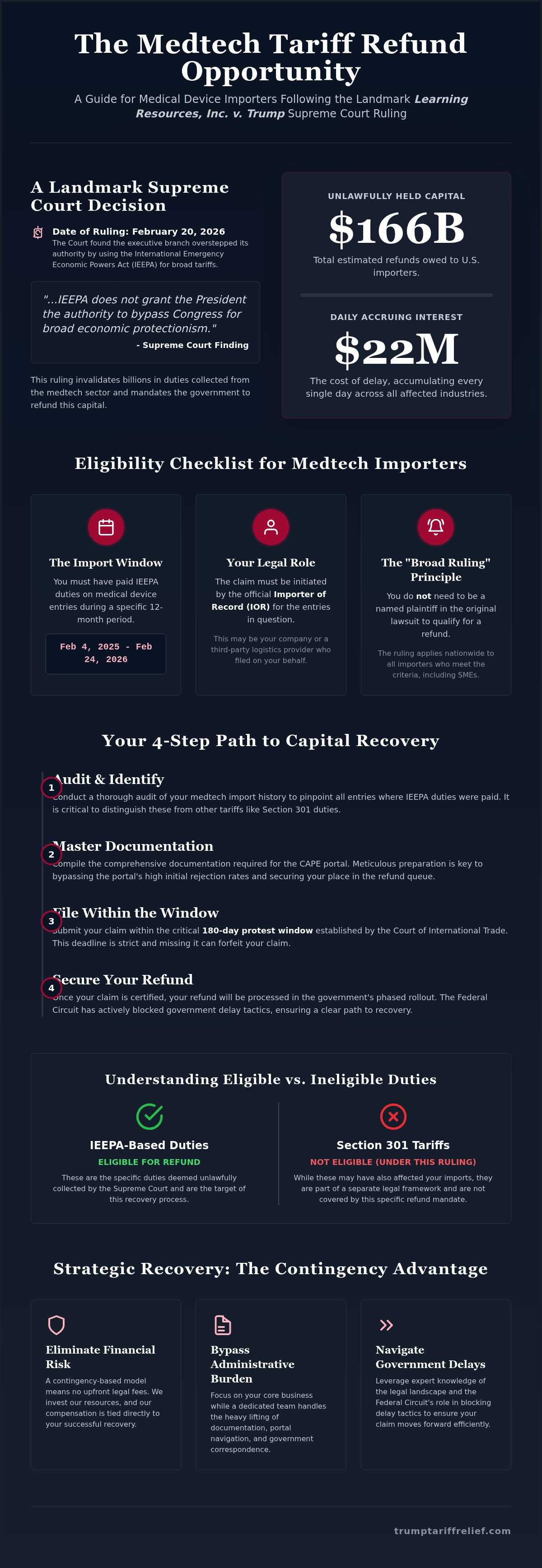
On February 20, 2026, the Supreme Court of the United States delivered a landmark decision in Learning Resources, Inc. v. Trump, No. 24-1287. The Court ruled that the executive branch overstepped its statutory boundaries by using the International Emergency Economic Powers Act (IEEPA) to impose sweeping, indefinite tariffs on imported goods. This ruling effectively invalidated billions of dollars in duties collected from the medical technology sector. While the government argued these measures were necessary for national security and economic leverage, the Court found that IEEPA does not grant the President the authority to bypass Congress for broad economic protectionism. For organizations seeking a tariff refund for medical device importers, this decision transformed a long-standing legal dispute into a concrete financial opportunity.
The timing of this ruling is critical. Following the Supreme Court’s February decision, the Court of International Trade (CIT) issued implementation orders in March 2026. These orders established a mandatory framework for the U.S. government to return the unlawfully collected funds. It's essential to distinguish these IEEPA duties from Section 301 tariffs. While both may have impacted your shipments, only the IEEPA-based duties are currently eligible for this specific recovery process. Many medtech entries were double-taxed under both regimes; identifying the IEEPA portion is the first step in reclaiming your capital.
The Legal Precedent for Medical Importers
The Supreme Court’s decision clarifies that the medical sector cannot be targeted for broad-scale duty imposition under the guise of an emergency without specific, limited justification. This restores a vital balance of power, ensuring that trade-heavy industries aren't subject to sudden, unlegislated financial burdens. Because the Court found the initial collection was void ab initio, or invalid from the start, the government now faces a mandatory refund obligation. This isn't a discretionary grant; it's a legal requirement to return capital that was never lawfully theirs to hold.
Immediate Financial Implications
If your company acted as the Importer of Record (IOR) for medtech entries between February 4, 2025, and February 24, 2026, you're likely a potential claimant. The landscape has shifted from potential litigation to active administrative processing. With interest accruing at approximately $22 million per day across all affected industries, the scale of recovery is immense. You can Learn more about the IEEPA ruling to see how these legal shifts specifically impact your past entries. Securing a tariff refund for medical device importers now requires navigating the CAPE portal and meeting strict deadlines, as the government is already processing billions in certified refunds for those who move quickly.
Eligibility Criteria: Does Your Medical Device Import Qualify for a Refund?
The Supreme Court’s decision operates on the "Broad Ruling" principle. This means your firm doesn't need to have been a named plaintiff in the original litigation to benefit from the judgment. If you paid IEEPA duties on medical device entries between February 4, 2025, and February 24, 2026, you're eligible to participate in the recovery process. The Importer of Record (IOR) must initiate the claim. If you used a third-party logistics provider who acted as the IOR, they're the entity that must technically trigger the refund. Small and medium-sized enterprises (SMEs) in the medtech space often assume these legal victories only apply to industry giants, yet SMEs represent a significant portion of the $166 billion in total refunds owed. Many of these firms have millions frozen in HTS classifications for diagnostic equipment or surgical instruments that were improperly taxed. Securing a tariff refund for medical device importers isn't a privilege for the few; it's a right for every IOR that followed the rules while the government broke them.
Unliquidated vs. Liquidated Medtech Entries
Understanding the status of your entries is vital for determining your recovery timeline. Unliquidated entries are those where U.S. Customs and Border Protection (CBP) hasn't finalized the duty assessment. These provide the fastest path to a refund because the government can simply "zero out" the IEEPA duties before finalization. Liquidated entries, however, have a strict 180-day protest window. If your entry liquidated within the last 180 days, you must act immediately to file a protest. Once an entry is deemed "final and conclusive" beyond this window, securing a tariff refund for medical device importers becomes significantly more complex, often requiring specialized administrative intervention.
Preserving Your Right to Recovery
Filing a protest with CBP serves as a critical safeguard against administrative errors or government attempts to retain your capital. As the Federal Circuit Clears Way for Litigation and administrative processing, firms must monitor the Automated Commercial Environment (ACE) portal religiously. This portal tracks the status of every entry and serves as the primary record for your claims. If you're unsure where your entries stand, you can review the IEEPA eligibility criteria to ensure no capital is left on the table. Identifying your specific eligibility now prevents your claim from being rejected by the CAPE portal later.
Navigating the Mandate: How the Federal Circuit Blocked Government Delay Tactics
The Justice Department recently attempted a strategic retreat by requesting a stay on all IEEPA-related proceedings. Their goal was simple: delay the massive outflow of capital back to private industry while they sought alternative legal avenues. However, on March 2, 2026, the Federal Circuit issued a unanimous order that dismantled this attempt. By denying the government’s request for a stay, the court signaled that the era of unlawful duty collection is over. This decision immediately remanded cases back to the Court of International Trade (CIT), placing the recovery process under the supervision of Judge Richard Eaton. For those pursuing a tariff refund for medical device importers, this procedural victory is the catalyst that turns a legal theory into an administrative mandate. The government can no longer hide behind procedural stall tactics to keep your capital frozen.
The 'Legislative Solution' Trap
The government’s primary argument for a delay centered on a supposed "legislative solution." They suggested that Congress might intervene to retroactively validate the tariffs or create a separate compensation fund. The court saw through this tactic, recognizing it as a way to avoid immediate accountability. Waiting for a legislative fix that may never arrive is a high-risk gamble that medtech firms can't afford to take. More importantly, these delay tactics are often designed to push claims past the tariff refund statute of limitations. If you wait for the government to move at its own pace, you risk losing your right to recovery entirely. The court’s refusal to wait reflects a clear sense of urgency regarding the return of medtech capital, and it's a signal that importers should move with equal speed.
CIT Proceedings and the Atmus Filtration Mandate
With the cases back at the CIT, the focus has shifted to the Atmus Filtration, Inc. v. United States procedural framework. Judge Eaton has issued clear instructions to U.S. Customs and Border Protection (CBP) that force the agency to move beyond litigation and into execution. These instructions include:
- Immediate preparation for the liquidation of unliquidated entries without IEEPA duties.
- Developing protocols for the reliquidation of entries previously taxed under the invalidated mandates.
- Submitting regular progress reports to the CIT to ensure administrative compliance.
This mandate is a massive win for the broader medical device industry. It forces CBP to begin the administrative implementation of the refund process rather than hiding behind the appellate process. While the government continues to appeal individual aspects of the nationwide system, the core mandate to return the money is now active. Securing a tariff refund for medical device importers now depends on your ability to meet the court's accelerated timeline and provide the necessary documentation to support your claim. By removing the threat of a stay, the Federal Circuit has cleared the path for a streamlined, high-stakes recovery of your capital.
The Medtech Recovery Roadmap: Identifying Entries and Managing Documentation
Securing a tariff refund for medical device importers requires more than a simple request; it demands an airtight administrative record. Since U.S. Customs and Border Protection (CBP) launched the CAPE portal on April 20, 2026, nearly 30% of all refund filings have been rejected due to technical inaccuracies. This high rejection rate highlights the government's strict adherence to procedural perfection. To avoid these pitfalls, your firm must conduct a granular audit of every entry subject to IEEPA duties. You'll need to verify that your specific HTS codes fall within the scope of the Supreme Court's ruling and ensure you're enrolled in the Automated Clearing House (ACH). ACH enrollment is the only way to facilitate expedited electronic payments, ensuring your capital returns to your accounts without the delays of paper check disbursement.
Inventory and High-Value Claim Quantification
The first step in your roadmap is extracting complete entry data from your customs brokers and the Automated Commercial Environment (ACE) portal. If you don't have a clear picture of your historical entries, you can't quantify the interest you're owed, which currently accrues at a rate of approximately $22 million per day across the industry. Once you've extracted this data, you must categorize entries by their liquidation status. Prioritizing unliquidated entries allows for immediate duty removal, while liquidated entries require a more aggressive filing strategy to meet the 180-day protest window. Quantifying the total potential recovery is essential for justifying the administrative resources needed to push these claims through the CAPE system.
Audit-Ready Documentation Management
CBP's rejection of nearly one-third of claims proves that "good enough" documentation isn't sufficient. You must compile a comprehensive file for every entry, including commercial invoices, entry summaries (CBP Form 7501), and any relevant FDA 510(k) clearances that confirm the medical nature of the goods. Gathering the required documents for IEEPA tariff refund applications now prevents last-minute scrambles that lead to technical errors. Clean, audit-ready files are your best defense against arbitrary claim denials. If your documentation is disorganized, you risk losing millions in eligible capital to a simple clerical oversight. You can see how our documentation process works to understand the level of precision required for a successful recovery. To ensure your claim isn't part of the 30% rejection statistic, you should start your documentation audit today.
Strategic Recovery: Why a Contingency Model is the Best Path for Medtech Firms
The path to a tariff refund for medical device importers is paved with administrative landmines. While the Supreme Court has cleared the legal hurdles, the actual recovery of your capital is a labor-intensive battle against a bureaucracy that is currently rejecting nearly 30% of all claims. This isn't a simple form-filling exercise; it's a high-stakes audit and filing process that requires precision, speed, and deep trade expertise. Many medtech firms find themselves at a crossroads, hesitant to commit significant internal resources or upfront legal fees to a process that may take months to resolve. Our specialized team acts as the active engine for your recovery, managing the heavy lifting from the initial eligibility assessment to the final certified filing.
Our "No Upfront Cost" promise is designed specifically to protect your liquidity. In an industry where R&D budgets are the lifeblood of innovation, you shouldn't have to deplete your current capital to reclaim funds that were unlawfully seized. By operating on a contingency basis, we absorb the financial risk. Our success is directly tied to yours, creating a partnership where every entry is scrutinized and every eligible dollar is pursued with professional urgency. We don't just provide a service; we provide a risk-free shortcut through a complex regulatory system.
Contingency vs. Hourly Legal Fees
Traditional legal models often rely on high hourly fees that accumulate regardless of the final outcome. For mid-sized medtech firms, this creates a significant barrier to entry, often making the cost of recovery feel as burdensome as the original tariffs. A contingency model eliminates this risk entirely. It ensures that every eligible dollar is identified through a comprehensive tariff recovery for importers audit without adding a single line item to your current expenses. Because we only succeed when your refund check is cleared and sent to the Treasury, our incentives are perfectly aligned with yours to maximize the total recovery amount.
Streamlining the Path to Capital Restoration
Bypassing the steep learning curve of CIT and CBP requirements is essential for meeting the strict 180-day protest windows for liquidated entries. Our team leverages insider trade knowledge to navigate the government's remaining delay tactics, ensuring your claims aren't sidelined by administrative technicalities. We handle the documentation management and the intricate filings within the CAPE portal, allowing your team to focus on core operations while we secure your tariff refund for medical device importers. The window for recovery is narrow, and the government's interest obligation grows daily. Your next step is to schedule a preliminary medtech assessment to quantify your potential recovery before the filing window closes for good.
Reclaim Your Medtech Liquidity and Restore Financial Justice
The February 2026 Supreme Court decision has finally dismantled unlawful IEEPA duty mandates, putting billions back on the table for U.S. businesses. For your organization, securing a tariff refund for medical device importers is the most direct way to inject frozen capital back into your innovation pipeline. With the government's interest obligations growing by millions every day, the cost of inaction is too high to ignore. You've already paid the price for these invalidated policies; it's time to ensure you aren't left behind during the administrative rollout.
Don't let technical rejections or the strict 180-day protest window block your recovery. Our specialized team manages the heavy lifting of documentation and CIT mandate compliance on a pure contingency basis. We provide the expertise you need with no upfront costs and zero financial risk to your current budget. We only succeed when your refund check is certified and cleared.
Take the first step toward restoration today by clicking here to Get Your Free Medtech IEEPA Refund Assessment. It's time to right this wrong and bring your capital home where it belongs.
Frequently Asked Questions
Is the IEEPA court case refund real for medical device companies?
Yes, the tariff refund for medical device importers is a verified legal reality. Following the February 20, 2026, Supreme Court ruling in Learning Resources, Inc. v. Trump, billions in collected duties were declared unlawful. U.S. Customs and Border Protection (CBP) launched the Consolidated Administration and Processing of Entries (CAPE) portal on April 20, 2026, to process these claims. Approximately $100 billion has already been certified for disbursement to the Treasury as of late 2026.
How long does it take to receive a medtech tariff refund after filing?
Approved refund applications typically take 60 to 90 days for processing by CBP. Once a claim is certified through the CAPE portal, funds are sent to the Treasury for disbursement via the Automated Clearing House (ACH). This timeline depends heavily on the accuracy of your filing. With nearly 30% of filings currently being rejected for technical errors, ensuring your documentation is perfect from the start is the only way to avoid significant delays.
What is the difference between Section 301 and IEEPA refunds for medtech?
Section 301 tariffs and IEEPA duties are distinct legal mechanisms. The 2026 Supreme Court ruling only invalidated tariffs collected under the International Emergency Economic Powers Act. Section 301 duties, which target specific trade practices, remain active and aren't eligible for this refund process. Many medical device shipments were subject to both; your recovery audit must precisely isolate the IEEPA portion to ensure a successful claim within the CAPE system and avoid immediate rejection.
Can I still claim a refund if my customs broker didn't file a protest?
You can still claim a refund even without a prior protest, depending on the liquidation status of your entries. Unliquidated entries are handled through the standard CAPE process. For liquidated entries, the 180-day protest window remains a critical legal boundary. Phase Three of the CBP rollout, which launched in late July 2026, specifically targets finally liquidated tariff entries. Acting quickly ensures you don't miss the administrative windows established by the Court of International Trade.
What happens if the government appeals the Supreme Court's IEEPA decision?
The government is currently appealing the nationwide refund system established by the Court of International Trade. They argue that each importer should be required to file an individual lawsuit rather than using a centralized administrative portal. While the Supreme Court's core ruling on IEEPA authority stands, this procedural appeal could complicate or delay Phase II refunds for older entries. This makes immediate filing for currently eligible unliquidated entries a strategic necessity for medtech firms.
Do I need to hire a lawyer to get my medical device tariff refund?
You don't need to hire a traditional law firm, but you do need a specialized partner to navigate the bureaucracy. While the process is administrative, the 30% rejection rate proves it isn't simple. A recovery specialist manages the documentation and filings without the high hourly costs of traditional legal counsel. This partnership allows your firm to focus on innovation while experts handle the technical requirements of the CAPE portal and the March 2026 Federal Circuit mandates.
What are the deadlines for filing an IEEPA refund claim in 2026?
Filing deadlines are determined by the phased rollout of the CAPE portal. Phase One began on January 30, 2026, covering unliquidated entries. Phase Two launched on June 29, 2026, for reconciliation entries, and Phase Three opened in late July 2026. Beyond these portal phases, the 180-day protest window for liquidated entries remains the most urgent deadline. If you miss this window, your right to a tariff refund for medical device importers may be permanently forfeited.
How much does a tariff recovery service cost for medical importers?
Specialized recovery services typically operate on a contingency-fee basis. This means there are no upfront costs or hourly billing for the audit and filing process. The service provider only receives a fee if they successfully secure your refund. This model aligns the interests of the specialist with your firm, ensuring every eligible dollar is identified and recovered while protecting your current R&D budget from unnecessary administrative expenses or the risk of failed claims.
Ready to find out what your business may be owed?
Check My Eligibility