
Over $166 billion in corporate capital is currently sitting in federal accounts, rightfully belonging to U.S. importers who were caught in the crosshairs of unconstitutional trade measures. You likely feel the weight of these IEEPA duties on your balance sheet, yet the prospect of litigating against the federal government feels like a costly, bureaucratic gamble. It's frustrating to watch your working capital remain locked away while legal deadlines for the Court of International Trade loom closer.
This article explains how a professional tariff refund contingency fee agreement transforms this complex legal battle into a risk-free financial recovery. By leveraging a success-based model, your business can reclaim millions in duties paid between February 2025 and February 2026 without any upfront financial exposure. We'll examine the implications of the 2026 Supreme Court ruling in Learning Resources, Inc. v. Trump, the specific 2027 timelines for filing your claims, and the precise way an elite recovery partner manages the entire litigation process to ensure you receive your full principal plus statutory interest.
Key Takeaways
- The Supreme Court's decision in Learning Resources, Inc. v. Trump doesn't trigger automatic refunds, so businesses must proactively file claims to recover their capital.
- A tariff refund contingency fee agreement eliminates financial risk by ensuring you only pay a percentage of the actual duties and interest successfully recovered.
- Performance-based models offer a superior ROI over traditional hourly legal billing, which often drains resources before a refund is even secured.
- Comprehensive recovery agreements must include full management of the process, from initial eligibility audits to the final delivery of refund checks and statutory interest.
- Specialized trade experts provide a decisive advantage over general counsel by navigating the technical complexities of IEEPA and Court of International Trade filings.
The $130 Billion IEEPA Refund Opportunity: Why Action is Required in 2026
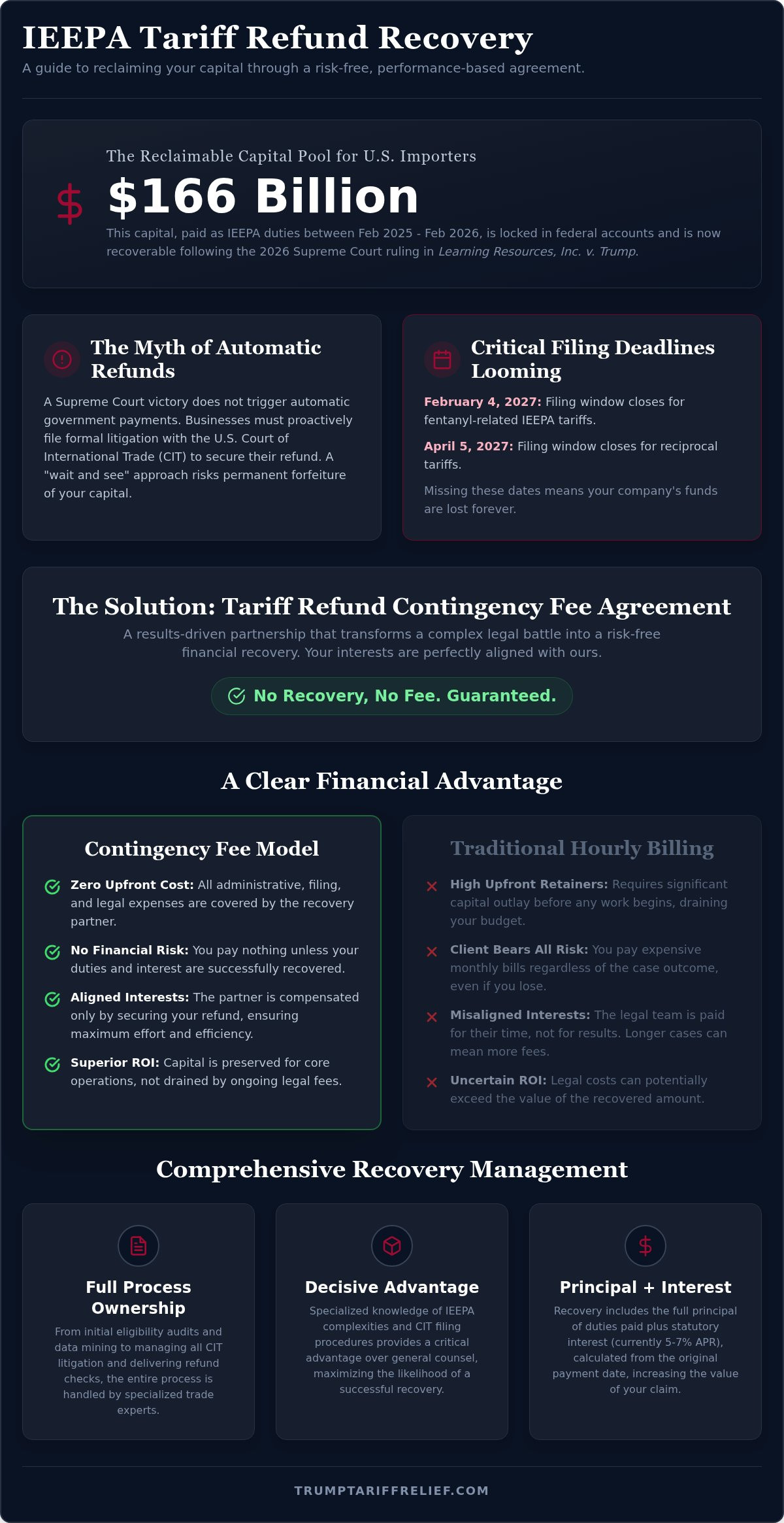
The U.S. Supreme Court's February 20, 2026, decision in Learning Resources, Inc. v. Trump effectively dismantled the legal basis for billions in tariffs. This landmark ruling confirmed that duties imposed under the International Emergency Economic Powers Act (IEEPA) were unauthorized and unlawful. For businesses that paid these levies between February 2025 and February 2026, the door to financial restoration is now open. However, this isn't a passive windfall. The government won't hand back your capital without a fight.
Debunking the Myth of Automatic Refunds
Many importers mistakenly assume that a Supreme Court victory leads to automatic checks in the mail. It doesn't. While U.S. Customs and Border Protection (CBP) has established the CAPE administrative system, it's a complex procedural hurdle rather than a guarantee of payment. If your entries are already liquidated, you must file formal litigation with the U.S. Court of International Trade (CIT) to secure your rights. A "wait and see" approach is the fastest way to hit a statute of limitations. For fentanyl-related IEEPA tariffs, your window for filing closes on February 4, 2027. For reciprocal tariffs, you only have until April 5, 2027. Missing these dates means permanent forfeiture of your company's capital.
The Scale of Reclaimable Capital
The total pool of available refunds is now estimated at $166 billion. This represents a massive infusion of liquidity for sectors like manufacturing and retail that bore the brunt of these trade measures. Beyond the principal refund, federal law requires the government to pay statutory interest on these claims, which currently ranges between 5% and 7% APR. This interest is calculated from the date you originally paid the duty, meaning the value of your claim grows the longer it remains unpaid.
Because the recovery process involves technical documentation and high-stakes federal litigation, most firms choose a tariff refund contingency fee agreement to manage the financial risk. Utilizing a tariff refund contingency fee agreement allows your business to pursue its rightful capital without diverting your existing budget toward expensive legal retainers. You can learn more about the specific IEEPA eligibility requirements to see if your 2025 entries qualify for this massive recovery effort. We handle the heavy lifting, ensuring your claims are filed accurately before the 2027 deadlines expire.
What is a Tariff Refund Contingency Fee Agreement?
A tariff refund contingency fee agreement is a results-driven contract where the recovery partner's compensation is tied directly to the amount of capital restored to your business. Unlike traditional legal retainers that require monthly payments regardless of the outcome, this model ensures that our interests are perfectly aligned with yours. If we don't win your case, you don't pay a cent. This structure is particularly vital for IEEPA recovery, where the complexity of federal litigation can lead to years of legal maneuvering before a check is issued. It transforms a potential legal liability into a strategic asset, allowing your finance team to project a recovery without accounting for ongoing legal expenses.
How the 'No-Win, No-Fee' Structure Protects Your Cash Flow
The primary advantage of this model is the complete transfer of financial risk. Pursuing a multi-million dollar claim against the federal government involves significant costs for data mining, customs documentation management, and expert testimony. Under a tariff refund contingency fee agreement, we absorb all these administrative and filing expenses. This allows you to preserve operational capital for your core business functions while we handle the heavy lifting of the CIT litigation process. There are no hidden surcharges or surprise administrative fees; our success is the only metric that matters. It's a no-nonsense approach to business advocacy that prioritizes your bottom line over billable hours.
The Legal Basis for Contingency in Customs Recovery
Contingency models are the gold standard for high-volume trade litigation because they fund the sophisticated data analysis required to identify every eligible entry. Our team uses proprietary systems to audit your 2025-2026 import history, ensuring that not a single dollar of unconstitutional duty is left on the table. This approach incentivizes our experts to maximize your recovery, including the pursuit of statutory interest. You can see how our contingency process works to understand the step-by-step path from eligibility assessment to final check delivery. By removing the financial barrier to entry, we empower businesses of all sizes to stand up against unlawful trade measures. This model isn't just about convenience. It's a sophisticated risk-transfer mechanism that ensures even the most complex federal claims are accessible to any importer impacted by the IEEPA overreach. If you're ready to secure your recovery without budget strain, you should explore our performance-based solutions today.
Contingency Fees vs. Hourly Legal Billing: A Financial Comparison
Choosing between an hourly legal retainer and a performance-based model is the difference between a variable liability and a guaranteed asset. In the high-stakes environment of federal trade litigation, hourly billing often leads to a financial black hole. Large firms may charge hundreds of dollars per hour to research the same IEEPA precedents, yet they don't share in the risk if the Court of International Trade rules against a specific entry. This creates a significant incentive gap where the law firm remains profitable even if the client loses millions in potential refunds. It's a lopsided arrangement that places the entire burden of proof and payment on the importer.
A tariff refund contingency fee agreement eliminates this friction. Because the consultant only receives a fee upon the actual delivery of funds, every hour spent on your case is an investment in a positive outcome. This model forces a level of efficiency and thoroughness that hourly billing simply cannot match. It transforms the recovery process from a legal expense into a strategic capital restoration project where the partner's success is tied directly to yours.
Eliminating Upfront Costs and Retainer Fees
Retainers and upfront consulting packages often drain a project's ROI before the first filing is even submitted. For many importers, these are "sunk costs" that make it difficult to pivot if the legal strategy needs adjustment. By removing the need for an initial capital outlay, we allow your business to pursue its rightful claims without impacting the current fiscal year's budget. It's a strategic move that levels the playing field, allowing mid-sized firms to fight the government with the same elite expertise as global conglomerates. You can find more details on how these laws impact your business in our resource on IEEPA Explained for Importers.
Aligning Incentives for Maximum Recovery
In an hourly model, a legal team might stop after identifying the most obvious entries to save time. In contrast, our performance-based approach drives our experts to conduct an exhaustive audit of your entire 2025-2026 import history. We leave no stone unturned because our compensation depends on the total volume of duties and statutory interest we recover. This ensures that even small, misclassified entries are included in the final claim, maximizing the total value returned to your balance sheet. For a deeper look at the recovery landscape, read our IEEPA Tariff Refund Recovery: The 2026 Guide. We don't just file paperwork; we hunt for every eligible dollar to ensure your recovery is truly comprehensive.
Key Provisions to Look for in Your Recovery Agreement
A robust tariff refund contingency fee agreement should do more than just promise a check. It must outline a comprehensive strategy for managing the entire lifecycle of your claim. Importers often sign agreements without realizing that the administrative process is only half the battle. If U.S. Customs issues a Request for Information or a Notice of Action, your partner must be contractually obligated to handle the response. Without these protections, your business could be left exposed to additional scrutiny without professional support. Your agreement should function as a shield, transferring the burden of proof and the technical workload entirely to the recovery expert.
Interest recovery is another critical provision that can significantly impact your final ROI. Federal law requires the government to pay statutory interest on unconstitutional duties, which currently sits between 5% and 7% APR. You should ensure your tariff refund contingency fee agreement explicitly includes the pursuit of this interest. Some consultants only focus on the principal duty amount, leaving thousands of dollars in accrued interest on the table. A truly results-oriented partner will fight for every cent, recognizing that this interest is part of your rightful restoration. If you want to see how these details impact your specific situation, you can review our frequently asked questions about tariff refunds for more clarity.
Scope of Services: Beyond Simple Filings
The technical demands of IEEPA claims require more than just submitting a form through the CAPE portal. Your agreement must cover the management of CF28 and CF29 forms, which are often used by the government to challenge eligibility. If your entries are finally liquidated, the agreement must also encompass litigation before the U.S. Court of International Trade. This end-to-end coverage ensures that you aren't forced to hire separate counsel if the administrative process stalls. We manage every procedural hurdle, from the initial eligibility audit to the final delivery of your refund check. You should request a preliminary assessment to ensure your documentation meets these rigorous federal standards.
Transparency and Reporting Requirements
Maintaining clear visibility into your claim's status is essential for your internal financial reporting. Look for provisions that mandate regular updates and a transparent breakdown of the final refund calculation. Your recovery partner should provide a detailed audit trail that matches your import records with the government's liquidation data. This level of transparency prevents accounting errors and ensures that your finance team can accurately track the restoration of capital. Data security is equally paramount; the agreement must include strict confidentiality clauses to protect your proprietary supply chain information and sensitive trade data throughout the multi-year litigation process.
Securing Your Refund with Trump Tariff Relief: Our Performance-Based Approach
Trump Tariff Relief isn't a general practice law firm. We're specialized trade advocates focused exclusively on IEEPA and Section 301 recovery. Most general counsel lack the technical depth required to navigate the Automated Commercial Environment (ACE) portal or the Consolidated Administration and Processing of Entries (CAPE) system. Our team combines high-level legal gravitas with deep customs data analysis to ensure your claim is bulletproof. By entering into a tariff refund contingency fee agreement with us, you gain access to an elite recovery engine that has already identified billions in eligible refunds for U.S. importers. We don't just file papers; we manage the entire litigation lifecycle to ensure your capital is restored with full statutory interest.
The 'We-Do-The-Work' Narrative
Our primary objective is to minimize the administrative strain on your internal team. We know your trade compliance and finance departments are already stretched thin. Our proprietary methodology allows us to extract and audit your import history with minimal input from your staff. We handle the technical heavy lifting, from identifying misclassified entries to managing government challenges like CF28s. This proactive approach is vital because the clock is ticking. You should review the Statute of Limitations for IEEPA Claims to understand why delaying your filing by even a few weeks could result in a permanent loss of your recovery rights. We act as your assertive ally, ensuring every procedural hurdle is cleared before the 2027 deadlines expire.
Your Path to Financial Restoration
Reclaiming your capital is a streamlined, three-step process designed for maximum efficiency and zero financial risk:
- Step 1: The Preliminary Assessment. We conduct a no-cost, no-obligation audit of your 2025-2026 entries to determine your total recovery potential.
- Step 2: Signing the Agreement. Once eligibility is confirmed, you sign the tariff refund contingency fee agreement, formally transferring the financial risk of litigation to our firm.
- Step 3: Filing and Recovery. Our experts manage all CIT filings and CBP correspondence until your refund check, including accrued interest, is delivered to your business.
It's time to stop letting the government hold your working capital. The 2026 Supreme Court ruling provided the catalyst, and we provide the solution. Start your free assessment today and secure your rightful restoration before the window of opportunity closes forever.
Secure Your Rightful Restoration Today
The 2026 Supreme Court ruling in Learning Resources, Inc. v. Trump was a significant victory for the trade community, but the government won't return your capital voluntarily. With over $160 billion in potential refunds at stake, the burden of recovery falls squarely on your business. You must act before the 2027 deadlines for fentanyl and reciprocal tariffs pass, or you'll lose these funds forever.
Utilizing a tariff refund contingency fee agreement is the most effective way to transfer the risk of federal litigation to specialized experts. Our team manages every technical detail, from the initial audit to the final delivery of your check plus statutory interest. We've built our reputation on a no-nonsense approach that protects your bottom line while righting a regulatory wrong.
Start Your Free IEEPA Eligibility Assessment and restore your company's liquidity without any upfront cost. It's time to reclaim what's yours.
Frequently Asked Questions
Is the IEEPA tariff refund contingency fee agreement legally binding?
Yes, a tariff refund contingency fee agreement is a standard commercial contract that's legally binding. It defines the professional relationship between your business and our recovery specialists, establishing the scope of work and the success-fee structure. This agreement ensures that both parties are committed to the litigation process before the Court of International Trade. It provides the legal framework necessary for our team to act as your advocate while securing the restoration of your capital.
Can I switch to a contingency model if I already started a claim?
You can typically transition to our performance-based model even if you've already initiated a claim through the CAPE portal or filed an initial protest. Many importers realize that the technical documentation and government challenges involved in IEEPA recovery are more complex than they first appeared. We can audit your existing filings and integrate them into our specialized recovery engine. This allows you to stop paying hourly legal fees and transfer the ongoing financial risk to us.
How much is the typical contingency fee for tariff recovery?
The success fee is calculated as a percentage of the total capital successfully restored to your business. This percentage varies depending on the volume of entries, the complexity of your supply chain data, and whether the claim requires extensive litigation. Because this is a performance-based arrangement, you don't pay any costs unless we deliver a refund check. This structure ensures our experts are highly motivated to identify every eligible dollar and maximize your total recovery amount.
What happens if the government denies my tariff refund claim?
If the government denies a claim, our team evaluates the merits of filing an appeal or moving the case into formal litigation. Under our contingency agreement, we absorb all costs associated with challenging these denials. If the claim is ultimately unsuccessful after all legal avenues are exhausted, your business owes nothing. We take on the entire financial burden and the risk of failure, ensuring that a denial doesn't result in out-of-pocket losses for your firm.
Does the contingency fee apply to the interest recovered as well?
Yes, the success fee applies to the total value recovered, which includes both the principal duties and the statutory interest. Federal law requires the government to pay interest on these unconstitutional tariffs, which currently ranges between 5% and 7% APR. Our team fights to maximize every component of your restoration. This inclusive structure incentivizes our experts to pursue the full interest amount you're legally owed, which can add significant value to your final refund check.
Is there any risk of being audited for signing a contingency agreement?
Signing a recovery agreement doesn't increase your risk of a general customs audit. Pursuing a refund for unconstitutional duties is a legitimate exercise of your rights following the 2026 Supreme Court ruling. We ensure every claim is backed by rigorous data analysis and precise documentation. Our specialized focus on compliance means your filings are handled with a level of accuracy that actually reduces the likelihood of government inquiries or misclassification errors during the process.
Can I cancel the agreement if I decide not to pursue the claim?
Most agreements include specific termination clauses that outline how a client can withdraw from the process. While you maintain the right to cancel, it's essential to do so before significant litigation costs are incurred or federal deadlines expire. We prioritize transparency and will walk you through these provisions before any work begins. Our goal is to serve as a protective partner, ensuring you maintain control over your legal strategy throughout the entire restoration lifecycle.
How long does the recovery process take under a contingency model?
The timeline for recovery depends on whether your entries are currently unliquidated or finally liquidated. Administrative refunds through the CAPE system may be processed in several months; however, complex litigation before the Court of International Trade can take significantly longer. Regardless of the duration, our contingency model means we stay committed to your case until the final check is delivered. We manage the momentum of the process, ensuring government delays don't stall your capital restoration.
Ready to find out what your business may be owed?
Check My Eligibility