
The 2026 statute of limitations for IEEPA claims is a hard wall; choosing the wrong recovery partner today could mean paying for the privilege of a denied claim. It's frustrating to watch potential capital sit in government accounts while your internal teams are already stretched thin by budget freezes and the daunting task of auditing thousands of entries. You shouldn't have to risk your remaining operational budget to reclaim funds that were never supposed to be paid in the first place.
By comparing tariff recovery fee models, you can identify the path that guarantees a maximum net recovery without any upfront consulting spend or hidden legal costs. This guide evaluates the financial impact of hourly and project-based billing against a pure contingency model. We'll show you how to secure a full-service recovery that handles the government audits for you, ensuring your 2026 financial restoration is a risk-free profit center rather than a new liability. It's time to reclaim your capital with a partner who has real skin in the game.
Key Takeaways
- Start protecting your 2026 budget by comparing tariff recovery fee models to identify which structures place the financial risk on the consultant rather than your firm.
- Recognize the inherent pitfalls of hourly and project-based billing that often lead to high costs even when claims are unsuccessful or denied.
- Learn how to calculate a true Net Recovery that accounts for both the total refund amount and the internal resources saved through full-service claim management.
- Discover why a success-only contingency model is the most effective way to align incentives and maximize your IEEPA refund before the 2026 statute of limitations expires.
Understanding the Landscape of Tariff Consultant Fee Structures
The window to reclaim billions in overpaid duties is rapidly closing. As the 2026 statute of limitations approaches, U.S. importers must distinguish between routine logistics and high-stakes financial recovery. A specialized tariff recovery consultant doesn't just manage your daily filings; they act as forensic advocates who identify historical errors and legal opportunities for capital restoration. While you may already understand What is a Tariff? from a broad economic perspective, the practical reality of reclaiming those funds requires a different level of expertise.
Tariff recovery fee models are the contractual frameworks, typically hourly, project-based, or contingency, used to compensate experts for securing overpaid import duties. Selecting the right model is a critical decision for your 2026 fiscal planning. The recent surge in recovery demand stems directly from the IEEPA Supreme Court ruling, which challenged the government's authority to maintain certain duties indefinitely. This legal shift has turned what was once a routine customs process into a complex litigation-style recovery effort.
The Complexity of 2026 Trade Recovery
Standard customs brokerage data isn't sufficient for the rigorous requirements of the 2026 CAPE refund portal. Successfully securing an IEEPA or Section 301 refund demands a deep understanding of IEEPA explained in the context of evolving trade laws. Recent regulatory shifts have increased the documentation burden significantly. You need a partner who can navigate the thousands of entries and technical legal arguments required to satisfy government auditors. This isn't just about data entry; it's about building a bulletproof case for every dollar you're owed.
Why Fee Transparency Matters for Importers
By comparing tariff recovery fee models, you can quickly spot red flags in consultant proposals. Beware of firms that demand large upfront retainers or charge hourly rates regardless of whether they actually recover your money. These models shift all the risk onto your company's balance sheet. In a year of budget freezes and tight margins, your recovery effort should be a risk-free asset, not an unpredictable expense. A transparent, success-based fee structure ensures the consultant has the same goal you do: maximizing the net refund that returns to your working capital. This alignment is the only way to ensure your procurement goals are met without adding new financial liabilities.
Hourly vs. Project-Based vs. Contingency Fees: A Direct Comparison
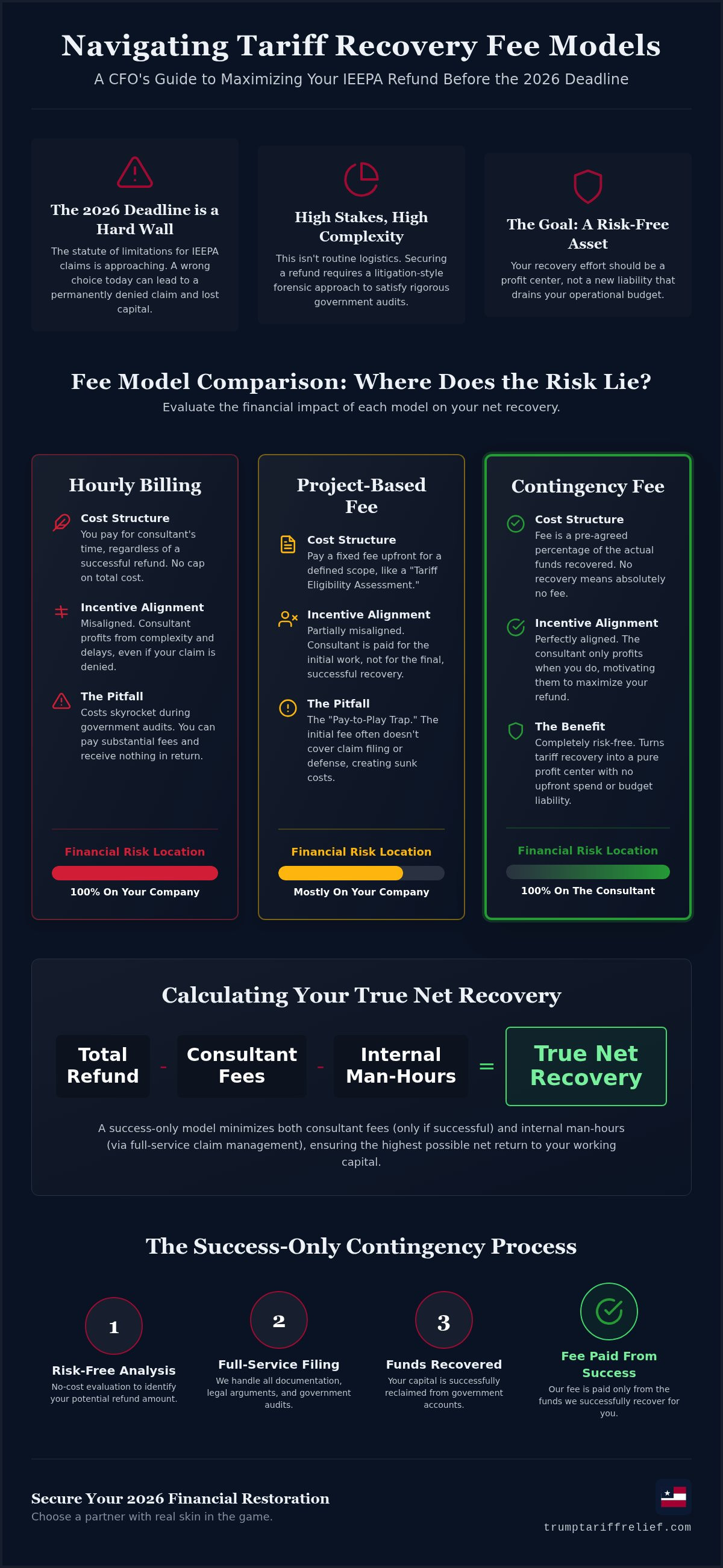
CFOs face a binary outcome in tariff recovery; you either reclaim your capital or you don't. When comparing tariff recovery fee models, the most important variable is the location of risk. Traditional models often leave the importer holding the bill for unsuccessful efforts, while specialized recovery partners align their fees with your actual cash flow. While U.S. Government Tariff Resources provide the raw data on what was paid, they don't account for the cost of reclaiming those funds in a high-stakes regulatory environment.
The Pitfalls of Hourly Billing in Tariff Claims
Hourly billing is the standard for general legal services, but it's a liability in trade recovery. If Customs and Border Protection (CBP) initiates an audit or requests granular documentation for ten thousand entries, your legal fees will skyrocket. There's no incentive for the firm to resolve the claim quickly. You're paying for their time, not your refund. By comparing tariff recovery fee models through the lens of a CFO, it's clear that hourly billing creates a direct conflict of interest where the consultant profits from the very complexity that slows your recovery.
The Project-Fee Trap for Importers
Project-based fees often appear as a middle ground, but they frequently function as a pay-to-play trap. Importers pay for a Tariff Eligibility Assessment only to find that the fixed fee doesn't cover the actual filing or the subsequent government defense. This creates a sunk cost bias. You feel forced to continue spending just to justify the initial assessment cost. These models often exclude the most difficult part of the process, such as government litigation or defending claims in the CAPE portal, leaving your team to handle the heavy lifting while the consultant keeps their fee.
To accurately calculate the Total Cost of Ownership (TCO) of a recovery effort, look beyond the consultant's invoice. You must factor in the internal man-hours required to gather data for hourly firms and the cost of capital tied up during long, un-incentivized audits. The contingency model is the only structure that guarantees a positive ROI. By operating on a success-only basis, the consultant takes on the full burden of documentation and government interaction. This model ensures that your net recovery is always a gain, never an expense. It's the most efficient way to see the recovery process in action without risking a single dollar of your 2026 budget.
The Mechanics of Contingency-Based Recovery Fees
Contingency billing isn't just a pricing strategy; it's a risk transfer mechanism that places the burden of success squarely on the consultant. When comparing tariff recovery fee models, the success-based approach is the only one that forces the expert to act as a dedicated financial partner. This model aligns the consultant's goals directly with your company's capital restoration. In the 2026 trade consultancy environment, the standard percentage-of-recovery structure has become the preferred choice for firms that value results over billable hours.
A contingency fee model ensures the consultant only receives payment once a refund check from U.S. Customs is physically secured. This alignment is particularly vital for mid-sized manufacturers who can't afford to gamble their working capital on uncertain legal outcomes. By removing the cost of entry, this structure democratizes access to elite trade expertise. Understanding the Legal Definition of Tariff reveals the technicalities that government auditors use to deny claims; a contingency partner is incentivized to overcome every one of those hurdles.
Eliminating Upfront Financial Risk
Zero out-of-pocket models act as a protective shield for your corporate R&D and operations budgets. You don't have to seek special board approval for a new consulting spend when there's no initial cost. In this scenario, the consultant acts as an investor. They only take on winning IEEPA cases because their own resources are at stake. You can see how our process works to understand how we absorb the data costs and administrative heavy lifting from the start. This approach transforms a potential legal headache into a streamlined asset recovery project.
Maximizing the Total Refund Amount
Success-based models naturally drive consultants to dig deeper into customs documentation. While an hourly firm might stop after reviewing the most obvious entries, a contingency expert combs through every line item to find hidden eligibility. They have every incentive to identify even the most obscure entry rather than just picking the low hanging fruit. This motivation leads to superior legal arguments for contested entries. When their compensation depends on the final dollar amount, they fight harder to ensure every eligible cent is returned to your balance sheet before the 2026 deadline.
Evaluating the ROI of Your Tariff Recovery Partner
Net ROI is the only metric that truly matters for a CFO. When comparing tariff recovery fee models, looking only at the top-line refund is a fundamental mistake. You must calculate the Net Recovery, which is the total refund minus consultant fees and the value of internal man-hours saved. If your internal team spends months auditing thousands of entries, that's capital and talent diverted from core business growth. A specialized partner eliminates this drain by absorbing the operational burden.
Vetting the expert is just as critical as the fee structure. A general customs broker might handle your daily entries, but a Section 301 and IEEPA specialist understands the forensic nuances required for a successful government claim. Generalists often miss thousands of dollars in eligible entries because they don't have the specialized legal knowledge to challenge aggressive government denials. In the context of 2026, the cost of delay is far higher than any fee percentage. Waiting another month to save a small margin in fees could result in missing the statute of limitations entirely, leaving your firm with zero recovery.
The Hidden Value of Full-Service Management
Quantifying the hours saved on customs documentation management is essential for an accurate ROI analysis. A full-service partner handles every U.S. Customs inquiry and government audit on your behalf. This integrated approach doesn't just save time; it leads to faster cash-in-hand. By managing the entire lifecycle of the claim, the expert ensures that technical roadblocks are cleared before they become delays. This is the "heavy lifting" that internal procurement teams are rarely equipped to handle while maintaining their daily responsibilities.
Success Rate vs. Fee Percentage
Don't be misled by low fee percentages from unproven firms. The math is simple: a 20% fee on a $2M recovery leaves you with $1.6M in net capital, while a 10% fee on a $500k recovery only nets you $450k. The expertise of the partner directly dictates the size of the total recovery. When comparing tariff recovery fee models, prioritize the firm's historical success with complex IEEPA claims. A "No Upfront Cost" guarantee must be the baseline for any final contract. This ensures the consultant is fully incentivized to maximize your refund, as they only profit when you win. It transforms the recovery effort from a speculative expense into a guaranteed financial gain.
Ready to see how much capital your firm can reclaim before the 2026 deadline? Get your risk-free eligibility assessment today and secure your refund without upfront cost.
Why Trump Tariff Relief Uses a Success-Only Model
We believe U.S. importers shouldn't be penalized for government overreach. Our firm is built on the principle of "righting a wrong" by reclaiming capital that belongs on your balance sheet, not in a federal treasury account. By comparing tariff recovery fee models, it becomes evident that the only way to truly advocate for the importer is to remove every financial barrier to entry. We operate exclusively on a success-only basis because we believe in our ability to deliver results. If we don't recover your funds, you don't owe us a cent.
Our contingency-based recovery fees are designed specifically to protect your working capital during a period of economic uncertainty. While competitors might suggest complex capital strategies to bridge refund gaps, we prefer a direct path to liquidity. We bring a high level of specialized expertise to IEEPA Tariff Refund Recovery, focusing on the forensic data analysis required to win contested claims. This approach ensures that your recovery project remains a profit center from day one.
A Low-Risk, High-Reward Partnership
We assume the entire financial risk and the administrative heavy lifting of documentation so your team doesn't have to. Our proprietary "if-then" framework allows us to rapidly categorize thousands of customs entries, identifying those with the highest probability of success. This systematic approach provides your company with the sophisticated expertise of a top-tier trade law firm without the burden of billable hours or unpredictable monthly invoices. We act as an extension of your finance department, providing the muscle needed to navigate the CAPE portal and satisfy government auditors.
Claim Your Refund Before the 2026 Deadlines
The window for these claims is narrow and closing fast. Understanding the tariff refund statute of limitations is critical for any CFO planning their 2026 fiscal strategy. Once these deadlines pass, the opportunity to reclaim these specific duties is gone forever. You can find a comprehensive breakdown of the requirements in our IEEPA Tariff Refund Recovery: The 2026 Guide. Don't let your eligible capital become a permanent government asset. When comparing tariff recovery fee models, the decision ultimately comes down to speed and certainty. Secure your free, zero-risk eligibility assessment today to ensure your firm is at the front of the line for the next round of CBP disbursements.
Reclaim Your Capital Without Financial Risk
After comparing tariff recovery fee models, the path to fiscal restoration is clear. Hourly and project-based structures place the burden of government bureaucracy on your balance sheet, often resulting in sunk costs for denied claims. A pure contingency model ensures that your recovery effort remains a risk-free profit center. By aligning our success with your refund, we provide specialized IEEPA experts who manage your entire claim from forensic documentation to final disbursement.
You don't have to navigate the complexities of the 2026 statute of limitations alone or worry about high legal bills. We handle the heavy lifting with zero upfront costs, no hourly billing, and no hidden assessment fees. It's time to right the wrong of overpaid duties and return that capital to your working budget. We only pay ourselves when you receive your money, ensuring we're fully motivated to maximize your net recovery.
Get Your Free IEEPA Eligibility Assessment today and secure your refund before the window expires. We're ready to help you win back what's yours.
Frequently Asked Questions
What is the typical percentage for a contingency-based tariff recovery fee in 2026?
Contingency percentages are typically structured as a portion of the actual funds recovered, varying based on the complexity and volume of the claim. Industry standards for trade consultancy reflect the risk the expert assumes by absorbing all data and filing costs. You should review the specific terms of your engagement to ensure the percentage aligns with the scale of your IEEPA recovery and your firm's specific documentation needs.
Are there any hidden costs or filing fees I should be aware of?
No, a true success-based model includes all administrative and filing costs within the scope of the recovery effort. You shouldn't encounter surprise charges for data reconciliation, document retrieval, or government portal access. Our model specifically ensures that the importer pays nothing out of pocket, as we cover the operational expenses required to satisfy U.S. Customs auditors and secure your capital before the 2026 deadline.
Can I switch from an hourly consultant to a contingency-based firm mid-claim?
Yes, it's possible to transition your recovery effort to a contingency firm if your current hourly provider isn't delivering results. This is often a strategic move when comparing tariff recovery fee models and realizing that hourly bills are accruing without a corresponding refund check. We can review your existing documentation to determine the most efficient path forward for your claim before the statute of limitations expires.
Do I still have to pay if the government denies my IEEPA refund claim?
No, you don't owe any fees under a pure contingency model if the government denies your refund claim. This structure ensures the consultant has skin in the game and is only compensated for successful outcomes. If the recovery isn't achieved, the consultant absorbs the loss of their time and resources, which protects your company's working capital and prevents the creation of new financial liabilities.
How do project-based fees differ from success-based fees in trade law?
Project-based fees charge you for a specific task, such as an audit, regardless of whether it leads to a refund. Success-based fees only trigger a payment once the capital is physically restored to your accounts. This distinction is vital when comparing tariff recovery fee models, as success-based structures guarantee a positive return on investment. They align the interests of the consultant with your firm's cash flow goals.
Why do some firms charge upfront for a tariff eligibility assessment?
Some firms charge upfront because they operate on a service-delivery model rather than a recovery-guarantee model. These firms profit from the process of looking for refunds, even if they find nothing. We avoid this approach by offering a free eligibility assessment. We only want to invest our time and resources in claims with a high probability of success, ensuring our partnership remains risk-free for the client.
Is the contingency fee calculated on the gross or net refund amount?
Contingency fees are typically calculated based on the gross refund amount recovered from U.S. Customs. This includes the base tariff amount and any applicable interest the government pays on the overpayment. This transparent calculation ensures that both the importer and the consultant benefit directly from the total volume of capital successfully reclaimed. It provides a clear, predictable framework for measuring the success of the recovery effort.
What happens if the refund process takes longer than the consultant expected?
The consultant continues to manage the claim without additional cost even if the government's processing time extends beyond expectations. Because the fee is fixed to the outcome, the consultant remains incentivized to push the claim through the CAPE portal as quickly as possible. Your company is protected from the billable hour creep that often occurs during long government delays or complex documentation requests from auditors.
Ready to find out what your business may be owed?
Check My Eligibility