
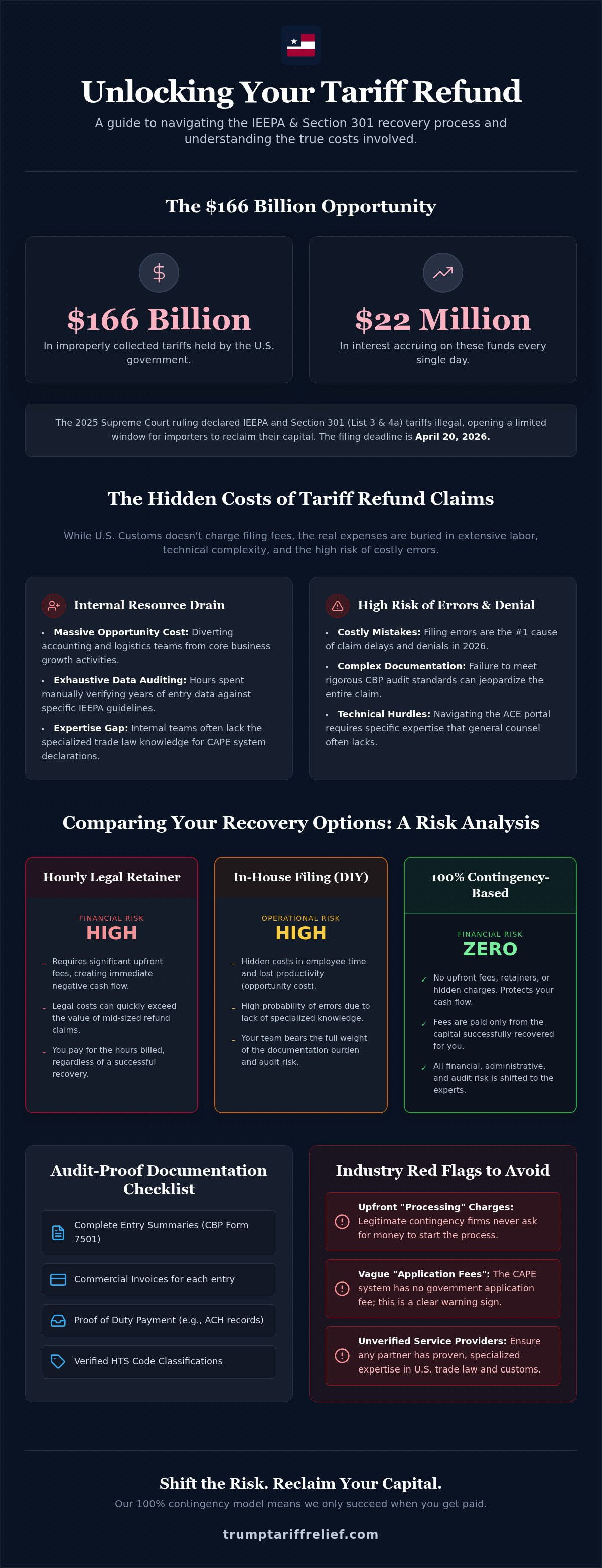
Did you know the U.S. government is currently sitting on approximately $166 billion in illegal tariff payments while interest accrues at a staggering $22 million per day? Since the 2025 Supreme Court ruling, the race to recover these funds via the new CAPE system has intensified, yet many importers are hesitating. This hesitation often stems from the hidden costs of tariff refund claims, specifically the fear that high legal retainers and complex documentation will drain more capital than they recover.
You've likely felt the frustration of being unfairly taxed and the anxiety of throwing good money after bad on traditional legal fees. It's a valid concern when the 2026 filing deadlines are approaching and the documentation burden is immense. This article reveals the true financial impact of reclaiming IEEPA and Section 301 duties, exposing why hourly billing models often fail businesses. We will explore a zero-risk path to capital recovery that shifts the administrative weight and audit risk away from your internal team and onto seasoned experts who only win when you do.
Key Takeaways
- While U.S. Customs doesn't charge filing fees, the hidden costs of tariff refund claims lie in the extensive internal labor required for data auditing and CAPE declarations.
- Learn why traditional hourly legal retainers create immediate negative cash flow and can often exceed the total value of mid-sized IEEPA refund claims.
- Identify the technical requirements for ACE portal access and the rigorous documentation standards needed to protect your business during a CBP audit.
- Protect your capital by recognizing industry red flags, such as upfront "processing charges" or "application fees" from unverified service providers.
- Discover how a 100% contingency-based recovery model shifts all financial risk to experts, ensuring success fees are only paid after your capital is recovered.
Understanding the Total Cost to File for a Tariff Refund
U.S. Customs and Border Protection (CBP) provides the Consolidated Administration and Processing of Entries (CAPE) system as a portal for submissions, but the idea that filing is "free" is a dangerous misconception. The hidden costs of tariff refund claims are buried in the technical labor required to audit years of entry data and the high stakes of document verification. If your documentation doesn't meet the precise standards set by the April 20, 2026, IEEPA refund guidelines, your claim faces immediate denial. Before analyzing recovery strategies, it's vital to understand the foundational nature of these duties. What is a Tariff? In this context, it represents a tax on imported goods that the Supreme Court has now deemed improperly applied under the International Emergency Economic Powers Act.
What is an IEEPA Tariff Refund?
On February 20, 2025, the U.S. Supreme Court delivered a landmark ruling stating that previous executive actions to impose sweeping tariffs under the IEEPA were illegal. This decision opened the floodgates for importers to recover billions in duties paid on Section 301 List 3 and List 4a goods. Unlike standard duty drawbacks, which rely on the export of imported goods, an IEEPA refund is a legal mechanism to reclaim overpaid duties that were imposed outside the statutory authority of the executive branch. This isn't a government handout; it's the restoration of capital that was taken from your business through an unlawful tax.
Internal vs. External Filing Costs
Diverting your internal accounting or logistics teams to manage these filings often costs more than the refund is worth. These teams aren't trained in the intricacies of CAPE declarations or the specific trade law nuances required for a successful Tariff Eligibility Assessment. When you pull staff from their core roles, you create a massive opportunity cost that stalls your actual business growth. While your general corporate counsel might understand the broad strokes of the law, they often lack the specialized trade expertise to navigate the ACE portal's technical requirements. This expertise gap leads to filing errors, which in 2026, are the primary cause of claim delays.
The hidden costs of tariff refund claims also include the literal cost of time. With interest on these refunds accumulating at roughly $22 million per day nationwide, every day spent on internal learning curves is capital lost. In 2026, time is a more expensive factor than money because the window for administrative recovery is narrowing. Waiting for an internal team to master the CAPE system isn't just inefficient; it's a financial gamble with your company's recovery potential. You don't just pay for the filing; you pay for the risk of doing it wrong and losing the claim entirely.
Direct vs. Indirect Expenses in the Filing Process
The administrative reality of reclaiming capital is far more grueling than a simple portal submission. While the government provides the CAPE system, the hidden costs of tariff refund claims manifest in the exhaustive data auditing required to prove eligibility. You must source and verify every single entry made over multiple years. If a single HTS code is misclassified, the entire claim can be flagged for an audit or outright denial. This technical precision is why many firms find that litigation costs for tariff refunds can quickly spiral, potentially eclipsing the value of the recovery itself for mid-sized operations.
The Documentation Burden
Establishing a bulletproof claim requires more than just a summary of payments. You must compile the required documents for IEEPA tariff refund, which includes entry summaries, commercial invoices, and proof of duty payment. For high-volume importers in 2026, manual verification is no longer viable. The labor involved in cross-referencing thousands of entries against the Supreme Court ruling is immense. Automated auditing tools are now essential to ensure accuracy and protection against CBP inquiries. If you don't have these systems in place, your internal team will be buried in paperwork for months. Our experts provide a comprehensive eligibility audit to remove this burden from your shoulders.
The Cost of Waiting: Processing Timelines
Time is your greatest adversary in the recovery process. You must remain acutely aware of the tariff refund statute of limitations. Missing a deadline means forfeiting your right to capital that is legally yours. Beyond the legal cutoff, there is the simple reality of ROI. With interest accumulating at $22 million per day nationwide, every week of delay reduces the relative value of your refund. Early filing isn't just about speed; it's about securing your place in the queue before potential fund depletion or regulatory shifts complicate the landscape. The government's processing window is already congested. Filing late increases the likelihood of prolonged CBP inquiries, which adds even more to the hidden costs of tariff refund claims through extended administrative follow-ups.
Comparing Fee Structures: Hourly Legal vs. Contingency
Recovery is a high-stakes financial operation, and how you pay for it determines your ultimate ROI. One of the most significant hidden costs of tariff refund claims is the upfront retainer required by traditional law firms. These firms operate on a model that creates immediate negative cash flow for your business. You're forced to pay for legal research and administrative filings before a single dollar is recovered from the government. In an era where capital is expensive, committing thousands to a retainer for a process that may take months is a strategic risk many importers can't justify.
The hourly trap is particularly dangerous for mid-sized claims. If a law firm bills $500 per hour to audit entries and file CAPE declarations, the legal fees can quickly exceed the value of the refund itself. This creates a scenario where you win the legal battle but lose the financial war. Traditional legal models bill for effort, not results. This means you're on the hook for the bill even if the CBP denies your claim due to documentation errors or shifting regulatory interpretations. Transparency in 2026 requires a service agreement that protects your bottom line, not just the lawyer's billable hours.
When Does the Hourly Model Make Sense?
Fixed-fee or hourly legal work typically only makes sense for massive conglomerates with internal legal departments that simply need a "second pair of eyes" on a pre-prepared filing. For everyone else, the risks of billing for effort rather than results are too high. To calculate your break-even point, you must weigh the projected refund against the estimated 50 to 100 hours of specialized trade law work required. If the math doesn't show a clear 5x return on the legal spend, the hourly model is a liability. Most businesses find that the unpredictability of trade law makes upfront payments a poor investment.
The Benefits of Contingency-Based Recovery
A contingency-fee model is the gold standard for businesses seeking a zero-risk path to capital recovery. Under this structure, the incentives are perfectly aligned: your partner only gets paid when you receive your check. This model covers the hidden costs of tariff refund claims by absorbing the expense of expert trade audits, data collection, and documentation management. It shifts the entire financial burden away from your balance sheet and onto the recovery expert.
At Trump Tariff Relief, we operate on a 100% contingency basis. We manage the entire lifecycle from the initial Tariff Eligibility Assessment to final filing with no upfront costs. This approach ensures that we're highly motivated to identify every eligible dollar from List 3 and List 4a. We take on the risk of a denial, so you don't have to. It's the most effective way to right the wrong of illegal taxation without risking further capital on legal uncertainty.
Avoiding Hidden Costs and Filing Scams
The surge in recovery opportunities since the 2025 Supreme Court ruling has unfortunately invited bad actors into the trade space. One of the most dangerous hidden costs of tariff refund claims isn't a legal fee, but the loss of sensitive company data to fraudulent "ghost filers." These entities often demand upfront "application fees" or "processing charges," claiming they have a fast-track to CBP funds. In reality, U.S. Customs and Border Protection does not charge any fee for processing a refund. Any request for payment before capital is recovered is a definitive red flag. If you encounter a firm demanding money to "open a file," you're likely facing a scam that adds zero value to your recovery efforts.
Data security is another critical concern that many importers overlook until it's too late. Your customs entries contain proprietary pricing, supplier details, and financial records that are highly valuable to competitors and bad actors. Entrusting this to a firm without a verified track record in CBP compliance is a massive liability. Beyond the threat of identity theft, ghost filers often submit incomplete or inaccurate declarations that fail to meet the standards of the CAPE system launched on July 20, 2026. These errors trigger audits that can haunt your business for years, creating long-term hidden costs of tariff refund claims through legal defense and potential penalties.
Vetting Your Recovery Partner
To protect your interests, you must perform a rigorous tariff refund assessment on any potential partner. Ask specifically about their experience with the Section 301 litigation and their understanding of the distinctions between List 3 and List 4a eligibility. A legitimate partner should have a deep IEEPA explained knowledge base and be able to demonstrate a history of successful trade remedy recovery. If they can't explain the technical requirements of the CAPE system or provide a clear success-fee structure, they aren't equipped to handle your capital. Transparency is the only defense against the predatory practices of unverified consultants.
CBP Compliance and Audit Protection
A professional recovery partner acts as a protective buffer between your firm and the federal bureaucracy. They should provide proof that every filing is actually submitted in the ACE portal, giving you full transparency into the status of your claim. Recognizing official CBP communications from the new webpage launched on April 20, 2026, is vital; scammers often mimic government branding to solicit secure information. A seasoned expert manages these communications for you, filtering out phishing attempts and ensuring that every response to a legitimate inquiry is legally sound and audit-proof. Don't risk your recovery on unverified entities; start your zero-risk assessment today to verify your eligibility with experts who prioritize your data security and compliance.
Reclaiming Your Capital with Trump Tariff Relief
The complexities of trade law and the administrative burden of CAPE declarations shouldn't stand between your business and its rightful capital. We built our firm to eliminate the hidden costs of tariff refund claims by providing a high-performing partnership that assumes 100% of the financial risk. Our model is simple: we do the work, we manage the documentation, and we navigate the bureaucracy. You only pay a success fee once the refund check is in your hands. This approach transforms a high-stakes legal challenge into a streamlined recovery operation with zero impact on your immediate cash flow.
Our team of trade and legal experts specializes in identifying every eligible dollar from Section 301 List 3 and List 4a. We don't just file paperwork; we conduct comprehensive eligibility audits that uncover overpayments often missed by general accounting teams or standard customs brokers. By managing the entire lifecycle from initial assessment to final check issuance, we protect your internal teams from the labor-intensive documentation burden that often derails DIY attempts. Our how it works process is engineered for maximum efficiency, ensuring your claim is audit-proof and compliant with the latest CBP standards.
The Trump Tariff Relief Process
We've distilled the recovery journey into three high-impact stages designed to move your claim through the system quickly. First, we conduct a Preliminary Assessment at no cost to you to confirm your eligibility and estimate your potential recovery. Second, our experts handle all data retrieval and entry verification, cross-referencing your records against the 2025 Supreme Court ruling. Finally, we file the CAPE declaration through the ACE portal and manage all follow-up communications with CBP. This end-to-end management ensures that the hidden costs of tariff refund claims are completely removed from your balance sheet.
Secure Your Refund Before the 2026 Deadlines
The window for recovery is narrowing. With the 2026 filing deadlines approaching and interest accumulating at roughly $22 million per day nationwide, delay is the most expensive mistake you can make. The government is currently processing billions in refunds for companies like Apple and Amazon, and your business deserves the same restoration of capital. We provide the protective strength and insider expertise needed to cut through the bureaucracy and secure your spot in the recovery queue. You don't need to spend a dime today to begin the process of righting this financial wrong. Claim your free tariff refund assessment now and let our team start the heavy lifting for your business.
Secure Your Recovery Without Financial Risk
Navigating the 2026 trade landscape requires more than just knowing you're owed money; it requires a strategy that doesn't drain your remaining capital. We've exposed how hourly legal retainers and intensive internal labor represent the true hidden costs of tariff refund claims. These expenses create immediate negative cash flow and offer no guarantee of success. By contrast, a contingency-based model ensures that your interests and your partner's incentives are perfectly aligned. You shouldn't have to pay for the privilege of reclaiming what is already yours.
Our team of expert trade consultants handles every aspect of the documentation burden, providing a dedicated focus on Section 301 and IEEPA recovery. We assume all the risk, managing the complex CBP filings so your team can remain focused on growth. Don't let your capital sit in government accounts while interest accumulates at $22 million per day nationwide. Start your zero-risk tariff refund assessment today and take the first step toward restoring your company's financial health. It's time to right this wrong and win back your capital with total confidence.
Frequently Asked Questions
Is there a government fee to file for an IEEPA tariff refund?
No, U.S. Customs and Border Protection (CBP) does not charge any fees for processing tariff refunds. The CAPE system launched on July 20, 2026, is a government utility designed for legitimate duty recovery without upfront filing costs. Any entity or website demanding an "application fee" or "processing charge" is likely a fraudster soliciting secure information. While the filing itself is free, the labor-intensive process of auditing years of entry data remains a significant hurdle for internal teams.
What is a contingency fee for tariff recovery services?
A contingency fee is a success-based payment model where the consultant only receives compensation after your refund is successfully recovered. This structure eliminates the financial risk of paying for effort rather than results. At Trump Tariff Relief, we assume the entire administrative burden and technical risk. You don't owe anything unless we secure your check, ensuring our team is highly motivated to identify every eligible dollar from Section 301 List 3 and List 4a.
Can I file for a tariff refund myself to save on costs?
You can technically file through the ACE portal yourself, but the hidden costs of tariff refund claims often outweigh the perceived savings. DIY filers frequently struggle with sourcing years of entry summaries and verifying HTS codes against the 2025 Supreme Court ruling. Incomplete declarations or technical errors in the CAPE system trigger CBP audits. These administrative setbacks create long-term costs and delays that a professional recovery partner is specifically equipped to avoid from the start.
How much of my refund will a consultant take as a fee?
Consultant fees are typically structured as a percentage of the actual capital recovered from the government. This success fee covers the expert labor, technical auditing tools, and documentation management required for a successful filing. Because there are no upfront costs, this model ensures that your business maintains positive cash flow throughout the recovery process. You'll only pay for verified results, making it a low-risk strategy compared to paying hourly legal retainers for uncertain outcomes.
Are there any hidden costs I should be aware of before filing?
The primary hidden costs of tariff refund claims include the diversion of your internal accounting staff and the technical risk of claim denial. Managing thousands of entries requires hundreds of hours of expert labor. If your team lacks trade law expertise, they may miss eligible duties or submit inaccurate data that leads to a federal audit. Professional contingency firms absorb these operational costs and technical risks, protecting your bottom line from unexpected administrative expenses.
How long does it take for the refund to be issued once I file?
Refund timelines depend on the accuracy of your documentation and current CBP processing volumes. Since the CAPE system's launch in July 2026, the government has been working through a massive backlog of claims. High-volume importers with clean, verified data typically see faster processing. However, incomplete filings or those flagged for manual review can face significant delays. Working with experts who ensure your documentation is audit-proof is the most effective way to accelerate your check issuance.
What happens if my tariff refund claim is denied?
If your claim is denied while working with a contingency-based firm, you owe absolutely nothing for the work performed. This is the core advantage of our partnership; we assume the risk of the time and labor invested. If you choose an hourly legal model, you're still responsible for the billable hours even if the government rejects your filing. A denial typically results from improper documentation or misclassification, which our expert trade audits are designed to prevent.
Is it too late to start a tariff refund claim in 2026?
It's not too late, but the window for recovery is narrowing as the 2026 filing deadlines approach. Interest on the $166 billion owed to U.S. companies is accumulating at $22 million per day, making every day of delay a financial loss. Importers who wait risk fund depletion or regulatory changes that could complicate the recovery process. Securing your spot in the queue now ensures your claim is processed before the administrative window for IEEPA recovery closes.
Ready to find out what your business may be owed?
Check My Eligibility