
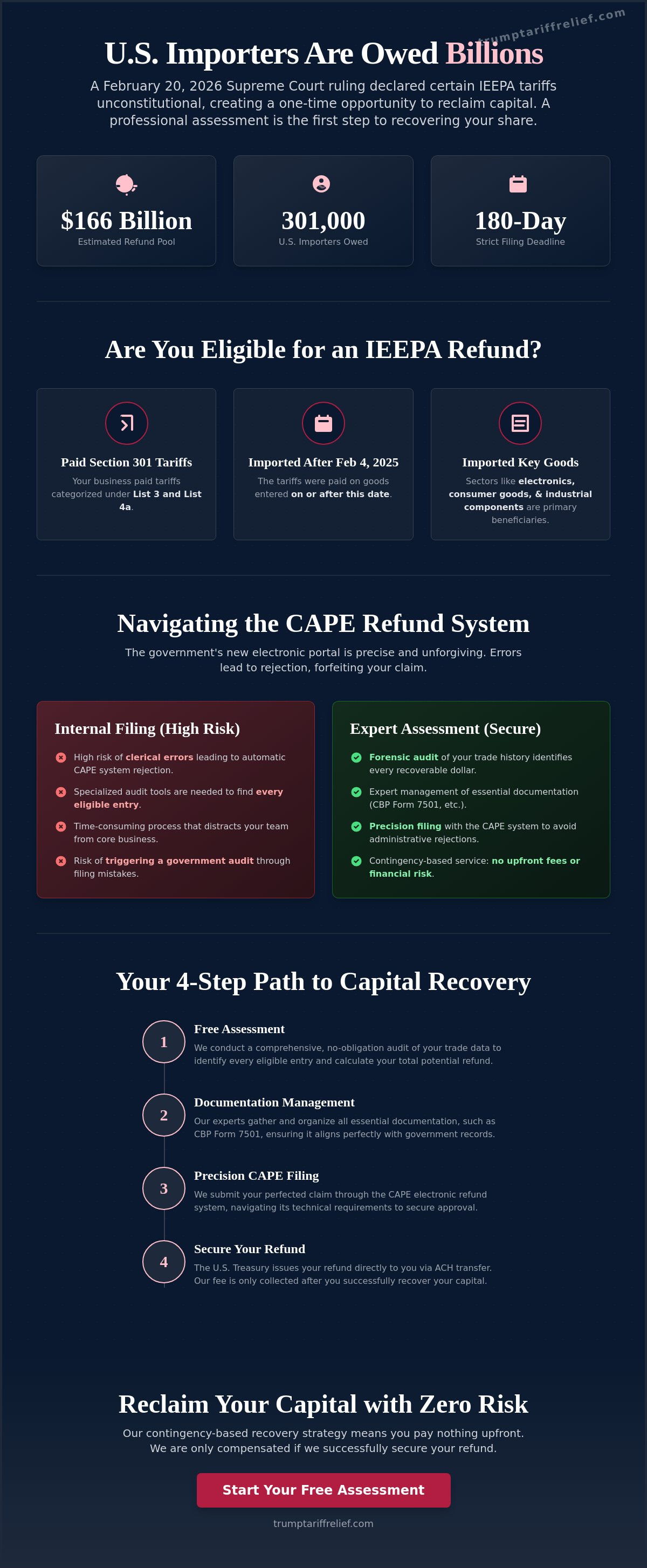
Roughly 301,000 U.S. importers are currently owed a share of an estimated $166 billion in unconstitutional payments. Following the February 20, 2026, Supreme Court ruling, the federal government must return tariffs collected under the International Emergency Economic Powers Act since early 2025. However, the window to reclaim this capital is narrow, and the technical requirements are unforgiving. A professional tariff refund assessment is the essential first step to determine if your specific import history qualifies for recovery through the new CAPE system.
You've likely dealt with enough customs bureaucracy to know that automatic refunds don't exist in international trade. It's natural to worry about the time wasted on ineligible claims or the risk of triggering a government audit through clerical errors. We're here to offer a low-risk path to capital recovery that removes the administrative burden from your team. This guide will help you confirm your IEEPA eligibility, understand the strict 180-day filing deadlines for liquidated entries, and explain how our expert documentation management secures your ACH refund with zero upfront risk.
Key Takeaways
- Determine how a professional tariff refund assessment serves as a comprehensive audit of your trade data to identify every eligible entry since early 2025.
- Navigate the technical criteria for IEEPA recovery by identifying the specific Section 301 tariffs and HTS codes that qualify for a refund.
- Evaluate the significant risks of internal filings versus the precision of specialized trade consultancies in avoiding administrative rejections.
- Secure your claim by organizing essential documentation, such as CBP Form 7501, required for the new CAPE electronic refund system.
- Leverage a contingency-based recovery strategy to reclaim your capital without the burden of upfront legal fees or financial risk.
The Critical Role of a Tariff Refund Assessment in 2026
A tariff refund assessment isn't a mere administrative review. It's a forensic audit of your trade history. For the 301,000 U.S. importers affected by recent trade enforcement, 2026 represents the most significant financial recovery window in decades. This isn't a standard duty drawback process where you recover funds based on re-exportation. Instead, this is a direct reclamation of capital that was collected under unconstitutional authority. If your business paid tariffs on goods entered on or after February 4, 2025, you're likely sitting on significant trapped capital. The federal government currently owes an estimated $166 billion to private enterprises, but these funds aren't distributed automatically.
The IEEPA Ruling: Why This Capital is Now Reclaimable
The legal landscape shifted on February 20, 2026, when the Supreme Court ruled that certain duties imposed under the International Emergency Economic Powers Act (IEEPA) were unconstitutional. This ruling invalidated tariffs applied to a vast range of imports starting in early 2025. It's a rare, one-time opportunity for financial restoration. Because the ruling addresses the legality of the tax itself, the recovery path is distinct from traditional trade mitigation. You can learn more about the specific legal triggers on our IEEPA explained page. You're not asking for a favor; you're reclaiming what's legally yours.
The CAPE Portal and the Government’s Refund Mechanism
To manage the massive influx of claims, U.S. Customs and Border Protection launched Phase 1 of the CAPE system on April 20, 2026. This portal requires precise, electronic declarations. If your data is slightly off, the system will flag the entry for rejection. A preliminary assessment ensures your filing matches the government’s records exactly. Without this level of precision, you risk missing the strict 180-day filing deadline for liquidated entries. The clock is ticking. If you don't act within that window, your right to recovery effectively expires, leaving your capital in the government's hands forever.
Defining Eligibility: Is Your Business Qualified for an IEEPA Recovery?
Determining eligibility is the most technical phase of the recovery process. While the Supreme Court's February 20, 2026, decision opened the floodgates for restoration, it didn't grant a blanket refund for all duties paid. Eligibility centers specifically on Section 301 tariffs categorized under List 3 and List 4a that were paid on or after February 4, 2025. If your business imported electronics, consumer goods, or industrial components during this period, you likely qualify for a significant return of capital. A precise tariff refund assessment acts as the essential filter, separating eligible entries from those that remain subject to standard trade enforcement.
Harmonized Tariff Schedule (HTS) codes are the primary variable in this equation. Each code in your historical data must be cross-referenced against the court-ordered invalidation list to determine its individual claim value. Understanding the legislative history of IEEPA helps clarify why these specific lists were targeted. The act was never intended to serve as a permanent mechanism for broad trade taxes without congressional oversight. Consequently, sectors like manufacturing, high-volume retail, and technology are the primary beneficiaries of this correction. Identifying these "eligible" entries requires a forensic look at your historical trade data, distinguishing them from "excluded" entries like those subject to anti-dumping or countervailing duties.
Identifying Eligible Import Categories
The distinction between List 3 and List 4a is critical because these lists cover thousands of individual HTS codes. An effective assessment doesn't just look at totals; it scrutinizes every line item on your CBP entry summaries. Common misconceptions often lead importers to believe that all recent duties are refundable. They aren't. Only those specifically linked to the IEEPA overreach qualify for the current recovery window. If you're unsure where your specific goods fall, you can review our frequently asked questions to see how different product categories are handled.
The Threshold for a Meaningful Recovery
Not every eligible entry warrants a claim. For large-scale importers, prioritizing high-value claims is the most efficient path to restoration. Smaller volumes may be impacted by "de minimis" rules or administrative complexities that could erode the net benefit. However, because the total refund pool is estimated at $166 billion, even mid-sized importers often find six or seven-figure recoveries waiting in their files. A professional tariff refund assessment quantifies this potential before you commit resources to the filing process. It’s about identifying the maximum recovery with the minimum administrative friction.
Assessment Framework: Internal Audits vs. Specialized Trade Consultancies
Choosing the right partner for your recovery effort is a decision that impacts both your bottom line and your future compliance standing. Many companies initially consider an internal "DIY" approach to save on fees. However, the hidden costs of diverting your logistics or finance teams from their core operations often exceed the recovery itself. An internal tariff refund assessment frequently lacks the forensic depth needed to survive a rigorous CBP review. While your general corporate counsel understands the broad legal implications of the court’s ruling, they rarely possess the specialized trade data tools required to map thousands of HTS codes to specific entry summaries. This gap in expertise is where most internal claims fail.
Specialized trade consultancies act as a high-performing partner. They take on the heavy lifting and the risk. Unlike internal teams, these experts have seen the nuances of bureaucracy and know exactly where the CBP looks for discrepancies. By utilizing an insider who understands the IEEPA Duty Refunds framework, you ensure your claim is positioned for immediate approval rather than a lengthy administrative rejection. Professional advocacy is about more than just filing forms. It's about righting a financial wrong with the precision that only a dedicated specialist can provide.
The Complexity of Customs Data Mining
Extracting entry data from the 2025 and 2026 period requires more than a basic spreadsheet. It demands specialized software capable of reconciling historical ACE (Automated Commercial Environment) records with your internal ERP data. Internal teams often struggle to match purchase orders with liquidated entry dates, leading to incomplete filings. A professional assessment identifies these gaps early. It catches the clerical errors that trigger system flags in the CAPE portal. If your data doesn't align perfectly with the government's records, your recovery stops before it even begins.
Risk Mitigation and Audit Protection
Filing a claim without professional oversight is an invitation for government scrutiny. A robust tariff refund claim verification process ensures that every dollar reclaimed is backed by ironclad documentation. This verification acts as a buffer between your firm and the CBP. It protects you from future audits by ensuring your submission complies with the latest 2026 regulatory guidance. We don't just file papers. We build a defensive wall around your recovery, ensuring your capital stays in your accounts where it belongs.
Preparation for Filing: The Documentation Required for a Successful Claim
Winning a claim against the federal government requires more than just a valid legal argument. It requires ironclad proof. While the court ruling provides the precedent, your documentation provides the substance. The centerpiece of any successful tariff refund assessment is CBP Form 7501, the Entry Summary. This document serves as the official record of your import transaction, detailing the HTS codes used and the specific duties paid. If you don't have these forms readily available, you must retrieve them from the Automated Commercial Environment (ACE) portal before the filing window closes. We handle this retrieval as part of our specialized documentation management, ensuring no entry is left behind.
Secondary evidence is equally critical for verification. You'll need to gather commercial invoices and packing lists that confirm the nature of the goods imported. These documents must reconcile perfectly with your entry summaries to withstand a potential audit. If your records are incomplete due to standard corporate data retention policies, it's vital to act quickly. We specialize in retrieving historical data directly from government databases to fill these gaps. Once your submission is finalized through the CAPE portal, the timeline for refund issuance typically follows the CBP's electronic ACH processing schedule. This system is designed for speed, but it only works if your initial filing is flawless.
Building Your Evidence Portfolio
Organizing entry data is a methodical process that leaves no room for error. You must categorize every import by HTS code, entry date, and liquidation status. Because the CAPE system is entirely electronic, digital record-keeping isn't just a preference; it's a mandatory requirement for the 2026 recovery window. Common gaps, such as missing ACH payment confirmations or mismatched invoice values, are the leading causes of summary claim denials. A professional tariff refund assessment identifies these discrepancies before they reach a customs officer's desk, protecting your reputation and your recovery.
Navigating the Statute of Limitations
Time is your greatest adversary in trade recovery. Under current regulations, you have a strict 180-day deadline for IEEPA tariff refunds from the date of liquidation for each individual entry. Late filings are summarily rejected by the CBP without any path for appeal. To ensure your documentation is audit-ready and compliant, we recommend starting your assessment at least 90 days before your specific window closes. This lead time allows for the forensic reconciliation of your records and the correction of any data anomalies. Don't leave your capital at risk. Secure your recovery by initiating your documentation audit today.
Securing Your Recovery: Why a Contingency-Based Assessment is the Optimal Strategy
The primary hurdle for many executive teams is the concern over upfront costs associated with specialized trade recovery. Traditional consulting models often demand significant retainers before a single dollar is reclaimed. A contingency-based tariff refund assessment eliminates this friction. By operating on a success-only framework, we ensure that your recovery effort doesn't compete with your current operational budget. This model is the most aggressive path to restoration because it places the burden of performance entirely on the advocate. We don't just provide a service; we act as a high-performing partner that only benefits when you win.
Righting a financial wrong of this magnitude requires a partner willing to take on the heavy lifting. The government currently holds billions in unconstitutional tariffs, and the 180-day deadline for liquidated entries means there's no room for hesitation. Utilizing a success-based model ensures that every entry in your history is scrutinized with maximum effort. Our team manages the technical audit and documentation, allowing your staff to focus on their primary responsibilities. This transparency in our fee structure provides total clarity: our interests are perfectly aligned with the maximum possible recovery of your capital.
The Advantage of Success-Based Partnership
Trump Tariff Relief takes on all the administrative risk and labor. We understand that navigating the CAPE system and reconciling historical HTS codes is a resource-heavy endeavor. By removing the barrier of upfront fees, we allow businesses of all sizes to pursue their rightful claims. This model is particularly effective for importers who have already experienced the cash flow strain of these unconstitutional duties. You reclaim your liquidity without a secondary financial hit, ensuring the recovery process is entirely cash-flow positive from day one. This partnership ensures that your tariff refund assessment is conducted with the highest level of forensic precision.
Taking Action: Your Preliminary Assessment
The first step is a rapid evaluation of your import history. You can learn more about the IEEPA ruling to understand the legal foundation of your claim, but the most critical move is initiating your preliminary eligibility check. Our turnaround time is designed for speed, providing you with a clear confirmation of your recovery potential within days. The 2026 deadlines are non-negotiable. If you don't secure your place in the recovery queue now, you risk losing your share of the $166 billion pool forever. Contact us today to begin your risk-free assessment.
Reclaim Your Capital Before the Window Closes
The 2026 recovery window represents a rare alignment of legal justice and financial opportunity. With an estimated $166 billion in unconstitutional duties waiting to be returned, your business deserves its share of these funds. We've detailed how a professional tariff refund assessment serves as the definitive roadmap through the CAPE portal's technical requirements. By reconciling historical HTS codes and securing essential Form 7501 summaries, you eliminate the risk of administrative rejection.
You don't have to navigate this bureaucracy alone. As a specialized trade consultancy, we provide national support for manufacturers, retailers, and distributors seeking restoration. Our contingency model ensures you only pay if we recover your money. This success-based partnership removes the financial barrier to entry, allowing you to act with the urgency these 180-day deadlines demand. The path to restoration is clear; we're ready to do the heavy lifting for you.
Get Your Free Tariff Eligibility Assessment Now and take the first step toward reclaiming your trapped capital. Your recovery is our priority.
Frequently Asked Questions
What exactly is a tariff refund assessment?
A tariff refund assessment is a forensic audit of your historical trade data designed to identify specific entries eligible for recovery under the 2026 Supreme Court ruling. This process involves mapping your Harmonized Tariff Schedule (HTS) codes against the court-ordered invalidation list. It ensures that every eligible entry summary is identified and verified before submission to the government's CAPE portal. This specialized audit transforms complex customs records into a clear, actionable path for capital restoration.
Is the China tariff refund program real and legitimate?
Yes, this is a legitimate legal restoration following the February 20, 2026, Supreme Court ruling that invalidated specific duties imposed under the International Emergency Economic Powers Act. The federal government is estimated to owe importers approximately $166 billion in unconstitutional payments. This isn't a speculative program; it's a court-ordered return of capital for imports entered on or after February 4, 2025. Thousands of U.S. importers are already utilizing the CAPE system to secure these ACH refunds.
How much does a professional tariff recovery service cost?
We operate on a success-based contingency model, which means there are no upfront costs or consulting fees for your business. You only pay a percentage of the actual capital we successfully recover for you. This structure removes all financial risk and aligns our success directly with yours. If we don't recover funds for your business, you don't owe us anything. It's a high-reward partnership designed to right a financial wrong without impacting your current budget.
What is the deadline for filing an IEEPA tariff refund claim in 2026?
Importers must file a claim within 180 days of the liquidation date for each individual entry. Because liquidation dates vary across your import history, there is no single "closing date" for all claims. Instead, you face a series of rolling deadlines that require constant monitoring. A professional tariff refund assessment is essential to track these dates and ensure your documentation is submitted through the CAPE portal before your right to recovery expires for each entry.
Can my business file for a refund if we no longer use the same customs broker?
Yes, your current brokerage relationship doesn't affect your eligibility for a refund. As long as your company was the "importer of record" that paid the duties, you own the right to the recovery. We can retrieve your historical data directly from the government’s ACE portal, even if you've changed brokers or your internal records are incomplete. We take over the documentation management process to ensure your claim is filed accurately regardless of your past service providers.
How long does it take to receive the actual refund from the U.S. government?
Refunds are typically issued via electronic ACH within several weeks to a few months after a claim is successfully processed through the CAPE system. The U.S. Customs and Border Protection no longer issues paper checks for these recoveries, making electronic registration mandatory. The speed of your refund depends heavily on the accuracy of your initial filing. Flawless documentation leads to faster approval, while errors can result in lengthy administrative delays or summary rejections.
What happens if my tariff refund assessment shows I am not eligible?
If the assessment determines that your import history doesn't meet the technical eligibility criteria, you owe us nothing. This preliminary check provides your executive team with essential clarity and peace of mind without any financial commitment. We believe in transparency and efficiency, so we'll never advise you to pursue a claim that doesn't have a high probability of success. You'll simply receive a definitive answer on your standing at no cost to your firm.
Does filing for a refund trigger a broader customs audit of my business?
Filing a verified claim under the 2026 ruling is a standard administrative procedure and doesn't inherently trigger a broader customs audit. In fact, our professional verification process serves as a protective buffer. By ensuring your claim matches the government’s records exactly before submission, we reduce the likelihood of flags or system discrepancies. We build your case with forensic precision to ensure it meets the strict CAPE requirements, allowing for a smooth recovery without attracting unnecessary scrutiny.
Ready to find out what your business may be owed?
Check My Eligibility