Over 330,000 U.S. businesses are currently sitting on a collective $175 billion in unlawful duties paid under the invalidated IEEPA tariffs. It's a staggering sum that represents capital that belongs back in your company's operations rather than government accounts. You likely feel the pressure of the 2026 filing window, especially when your internal teams are already stretched thin by the complexity of years of customs data. Navigating this landscape is about more than just compliance; it's about maximizing your tariff refund amount through precise, aggressive recovery strategies.
We're here to ensure your business doesn't leave a single dollar on the table. This guide reveals the professional documentation secrets and forensic audit techniques necessary to reclaim your capital following the historic Supreme Court ruling. We'll walk you through the process of verifying eligibility across multiple years of entries and show you how to leverage a hands-off recovery model to restore your bottom line without draining your internal resources. It's time to right this financial wrong and secure the full restoration of the capital your business is owed.
Key Takeaways
- Capitalize on the historic $175 billion recovery window opened by the landmark 2026 Supreme Court ruling on IEEPA tariffs.
- Master forensic data mining strategies for maximizing your tariff refund amount by identifying every eligible entry buried within your ACE portal history.
- Eliminate claim leakage by aligning internal commercial invoices with Form 7501 entry summaries to withstand rigorous CBP validation.
- Distinguish between standard customs brokerage and specialized recovery audits to ensure past filing errors are identified and corrected for full reimbursement.
- Secure a risk-free path to capital restoration through a professional recovery process that operates entirely on a 100% contingency basis.
The 2026 IEEPA Tariff Ruling: A $170 Billion Capital Recovery Opportunity
On February 20, 2026, the legal landscape for U.S. importers shifted permanently. The Supreme Court's landmark ruling against the use of the International Emergency Economic Powers Act (IEEPA) to impose trade duties didn't just change policy; it unlocked a $170 billion reservoir of corporate capital. For businesses across the retail, tech, and manufacturing sectors, 2026 is officially the "Year of Recovery." While most executives understand what a tariff is in a general sense, few were prepared for the massive scale of this specific restoration event. Over 330,000 businesses are now eligible to reclaim funds that were collected under an unconstitutional framework.
It's vital to distinguish this recovery path from the ongoing Section 301 litigation. While Section 301 tariffs are tied to specific trade investigations, the IEEPA ruling was a direct strike against executive overreach. This means the pathway to recovery is more direct, provided you have the forensic data to back your claim. If your company paid duties between April 2025 and February 2026, you aren't just looking for a windfall. You're seeking a full restoration of capital that was unlawfully diverted from your bottom line. Achieving this requires a strategic approach focused on maximizing your tariff refund amount before the administrative windows begin to close.
Why the Court Ruled Against These Tariffs
The Court's decision centered on a clear pattern of legal overreach. It determined that the IEEPA does not grant the President the authority to bypass Congress to impose broad import duties. This ruling effectively invalidated the tariffs retroactively for goods entered during the contested period. To manage the resulting $175 billion in potential claims, U.S. Customs and Border Protection (CBP) launched the Consolidated Administration and Processing of Entries (CAPE) portal on April 20, 2026. This portal is designed to streamline the process, yet the burden of proof remains entirely on the importer. Successfully maximizing your tariff refund amount depends on your ability to navigate this new digital interface with precision and speed.
The Cost of Inaction: Understanding the 3-Year Deadline
In the world of trade law, time is the enemy of recovery. Every day your team spends "evaluating the situation" is a day closer to the expiration of your legal rights. The statute of limitations for tariff protests and refund claims is strict. Waiting for the government to issue "clearer guidance" is a strategy that often results in permanent capital loss. CBP is processing claims quickly, with some refunds being certified in as little as 18 days, but the window to file won't stay open forever. You must move from observation to action while the CAPE portal is operational and your data is accessible. For a detailed breakdown of the timing requirements, review our guide on the Tariff Refund Statute of Limitations: The Critical Deadlines for IEEPA Claims.
Strategic Identification: How to Maximize Your Eligible Entry Pool
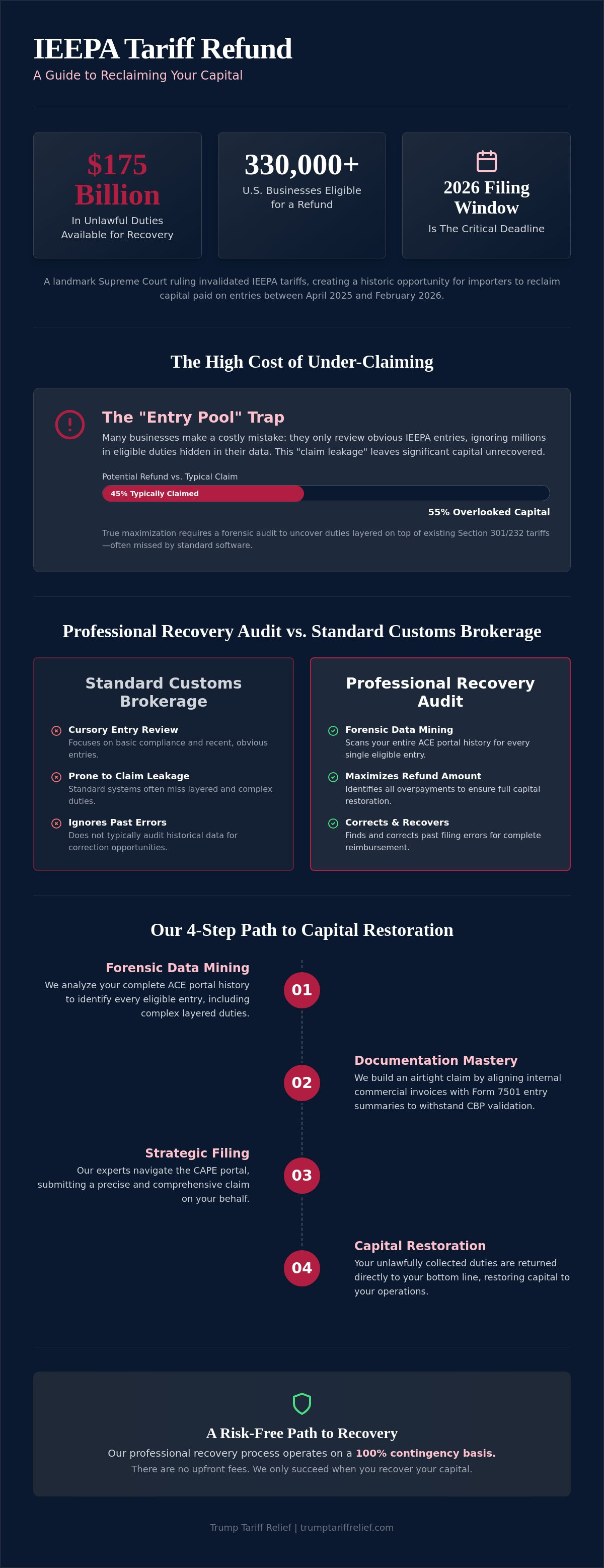
Many importers fall into the "Entry Pool" trap. They assume that a cursory glance at their 2025 customs records is sufficient to identify their total refund potential. This narrow focus is a costly mistake. If you only target the most obvious IEEPA entries, you're likely ignoring millions in eligible capital. True success in maximizing your tariff refund amount requires a forensic audit of every transaction entered between April 2025 and February 2026. This means digging into HTSUS subheadings where IEEPA duties were layered on top of existing Section 301 or 232 duties. These "hidden" duty layers are often overlooked by standard automated systems, but they represent a significant portion of the $175 billion recovery opportunity.
Identifying these opportunities requires moving beyond the surface level of your monthly statements. You must analyze the specific duty rates applied to each line item to detect anomalies. Standard customs software often fails to flag entries where multiple tariff regimes overlapped, leading to significant under-claiming. By conducting a comprehensive review of all entries during the affected period, you ensure that your claim reflects the true extent of the overpayments. You can learn how a professional recovery assessment identifies these hidden opportunities without taxing your internal resources.
Mining the ACE Portal for Lost Capital
The Automated Commercial Environment (ACE) portal serves as the definitive, single source of truth for your business's tariff history and recovery potential. To begin the extraction process, your team must pull comprehensive "Entry Summary" reports that cover the entire IEEPA period from early 2025 through February 2026. You need to monitor specific data fields with extreme scrutiny: Entry Type, total Duty Amount, and every individual HTSUS subheading applied to the line items. Don't simply look for the IEEPA flag; look for the dollar amounts that don't align with standard duty rates. This granular data mining is the only way to ensure no eligible entry is left behind.
Categorizing Entries by Liquidation Status
Your recovery strategy must bifurcate entries based on their current status: liquidated or unliquidated. Unliquidated entries represent the "low-hanging fruit." Because these files are technically still open in the eyes of CBP, they offer the fastest, most streamlined path to a refund through the CAPE portal. However, the real challenge and opportunity lie in liquidated entries. These are files that CBP has officially closed. To recover these funds, you must employ a "Protest" strategy, effectively reopening the files based on the Supreme Court's ruling. Many businesses forget about entries from early 2025 that have already liquidated, assuming those funds are gone forever. They aren't. By auditing both categories, you capture the "forgotten" capital from the start of the IEEPA implementation and ensure you are maximizing your tariff refund amount across the entire eligibility window.
Documentation Mastery: Building an Airtight Claim to Prevent Leakage
Identifying eligible entries is only half the battle. The path to actually maximizing your tariff refund amount is often blocked by "documentation leakage." This occurs when the data on your commercial invoices doesn't perfectly mirror the information on your CBP entry summaries. In the high-stakes environment of 2026, CBP auditors aren't looking for reasons to grant your refund; they're looking for discrepancies to deny it. Even a minor mismatch in quantity, value, or description can lead to a partial or full reduction of your claim. If your records are fragmented, you're essentially handing your capital back to the government.
To build an airtight case, you must align every internal commercial invoice with its corresponding Form 7501. This alignment isn't just about matching numbers; it's about proving the actual financial harm your business suffered. CBP requires "Proof of Payment" to verify that your company, as the Importer of Record, actually disbursed the funds for these unlawful duties. Without this verification, the government may argue that the duty was passed on to consumers or never actually paid. Utilizing professional Customs Documentation Management is the most effective way to automate this verification process, ensuring that every entry in your claim is backed by a complete, audit-ready digital trail.
The Importer’s Essential Documentation Checklist
A successful claim requires a specific set of records for every entry. If your digital archives are incomplete, you risk leaving significant capital on the table. Your recovery team must secure:
- CBP Form 7501: The entry summary that acts as the primary record of the transaction.
- Commercial Invoices: Detailed documents showing the transaction between you and the foreign supplier.
- Packing Lists: Verification of the specific goods, quantities, and weights.
- Bill of Lading (BOL): The contract of carriage that proves the goods entered the U.S. during the eligibility window.
Avoiding Common Filing Errors
Mismatched HTS codes are a primary red flag for CBP auditors. If your commercial invoice lists one classification while the entry summary uses another, the CAPE system may flag the entry for manual review or automatic rejection. Similarly, entry dates are critical. A single-day error can disqualify a $100,000 claim if it falls outside the specific IEEPA window. CBP's CAPE tool requires precise data alignment to avoid automatic rejection. Precision is the difference between a certified refund and a permanent loss of capital. By automating the cross-referencing of these data points, you protect your business from the administrative errors that sink most recovery attempts.
Professional Recovery Audit vs. Standard Customs Brokerage
Your customs broker is an essential partner for day-to-day operations, but they aren't built for retroactive forensic audits. Their business model is transactional, focusing on clearing current shipments as efficiently as possible. Retroactive recovery requires a completely different set of tools and a much deeper level of scrutiny. When the goal is maximizing your tariff refund amount, you need an advocate who isn't afraid to challenge the original filing data to find every eligible dollar. Standard brokers are gatekeepers of the present; recovery specialists are investigators of the past.
There's also a potential conflict of interest to consider. Many IEEPA refund opportunities stem from how entries were originally classified. If your broker was responsible for those initial filings, they may be hesitant to highlight errors that could now be corrected for a refund. Standard customs brokers often use automated software that replicates classification errors across thousands of entries, compounding the loss over time. A specialized audit firm provides a fresh, independent perspective. We look past the surface-level claims to find secondary and tertiary opportunities, such as misapplied duty rates or overlooked HTSUS subheadings that were subject to unlawful IEEPA layers.
The Limitations of Internal Logistics Teams
Internal logistics departments are currently facing an administrative bandwidth crisis. Handling the daily movement of goods is a full-time job; managing a $170 billion recovery opportunity is another. Most teams lack the specialized legal knowledge to navigate the specific complexities of the 2026 Supreme Court ruling, particularly the nuances between IEEPA and Section 301. Trump Tariff Relief acts as an extension of your team, taking the heavy lifting off your staff so they can focus on operations while we handle the bureaucracy. We provide the specialized expertise needed to interpret the ruling's specific nuances and apply them to your unique entry history.
Why a Success-Based Model Guarantees Maximization
The most significant difference lies in the incentive structure. Traditional law firms often charge hourly rates, regardless of the outcome. This can lead to spiraling costs with no guarantee of capital restoration. Our contingency-based model aligns our interests directly with yours. We only get paid if you receive a refund, which ensures we are aggressive in maximizing your tariff refund amount. We leave no stone unturned because our success is tied to yours. This model also drives speed. While hourly consultants might benefit from a slow process, we are motivated to navigate the CAPE portal as efficiently as possible to return your capital. For a deeper look at what to look for in a partner, read our guide on How to Choose an IEEPA Tariff Refund Consultant.
If you're ready to secure your capital, start your professional recovery assessment today.
Securing Your Maximum Refund with Trump Tariff Relief
Securing your capital shouldn't be another financial burden. At Trump Tariff Relief, we operate on a 100% contingency-based model. This means there are no upfront costs, no hourly legal fees, and no risk to your operating budget. Our interests are perfectly aligned with yours; we only receive a fee if we successfully restore your capital. This incentive structure is the primary reason businesses across the U.S. trust our specialized IEEPA recovery framework. We don't just file claims. We conduct a relentless pursuit of every dollar owed to your business, ensuring that maximizing your tariff refund amount is the central focus of our engagement.
Our team of trade experts manages the entire complex interface with CBP on your behalf. We navigate the CAPE portal, handle the forensic data mining, and manage the rigorous documentation requirements that often trip up internal logistics teams. From the initial eligibility assessment to the final certification of your refund, we provide a steady hand through the bureaucracy. Our process is designed to be as hands-off as possible for your staff, allowing them to remain focused on your core business while we right the financial wrong of these unlawful duties.
Your Free Eligibility Assessment
The first step toward restoration is understanding the scale of your opportunity. During our preliminary data review, we analyze your ACE portal reports to pinpoint exactly where IEEPA duties were applied. We identify your total "Max Recovery" potential in under 72 hours, giving you a clear financial roadmap before you commit to the process. This assessment is comprehensive, looking past simple entries to find the layered duties that standard audits often miss. Learn how our assessment works and see the data-driven precision we bring to every claim.
Take Action Before the Window Closes
The 2026 filing cycle is a high-stakes race against time. As the CAPE portal continues to process billions in claims, the administrative window for new submissions will inevitably tighten. Waiting to act only increases the risk of permanent capital loss. You've already paid the price for unlawful trade policy; don't pay the price for inaction. Contact Trump Tariff Relief today for a free assessment and take the first step toward maximizing your tariff refund amount. Professional recovery is the only way to guarantee that no capital is left behind in government accounts.
Secure Your Capital Restoration: The Window for Recovery Is Open
The $170 billion IEEPA recovery opportunity isn't just a regulatory shift; it's a critical moment for financial restoration. Successfully navigating the 2026 landscape requires more than basic filing. It demands forensic ACE portal audits to uncover hidden entries and airtight documentation to withstand rigorous CBP scrutiny. By shifting from standard brokerage to a specialized recovery audit, your business transitions from passive observation to active capital reclamation. You've already paid the price for unlawful duties. Now it's time to bring that capital home where it belongs.
Our expert team specializes in the specific nuances of the 2026 IEEPA ruling. We manage the entire process, from deep-data mining to final certification, ensuring that no eligible entry is left behind in government accounts. Because we operate on a 100% contingency-based model, you only pay if we recover your money. This alignment of interests is essential for maximizing your tariff refund amount before the 2026 filing window closes forever. Don't let administrative complexity stand between your business and its rightful capital. Claim Your Free Tariff Refund Assessment today and secure the restoration your business deserves.
Frequently Asked Questions
Is the IEEPA tariff refund program legitimate?
The program is a direct result of the February 20, 2026, U.S. Supreme Court ruling that invalidated duties imposed under the International Emergency Economic Powers Act. In response to this legal mandate, U.S. Customs and Border Protection launched the CAPE portal on April 20, 2026, specifically to facilitate these reimbursements. It's a verified federal process designed to restore billions in unlawfully collected capital to American importers of record.
How do I calculate my potential tariff refund amount?
Calculating your total recovery requires a forensic extraction of your ACE portal data for all entries between April 2025 and February 2026. You must identify every line item where IEEPA duties were layered over standard rates. Professional auditing is the most effective method for maximizing your tariff refund amount, as it identifies misclassified entries and hidden duty layers that automated internal reports often overlook.
What is the deadline for filing IEEPA claims in 2026?
Deadlines are governed by strict customs protest windows and the operational timeline of the CAPE portal. Generally, importers have 180 days from the date of liquidation to file a protest; however, the specific IEEPA recovery window is subject to rapid administrative changes. Waiting for clearer guidance often leads to permanent capital loss. You must initiate your eligibility assessment immediately to ensure your claims are filed before these statutory windows close.
Can I claim a refund for entries that have already liquidated?
Yes, you can recover duties from liquidated entries by utilizing specific protest strategies or the CAPE tool's ability to reopen closed files. While unliquidated entries offer a faster path, liquidated files from early 2025 often contain significant untapped capital. Our recovery framework focuses on auditing your entire entry history during the affected period to ensure that even "closed" files are evaluated for potential reimbursement.
How long does the tariff refund process take from filing to payment?
CBP initially anticipated a 60 to 90 day turnaround for valid IEEPA refunds once a CAPE declaration is accepted. However, as of late May 2026, the average processing time has been approximately 18 days for well-documented claims. The speed of your payment depends heavily on the precision of your data alignment and the completeness of your digital documentation trail during the initial submission phase.
What is the difference between a duty drawback and an IEEPA refund?
Duty drawback is an ongoing program that recovers up to 99% of duties on goods that are subsequently exported or destroyed. In contrast, the IEEPA refund is a one-time recovery event resulting from a specific court ruling. It applies to all eligible duties paid on imported goods entered during the 2025-2026 window, regardless of whether those goods remained in the U.S. or were later exported.
Do I need to pay any upfront fees for tariff recovery services?
Our recovery services are provided on a 100% contingency-fee basis, meaning there are no upfront costs or hourly billing. This model ensures that maximizing your tariff refund amount is our primary objective; we only receive a fee if we successfully secure a refund for your business. We take on the administrative burden and the risk, providing a low-friction path to capital restoration for your logistics and finance teams.
Which industries are most likely to qualify for the largest refunds?
Importers in the retail, high-tech, and manufacturing sectors typically qualify for the largest refunds due to the high volume of goods affected by the 2025-2026 IEEPA duties. Any business that imported significant quantities of consumer electronics, industrial components, or apparel during this period should conduct an immediate audit. Over 330,000 businesses across these sectors are currently eligible for a portion of the $175 billion recovery pool.
Ready to find out what your business may be owed?
Check My Eligibility