What if the window to reclaim your share of $175 billion in unlawfully collected duties is closing faster than you realize? Following the February 20, 2026, Supreme Court ruling that invalidated IEEPA tariffs, many importers are still struggling to pinpoint the exact tariff refund statute of limitations governing their recovery. You might feel overwhelmed by the bureaucratic complexity or anxious that a simple administrative delay will permanently forfeit your capital. It's a valid concern; the government isn't going to hand this money back automatically.
We understand the urgency of righting this financial wrong and securing the justice your business deserves. This article clarifies the exact legal deadlines you must meet to reclaim your IEEPA tariff deposits before the window for recovery slams shut. You'll learn the critical distinctions between the two-year Court of International Trade filing rule and the 180-day CBP protest window. We also provide a direct roadmap to verify your eligibility and take immediate action to preserve your claim today.
Key Takeaways
- Master the distinction between the 2-year CIT window and the 180-day CBP protest deadline to secure your recovery in the proper legal venue.
- Learn how the tariff refund statute of limitations varies based on entry status, protecting your right to reclaim capital from both liquidated and unliquidated files.
- Evaluate how your entry type, whether formal or informal, changes the complexity of the documentation required for a successful claim.
- Follow a strategic roadmap to audit your 2025 duty deposits and identify which entries are approaching the point of no return.
- Leverage a specialized recovery model where experts handle the heavy lifting of documentation management on a contingency basis.
Understanding the IEEPA Tariff Refund Statute of Limitations
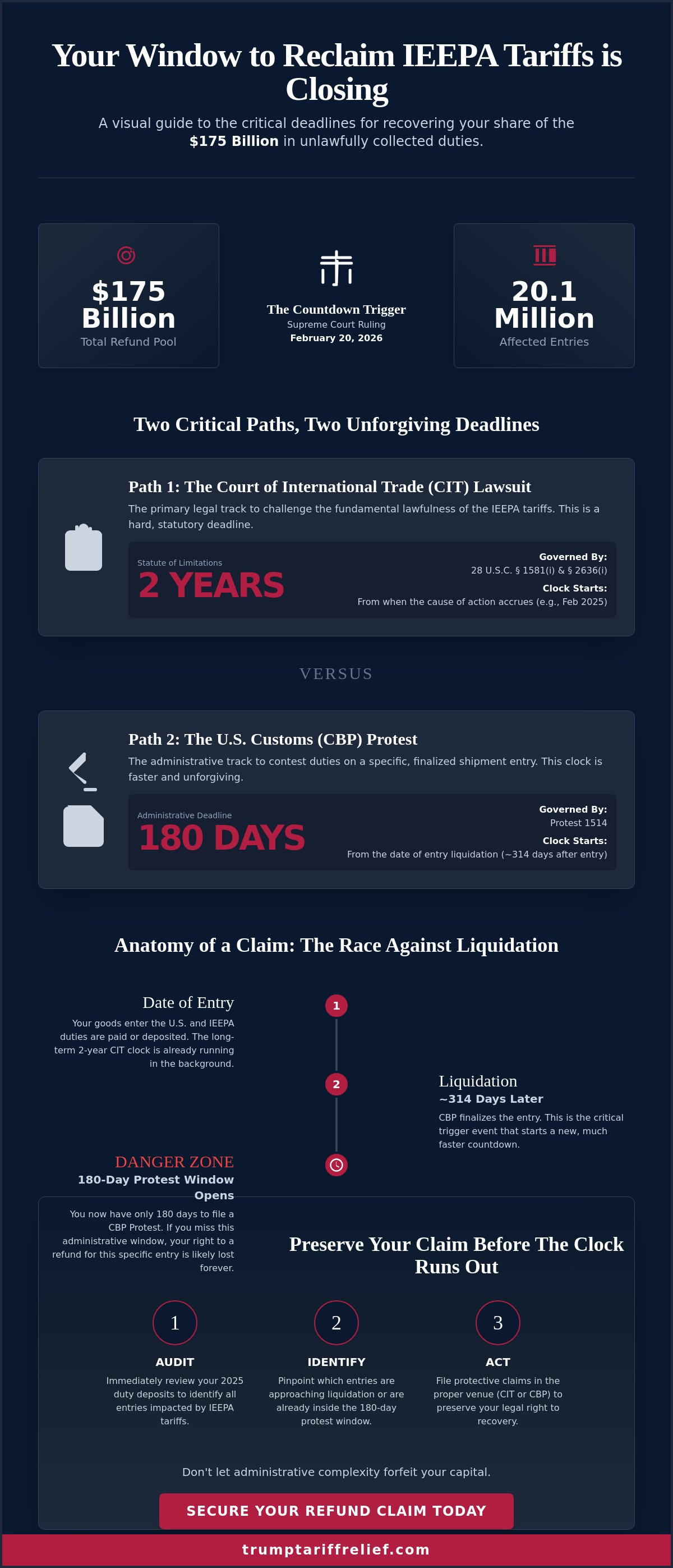
In the world of customs law, the tariff refund statute of limitations serves as a definitive expiration date for your right to recover capital. It isn't a suggestion; it's a hard wall. If you cross it without filing the necessary paperwork, your overpaid duties belong to the U.S. Treasury forever. The February 20, 2026, Supreme Court ruling that invalidated IEEPA tariffs didn't just right a financial wrong. It triggered a high-stakes countdown for every importer who paid into the estimated $175 billion collected under these unlawful programs.
You must distinguish between statutory and regulatory deadlines to protect your bottom line. A statutory deadline, such as the two-year window to file a lawsuit under 28 U.S.C. § 2636(i), is set by federal law and is notoriously difficult to bypass. Conversely, a regulatory deadline, like the 180-day window to protest a liquidated entry with U.S. Customs and Border Protection (CBP), is an administrative requirement that governs how you interact with the agency. Both are lethal to your claim if ignored. Waiting for a government notice is a high-risk strategy that often leads to forfeiture. While CBP initiated a limited refund phase on April 20, 2026, this only covered a fraction of the 20.1 million affected entries. If you aren't proactive, you're leaving your recovery to chance.
The Legal Basis for Recovery
The International Emergency Economic Powers Act (IEEPA) was never intended to function as a blank check for indefinite trade taxes. When the Supreme Court ruled the "Fentanyl Tariffs" and "Liberation Day" duties unlawful, it established a "right of action" for importers. This legal standing allows you to demand the return of your deposits through the U.S. Court of International Trade (CIT). For a deeper dive into these mechanics, you can see how IEEPA explained functions within the broader framework of your recovery rights.
Why Time is Your Biggest Adversary
Don't assume "tolling" will save your claim. While some legal clocks pause during active litigation, trade law is rarely that forgiving. The government frequently uses expired deadlines as its primary defense to retain overpaid duties. Whether your shipments were caught in the 2025 China levies or reciprocal tariffs on Canada and Mexico, the clock is ticking from the moment your entries liquidate. If you don't file a protective claim, the government's silence is effectively a permanent "no."
The Two Critical Deadlines: CIT Filings vs. CBP Protests
Securing your refund isn't a matter of filing a single form and waiting for a check. You're navigating two distinct legal tracks, each with its own tariff refund statute of limitations that can independently bar your recovery. The first track involves the U.S. Court of International Trade (CIT); the second involves administrative protests with U.S. Customs and Border Protection (CBP). If you fail to address both, you risk leaving a significant portion of your $175 billion share on the table. Most importers must pursue both paths because CBP’s internal refund process, which began on April 20, 2026, is restricted to unliquidated entries and those within a narrow 80-day window of liquidation.
Determining which deadline applies depends entirely on the current status of your entries. If your goods entered the country during the "Fentanyl Tariff" surge of early 2025, they may have already liquidated, meaning the clock is ticking on your right to protest. Conversely, if your entries are still open, your strategy shifts toward the CIT to preserve your long-term rights. You can see how it works to get a clearer picture of which track fits your specific documentation.
Section 1581(i) and the Two-Year Clock
The primary vehicle for challenging the IEEPA tariffs is a lawsuit filed under 28 U.S.C. § 1581(i). This path is governed by a two-year statute of limitations that typically begins when the cause of action accrues. For many, this date is tied to the original implementation of the tariffs in February 2025. If you wait until 2027 to act on these early entries, you'll find the courthouse doors locked. The 2-year CIT deadline is generally non-negotiable.
The 180-Day Protest Window
Once CBP "liquidates" an entry, a process that usually occurs 314 days after the date of entry, the administrative clock accelerates. You have exactly 180 days from that liquidation date to file a formal "Protest 1514." This is your only administrative tool to contest the duties directly with the agency. If you allow this 180-day window to expire without a challenge, the liquidation becomes final and binding. Even a favorable Supreme Court ruling won't force CBP to reopen a finalized entry if you didn't protect it in time. This creates a rolling series of deadlines for the 20.1 million affected entries, requiring constant vigilance to ensure no shipment falls through the cracks.
How Entry Type Affects Your Tariff Refund Deadline
Your path to recovery depends heavily on how your goods were classified at the border. While the tariff refund statute of limitations remains the overarching legal boundary, the specific documentation requirements and the timing of your "right to action" shift based on whether you filed formal or informal entries. High-value shipments over $2,500 follow a rigid regulatory track, while low-value e-commerce batches face a different set of administrative hurdles. Understanding these distinctions is the only way to ensure your internal audit captures every dollar of the estimated $166 billion collected by CBP.
The status of "reconciliation" entries adds another layer of complexity. If you used the reconciliation process to finalize values or classifications, your tariff refund statute of limitations may not have started ticking on the date of entry. Instead, the clock often begins when the reconciliation entry itself liquidates. This nuance can either grant you extra time or create a hidden trap if you assume all your 2025 shipments share the same deadline. For specific questions on how these classifications impact your filing, our FAQ provides deeper technical breakdowns.
The Complexity of Formal Entries
Formal entries require an exhaustive audit trail under 19 U.S.C. § 1484. To secure a refund for these shipments, you must maintain precise records for at least five years, even after the refund is processed. Large-volume importers often face the daunting task of managing thousands of line items across multiple ports. We help you aggregate these claims to meet the U.S. Court of International Trade (CIT) requirements, ensuring that high-value recovery efforts aren't derailed by missing paperwork or fragmented data.
Informal Entries and De Minimis Limits
Small-batch importers and e-commerce retailers were hit especially hard by the "Liberation Day" reciprocal tariffs. Even if your shipments fell under the Section 321 de minimis threshold of $800, they may have been subject to IEEPA duties depending on the country of origin. The refund process for these entries is often simplified, but the high frequency of shipments makes the 180-day protest window a logistical nightmare. If you're a retailer with thousands of low-value entries, you must move quickly to identify liquidated shipments before the administrative clock runs out on your ability to file a Protest 1514.
Steps to Preserve Your Claim Before the Clock Runs Out
Action is the only antidote to a closing legal window. While understanding the tariff refund statute of limitations is necessary, it won't recover a single dollar without a proactive filing strategy. Importers must move beyond passive observation and begin the technical work of securing their claims. The government is not obligated to remind you of your deadlines. In fact, every day you delay increases the risk that your entries will finalize, moving your capital out of reach forever. You need a systematic approach to identify, categorize, and protect every affected shipment before the clock runs out.
Your immediate priority is a comprehensive internal audit of all IEEPA duty deposits made during the 2025 calendar year. This isn't just about high-level totals; it's about line-item precision. You must identify every entry approaching the 180-day liquidation mark to stop the regulatory clock. If the 2-year tariff refund statute of limitations for a CIT filing is looming, you must also prepare the necessary summons to preserve your right to sue. Managing this documentation burden is often too complex for internal teams to handle alone, which is why most successful claimants engage a specialized recovery firm to lead the charge.
Auditing Your Tariff History
The first step in your recovery roadmap is pulling your ACE (Automated Commercial Environment) reports. These reports provide the raw data needed to identify specific HTS codes subject to the unlawful IEEPA duties. You'll need to filter for the "Fentanyl Tariffs" and "Liberation Day" codes to determine exactly how much you're owed. This audit serves as the foundation for your entire claim. You can learn more about the IEEPA refund claim process to ensure your data collection meets the rigorous standards required by CBP and the Court of International Trade.
Filing a Protective Protest
For entries that have already liquidated, you must file a "protective" protest within 180 days. This filing must include specific language asserting that the duties were collected under an unlawful Executive Order, citing the 2026 Supreme Court ruling. Don't be discouraged if CBP denies your initial protest; in many cases, a denied protest is a mandatory administrative step that clears the path for a lawsuit in the CIT. Managing multiple protests across different ports of entry requires meticulous organization, as a single missed deadline at one port can invalidate that portion of your recovery. If you're ready to stop the clock on your expiring entries, you can start your eligibility assessment now to ensure no capital is left behind.
Maximizing Recovery with Trump Tariff Relief
The complexity of the tariff refund statute of limitations makes recovery a logistical battlefield. While general corporate legal teams often approach these claims with hourly billing and academic caution, our approach is built for speed and results. We understand that for most businesses, the sheer volume of documentation required to challenge thousands of line items is the primary barrier to justice. We remove that barrier by acting as your high-performing partner, taking on the heavy lifting of data management and regulatory filing while you focus on your core operations. Our team monitors the rolling deadlines for your specific entries daily, ensuring that no administrative window closes on your capital.
Efficiency is our hallmark. Because we specialize exclusively in IEEPA Tariff Refund Recovery and Customs Documentation Management, we bypass the learning curve that slows down generalist firms. We've built the systems necessary to process large-scale data sets from ACE reports, allowing us to identify every eligible entry with surgical precision. This specialized focus is critical when you're fighting to reclaim a portion of the $175 billion in unlawfully collected duties before the tariff refund statute of limitations permanently bars your path.
Why Contingency Matters in Tariff Recovery
Challenging the U.S. government shouldn't require a massive upfront investment. We operate on a contingency-fee model, which means we only win when you get your capital back. This eliminates the financial risk of pursuing a claim and aligns our incentives directly with your success. Unlike traditional law firms that bill for every email and phone call, we invest our own resources into your recovery. You can see how our recovery process works in detail to understand the low-risk, high-reward nature of our partnership.
Your Next Steps
The time for analysis has passed; the time for action is now. Your first step is requesting a preliminary eligibility assessment to determine the total value of your potential refund. Our onboarding process is designed for maximum efficiency, moving from a simple data dump to a fully filed claim in the shortest possible timeframe. We handle the technical complexities of both CIT filings and CBP protests, providing you with a streamlined path to financial restoration. If you're still concerned about specific timelines or documentation requirements, check our frequently asked questions for more on deadlines and eligibility. Don't let the government keep what is rightfully yours simply because a clock ran out.
Secure Your Financial Restoration Today
The Supreme Court's historic ruling on February 20, 2026, confirmed what many importers already knew: the IEEPA tariffs were an unlawful overreach. However, winning in court is only half the battle. To reclaim your portion of the $175 billion collected, you must navigate a complex regulatory landscape before the tariff refund statute of limitations expires. Whether you're facing the 180-day CBP protest window or the two-year CIT filing deadline, the clock is your most formidable opponent. The government is counting on your inaction to keep your capital in its coffers.
You don't have to manage this documentation burden alone. Our expert team of trade and legal specialists provides national coverage for all U.S. importers, handling every technical detail of your recovery on a contingency basis. We only win when you get your money back, meaning there are no upfront costs to secure your claim. Start Your Free Tariff Eligibility Assessment Now to identify your recovery potential and stop the clock on your expiring entries. It's time to bring your capital back home where it belongs.
Frequently Asked Questions
Is it too late to claim a refund for IEEPA tariffs paid in early 2025?
No, it's not too late, but your window is narrowing significantly. The two-year tariff refund statute of limitations for filing a lawsuit at the Court of International Trade generally begins when the cause of action accrues, which for many was the initial payment in early 2025. This means you must take affirmative legal action before the second anniversary of those payments to preserve your right to recovery.
What is the exact deadline for the "Liberation Day" tariff refunds?
The deadline isn't a single date but a rolling series of targets based on your entry status. For liquidated entries, you must file a protest within 180 days of the liquidation date. For the broader judicial recovery path, the two-year CIT deadline remains the primary cutoff, typically measured from the implementation of the reciprocal tariffs in early 2025.
Can I still file a claim if I didn’t protest the entry at the time of import?
Yes, because protests are not filed at the time of import. You only file a formal protest after U.S. Customs and Border Protection liquidates the entry, which typically occurs 314 days after the goods enter the country. Once that liquidation happens, you have a 180-day window to contest the duties, regardless of whether you raised an objection when the goods first arrived.
How long does the statute of limitations last for Section 301 vs. IEEPA tariffs?
Both programs generally fall under the two-year statute of limitations for the Court of International Trade as defined by 28 U.S.C. § 2636(i). While the duration is the same, the trigger dates differ. The IEEPA recovery timeline is specifically tied to the 2025 Executive Orders and the subsequent February 20, 2026, Supreme Court ruling that invalidated them.
What happens if I miss the 180-day protest window but am within the 2-year CIT window?
Missing the 180-day protest window usually makes the liquidation final and binding at the administrative level. While you may still have a path forward through a direct CIT lawsuit under Section 1581(i), it's a more complex legal hurdle. It's always safer to file a protective protest to ensure all administrative and judicial avenues for recovery remain open.
Can the government extend the statute of limitations for tariff refunds?
It's highly unlikely that the government will grant an extension. Statutory deadlines are established by federal law and are rarely moved for the benefit of importers. Waiting for the government to voluntarily extend a deadline is a high-risk strategy that usually ends in the permanent forfeiture of your overpaid duties.
How long does it take to receive a check once the claim is filed?
The timeline varies based on the complexity of your entries and the current status of CBP systems. CBP initiated the first phase of IEEPA refunds on April 20, 2026, focusing on unliquidated entries. However, with over 20 million entries affected, the agency has stated it needs significant time to build out full refund functionality for more complex, liquidated claims.
Do I need a lawyer to file a claim before the statute of limitations expires?
While you don't strictly need a lawyer for a simple administrative protest, a specialized recovery firm is vital for managing the documentation of thousands of line items. Navigating the Court of International Trade requires specialized expertise that goes beyond general corporate legal services. We handle the heavy lifting of documentation management to ensure your filing is accurate and timely.
Ready to find out what your business may be owed?
Check My Eligibility