
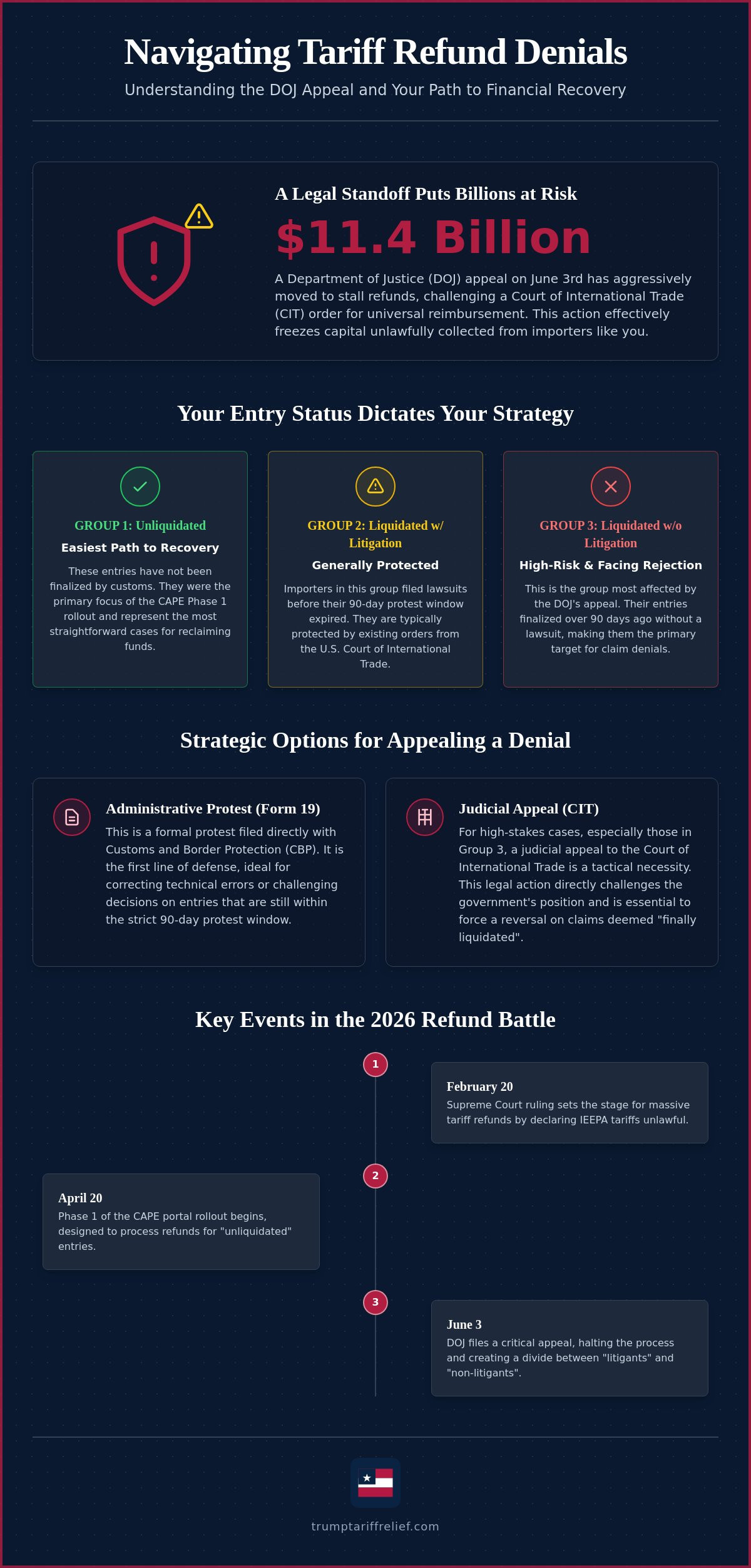
The Department of Justice's June 3 appeal is more than a legal formality; it's an aggressive move to restrict $11.4 billion in refunds to a narrow group of importers. If you've received a denial notice or find your entries stuck in the "finally liquidated" category, you're likely feeling the weight of a closing 90-day protest window. Appealing a rejected tariff claim is no longer just a clerical task. It's a high-stakes tactical necessity for any business that refuses to let their recovery rights be sidelined by government delays and bureaucratic shifts.
You've worked hard to navigate the CAPE portal's evolving requirements, and it's frustrating to see legitimate claims stalled by the latest CIT rulings. We're here to provide the clarity you need to reverse a rejection and protect your bottom line. This article explores how to identify your specific entry group status and leverage the latest legal precedents to force a successful reversal. We'll examine the Phase 3 anticipated rollout and the exact steps required to turn a denied claim into a low-risk path for financial restoration.
Key Takeaways
- Learn why the DOJ's recent appeal has stalled billions in refunds and how to determine if your specific entry status is affected.
- Master the distinction between unliquidated and finally liquidated entries to choose the most efficient path toward capital restoration.
- Discover the critical differences between filing an administrative Form 19 protest and pursuing a judicial appeal through the Court of International Trade.
- Gain a clear, step-by-step framework for appealing a rejected tariff claim before your strict protest windows expire.
- Understand how a contingency-based recovery partnership removes financial risk while navigating the complexities of the 2026 IEEPA refund battle.
Why Your Tariff Refund Claim Might Be Stalled or Rejected in 2026
A rejected tariff claim isn't always a definitive "no." In the current regulatory environment, it often manifests as a "stalled" status within the Consolidated Administration and Processing of Entries (CAPE) portal. This formal denial or administrative freeze prevents your business from reclaiming capital that the Supreme Court already ruled was unlawfully collected. To understand the stakes, one must first grasp what a tariff is in a legal context. It's a tax on imported goods; when that tax is declared illegal, the government is technically holding your property without authorization. Appealing a rejected tariff claim becomes the only mechanism to force the return of those funds.
The primary catalyst for recent rejections is the Department of Justice (DOJ) appeal filed on June 3, 2026. This legal maneuver directly challenges the Court of International Trade's (CIT) order for universal refunds. While the Supreme Court's February 20 decision set the stage for recovery, the DOJ is now fighting to limit disbursements only to those importers who filed individual lawsuits. This creates a massive divide between "litigants" and "non-litigants," leading Customs and Border Protection (CBP) to freeze or reject claims from businesses that haven't yet asserted their rights through the proper legal channels.
The Impact of the DOJ Appeal on CAPE Refunds
The DOJ appeal effectively threw a wrench into the Phase 1 rollout that began on April 20, 2026. Initially, Phase 1 was designed to handle unliquidated entries with relative ease. However, to protect the federal treasury's cash flow, CBP has begun rejecting claims for importers who are not part of the active litigation. This shift from an automatic administrative process to a "litigation-required" model means that if you aren't currently represented in a CIT action, your CAPE declaration is likely to be met with a denial or an indefinite hold. You can find more detail on the legal background in our IEEPA explained resource.
Common Triggers for IEEPA Claim Denials
Beyond the high-level legal battle, many rejections stem from technicalities that CBP uses to disqualify entries. Incorrect HTS codes or missing documentation in your initial CAPE filing provide easy grounds for a quick denial. A more complex issue involves entries that CBP deems "finally liquidated." If an entry liquidated more than 90 days before your claim and you haven't filed a protest, the government considers the "books closed." Appealing a rejected tariff claim in these instances requires a deep understanding of liquidation status and the specific impact of the unlawful IEEPA tariffs on your specific entry types. If your documentation doesn't perfectly align with the CAPE requirements, the system is designed to trigger a rejection rather than an inquiry.
The Three Categories of Liquidation: Why Your Entry Status Matters
In the world of customs law, entry liquidation is the "closing of the book" on your import. It's the moment CBP finalizes the duty calculation and locks in the financial obligation. If you're currently appealing a rejected tariff claim, your success depends entirely on which of the three liquidation categories your entries fall into. Each category dictates a different legal strategy and determines whether your path to recovery is a straightforward administrative update or a complex judicial battle.
- Group 1: Unliquidated or Not Final. These entries haven't yet reached the "final" stage. They represent the easiest path to recovery and were the primary focus of CAPE Phase 1 launched on April 20, 2026.
- Group 2: Finally Liquidated with Pending Litigation. These importers filed individual lawsuits before their 90-day protest windows expired. They are generally protected by existing orders from the U.S. Court of International Trade.
- Group 3: Finally Liquidated Without Litigation. This is the high-risk group currently facing widespread rejections. These entries liquidated more than 90 days ago without an accompanying lawsuit, and they are the primary target of the DOJ's June 3 appeal.
Understanding these distinctions is the first step in reclaiming your capital. If you're unsure where your business stands, you can request a preliminary recovery assessment to categorize your entries before the next deadline passes.
The 90-Day Rule and Final Liquidation
The 90-day window following liquidation is the point of no return for standard protests. Once this clock runs out, CBP considers the entry settled. Importers must monitor their entries via the Automated Commercial Environment (ACE) portal to track these dates with precision. Final liquidation is the moment a duty becomes legally unchangeable without court intervention. If you miss this window, appealing a rejected tariff claim requires proving that the government's collection was fundamentally unlawful under the recent Supreme Court ruling, regardless of the timeline.
Why Group 3 Importers Are Being Targeted for Rejection
The government's current strategy is to limit IEEPA refunds to those who actively sued. They argue that if you didn't file a case, you aren't entitled to the universal refund order issued by the CIT. This "litigants-only" stance is a direct attempt to save billions in federal revenue by excluding businesses in this unprotected category. Specialized advocacy is now a necessity for Group 3 importers to ensure their rights aren't bypassed in the Phase 3 rollout expected in late July 2026.
Strategic Options for Appealing a Rejected Tariff Claim
A rejection notice from CBP is a catalyst for action, not a signal to surrender. If your CAPE declaration was denied, the clock is now ticking on your window for appealing a rejected tariff claim. The most dangerous path you can take is a passive one; waiting for the government's June 3 appeal to resolve itself could result in a permanent loss of your recovery rights. You must transition from a standard administrative request to a formal legal challenge to protect your capital. Standing still while the DOJ attempts to narrow the scope of refunds is the fastest way to ensure your business never sees a dime of the $11.4 billion currently at stake for finally liquidated entries.
Your first line of defense is the administrative protest. This involves filing a Form 19 with CBP to formally dispute their decision. Unlike the initial CAPE filing, a protest is a legal document that demands a specific justification for why the denial was incorrect. You typically have a 180-day window from the date of liquidation or the date of the decision to file. For those dealing with complex entry statuses, requesting a "Suspension of Liquidation" is a vital tactic. This move essentially pauses the regulatory clock, preventing your entries from becoming final while the broader DOJ appeal proceeds through the courts. It ensures that your entries remain "active" in the eyes of the law, keeping the door open for future disbursements.
Filing a Formal Protest with CBP
Customs makes a clear distinction between a CAPE claim and a formal Protest Against Decisions of Customs Service. A claim is a request for a refund; a protest is a legal challenge to a specific agency determination. To succeed, your filing must include precise entry numbers, accurate HTS codes, and a robust legal argument based on the Supreme Court's IEEPA ruling. Precision is non-negotiable here, as any technical error can result in an immediate second denial. Learn more about IEEPA explained to ensure your justification aligns with current case law.
Joining the "Me-Too" Litigation
Many importers are now opting for judicial appeals by joining ongoing litigation at the Court of International Trade. These are often called "protective filings." By initiating your own suit or joining a consolidated action, you ensure that any future victory against the DOJ appeal applies directly to your business. This is particularly critical for Group 3 importers who were not original litigants. The Federal Circuit’s upcoming ruling on the Section 122 tariffs and the IEEPA universal refund order will dictate trade strategy for the next 12 months. Securing your place in the litigation queue now is the only way to guarantee you aren't left behind when the final disbursements are ordered. Appealing a rejected tariff claim through the courts provides a level of protection that administrative filings alone cannot match.
Step-by-Step: What to Do After a Tariff Refund Denial
Receiving a denial notice from the CAPE portal is a critical turning point in your recovery journey. You must act with immediate urgency because the administrative and judicial clocks don't stop for deliberation. Appealing a rejected tariff claim requires a methodical, aggressive response to ensure you don't forfeit your right to capital that was unlawfully collected. If you've been met with a "stalled" or "denied" status, follow this structured path to protect your interests.
- Step 1: Identify the exact reason for the rejection. Closely examine the CBP notice or the CAPE status code. Is the denial based on a technical mismatch, or is it a legal hold related to the June 3 DOJ appeal?
- Step 2: Segregate your entries by liquidation date. Organize your data to prioritize the oldest entries first. The 180-day protest window is unforgiving, and missing it on your oldest entries can lead to a permanent loss of recovery rights.
- Step 3: Consult a specialist to determine your filing path. Based on your liquidation category, you need to decide if a standard Form 19 Protest or a formal CIT judicial filing is the most effective way to force a reversal.
- Step 4: Audit your documentation for accuracy. Rejections are often triggered by minor discrepancies. A comprehensive review of your original filing is necessary to prevent a second, more permanent denial.
If the government has flagged your claim for rejection, it's often a tactical move to test your resolve. You can secure a preliminary recovery assessment today to stop the clock on your expiring appeal rights and begin the formal reversal process.
Auditing Your Documentation
Precision is your greatest asset when challenging a denial. Cross-reference every entry number and HTS code with the Required documents for IEEPA tariff refund to ensure compliance. You must confirm that your Importer of Record (IOR) information is current and matches CBP’s internal records exactly. Additionally, verify that the specific Section 301 list, specifically List 3 or List 4a, is correctly identified for every line item in your appeal package.
Calculating the Stakes
Before committing resources to an appeal, you must determine the total value of the capital at risk. Even a "small" rejection involving a handful of entries could represent six or seven figures of recoverable capital. You can see the impact of our specialized advocacy by reviewing how our process works. We focus on maximizing these recoveries while minimizing the administrative burden on your internal teams.
Partnering for Recovery: How We Manage the Appeal Process
Standard customs brokers are built for compliance, not confrontation. The current climate of 2026 tariff law demands a partner who understands the nuances of the CAPE portal and the aggressive stance of the DOJ. Appealing a rejected tariff claim is a high-stakes endeavor that requires more than just filling out forms; it requires a tactical understanding of how to force the government’s hand. We position ourselves as your bold advocate, navigating the bureaucracy to ensure your business isn't a casualty of the ongoing legal battle. Our team takes on the risk and the complexity, transforming a denied claim into a successful financial restoration through a forensic documentation audit and aggressive government filings.
Urgency is the defining factor of this recovery cycle. The window for reclamation is finite, and the government is counting on importers to become overwhelmed by the procedural hurdles. Waiting for the DOJ appeal to settle is a strategic error; by the time the final rulings are handed down, many administrative protest windows will have long since closed. If you wait for the "perfect" moment, you'll likely find the door to recovery has been bolted shut. Our proactive model ensures that your entries are protected by protective filings and me-too litigation status now, giving you the best possible standing when the final disbursements are ordered.
The Advantage of Contingency-Based Advocacy
Most trade attorneys demand high upfront retainers and hourly fees, creating a significant financial barrier for mid-sized importers already struggling with the impact of unlawful tariffs. We've removed this obstacle by utilizing a contingency-based model where we only win when you recover your capital. This aligns our interests perfectly with yours. If we don't successfully reverse your denial, you don't owe us a fee. This high-reward, low-risk partnership is the most effective way to navigate the current legal chaos. Learn more about Why Contingency Fees Work for Tariff Recovery and how they protect your bottom line during the appealing a rejected tariff claim process.
Secure Your Preliminary Assessment Today
The path to restoration begins with a simple, low-friction eligibility check. Our experts quickly identify which of your rejected entries fall into the recoverable categories and which require immediate judicial intervention. We handle the technical audit, the legal justification, and the persistent follow-up required in the CAPE system. Don't let your recovery rights expire due to government-induced uncertainty or administrative delays. Request your free Tariff Eligibility Assessment today to see exactly how much capital we can reclaim for your business before the next 2026 deadline passes.
Secure Your Capital Before the Window Closes
The 2026 IEEPA refund battle has reached a critical juncture where passivity is the greatest risk to your bottom line. With the DOJ appeal threatening $11.4 billion in potential refunds for finally liquidated entries, the distinction between active litigants and passive observers has never been more vital. You've identified how your liquidation status dictates your recovery path and why a formal protest is your first line of defense against bureaucratic delays. Appealing a rejected tariff claim is a tactical necessity that requires expert documentation and a bold legal strategy to overcome the government's attempts to restrict your capital.
We provide the specialized expertise needed to manage complex CIT and IEEPA filings without the burden of upfront consulting fees or hidden costs. Our contingency-based model ensures that you pay $0 unless we recover your money. We take on the heavy lifting of the documentation audit and the final government filing to ensure your business stays ahead of expiring deadlines. Start Your Risk-Free Recovery Assessment today. You don't have to navigate this bureaucracy alone; we're ready to fight for the financial restoration your company deserves.
Frequently Asked Questions
Is it too late to appeal a rejected tariff claim from 2024 or 2025?
No, it's not too late, but your eligibility depends heavily on your specific liquidation status. The Supreme Court's February 20, 2026, ruling created a new path for recovery, but you generally only have 180 days from the date of a CBP decision or liquidation to file a protest. If your entries are finally liquidated, you must act quickly to ensure your claim isn't barred by the statute of limitations.
What happens if the DOJ wins its appeal against the universal refund order?
If the DOJ's June 3 appeal is successful, the government will likely restrict IEEPA refunds only to importers who filed individual lawsuits at the CIT. This move would exclude thousands of businesses from the $11.4 billion pool designated for finally liquidated entries. Appealing a rejected tariff claim by joining the litigation queue now is the only way to ensure you aren't left behind if the court limits the scope of the universal injunction.
How long do I have to file a protest after my claim is rejected?
You typically have 180 days from the date of the CBP denial or the date of liquidation to file a formal Form 19 protest. However, the most critical timeline is the 90-day window following final liquidation. Missing these strict deadlines is the primary reason claims are permanently lost, so you must transition to a formal appeal as soon as you receive a "denied" status in the CAPE portal.
Can I appeal a rejection if I never filed an original lawsuit in the CIT?
Yes, you can still file an administrative protest with CBP. However, the government is currently using the lack of a lawsuit to justify rejections for many Group 3 importers. To counter this, many businesses are now filing "me-too" suits or protective filings to gain the same legal protections as the original litigants who won the Supreme Court case.
What is the difference between a CBP rejection and a "stalled" CAPE refund?
A rejection is a formal denial that starts your 180-day clock for a legal appeal. A "stalled" status typically means your entry is stuck in an administrative hold, often because it's flagged for reconciliation or belongs to the Phase 3 group of finally liquidated entries. Phase 3 processing is anticipated to begin in late July 2026, but only for those who have met specific legal requirements.
Do I need a lawyer to appeal a tariff refund denial?
While a lawyer isn't strictly required for an administrative Form 19 protest, the 2026 IEEPA battle is exceptionally complex. The DOJ's aggressive tactics and the technical requirements of the CAPE portal mean that most self-filed appeals are rejected for minor technicalities. Specialized advocacy is essential to navigate the judicial requirements of the Court of International Trade.
What documents are most critical for a successful appeal?
The most vital documents are your original CBP Form 7501 (Entry Summary) and verified proof of duty payments. You must be able to clearly identify that your goods were subject to the unlawful IEEPA Section 301 List 3 or List 4a collections. Any discrepancy in your Importer of Record (IOR) information or HTS codes will result in an immediate second denial.
How much does it cost to have Trump Tariff Relief handle my appeal?
We operate on a contingency-based model, which means there are no upfront consulting fees or hourly charges. You only pay a percentage of the capital we successfully recover for your business. If we don't win your case, you pay us nothing. Appealing a rejected tariff claim with our team is a low-risk partnership designed to reclaim your capital without adding to your administrative expenses.
Ready to find out what your business may be owed?
Check My Eligibility