
The February 2026 Supreme Court ruling didn't just invalidate an overreach of executive power; it opened a high-stakes window for importers to claw back millions in overpaid duties. Your refund isn't automatic, and the federal government won't hand back your capital without a fight. Identifying the required documents for IEEPA tariff refund claims is the first step in transforming a regulatory victory into a balance sheet recovery. If your records from 2025 are disorganized or missing, you're not just facing an administrative hurdle. You're risking a permanent loss of liquidity.
We understand that the technical complexity of the CAPE declaration and the fear of a CBP audit can feel paralyzing. It's frustrating to realize that after nearly 60% of companies saw their gross margins drop due to these tariffs, the burden of proof still rests on your shoulders. This article will help you master the documentation requirements needed to reclaim your capital and protect your business from federal scrutiny. We'll break down the 2026 importer's checklist, from CBP Form 7501 to the specific digital records required for the ACE Secure Data Portal, ensuring your filing is bulletproof and your recovery is swift.
Key Takeaways
- Recognize why documentation acts as a forensic shield against federal scrutiny; it is the ultimate defense for your capital.
- Identify the specific required documents for IEEPA tariff refund, including CBP Form 7501 and commercial invoices that verify origin and value.
- Master the evidentiary standards for payment verification by securing ACH and Periodic Monthly Statement records.
- Learn the strict deadlines for liquidated and unliquidated entries to ensure your ACE Secure Data Portal audit occurs before your eligibility window expires.
- Discover how a professional recovery partnership handles the technical burden of data aggregation to reclaim your overpaid duties.
The Critical Role of Documentation in IEEPA Tariff Recovery
The February 20, 2026, Supreme Court ruling didn't just strike down a tariff; it shifted the entire legal burden of proof onto the importer. While the court found that the executive branch overstepped its authority, U.S. Customs and Border Protection (CBP) won't issue refunds based on goodwill. You must prove every cent paid. Documentation isn't just a filing requirement. It's a forensic shield that protects your claim from federal scrutiny. If you can't produce the required documents for IEEPA tariff refund claims, your company remains a victim of an invalidated tax. This recovery window is a rare opportunity to right a financial wrong, but the government's standards for evidence are uncompromising.
Your documentation serves as the primary defense against CBP audits. In the current regulatory climate, CBP is using the refund process to vet importer compliance. If your records are disorganized, you aren't just risking your refund; you're inviting a comprehensive investigation into your entire supply chain. The relationship between the Consolidated Administration and Processing of Entries (CAPE) declaration and your physical records is absolute. The CAPE filing is the digital map, but your commercial invoices and entry summaries are the ground truth. Discrepancies between the two will lead to immediate disqualification.
Understanding the IEEPA Tariff Ruling Context
The legal shift centers on the International Emergency Economic Powers Act (IEEPA). The court ruled this act doesn't grant the president the authority to impose tariffs, effectively terminating them as of February 20, 2026. This created a retroactive right to recovery for imports between February 1, 2025, and February 20, 2026. Readiness is the only difference between a successful refund and a summary rejection. You can learn more about how IEEPA works to understand the specific legal mechanics behind this landmark decision.
The Consequences of Incomplete Documentation
Missing records lead to immediate claim denial without the possibility of appeal. Unlike standard trade disputes, these special recovery windows are governed by strict administrative rules. If your data is incomplete, you lose the capital forever. You also increase the likelihood of a comprehensive customs audit. CBP views disorganized records as a red flag for broader non-compliance, which can lead to penalties far exceeding your potential refund. Finally, you face the loss of capital due to missed entry lines. Without the required documents for IEEPA tariff refund, such as the 7501 forms and clear proof of payment, those duties stay in the government's coffers. You've already paid the price of these tariffs once. Don't pay it again through administrative negligence.
Just as administrative gaps can lead to financial loss, neglecting your physical assets can result in expensive emergency repairs. Proactive maintenance from a specialist like UEC Roofing helps safeguard your commercial properties, ensuring that the capital you reclaim isn't immediately diverted to fix preventable structural issues.
Essential Customs and Commercial Records for Your Claim
Securing your refund requires more than a formal request. It demands a meticulous reconstruction of your trade history. To successfully reclaim capital, you must present a cohesive narrative through your required documents for IEEPA tariff refund claims. This isn't just about showing you paid; it's about proving the specific legal eligibility of every line item. Your records must withstand the pressure of federal scrutiny, acting as a forensic shield for your assets.
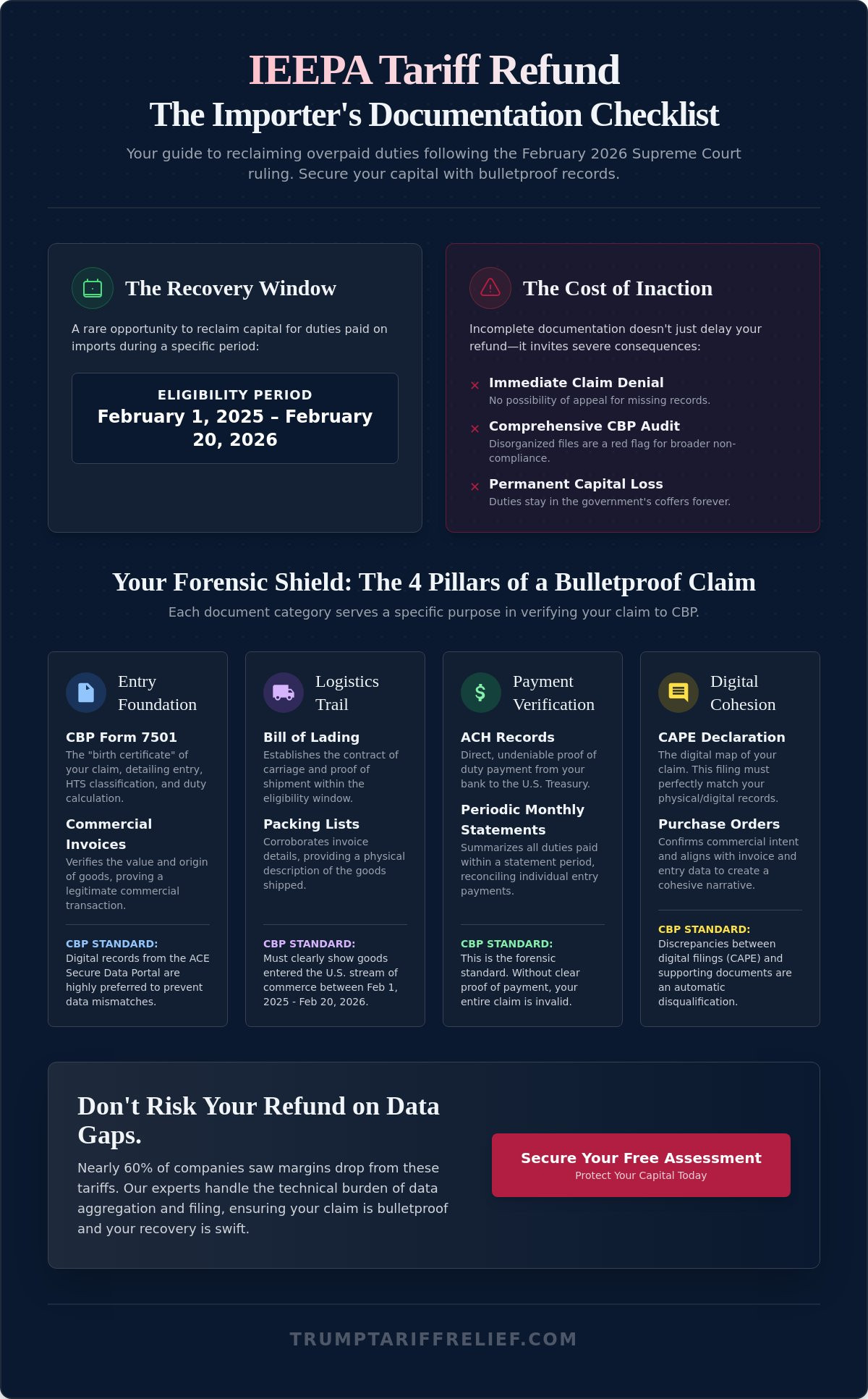
CBP Form 7501 stands as the "Birth Certificate" of your claim. It serves as the definitive record of entry, duty calculation, and HTS classification. Without this form, your claim doesn't exist in the eyes of the government. While paper records might suffice in some contexts, digital copies extracted directly from the ACE Secure Data Portal are the preferred standard. They ensure that the data you submit matches exactly what CBP has on file, reducing the risk of a mismatch that could trigger an audit. If you're unsure about your current records, you can learn how our assessment process identifies missing gaps in your required documents for IEEPA tariff refund submissions.
Commercial invoices and purchase orders provide the necessary context. They prove the value and origin of goods, ensuring that the transaction was a legitimate commercial exchange. Packing lists and Bills of Lading complete the logistics trail, verifying that the goods actually entered the U.S. during the eligible window of February 1, 2025, to February 20, 2026. This trail is vital for corroborating the intent and transaction details behind every entry.
Decoding CBP Form 7501 (Entry Summary)
Identifying List 3 and List 4A entries within your summaries is critical. Specific boxes on the 7501 contain the duty rates and HTS codes that determine eligibility. You must look for the secondary HTS codes that signify IEEPA-related duties. Relying on digital ACE records allows for faster reconciliation and ensures you're capturing every eligible entry before the 180-day protest deadline for liquidated entries or the 300-day window for unliquidated ones.
Commercial Documentation Standards
Proof of Payment: The Forensic Standard Required by CBP
An unpaid invoice is just a piece of paper in a customs audit. To satisfy federal investigators, you must move beyond showing what was billed and prove what was remitted. CBP adheres to a forensic standard that requires absolute verification of fund transfers. This is where many importers stumble. They assume a commercial invoice is sufficient, but without a clear link to a bank transaction, your claim for a refund is dead on arrival. Identifying the required documents for IEEPA tariff refund must include evidence of actual duty remittance to the U.S. Treasury.
The primary evidence for your claim involves Automated Clearinghouse (ACH) and Periodic Monthly Statement (PMS) records. These are the gold standard for verifying that duties were actually paid. For high-value individual entries, CBP may even require bank confirmation letters to bridge data gaps. Reconciling these customs payments with your corporate general ledger isn't just good practice; it's a mandatory step in compiling the required documents for IEEPA tariff refund. If the money trail is broken, the recovery is lost.
Navigating the Automated Clearinghouse (ACH) Records
Extracting payment confirmation from the ACE Secure Data Portal is the most efficient way to prove remittance. You must match specific ACH trace numbers directly to your entry numbers. This process becomes complex when payments are bundled for multiple shipments. In these cases, you need a detailed breakdown that shows exactly how much of a single large transfer was allocated to the specific IEEPA-impacted entries. If the math doesn't perfectly align with the entry summary, CBP will reject the entire line item without hesitation.
Internal Financial Reconciliation
A bulletproof claim requires cross-referencing duty payments with your audited financial statements. Federal auditors look for consistency across your trade and tax records. If you use transfer pricing, ensure your documentation supports the value declared on your entry summaries. Creating a paper trail that survives federal scrutiny means every dollar claimed must be traceable from your bank account to the government's coffers. This forensic level of detail ensures your recovery isn't just identified, but actually captured. We take on the heavy lifting of this reconciliation, ensuring your filing meets the highest evidentiary standards and protects your business from future scrutiny.
Maintaining these high evidentiary standards requires specialized expertise; the Certified Claims Professional Accreditation Council, Inc. (CCPAC) serves as a key resource for freight professionals seeking to master claims management through formal accreditation.
Avoiding the Data Gap Trap: A Readiness Checklist
The government won't wait for you to find a lost folder or a missing email. As backlogs grow following the February 2026 ruling, the speed of your recovery depends entirely on the completeness of your data. Many importers fall into the "data gap trap," assuming their customs broker has everything needed for a successful claim. In reality, brokers often purge records or provide incomplete datasets that fail to meet the forensic standards required by CBP. To secure your capital, you must take proactive control of your required documents for IEEPA tariff refund submissions.
Success requires a systematic approach to data aggregation. Follow this readiness checklist to ensure your filing is bulletproof:
- Step 1: Conduct a comprehensive data pull from the ACE portal. This is your primary source of truth. Ensure you capture all entries between February 1, 2025, and February 20, 2026.
- Step 2: Aggregate all commercial invoices for the eligible window. You must reconcile every entry summary with its corresponding invoice to prove the value and origin of the goods.
- Step 3: Verify HTS code eligibility against the IEEPA ruling. Not every product is eligible. You must cross-reference your HTS classifications with the specific lists invalidated by the Supreme Court.
- Step 4: Perform a gap analysis. Identify missing entry summaries or proof of payment early. If you find a discrepancy, you have a limited window to correct it before the 180-day protest deadline.
- Step 5: Secure secondary evidence. If primary documents are missing, gather bank statements or wire transfer confirmations immediately to bridge the evidentiary gap.
Don't leave your recovery to chance. If you're overwhelmed by the technical requirements, schedule a tariff eligibility assessment to identify your missing records before the filing window closes.
Strategy for Missing Broker Records
If your past customs broker is unresponsive or their records are incomplete, you have legal avenues to pursue. You can file a "Freedom of Information Act" (FOIA) request directly with CBP to retrieve your entry data. While this process can be slow, it provides the official government record of your transactions. In cases where the 7501 is unavailable, secondary evidence like bank statements and commercial contracts may be sufficient, provided they create an unbreakable link to the duty payment.
Digital Organization Best Practices
The CAPE declaration process is highly technical. To speed up your filing, use clear naming conventions for all files, such as "EntryNumber_Invoice_Date." All required documents for IEEPA tariff refund claims should be in OCR-searchable PDF formats. This allows CBP's automated systems to verify your data quickly, moving you to the front of the refund queue. For specific record retention questions and technical filing standards, consult the Trump Tariff Relief FAQ to ensure your digital archive meets federal requirements.
Streamlining Your Recovery with Trump Tariff Relief
The administrative weight of a federal refund claim can crush an internal logistics team already stretched thin. Sourcing, verifying, and reconciling the required documents for IEEPA tariff refund demands hundreds of man-hours and a forensic level of precision that most businesses simply can't spare. We eliminate this burden by taking full ownership of the document collection and verification process. Our experts don't just ask for files. We perform a proprietary forensic audit of your trade history to identify every eligible dollar, ensuring nothing is left on the table. By offloading this technical work, your leadership can focus on expanding your logistics network and explore Affiliate Marketing Commissions through the industry-specific guides provided by The Truckermann.
Unlike traditional consulting firms that demand upfront hourly fees regardless of your success, we operate on a "No-Risk" contingency model. This means our incentives are perfectly aligned with yours. We only get paid when you receive your refund. We take on the technical risk and the bureaucratic heavy lifting, transforming a complex legal mandate into a streamlined financial recovery. If you've been hesitant to pursue a claim due to the technical difficulty, our partnership provides the shortcut you need to secure your capital.
Why a Specialized Partner Outperforms DIY Filing
General customs brokers often miss the legal nuances of IEEPA precedents because they focus on ongoing clearance rather than retroactive recovery. We maintain a direct interface with CBP systems to accelerate processing and bypass the typical backlogs that stall individual filings. You can learn how our recovery process works step-by-step to see how we bridge the gap between disorganized records and a successful remittance.
Secure Your Capital Before the Deadline
The 2026 filing window is a fleeting opportunity. With strict 180-day and 300-day deadlines governing your entries, every day of delay increases the risk of permanent capital loss. Don't let administrative friction prevent you from righting this financial wrong. You can start your preliminary eligibility assessment today to determine the exact value of your claim. Reclaim what your business is legally owed and restore your margins before the window closes forever. We handle the required documents for IEEPA tariff refund submissions so you can focus on running your business.
Take Command of Your Financial Recovery
The 2026 Supreme Court ruling provides a historic opening to reclaim your capital, but the window for action is narrow. Success isn't about simply asking for a refund; it's about presenting an airtight forensic case to CBP. By mastering the required documents for IEEPA tariff refund claims, you move beyond administrative frustration and toward a significant restoration of your gross margins. You've already endured the financial strain of these invalidated tariffs. It's time to bring that capital back to your balance sheet.
We're here to ensure you don't navigate this bureaucracy alone. Our expert trade attorneys and forensic auditors specialize in identifying every eligible dollar while removing the technical burden from your team. We've already recovered millions for U.S. importers through our contingency-based model, which ensures there are no upfront costs for your business. We only win when you do. Don't let strict federal deadlines erase your right to recovery.
Get Your Free IEEPA Eligibility Assessment Now and take the first step toward reclaiming what you're legally owed. Your capital belongs in your business, not the government's coffers. Let's start the recovery process today.
Frequently Asked Questions
What are the most important documents for an IEEPA tariff refund?
The most critical items are CBP Form 7501, commercial invoices, and definitive proof of payment like ACH or Periodic Monthly Statement (PMS) records. These are the core required documents for IEEPA tariff refund submissions that establish the forensic link between your imports and the overpaid duties. Without these primary records, CBP will likely deny your claim during the CAPE processing phase. You must ensure every document is clear and matches the data in the ACE portal.
Can I claim a refund if I no longer have the original commercial invoices?
You can still file, but you'll need robust secondary evidence to substantiate the value and origin of your goods. While the 7501 is the "birth certificate" of the claim, the invoice provides the commercial context. If the originals are lost, you can use FOIA requests to pull data from CBP or rely on bank statements and purchase orders. We specialize in aggregating these disparate data points to build a bulletproof case for our clients.
Do I need to provide proof of payment for every single entry?
Yes, CBP demands a verified money trail for every individual entry line item. You cannot simply point to a general ledger; you must show that the specific duty amount was remitted to the U.S. Treasury. If your payments were bundled via ACH, you must provide a reconciliation report that maps the total transfer to the specific entries included in your claim. This level of forensic detail is mandatory to survive a potential customs audit.
How far back do my records need to go for the IEEPA claim?
Your documentation must specifically cover the period between February 1, 2025, and February 20, 2026. This is the precise window for imports impacted by the Supreme Court's decision on IEEPA authority. While some historical records might be useful for transfer pricing context, the refund eligibility is strictly limited to entries liquidated or unliquidated within that specific thirteen month timeframe. Don't waste time on entries outside this window.
What is a CAPE Declaration and how does it relate to my documentation?
The Consolidated Administration and Processing of Entries (CAPE) Declaration is the digital filing required to activate your refund. It serves as a master list of all eligible entries your business is claiming. While the CAPE declaration is the formal request, it must be supported by your physical required documents for IEEPA tariff refund. Think of the CAPE as the summary and your invoices and 7501s as the evidence that proves the summary is accurate.
Is a digital copy of CBP Form 7501 sufficient for the refund process?
Digital copies are not just sufficient; they're the preferred standard for the 2026 refund process. Extracting these forms directly from the ACE Secure Data Portal ensures that your submission aligns perfectly with CBP's internal records. This alignment is crucial for passing the initial verification phase without triggering a manual review. We recommend using OCR searchable PDF formats to allow for faster automated processing by customs officials during the refund queue.
What happens if my customs broker from 2025 is no longer in business?
You aren't at a dead end if your broker is gone. You have the legal right to request your own entry data directly from CBP through a Freedom of Information Act (FOIA) request. While this process can take longer than a standard broker data pull, it's a reliable way to secure the 7501 summaries needed for your claim. Our team often manages these requests to ensure importers don't lose their capital due to a broker's closure.
How long should I keep my records after receiving a tariff refund?
You must retain all documentation for at least five years from the date of entry or liquidation. However, because these refunds are subject to retroactive scrutiny, we advise keeping your records for at least seven years. This protects your business if CBP decides to conduct a post-refund audit. Storing these files in a secure, digital archive ensures you can defend your recovery long after the capital has been returned to your balance sheet.
Ready to find out what your business may be owed?
Check My Eligibility