
What if your company’s most sensitive trade data is currently the target of a $175 billion gold rush? With the Supreme Court’s February 2026 ruling declaring IEEPA tariffs unconstitutional, the race to reclaim unlawfully collected duties has attracted more than just legitimate experts; it's invited predatory actors looking for a quick payday. If you're feeling the pressure of the 80-day filing window for liquidated entries, you aren't alone. However, verifying a tariff refund company before handing over your ACE portal credentials is the only way to ensure your recovery doesn't turn into a security breach.
You've likely worked hard to maintain compliance in a volatile trade environment, and the last thing you need is more bureaucracy or a data leak. We understand that the new CAPE portal requirements and the looming statute of limitations create a high-stakes environment where mistakes are costly. This guide will provide you with the exact technical criteria needed to identify true IEEPA recovery specialists who operate on a contingency basis. You'll learn how to audit a consultant’s legal expertise and secure a no-risk path to reclaiming your capital before the 2026 deadlines expire.
Key Takeaways
- Understand how the 2026 CAPE portal launch creates a high-stakes window for reclaiming unconstitutional IEEPA duties following the Supreme Court's landmark ruling.
- Protect your sensitive trade data from predatory firms by verifying a tariff refund company doesn't demand upfront "consulting" or "administrative" fees.
- Distinguish between general customs brokerage and specialized trade law expertise to ensure your provider can navigate complex CBP protest procedures.
- Use our targeted five-question checklist to audit a firm's technical diligence and confirmed success rate with IEEPA-related recovery claims.
- Secure a no-risk path to capital restoration by prioritizing a results-only partnership that operates on a strictly contingency-based model.
The 2026 IEEPA Refund Landscape: Why Verification is Mandatory
The February 20, 2026, Supreme Court ruling fundamentally shifted the financial landscape for U.S. importers. By declaring specific tariffs unconstitutional, the Court opened a recovery pool estimated between $170 billion and $175 billion. This isn't a loophole or a government handout; it's the restoration of capital that was unlawfully seized from over 300,000 businesses. On April 20, 2026, U.S. Customs and Border Protection (CBP) responded by launching the Consolidated Administration and Processing of Entries (CAPE) portal. This system is now the primary vehicle for reclaiming these funds, but its technical complexity makes verifying a tariff refund company a non-negotiable step for any CFO or trade manager. The stakes are too high to trust an unvetted partner with your trade data.
The race to reclaim these funds is driven by a strict 80-day window for liquidated entries. If your company paid IEEPA-related duties between February 1, 2025, and February 20, 2026, the opportunity for restoration is immediate but fleeting. Because the CAPE system requires precise entry summaries and proof of payment from the ACE portal, the process demands a high level of technical diligence. A single error in a CAPE Declaration can result in a rejected claim, leaving your capital in government hands indefinitely. This high-value environment has created a surge in service providers, making it difficult to distinguish between legitimate trade law experts and opportunistic startups.
The Rise of 'Tariff Cowboys' and Recovery Scams
The scale of this $175 billion opportunity has unfortunately attracted "tariff cowboys" looking to exploit the urgency of the filing deadlines. These illegitimate firms often use high-pressure sales tactics, demanding upfront "administrative fees" or "consulting retainers" before they've even performed a basic eligibility assessment. CBP has issued specific warnings regarding phishing attempts on social media and via email, where bad actors pose as recovery specialists to steal ACE Secure Data Portal credentials. Choosing the wrong partner carries risks that extend far beyond a lost refund. Improper filings in the CAPE system can trigger comprehensive CBP audits, heavy financial penalties, and the permanent forfeiture of your right to recover duties on those specific entries.
Understanding the Legal Basis: Beyond Section 301
It's vital to distinguish these recoveries from standard Section 301 China tariffs. While many importers are used to those ongoing trade battles, the current refund window applies strictly to duties imposed under the International Emergency Economic Powers Act (IEEPA). The International Emergency Economic Powers Act (IEEPA) is a federal law that grants the President the authority to regulate international commerce during a declared national emergency. For a deeper dive into how these specific entries qualify for restoration, you can review our guide on IEEPA Explained. When you're verifying a tariff refund company, you must confirm they understand this legal distinction; misclassifying entries under the wrong trade authority will lead to immediate claim rejection within the CAPE portal.
Identifying Red Flags: How to Spot Illegitimate Tariff Recovery Firms
The sudden availability of billions in unconstitutional tariff duties has unfortunately triggered a surge in predatory behavior. When you're verifying a tariff refund company, your first line of defense is a critical eye toward their business model. Legitimate experts understand that this is a recovery of your capital, not a standard consulting project. If a firm's first request is for your credit card rather than your entry data, you're likely dealing with an entity more interested in volume than victory. Identifying these red flags early protects your trade data and your bottom line.
- Demanding upfront fees: Any request for "administrative" or "consulting" payments before a single dollar is recovered is a major warning sign.
- Lack of CBP protest expertise: If they can't explain the difference between a standard protest and a CAPE Declaration, they aren't specialists.
- Blind guarantees: No legitimate provider can guarantee a 100% recovery without first reviewing your specific CBP Form 7501 summaries.
- Unsecured data requests: Asking for full ACE portal login credentials without a formal Power of Attorney (POA) agreement is a massive security risk.
The Danger of Upfront Payments
The industry standard for high-stakes trade recovery is a strictly contingency-based model. Legitimate firms assume the risk because they have the technical confidence to win. If a provider insists on a "pay-for-effort" structure, they're shifting the financial burden onto you. Be especially wary of firms claiming they need "application fees" to submit your data to the CAPE portal. The government does not charge a fee for this submission; it's a free system. You're paying for their expertise in documentation, not for access to the portal itself. If you're unsure about a firm's fee structure, you can review our FAQ on recovery models to see how a professional partnership should look.
Vague Legal and Trade Credentials
Trade law is highly specialized. Many general corporate law firms or generic consultants are attempting to pivot into IEEPA recoveries without understanding the underlying nuances of Section 301 List 3 and List 4a. These specific lists carry different eligibility triggers that require a deep audit of your HTS codes. A legitimate specialist will employ trade counsel or licensed customs experts who manage the heavy lifting of documentation. Without this level of technical diligence, your claim is at high risk of a CBP rejection. Verifying a tariff refund company requires confirming they have a proven track record with complex customs protest procedures, not just a general understanding of business law.
The Anatomy of a Legitimate IEEPA Refund Specialist
Legitimacy in the trade recovery space isn't defined by marketing budgets or high-pressure sales teams. It's defined by technical precision and a deep understanding of the regulatory framework. When you're verifying a tariff refund company, you're looking for a partner that operates more like a surgical trade law firm than a generic administrative service. A legitimate specialist brings a "results-only" mindset to the table, assuming the entire financial risk of the recovery process. This means they only profit when you receive your refund check from U.S. Customs and Border Protection (CBP).
A foundational element of a legitimate operation is the Eligibility Assessment. This isn't a surface-level scan of your import volume. It's a rigorous audit of your CBP Form 7501 entry summaries to confirm that each entry specifically falls under the unconstitutional IEEPA mandates. If a firm is ready to file without this level of technical diligence, they're likely guessing with your data. You can see how this rigorous vetting process fits into a broader recovery strategy by reviewing how it works from a technical perspective. Proper auditing ensures that your CAPE Declaration is bulletproof before it ever reaches a CBP officer’s desk.
Why Specialization Matters for IEEPA Claims
You may wonder why your standard customs broker isn't leading this charge. While brokers are essential for the daily movement of goods, IEEPA recovery is a specialized legal protest, not a standard clerical entry. Many importers confuse this process with Duty Drawback, but the two are fundamentally different. Duty Drawback involves reclaiming duties on exported goods, whereas IEEPA recovery is a challenge to the constitutionality of the duties themselves. For a breakdown of these strategic differences, consult our IEEPA Guide. Verifying a tariff refund company requires confirming they have a deep bench of trade counsel who understand these nuances and have mastered the 2026 CAPE declaration process.
The Importance of Data Security and Confidentiality
Your commercial invoices and entry data contain your most sensitive business intelligence, including supplier names, unit pricing, and logistics patterns. A legitimate recovery firm treats this information as privileged. You should look for a Professional Services Agreement (PSA) that includes robust confidentiality clauses and clear data-handling protocols. In trade consultancy, the standard for secure document management involves encrypted transfers and restricted access. If a firm lacks a transparent policy on how they protect your commercial secrets, they don't have the professional infrastructure to handle your recovery. A seasoned expert doesn't just win your money back; they protect your competitive advantage throughout the entire process.
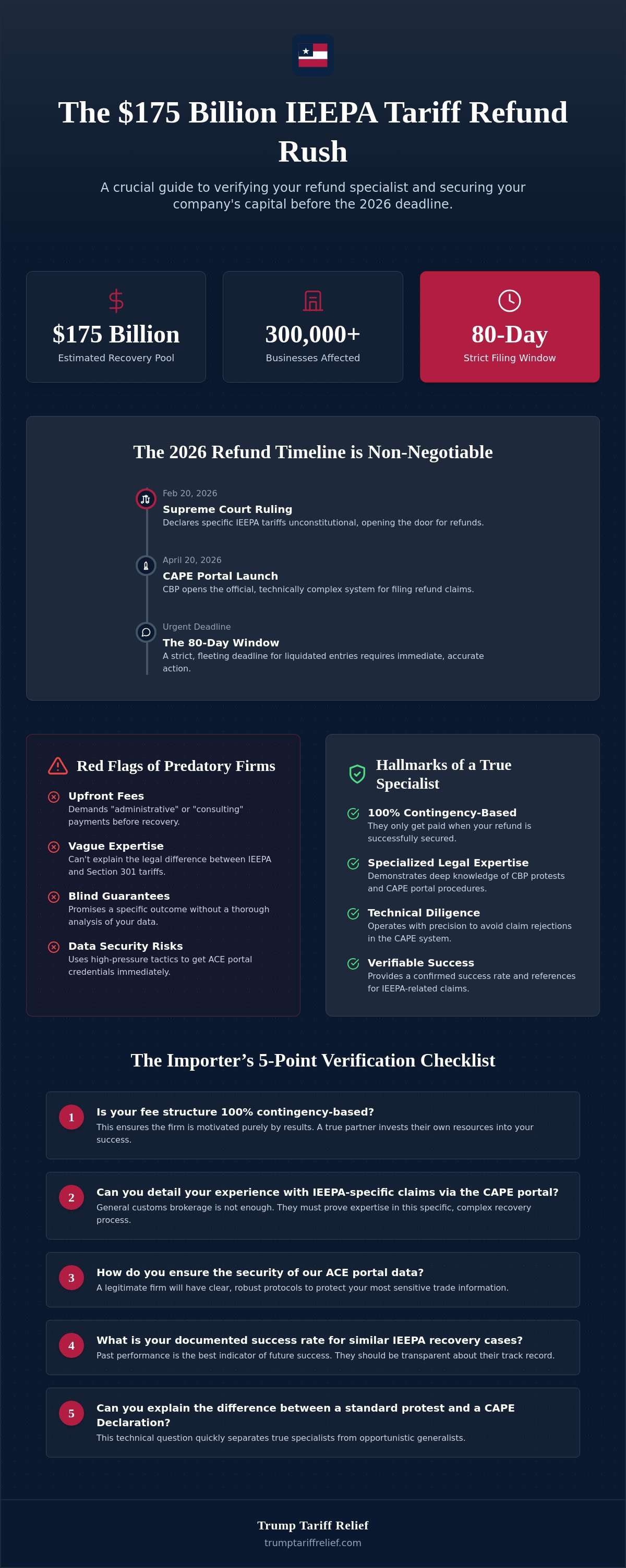
The Importer’s Verification Checklist: 5 Questions to Ask Before Signing
Before you authorize any third party to represent your business in the CAPE portal, you must subject them to a rigorous audit. Verifying a tariff refund company is a matter of protecting your corporate identity as much as it is about reclaiming capital. The technical complexity of these claims means that a "good enough" approach will often lead to immediate rejection by CBP. To ensure your recovery is handled by a high-performing partner rather than a data aggregator, you must demand clear answers to these five critical questions.
- Question 1: "What is your specific success rate or experience with IEEPA-related protests?" You aren't looking for general customs experience; you need a firm that has successfully navigated the distinction between IEEPA and Section 301.
- Question 2: "Do you charge any upfront fees, or is this strictly a contingency-based recovery?" A legitimate partner only profits when you win. Any request for a "setup fee" is a disqualifying red flag.
- Question 3: "How do you handle the technical reconciliation of entries flagged for CAPE?" They should be able to explain how they match your ACE data to specific unconstitutional HTS codes.
- Question 4: "Can you provide a preliminary eligibility assessment before we commit to a contract?" This proves they have the technical infrastructure to actually perform the work.
- Question 5: "What is your plan for meeting the statute of limitations deadlines for my specific entries?" Time is the enemy of recovery, and they must have a system for tracking your 180-day protest windows.
Evaluating the Eligibility Assessment Process
A legitimate assessment isn't a vague promise of potential value. It should be a data-driven report that identifies specific HTS codes, entry numbers, and duty amounts paid between February 1, 2025, and February 20, 2026. This level of precision is mandatory because a "one-size-fits-all" approach will fail the CAPE portal’s validation checks. For a detailed breakdown of what a professional audit looks like, you can consult this Tariff Refund Assessment guide. If a firm cannot provide this preliminary transparency, they're likely unprepared for the technical rigors of the 2026 landscape.
Understanding the Statute of Limitations
The urgency of the 2026 window cannot be overstated. While the CAPE portal is active, your individual right to protest specific entries is governed by strict 180-day windows from the date of liquidation. Waiting even a few weeks can result in the permanent expiration of your claim. A verified firm will actively track these Tariff Refund Deadlines to ensure no capital is left on the table due to administrative delays. If you're ready to secure your place in the recovery queue, it's time to start your eligibility assessment today and lock in your filing window before the statute of limitations expires.
The Trump Tariff Relief Standard: A Results-Only Partnership
In a landscape crowded with opportunistic service providers, the Trump Tariff Relief team stands apart by strictly adhering to a contingency-only model. Verifying a tariff refund company is simplified when the provider assumes 100% of the financial risk. We don't believe in billing for effort; we only bill for results. This means your business pays nothing unless we successfully secure your IEEPA refund from CBP. By aligning our success directly with yours, we provide the ultimate proof of legitimacy and commitment to your capital restoration.
Our team consists of seasoned legal and trade experts who specialize in the technical nuances of the International Emergency Economic Powers Act. We bridge the critical gap between complex federal litigation and your company’s bottom line. While others might offer vague advice, we manage the heavy lifting. This includes the exhaustive audit of your entry summaries, the preparation of technical reconciliations, and the direct filing of CAPE Declarations. We act as your assertive advocate, handling all government follow-up and documentation management so your internal team can stay focused on core operations.
How Our Process Ensures Legitimacy and Security
Transparency is the cornerstone of our recovery engine. Throughout the CAPE declaration process, we provide step-by-step communication that keeps you informed without burying you in bureaucracy. You'll always know the status of your unliquidated entries and where you stand in the filing queue. To see the specific milestones we navigate on your behalf, you can review our operational roadmap at How It Works. Our focus is on national recovery for American manufacturers, retailers, and tech firms who've been disproportionately impacted by these unconstitutional duties. We've built our infrastructure to handle the high volume of data required for the 2026 portal launch while maintaining the highest standards of commercial confidentiality.
Take the First Step: Your No-Risk Preliminary Assessment
The window for IEEPA claims in 2026 is closing fast. Every day you wait is a day closer to the expiration of your 180-day protest windows. Verifying a tariff refund company shouldn't be a hurdle; it should be the start of a protective partnership. We invite you to validate your potential refund amount with our experts through a comprehensive eligibility assessment. This process is designed to be low-friction and high-impact, providing you with a clear view of the capital available for reclamation without any upfront commitment. Don't let your unconstitutionally collected duties become a permanent loss for your business.
The time to act is now. Secure your recovery path and ensure your documentation meets the rigorous standards of the 2026 CAPE system. Get Your Free Tariff Eligibility Assessment today and let our specialists begin the work of righting this financial wrong for your company.
Reclaim Your Capital with Technical Confidence
The opportunity to reclaim unconstitutionally collected duties represents a significant moment for your business to restore its financial health. As we've explored, the difference between a successful recovery and a costly security breach lies in your vetting process. By prioritizing firms that offer a contingency-only fee structure and specialized IEEPA legal expertise, you ensure that your trade data remains protected while your claim moves through the CAPE system. Verifying a tariff refund company isn't just an administrative chore; it's a strategic necessity to shield your bottom line from predatory actors and filing errors.
Our team is ready to manage the heavy lifting of comprehensive documentation management so you don't have to navigate federal bureaucracy alone. We bridge the gap between complex trade law and your company's liquid capital. Don't let your recovery right expire due to administrative delays or the looming 2026 statute of limitations. Take the final step toward financial restoration today.
Secure your IEEPA refund with a verified expert assessment and reclaim what is rightfully yours. You've already paid the price of unconstitutional tariffs; now it's time to bring that capital home.
Frequently Asked Questions
Is the China tariff refund real or is it a scam?
The IEEPA tariff refund is a legitimate legal opportunity resulting from the Supreme Court's February 20, 2026, decision. This landmark ruling invalidated specific duties collected under the International Emergency Economic Powers Act. It's not a generic "China tariff" refund, but a targeted recovery for duties paid between February 1, 2025, and February 20, 2026.
How do I verify if a tariff refund company is authorized by CBP?
CBP doesn't maintain a list of "authorized" private consultants, so verifying a tariff refund company requires checking their technical infrastructure. Legitimate firms must have an established ACE Secure Data Portal account and submit claims through the CAPE portal launched on April 20, 2026. Always confirm the firm uses a formal Power of Attorney to act on your behalf rather than asking for your passwords.
What documents should I never share with a tariff recovery company?
You should never share your primary ACE portal login credentials or passwords with any third party. Legitimate recovery specialists will request a Power of Attorney to file a CAPE Declaration or ask for specific CBP Form 7501 entry summaries. Sharing your direct login info puts your entire trade history and corporate identity at risk of a security breach.
Can my current customs broker handle the IEEPA refund claim?
While your current customs broker can technically file a CAPE Declaration, many aren't equipped to handle the legal complexities of an unconstitutional protest. IEEPA recovery is a specialized trade law action rather than a routine administrative entry. If your broker lacks a dedicated recovery team, you might miss technical nuances that lead to a claim denial.
What is a typical contingency fee for tariff refund recovery?
Most professional recovery firms operate on a results-only model where you pay nothing if a refund isn't secured. When verifying a tariff refund company, avoid any provider that demands upfront "consulting" or "administrative" fees. A contingency-based structure ensures the firm is motivated to maximize your recovery while assuming the financial risk of the filing process.
How long does it take to receive an IEEPA refund after filing?
CBP generally expects to issue valid refunds within 60 to 90 days after they accept your CAPE Declaration. This timeframe applies to straightforward entries submitted through the new portal. However, certain complex cases involving unliquidated entries or detailed audits may take longer to process depending on the agency's current backlog.
What happens if my tariff refund claim is denied?
If your claim is denied, it's often due to clerical errors or misclassified HTS codes in the initial filing. Denials can be difficult to overturn once the 180-day protest window for liquidated entries has expired. This is why technical diligence and a thorough preliminary eligibility assessment are mandatory before you submit any data to the government.
Is there a deadline to file for an IEEPA tariff refund in 2026?
Deadlines are strict and vary based on the liquidation status of your specific entries. The initial phase of the CAPE system is limited to unliquidated entries and those liquidated within approximately 80 days of the filing date. You must also respect the standard 180-day protest window to ensure your right to recover doesn't expire permanently.
Ready to find out what your business may be owed?
Check My Eligibility