
Since the Supreme Court’s landmark ruling on February 20, 2026, over $166 billion in IEEPA duties has sat in government coffers, waiting for rightful owners to reclaim it. If your business acted as the Importer of Record between February 2025 and February 2026, you are likely part of the 301,000 entities entitled to a significant recovery. However, with so much capital on the line, the market is flooded with predatory actors and confusing jargon. Finding reliable tariff refund service reviews is now the first critical step in securing what you're owed without falling victim to sophisticated phishing scams or fake "tariff dividend" schemes.
You already understand that your internal team lacks the bandwidth to manage the complex documentation requirements of the new CAPE portal and the ACE Secure Data Portal. You want your money back, but you cannot afford the administrative burden or the financial risk of high hourly legal fees. This article provides the blueprint for evaluating recovery partners, ensuring you choose a firm that offers a zero-risk contingency model. We will identify the top-rated partners for your 2026 IEEPA claims and explain how to verify legitimacy so you can focus on your core operations while experts handle the heavy lifting.
Key Takeaways
- Understand the 2026 regulatory landscape and why the Supreme Court's decision makes your business eligible for a share of the $166 billion in owed refunds.
- Use professional tariff refund service reviews to identify partners who operate on a contingency basis, ensuring you face zero upfront financial risk during the recovery process.
- Distinguish between legitimate recovery experts and predatory scammers by recognizing the red flag demands for administrative fees or upfront deposits.
- Master the evaluation criteria for IEEPA expertise, focusing on firms that demonstrate deep technical knowledge of the CAPE portal and ACE system requirements.
- Streamline your recovery by choosing a partner that manages the entire customs documentation process, allowing your internal team to remain focused on core business operations.
The Rise of IEEPA Tariff Refund Services in 2026
The landscape of international trade changed overnight on February 20, 2026. The Supreme Court's decision in Learning Resources Inc. v. Trump didn't just strike down a series of executive actions; it unlocked a $166 billion pool of overpaid duties. This massive financial reservoir has triggered an unprecedented surge in firms claiming to be recovery experts. As a result, savvy importers are now scouring tariff refund service reviews to separate legitimate advocates from opportunistic newcomers. While approximately 301,000 U.S. importers are eligible for these funds, the complexity of the filing process means that simple mistakes can lead to permanent forfeiture.
General customs brokers are often ill-equipped for this specific recovery. Most brokers focus on forward-looking compliance and day-to-day entry filing. IEEPA recovery is different. It's a retroactive legal and financial audit. Businesses are turning to specialized consultants who understand the specific nuances of these unconstitutional tariffs. These specialists don't just file paperwork. They perform deep-dive forensic audits of past entries to ensure every dollar is accounted for. Because these firms often work on a contingency basis, they provide a low-risk path to capital restoration that internal departments simply can't match.
Understanding the Supreme Court Catalyst
The core of this opportunity lies in the International Emergency Economic Powers Act (IEEPA). The Court ruled that the executive branch exceeded its statutory authority by imposing specific tariffs under this act between February 2025 and early 2026. This is fundamentally different from Section 301 or Section 232 exclusions. Those are administrative and discretionary. Because the Court declared these specific IEEPA duties unconstitutional, the government is legally obligated to return the funds. You can learn more about how this specific legal framework impacts your business by visiting our IEEPA explanation page. The Court of International Trade has since established a strict timeline for these reliquidations, making immediate action a priority.
The Role of the CAPE Portal
U.S. Customs and Border Protection (CBP) launched the Consolidated Administration and Processing of Entries (CAPE) system to manage this massive volume of claims. It's not a simple process. Legitimate recovery partners use direct integration with the ACE Secure Data Portal to cross-reference your historical entry data with CAPE requirements. Navigating CAPE requires a high degree of technical precision. If your declaration doesn't perfectly align with the government's phased rollout schedule, your refund could be delayed or denied. This technical barrier is exactly why reading tariff refund service reviews is vital. You need a partner who understands how the recovery process works and has already successfully processed Phase 1 and Phase 2 entries through this system.
5 Key Criteria for Evaluating Tariff Recovery Service Reviews
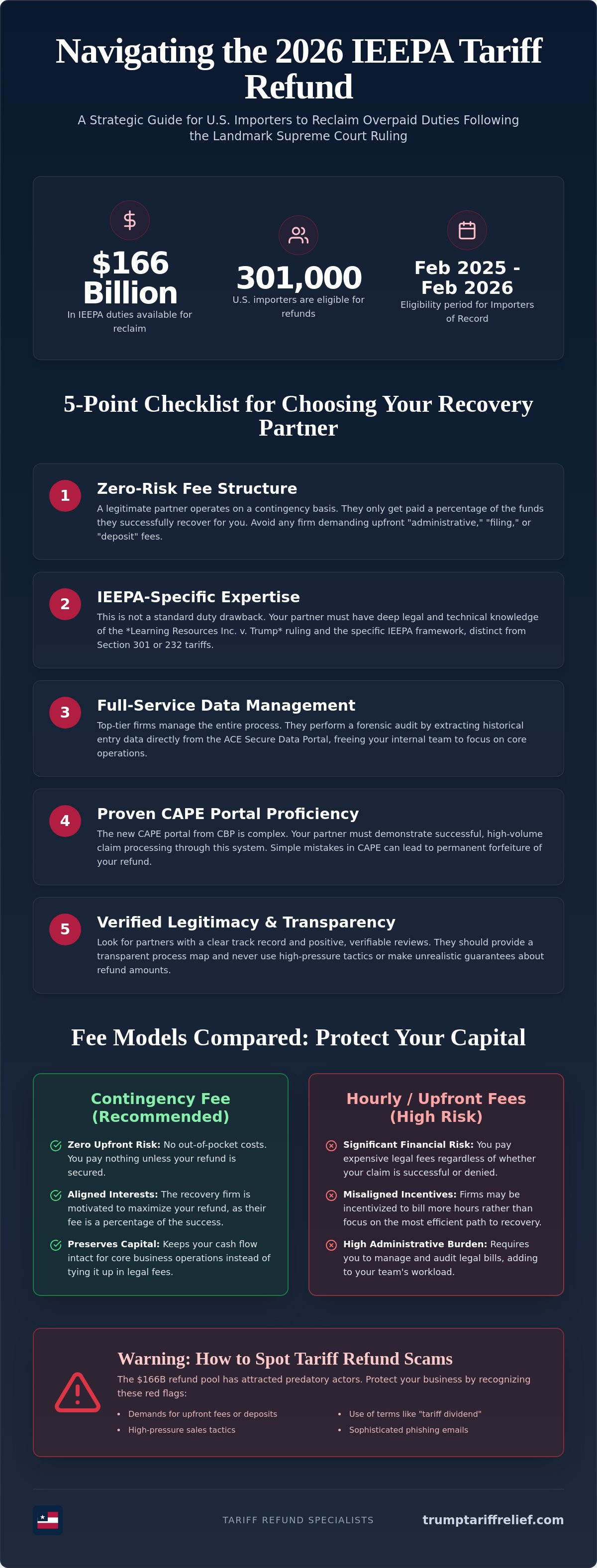
The sudden availability of $166 billion in government refunds has created a crowded marketplace. Many firms have pivoted from general consulting to claim expertise in trade law, but not all are equipped for the technical rigors of the CAPE portal. To protect your business from delays or denials, you must use a specific framework when analyzing tariff refund service reviews. Don't be swayed by glossy marketing; look for these five concrete indicators of a high-performing recovery partner.
- Contingency-Based Fee Structures: Legitimate partners only get paid when you do. Reviews should confirm that the firm takes a percentage of the actual recovery and never requests "administrative deposits" or "filing fees" upfront.
- IEEPA-Specific Technical Knowledge: Standard duty drawbacks are common, but unconstitutional IEEPA recovery is a specialized field. A legitimate partner distinguishes between IEEPA, Section 301, and Section 232 duties without hesitation.
- Full Customs Documentation Management: Your internal team shouldn't have to pull their own data. A top-tier firm handles the ACE portal data extraction and cross-references it with CAPE requirements on your behalf.
- Legal and Regulatory Oversight: The recovery process involves complex interpretations of "finally liquidated" entries and government appeals. Ensure the firm has dedicated trade attorneys or former CBP experts to navigate these hurdles.
- Sector-Specific Success Stories: A manufacturer has different entry codes and supply chain complexities than a retailer. Look for reviews from businesses within your specific industry to ensure the firm understands your unique data patterns.
Before you commit your data to an external firm, it's wise to see how a professional recovery engine operates. This transparency ensures you aren't just another number in a consultant's pipeline.
Vetting Technical Expertise
A general CPA or corporate lawyer is excellent for standard business operations, but they often lack the granular trade data knowledge required for IEEPA claims. The CAPE system is unforgiving. One incorrect entry code can disqualify a claim for thousands of dollars. You need a partner who specializes in Customs Documentation Management. This expertise ensures that your filings are accurate the first time. It's essential to learn how IEEPA works before hiring a consultant so you can ask the right technical questions during your initial interview.
Verifying Success Claims
Marketing materials often conflate "projected" refunds with "recovered" capital. When reading tariff refund service reviews, look for mentions of accepted CAPE declarations and actual checks received. A firm’s relationship with U.S. Customs and Border Protection (CBP) is also a significant factor in their efficiency. You shouldn't sign a contract based on a guess. Always demand a comprehensive Tariff Eligibility Assessment. This report should use your actual ACE data to provide a precise recovery figure, removing the guesswork from your financial planning.
Contingency Fees vs. Hourly Billing: What the Reviews Say
Choosing the right partner through tariff refund service reviews often comes down to one fundamental question: who carries the financial risk? In the high-stakes environment of IEEPA recovery, the billing model is the most significant indicator of a firm's confidence. While some traditional legal firms still utilize hourly billing, this approach often creates a conflict of interest. If a firm bills you for hundreds of hours only to have your claim rejected by U.S. Customs and Border Protection (CBP), you've essentially paid for the privilege of a financial loss. Reviews for top-rated services consistently highlight the "no upfront cost" guarantee as the gold standard for 2026.
The contingency model is designed to align the consultant’s incentives directly with your success. Under this framework, the recovery partner assumes all the administrative and legal costs associated with the CAPE portal filing. They only receive a percentage of the capital actually returned to your accounts. This eliminates the "hidden costs" often found in hourly consulting packages, which can exceed $200,000 over a multi-year case without any guarantee of a successful outcome. Because CBP does not charge fees for processing IEEPA refunds, any demand for an "administrative deposit" should be viewed as an immediate red flag.
The Financial Logic of Success-Based Recovery
For small to mid-sized importers, the contingency model is the only logical path. It transforms a complex regulatory hurdle into a pure "found money" scenario. When you evaluate tariff refund service reviews, look for mentions of "net recovery" versus "gross refund." A legitimate partner will be transparent about their sliding scale. In the current market, industry standards typically allow clients to retain between 72% and 97% of the total recovered duties. You can explore how contingency-based recovery works to ensure your financial reporting accurately reflects these performance-based gains.
Comparing the Long-Term ROI
The long-term return on investment (ROI) for contingency services is mathematically superior for most importers. Reviews for these firms frequently emphasize "peace of mind" and "low friction" because the burden of proof rests entirely on the service provider. If the government contests a "finally liquidated" entry, a contingency-based partner fights that battle using their own resources, not your billable budget. A fair market value success fee is a small price to pay for a partner that manages the entire risk profile of a $166 billion recovery landscape.
| Feature | Hourly Billing | Contingency Model |
|---|---|---|
| Financial Risk | High (Paid regardless of outcome) | Zero (No recovery, no fee) |
| Upfront Cost | Retainers and hourly rates | None |
| Incentive Structure | Billable hours and deposits | Maximum successful recovery |
| Administrative Burden | Client often manages data | Full end-to-end management |
Red Flags: How to Spot Tariff Refund Scams in 2026
The $166 billion pool of IEEPA refunds has attracted more than just legitimate importers. It has drawn a wave of sophisticated fraud targeting businesses that paid duties between February 2025 and February 2026. As you analyze tariff refund service reviews, you'll notice that the most reliable firms emphasize security and transparency. Scammers, conversely, rely on your fear of missing out on capital restoration. They use the complexity of the CAPE portal to mask their deception. Recognizing these four red flags is the only way to ensure your data and your refunds remain secure.
- Upfront Filing Fees: Never pay an "administrative deposit." U.S. Customs and Border Protection does not charge a single cent to process these refunds. If a firm asks for money before you receive your check, they are likely pocketing your cash and disappearing.
- Guarantees of 100% Recovery: Be wary of any firm that promises a specific dollar amount before performing a deep-dive audit of your ACE portal data. No legitimate partner can guarantee a result without reviewing your actual entry history.
- Lack of Verifiable Credentials: A legitimate recovery engine isn't run from a generic email address. Verify the firm's physical presence and ensure they have dedicated trade attorneys or specialized customs experts on staff.
- High-Pressure Tactics: While Phase 3 of the CAPE rollout is fast approaching, "act now or lose it all" messaging is a predatory hallmark. Reading authentic tariff refund service reviews will show you that professional urgency should never feel like a trap.
The "Official-Looking" Document Trap
Scammers frequently send phishing emails that mimic official ACE portal or CAPE system notifications. These documents look identical to government communications, often using official logos to solicit your private financial information. A legitimate service will never ask for your passwords. Instead, they will request a formal ACE portal authorization through the official government channel. This authorization allows them to perform a proper Tariff Eligibility Assessment without compromising your security. If you're unsure about a communication you've received, check our FAQ for common legitimacy questions.
Aggressive Deadline Marketing
Some firms use a "Three-Year Deadline" narrative to force quick signatures on predatory contracts. While there are real timelines, such as the 180-day liquidation period for specific entries, you shouldn't be pressured into a high-risk agreement. Understanding the real statute of limitations for IEEPA claims helps you distinguish between a seasoned advocate and a predatory marketer. If you want to avoid these traps entirely, you should partner with a firm that manages the entire recovery process with full transparency and zero upfront risk.
Why Trump Tariff Relief Leads the Industry in IEEPA Reviews
In a marketplace crowded with generalists and opportunistic newcomers, Trump Tariff Relief has secured its position as the premier authority for IEEPA recovery. Our reputation isn't built on generic consulting; it's forged through a singular, specialized focus. We only handle IEEPA and Section 301 tariff recovery. This narrow expertise allows us to master the technical nuances that general customs brokers often overlook. When you examine tariff refund service reviews, you'll see that importers value our "End-to-End" process. We take full responsibility for every stage of the claim, from the initial eligibility assessment to the final government filing.
Our commitment to a zero-risk partnership is absolute. We operate on a pure contingency basis, meaning you never pay a single cent unless we successfully recover your capital. This model removes the financial barriers to justice, allowing your business to reclaim overpaid duties without impacting your current cash flow. We take on the administrative burden by providing expert Customs Documentation Management. Our team does the heavy lifting within the ACE portal, extracting the necessary entry data and ensuring it meets the rigorous standards of the CAPE system. We don't just identify opportunities; we execute the recovery.
The Trump Tariff Relief Advantage
Navigating the CAPE portal requires more than just filling out forms. It requires a deep understanding of how the government's phased rollout impacts specific entry types. Our team of trade experts has a proven track record of preventing stuck payments for importers in the manufacturing, retail, and technology sectors. We understand the unique data patterns of these industries and how to align them with current CBP requirements. You can see how our process works to maximize your refund and ensure your claims are processed in the earliest possible phase.
Getting Started with a Free Assessment
The path to financial restoration begins with a transparent, no-obligation IEEPA eligibility review. During this initial assessment, we use your actual trade data to provide a precise calculation of your potential recovery. We believe in transparency over high-pressure tactics. If you're eligible, the steps to authorize us as your recovery partner are simple and secure. We handle the ACE portal authorization on your behalf, allowing us to begin the forensic audit immediately. Don't let your share of the $166 billion in owed duties sit in government accounts. Secure your capital and start your free tariff refund assessment today to join the hundreds of businesses who have already validated our performance through positive tariff refund service reviews.
Secure Your Capital Before the 2026 Recovery Window Closes
The opportunity to reclaim billions in unconstitutional duties represents a rare financial reset for U.S. importers. Success depends on your ability to distinguish between high-performing advocates and predatory newcomers. By prioritizing contingency-based fee structures and verifying specialized trade expertise, you ensure your business is positioned for maximum recovery without administrative strain. As you navigate the growing landscape of tariff refund service reviews, remember that legitimacy is defined by technical depth and the total removal of financial barriers.
Our team provides the specialized IEEPA trade consultants and expert CAPE portal management required to navigate this complex bureaucracy. We stand by a strict contingency commitment. You face $0 in upfront costs and only pay a success fee when your capital is returned. Don't let your rightful funds remain in government accounts while the 2026 deadlines approach. Take the first step toward financial restoration by choosing a partner that does the heavy lifting for you.
Get Your Free IEEPA Eligibility Assessment Now and secure the capital your business is owed. It's time to right this financial wrong and put your overpaid duties back to work for your company.
Frequently Asked Questions
Is the China tariff refund real or a scam?
The IEEPA tariff refund is a legitimate financial recovery opportunity resulting from the February 20, 2026, Supreme Court ruling in Learning Resources Inc. v. Trump. While the $166 billion in owed duties is real, the public nature of the ruling has led to a surge in phishing scams and fake "tariff dividend" emails. You must distinguish between legitimate recovery partners and scammers by vetting firms through tariff refund service reviews and ensuring they operate on a zero-risk contingency basis.
How much do tariff refund services typically charge?
Legitimate recovery partners typically operate on a contingency fee basis, meaning they only receive a percentage of the capital actually returned to your accounts. This model aligns the consultant's incentives with your success and eliminates upfront financial risk for the importer. You should be wary of any firm that demands "filing fees" or "administrative deposits" before a refund is secured, as U.S. Customs and Border Protection does not charge for processing these declarations.
What is the deadline for filing an IEEPA tariff refund claim in 2026?
The timeline for filing depends on the liquidation status of your entries within the phased CAPE system rollout managed by CBP. Phase 1 and Phase 2 launched in April and June 2026, with Phase 3 anticipated for late July 2026 to cover entries past the 180-day liquidation period. It's critical to initiate your Tariff Eligibility Assessment immediately to ensure your claims are filed before specific regulatory windows for unliquidated entries close permanently.
Can I file for a tariff refund through the CAPE portal myself?
You can technically file a CAPE Declaration through the ACE Secure Data Portal independently, but the technical requirements are exceptionally high. The Consolidated Administration and Processing of Entries system requires precise entry-by-entry validation against the Supreme Court's ruling parameters to avoid denial. Most businesses lack the internal Customs Documentation Management resources to navigate these multi-phased requirements without risking costly technical errors or forfeiture of their unliquidated entries.
How long does it take to receive a refund after the service files the claim?
Valid refunds are generally issued within 60 to 90 days of a CAPE Declaration being accepted by U.S. Customs and Border Protection. This timeline begins only after the technical validation of your entry data is complete and the declaration is officially accepted in the system. If your claim is part of the ongoing government appeal regarding "finally liquidated" entries, the processing window may be extended pending further judicial clarification from the Court of International Trade.
What documents will a legitimate recovery service ask for?
A legitimate service will primarily ask for your ACE Secure Data Portal authorization to perform a forensic audit of your historical imports. They will require access to specific documents such as your CBP Form 7501 Entry Summaries and proof of payment for the contested IEEPA duties. If a firm asks for your ACE password or direct access to your corporate bank accounts before a recovery is secured, treat it as an immediate red flag for fraud.
Will filing for a refund trigger a CBP audit of my other imports?
Filing for an IEEPA refund is a specific legal remedy authorized by the Supreme Court and is not a catalyst for a general customs audit. Because the refund process is managed through the standardized CAPE portal, it's treated as a routine reliquidation of entries impacted by the Learning Resources ruling. Utilizing a partner with specialized trade expertise ensures your filings are compliant, which further minimizes the risk of attracting unnecessary regulatory scrutiny to your broader operations.
What happens if the government denies my IEEPA refund claim?
If your claim is denied, a contingency-based partner will typically review the denial for technical errors and may file an appeal through the Court of International Trade if the law supports it. Under a success-based model, you owe nothing if the capital is not recovered, protecting your business from negative ROI. This is why checking tariff refund service reviews is vital; you need a partner with the legal gravitas to challenge government denials rather than a firm that abandons contested claims.
Ready to find out what your business may be owed?
Check My Eligibility