
With over $166 billion in IEEPA duties collected from 330,000 importers, the race to reclaim these funds has unfortunately attracted sophisticated bad actors. Safeguarding your business capital starts with avoiding tariff recovery scams that target your ACE portal credentials and sensitive financial data. It's vital to remember that legitimate recovery is a legal process, not a digital gift card; if a service demands an upfront fee, it's a scam. U.S. Customs and Border Protection does not charge for processing these refunds, which are currently accruing interest at a rate of 6%.
We understand the anxiety that comes with managing complex customs documentation while facing strict Phase 3 deadlines. You want to secure what's rightfully yours without exposing your company to further risk. This guide will teach you how to distinguish fraudulent phishing attempts from professional contingency-based services. We'll identify the specific red flags of B2B tariff fraud and provide a clear framework to verify the legitimacy of any recovery partner. By the end, you'll know exactly how to start a risk-free recovery process that protects your bottom line and restores your capital.
Key Takeaways
- Recognize that legitimate IEEPA refund processing through CBP never requires upfront payments, making any request for "filing fees" or "consultation retainers" an immediate red flag.
- Master the essential strategies for avoiding tariff recovery scams by identifying high-pressure tactics that exploit 2026 legal deadlines to compromise your secure ACE portal data.
- Verify the credibility of potential recovery partners by requesting a comprehensive eligibility assessment and confirming their physical corporate registration before sharing sensitive customs documentation.
- Secure your business capital by prioritizing contingency-based recovery models that align your partner's success with your financial restoration, ensuring a low-risk path to reclaiming your funds.
The Rise of Tariff Recovery Scams in 2026
The trade landscape shifted dramatically in February 2026 when the Supreme Court ruled that specific duties were unlawful. This decision unlocked a massive pool of capital, with CBP reporting between $166 billion and $170 billion in potential refunds. However, where there's significant capital, there's predatory behavior. We've seen a surge in sophisticated B2B fraud that exploits the technical nature of these recoveries. Success in avoiding tariff recovery scams requires a clear understanding of why this "perfect storm" exists right now.
The launch of the CAPE system on April 20, 2026, provided the official mechanism for recovery, but it also gave scammers a timeline to weaponize. As we approach Phase 3 in late July 2026, the pressure on importers to file for entries liquidated over 180 days ago is reaching a fever pitch. Scammers aren't just sending "lost package" texts anymore; they're deploying high-level phishing schemes designed to steal ACE Secure Data Portal credentials and corporate banking details. Distinguishing between a legitimate legal opportunity and a digital trap is the first step in protecting your business from financial exploitation.
Why Importers are High-Value Targets
Importers are currently sitting on a goldmine of uncollected interest, which is accruing at an estimated $650 million per month across the industry. Bad actors use public customs manifest data to identify exactly which businesses paid the highest duties. If your company imported goods under the affected HTS codes between February 2025 and February 2026, you're likely on a target list. These fraudsters adopt the "righting a wrong" narrative, mirroring the language of legitimate advocates to build false trust. They rely on the fact that most business owners feel a sense of financial injustice and are eager to reclaim their capital. By masquerading as recovery specialists, they gain access to sensitive documentation that can be used for identity theft or corporate espionage.
The Legal Catalyst: IEEPA Explained
The legal foundation for these refunds is the International Emergency Economic Powers Act (IEEPA). This act grants the President broad authority to regulate international commerce during national emergencies. The recent IEEPA ruling determined that certain tariffs exceeded this statutory authority, making them eligible for full refund with interest.
Legitimacy in this field is rooted in these specific court decisions, not in vague "government relief programs" or "stimulus packages." Scammers often invent official-sounding names to create a sense of federal endorsement. They exploit the narrow window of opportunity provided by the CAPE rollout phases to manufacture a sense of panic. If a firm claims you'll lose your rights tomorrow without an immediate upfront payment, they're ignoring the actual phased timeline established by CBP. Avoiding tariff recovery scams means looking past the urgency and verifying that a partner's process is grounded in these specific legal precedents rather than high-pressure sales tactics.
Identifying Red Flags of a Tariff Refund Scam
While consumer scams often rely on obvious grammatical errors, sophisticated B2B fraud is far more insidious. These actors target your business capital by mimicking the professional language of trade consultants. Successfully avoiding tariff recovery scams requires you to look past the official-looking letterhead and scrutinize the underlying business model. If a firm's primary goal seems to be securing your payment information rather than auditing your entry data, you're likely dealing with a bad actor.
A major indicator of fraud is a fundamental lack of specialized trade knowledge. Scammers often use "Trump Tariffs" as a vague catch-all term, failing to distinguish between the IEEPA ruling and the ongoing Section 301 landscape. If a representative cannot explain why Entry Types 21 and 22 were excluded from CAPE declarations effective July 7, 2026, they don't have the expertise required to manage your claim. They often apply extreme pressure for you to sign authorization forms without providing a clear explanation of the process or a transparent timeline for recovery.
The "Upfront Fee" Trap
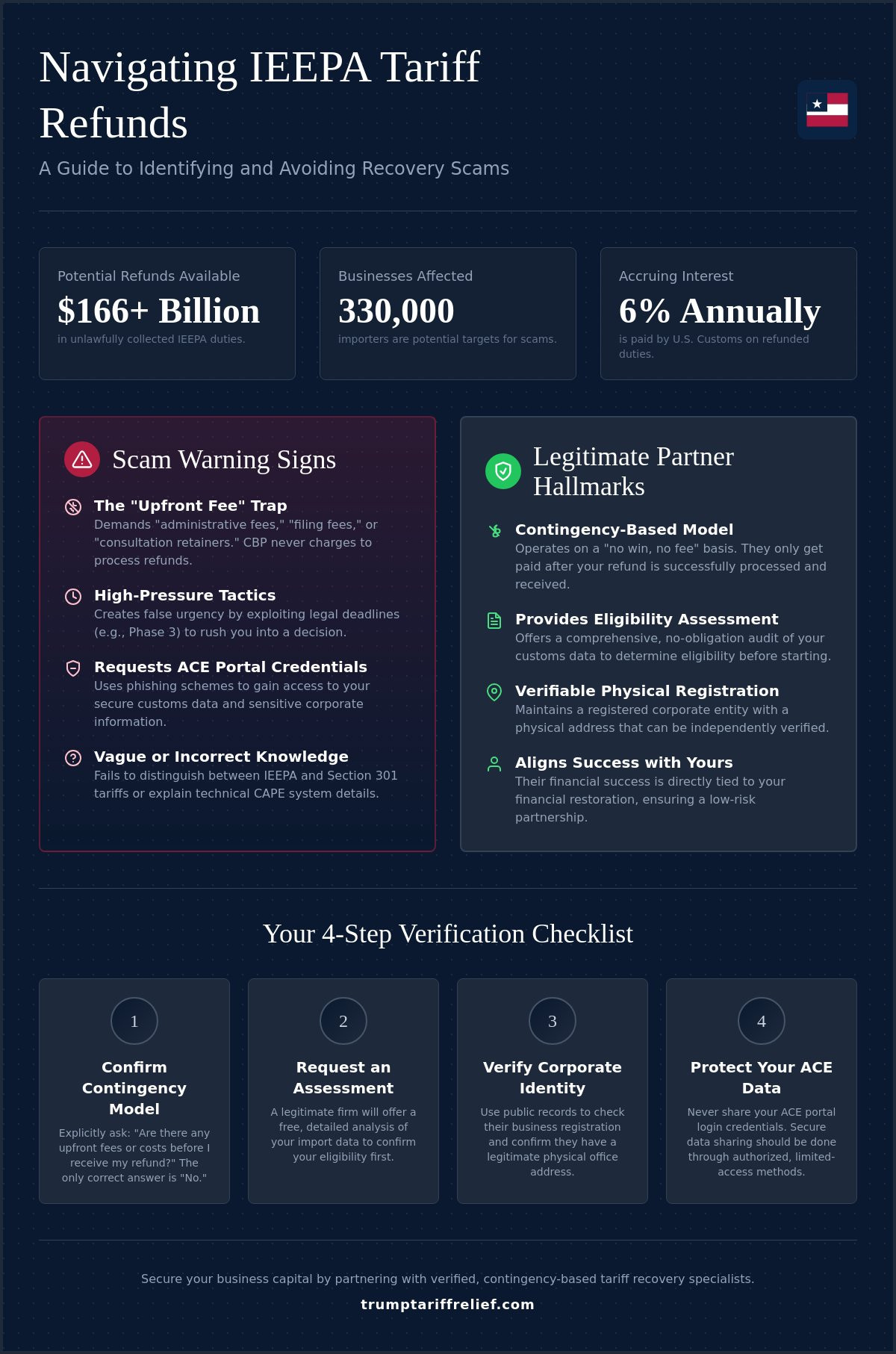
Legitimate recovery firms operate exclusively on a contingency basis. They assume the entire financial risk of the audit and filing process, only receiving payment once the refund is successfully issued to the Importer of Record. Scammers, conversely, often demand "administrative fees" or "consultation retainers" before any work begins. These fees often vanish along with the firm once the transaction is complete. Legitimate partners invest their own resources into your recovery because they're confident in the legal strength of the claim. If you're unsure about the standard fee structures in the industry, reviewing a comprehensive recovery FAQ can help clarify what to expect from a professional partner.
Phishing for Customs Data
Your import documentation is proprietary and highly sensitive. Scammers use fake CBP branding and official-sounding email addresses to trick you into sharing ACE Secure Data Portal credentials or bank account numbers. They may claim that "immediate access" is required to prevent a legal deadline from expiring. Before sharing any data, verify the digital security of the partner. A professional firm uses secure, encrypted portals and will never ask for your portal password. They'll also have a verifiable physical presence and corporate registration that matches their claims. Protecting your data is just as important as reclaiming your capital; don't let the urgency of a refund blind you to the risks of a data breach.
Professional Recovery vs. Fraudulent Schemes
The difference between a multi-million dollar financial restoration and a devastating corporate data breach lies in the service model you select. Legitimate recovery partners operate on a performance-based incentive structure, while predatory actors rely on volume-based exploitation. When avoiding tariff recovery scams, you must evaluate the depth of the audit process. A professional firm performs a granular, entry-by-entry analysis of your customs data to ensure every claim is defensible. Fraudulent schemes often skip this technical heavy lifting, instead asking for broad authorization to "file on your behalf" without providing a detailed reconciliation of your HTS codes and liquidation dates.
Transparency in the government filing process is another critical differentiator. A legitimate partner uses the ACE Secure Data Portal to file CAPE Declarations and provides you with verifiable filing receipts from U.S. Customs and Border Protection. Scammers often operate through generic call centers, using scripts designed to create panic rather than provide legal clarity. They can't explain the nuances of the government's June 2, 2026, appeal regarding finally liquidated entries because they lack the specialized trade counsel required to navigate such complex litigation. If a firm's primary asset is a high-pressure sales team rather than a staff of trade lawyers and customs experts, your capital is at risk.
The Contingency-Fee Benchmark
A "no-win, no-fee" structure is the ultimate marker of a legitimate firm. This contingency model perfectly aligns the interests of the consultant with those of your business. Because the firm only receives a success fee after the refund is issued to your bank account, they're incentivized to maximize your recovery while ensuring total compliance. This removes the financial barrier to entry, allowing you to pursue justice without risking additional capital. Understanding why contingency fees work for tariff recovery is essential for any importer looking to protect their bottom line while navigating the post-2026 trade environment.
The Verification of Legal Expertise
Tariff recovery is a legal undertaking, not a simple administrative task. It requires trade lawyers who understand the specific statutes of limitations and the phased rollout of the CAPE system. Legitimate firms possess a verifiable corporate history in the trade space and can cite the exact court orders that govern your specific entries. They don't hide behind anonymous websites or temporary PO boxes. Before signing any agreement, verify that the firm has the professional confidence to stand behind their work. A true partner takes on the administrative burden and the legal risk, positioning themselves as a powerful ally in your fight for financial restoration.
Actionable Steps to Verify a Tariff Consultant
Verifying a partner's credentials is the final barrier between your business and a potential financial disaster. Successfully avoiding tariff recovery scams requires more than just intuition; it demands a structured vetting process. You must move beyond the marketing materials and demand evidence of legal competency and corporate stability. If a firm is hesitant to provide a physical address or corporate registration details, they aren't a partner you can trust with your sensitive customs data.
The Preliminary Assessment Phase
Before signing any binding agreement, you must request a comprehensive eligibility assessment. A legitimate firm won't promise a "100% guarantee" because customs recovery is subject to complex government appeals, such as the June 2, 2026, filing regarding finally liquidated entries. Instead, they'll perform a deep audit of your required documents, including your CBP Form 7501s and commercial invoices. This phase should identify specific HTS codes eligible under the IEEPA ruling, providing you with a data-backed estimate of your potential recovery rather than a vague promise of "stimulus" funds.
Due Diligence Checklist for Importers
Professionalism is not a substitute for verification. You need a partner who functions as a specialized legal engine, not a lead generator for third-party services. Use this checklist to vet any firm before sharing your ACE portal access:
- Corporate History: Verify the firm's physical office location and business license. Scammers often operate through shell companies with no history in the trade law space.
- Technical Expertise: Ask for specific examples of HTS codes they've successfully navigated. If they can't discuss the nuances of the July 7, 2026, warehouse entry update, they lack the necessary technical depth.
- Data Security: Inquire about their encryption protocols and data retention policies. Your proprietary import documentation is a high-value target for identity theft and corporate espionage.
Once you've verified their history, scrutinize the engagement letter for any "administrative costs" or non-contingency language. Every term must be transparent and focused on the final recovery. Cross-reference their strategy with the latest China tariff refund updates to ensure their filing process aligns with current CBP regulations. If you're ready to secure your capital through a verified, legal channel, you should start your professional eligibility assessment today to ensure you meet the strict Phase 3 deadlines.
Secure Your IEEPA Refund with Trump Tariff Relief
The path to reclaiming your capital shouldn't be another source of financial risk. While you've learned the critical markers for avoiding tariff recovery scams, the next step is choosing a partner with the legal gravitas to navigate the CAPE system successfully. We operate on a strict contingency-only fee structure; we assume the entire administrative and legal burden of the audit. If we don't secure your refund from U.S. Customs and Border Protection, you don't pay a single cent. This "no-win, no-fee" model is our commitment to your bottom line, ensuring that your business is never out of pocket while pursuing the $170 billion in potentially refundable duties.
Our "we-do-the-work" narrative isn't just a slogan. It's a comprehensive service model that handles everything from the initial HTS code audit to the final government filing. We understand that trade bureaucracy is a labyrinth of shifting deadlines and technical requirements. With Phase 3 of the CAPE rollout beginning in late July 2026, the window for entries liquidated over 180 days ago is closing fast. We position ourselves as your active engine, managing the ACE Secure Data Portal and CAPE Declarations so you can focus on your core operations. We aren't just a service provider; we're a high-performing partner built to restore the capital that was unlawfully collected from your business.
Our Risk-Free Eligibility Audit
Our process begins with a granular analysis of your customs data to identify every specific refund opportunity. We don't rely on broad estimates; we scrutinize your CBP Form 7501s to ensure every claim is defensible and maximized. Throughout the recovery lifecycle, you'll receive transparent reporting that details the status of your filings and the interest accruing at the current 6% rate. This data-driven approach removes the guesswork from the recovery process. You can start your professional eligibility assessment here to see exactly where your capital is waiting.
A Partner in Financial Restoration
We're dedicated to righting the wrong for American importers who have been unfairly penalized by unlawful trade duties. Our team of trade and legal consultants possesses the specialized insider knowledge required to bypass the delays common in federal bureaucracy. This expertise is vital as we approach the final 2026 deadlines for IEEPA claims. The government's recent appeals regarding finally liquidated entries mean you need a partner who understands the current legal landscape. Don't let your rightfully earned capital vanish into the treasury. Secure your business capital and start your recovery process today before the statute of limitations expires.
Reclaim Your Capital with Professional Confidence
Distinguishing between legitimate legal restoration and predatory fraud is the final step in protecting your company's bottom line. Successfully avoiding tariff recovery scams requires a commitment to due diligence and a partner who understands the technical nuances of the CAPE system. You've learned that true recovery is built on a foundation of specialized legal expertise and a transparent, results-oriented business model. It's time to stop worrying about bad actors and start focusing on the financial justice your business deserves.
Our team of specialized IEEPA trade experts is prepared to handle the heavy lifting, from a comprehensive customs documentation audit to the final government filing. We operate exclusively on contingency-based fees; you only pay when we win. There are no upfront costs and no hidden risks to your business capital. Secure your refund before the 2026 deadlines expire and restore the liquidity your business needs to thrive. Start Your Risk-Free IEEPA Eligibility Assessment today. We're ready to help you win back what is rightfully yours.
Frequently Asked Questions
Is the China tariff refund real or a scam?
The IEEPA tariff refund is a legitimate legal process initiated by U.S. Customs and Border Protection on April 20, 2026. This follows a Supreme Court decision that ruled specific duties were unlawful. While the recovery opportunity is real, bad actors use the news as a lure to steal corporate data. You must distinguish between the official CAPE system and fraudulent phishing attempts to protect your capital.
How can I tell if a tariff recovery company is legitimate?
Legitimate firms operate exclusively on a contingency basis and possess a verifiable physical office with specialized trade legal consultants. They'll never demand upfront fees or ACE portal passwords. A real partner provides a detailed audit of your HTS codes and shares official CBP filing receipts rather than making vague promises of "government relief." Professionalism and transparency are the hallmarks of a valid recovery partner.
What is the IEEPA tariff refund deadline for 2026?
The refund process follows a phased rollout, with Phase 3 expected to begin in late July 2026. This critical phase covers entries that have been fully liquidated for at least 180 days. Because these windows are narrow and subject to strict federal timelines, immediate action is required. Missing these specific CAPE declaration windows could result in the permanent loss of your right to reclaim these funds.
Do legitimate tariff consultants charge upfront fees?
No, legitimate consultants do not charge upfront "filing fees," "administrative costs," or "consultation retainers." Professional recovery is a performance-based service where the consultant assumes the financial risk of the audit. Avoiding tariff recovery scams is much simpler when you remember that any request for payment before you receive your refund is a definitive red flag that should end the conversation immediately.
Can I file for a tariff refund on my own without a consultant?
You can technically file a CAPE Declaration through the ACE Secure Data Portal independently. However, the process requires a granular reconciliation of thousands of entries and a deep understanding of HTS eligibility under the IEEPA ruling. Most importers choose a specialized partner to manage the complex documentation. This ensures they don't miss interest-accrual opportunities or fall victim to administrative rejections that delay their capital restoration.
What documents are needed to verify my eligibility for a refund?
Eligibility verification requires your CBP Form 7501 (Entry Summary) and associated commercial invoices for goods imported between February 1, 2025, and February 23, 2026. A professional firm uses this data to perform a preliminary audit. This audit identifies which specific entries qualify for a refund plus the 6% interest currently accruing. Having these documents organized is the first step in avoiding tariff recovery scams and securing your funds.
What happens if I share my customs data with a scammer?
Sharing sensitive documentation with a bad actor exposes your business to corporate identity theft and financial fraud. Scammers use your ACE portal credentials to access proprietary manifest data or attempt to divert refund payments to fraudulent accounts. If you suspect you've shared information with an unverified party, you should immediately change your portal passwords and notify your bank and CBP to prevent unauthorized transactions.
How long does the legitimate recovery process usually take?
CBP anticipates that valid IEEPA refunds are generally issued within 60 to 90 days after a CAPE Declaration is filed and accepted. This timeline depends on the accuracy of your documentation and the current phase of the rollout. A professional partner monitors this process daily, ensuring your claim moves through the trade bureaucracy without unnecessary delays. They act as the active engine, pushing for the fastest possible restoration of your capital.
Ready to find out what your business may be owed?
Check My Eligibility