
What if the federal government is currently holding a six-figure check with your company's name on it, but it's set to expire in as little as 90 days? Following the landmark Supreme Court ruling on February 20, 2026, thousands of importers are finally discovering how to get money back from China tariffs and other trade penalties that were collected unlawfully. While trade wars have long drained your capital, the legal landscape has shifted in your favor, opening a massive window for financial restoration through the new CAPE program.
You've likely felt the frustration of watching your margins evaporate under complex regulations like IEEPA and Section 301. It's exhausting to navigate government bureaucracy while worrying about missing strict deadlines that could cost your business thousands in lost opportunities. We promise to show you how to leverage current federal programs to reclaim your funds with zero upfront risk. This guide provides a clear roadmap to confirm your eligibility, navigate the latest 2026 recovery protocols, and move your capital from government coffers back into your own growth strategy.
Key Takeaways
- Understand how the 2026 Supreme Court ruling on IEEPA overreach provides the definitive legal grounds to reclaim capital lost to unlawful trade penalties.
- Discover how to get money back from China tariffs by identifying which HTS codes and entry dates qualify for the federal CAPE refund program.
- Recognize the strict 90-day and 180-day filing windows to ensure your protest is submitted before the statute of limitations permanently bars your financial recovery.
- Learn how to execute a comprehensive duty audit and verify eligibility against Supreme Court criteria to restore capital for business reinvestment.
The 2026 Supreme Court Ruling: Why China Tariff Refunds are Now a Reality
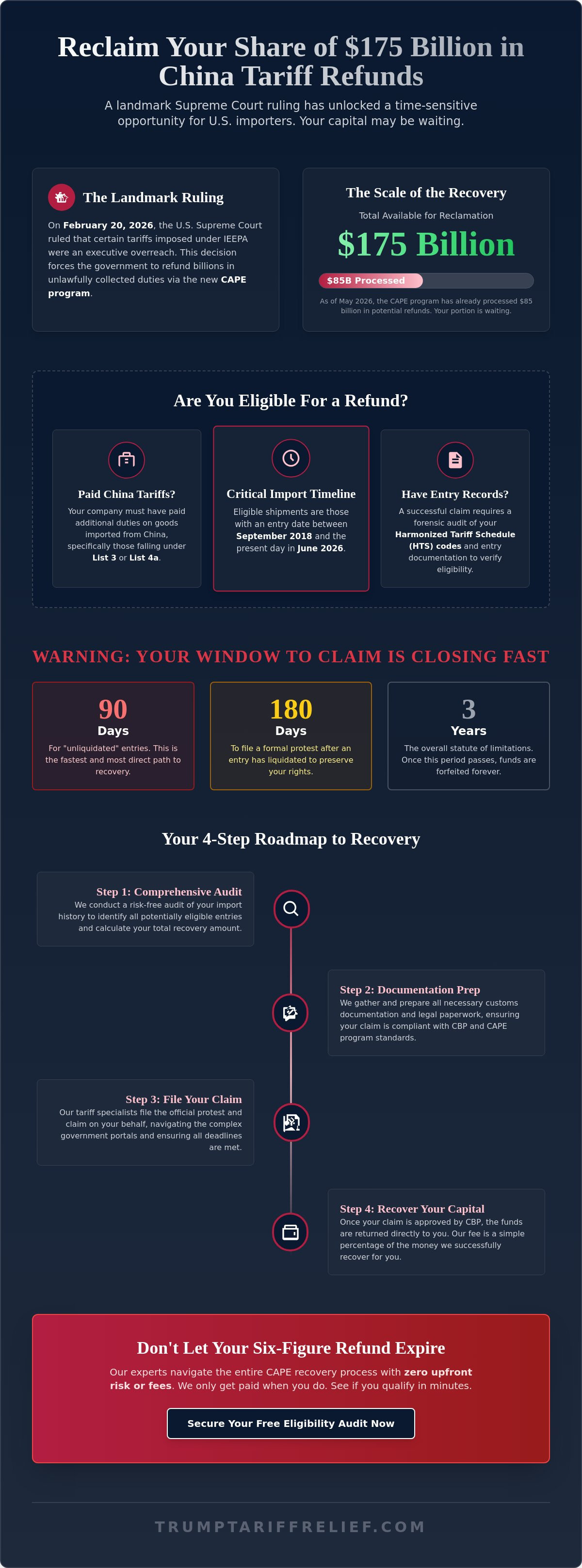
On February 20, 2026, the U.S. Supreme Court issued a decision that fundamentally changed the financial outlook for thousands of American businesses. The court ruled that certain tariffs imposed under the International Emergency Economic Powers Act (IEEPA) were a result of executive overreach. This landmark victory means that billions of dollars in duties, previously considered a sunk cost of the China-U.S. trade war, are now eligible for recovery. If your business paid duties on List 3 or List 4a goods, you're likely sitting on a significant refund opportunity.
The core of this legal battle involves the IEEPA, a federal law that grants the President authority to regulate international commerce during a declared national emergency. The Supreme Court found that the government exceeded this authority by indefinitely extending and expanding tariff lists without adhering to the required administrative procedures. This wasn't just a technicality; it was a violation of statutory limits. As a result, the government has been forced to establish the Consolidated Administration and Processing of Entries (CAPE) program to return capital to its rightful owners.
With this recovered capital, many businesses are choosing to reinvest in essential operational services; for those in the manufacturing or automotive sectors, you can check out Tired Tyres for specialized rubber and tire waste management.
Understanding the IEEPA vs. Section 301 Distinction
While most discussions focus on Section 301, the 2026 ruling specifically targets the procedural expansion under IEEPA. Specifically, List 3 and List 4a shipments are the primary focus of these recovery efforts. To understand the nuances of this legal framework, you can review our detailed IEEPA explained resource. The government is now legally mandated to refund these specific duties because the expansion lacked the necessary nexus to the original trade investigation. It's a high-stakes distinction that determines whether you're owed thousands or millions of dollars.
Is the China Tariff Refund Legit? Avoiding Scams
With billions on the line, it's natural to be skeptical. However, the CAPE program is a formal U.S. Customs and Border Protection (CBP) initiative that launched on April 20, 2026. You can verify the existence of these refund portals through official government channels. Be wary of consultants who demand massive upfront fees or guarantee success without an audit. A legitimate recovery partner operates on a contingency basis, ensuring they only win when you do. You can see our transparent process on our how it works page. This is a legal correction, not a temporary stimulus, and the window to claim your portion is closing fast.
Identifying Eligible Shipments: Which Tariffs Can You Reclaim?
Determining your eligibility for a refund requires a surgical look at your import history. While the 2018 U.S. tariff policy changes initiated a broad wave of duties, the 2026 Supreme Court ruling focuses specifically on those implemented under IEEPA authority. For most U.S. importers, this means the primary targets for recovery are shipments categorized under List 3 and List 4a. These lists encompass thousands of Harmonized Tariff Schedule (HTS) codes, ranging from consumer electronics to industrial components. If your business imported goods from China and paid these additional duties between September 2018 and the present day in June 2026, you likely have a valid claim for recovery.
The entry date of your shipment is the most critical factor in determining claim validity. Under the new CAPE program, the government prioritizes "unliquidated" entries or those that have liquidated within the last 80 to 90 days. However, even if your entries liquidated months ago, you may still preserve your rights through formal protests. Understanding how to get money back from China tariffs starts with a forensic audit of your HTS codes to ensure they match the specific lists challenged in court. This isn't a broad refund for every trade penalty; it's a targeted strike on specific, illegally collected duties that have sat on the government’s balance sheet for too long.
Qualifying Product Categories
The industries most heavily impacted by these unlawful tariffs include manufacturing, retail, and technology. If your inventory includes auto parts, household furniture, or semiconductor components, your potential recovery could be substantial. You must cross-reference your internal import logs against the federal HTS eligibility lists. Interestingly, even products that previously received "exclusions" might still be eligible for additional refunds if the original base duty was collected under the invalidated IEEPA expansion. A preliminary eligibility assessment can quickly clarify your standing.
Importers of residential health and safety products, such as those dealing in advanced water filtration systems designed to remove heavy metals and PFAS, are also seeing significant refund potential; read more about the importance of these systems in the current residential market.
The Role of Customs Documentation
Success in the recovery process depends on the precision of your data. You'll need to compile specific entry numbers, exact dates of entry, and the total dollar amount of duties paid. If your internal records are incomplete, you can often retrieve this information through your customs broker or by requesting an ACE (Automated Commercial Environment) report from CBP. Professional customs documentation management is essential because any discrepancy in entry numbers can lead to a summary rejection of your claim. Precision is your greatest ally in navigating the bureaucratic hurdles of the CAPE portal.
The 3-Year Statute of Limitations: Why Your Window is Closing
The window for recovery is not an open-ended invitation; it is a rigid legal cliff. As of June 2026, the current filing cycle has become the most critical period for importers seeking to reclaim their capital. While many believe they have ample time, the statute of limitations for filing a tariff-related lawsuit with the U.S. Court of International Trade is strictly two years from the date the cause of action first accrues. If you "sleep on your rights," you risk losing thousands in illegally collected duties that are rightfully yours. Every day counts. Every day that passes without a formal filing is a day closer to a permanent forfeiture of your business's capital.
It's vital to understand that this limitation applies to each individual shipment entry. This is not a collective deadline for your entire import history. Instead, the clock starts ticking for every specific entry number the moment it liquidates. For businesses wondering how to get money back from China tariffs, this granular timeline means that some of your claims may be expiring this week while others have months remaining. Precision in tracking these dates is the only way to ensure no capital is left on the table. You cannot afford to treat your trade data with anything less than forensic attention.
Calculating Your Filing Deadline
In the world of customs law, the "180-day rule" is the primary mechanism for preserving your rights. While the CAPE portal allows for direct refund claims within 90 days of liquidation, you must file a formal protest within 180 days to protect entries that fall outside that immediate window. Waiting for a government notification is a losing strategy; the burden of identification rests entirely on the importer. You should start your tariff refund assessment immediately to map out your specific deadlines before they expire and your rights vanish.
Prioritizing High-Value Entries
With the CAPE program already processing over $85 billion in potential refunds, administrative backlogs are beginning to impact processing times in mid-2026. To beat the clock, you must prioritize your high-value entries first. This strategic approach ensures that your largest capital outlays are secured before the inevitable "dash" for remaining funds reaches its peak. Major news outlets have already highlighted the rush of importers seeking to file before the Treasury's disbursement limits are reached. By moving quickly on your most significant shipments, you protect your most vital assets from bureaucratic delays and government exhaustion.
A Step-by-Step Roadmap to Filing a Successful Recovery Claim
Securing your refund requires a disciplined, multi-stage approach. It's not enough to know you're owed money; you must prove it through a rigorous administrative process. If you want to know how to get money back from China tariffs, you have to follow the specific roadmap established by the CAPE program. This isn't a simple form submission. It's a legal challenge to the duties you've already paid. You must be prepared to defend every line item in your import history against government scrutiny.
- Step 1: Conduct a comprehensive audit of all Section 301 duty payments. You need a complete list of every entry that included these specific trade penalties.
- Step 2: Verify eligibility against the Supreme Court IEEPA criteria. Not every China-related tariff is eligible, so you must isolate the List 3 and List 4a entries that fall under the 2026 ruling.
- Step 3: Organize and validate all customs entry documentation. This includes entry summaries, commercial invoices, and proof of duty payment to the government.
- Step 4: Draft and file the formal protest with U.S. Customs and Border Protection. This document must cite the relevant legal precedents and the CAPE program guidelines.
- Step 5: Monitor the claim status and respond to government inquiries. The Treasury requires certification before funds are disbursed, often requiring additional data.
Common Mistakes in the Filing Process
Many importers fail because of simple clerical errors. Incorrect HTS code classification is a leading cause for claim rejection. If your code doesn't match the challenged list exactly, the CAPE portal will flag it for denial. Missing the 180-day protest window for liquidated entries is another common pitfall. Once that window closes, the government's obligation to refund you effectively expires. You also need to ensure you have adequate proof of payment; a missing receipt can derail a six-figure recovery.
Self-Filing vs. Professional Recovery
Deciding between self-filing and professional recovery is a matter of efficiency and risk. Internal staff time spent on complex claims often costs more than the recovery itself, especially when trying to understand the technicalities of IEEPA explained by legal experts. Specialized trade consultants maintain a higher success rate because they understand the specific language CBP expects in a protest. You don't have to carry this burden alone. You can see exactly how it works on our process page and request a preliminary assessment to secure your place in the recovery queue.
Navigating the Recovery Process with Trump Tariff Relief
Reclaiming your capital from the federal government shouldn't be a second full-time job for your internal team. While the 2026 Supreme Court ruling opened the door to $175 billion in potential refunds, the bureaucratic machinery standing between you and your money is designed to be difficult. Trump Tariff Relief acts as your specialized advocate, cutting through the noise of IEEPA regulations and CAPE portal requirements. We don't just provide advice; we provide a high-performing engine that manages the entire recovery lifecycle on your behalf. If you're still questioning how to get money back from China tariffs, the most effective strategy is a partnership that shares your risk and maximizes your return.
Our team of trade experts brings a level of specialized legal and customs insight that general corporate counsel or standard brokers typically lack. We understand the nuances of the $20.6 billion already certified for Treasury disbursement as of May 22, 2026, and we know exactly what documentation the government requires to move your claim into that certified column. By utilizing a contingency model, we ensure that our success is directly tied to the amount of capital we restore to your business. This aligns our motivations perfectly with yours. We win only when you win.
Our Proven Contingency Framework
The "No Recovery, No Fee" promise is the cornerstone of our service. It removes the financial barrier to justice, allowing businesses of all sizes to challenge unlawful duty collections without risking additional capital. Our framework is designed for maximum efficiency and zero upfront cost. We handle the heavy lifting, including:
- Performing a comprehensive Tariff Eligibility Assessment to isolate valid IEEPA claims.
- Managing the complex Customs Documentation Management process to ensure entry numbers and HTS codes are flawless.
- Filing formal protests and navigating the CAPE portal's technical hurdles.
- Conducting all follow-up communications with U.S. Customs and Border Protection until the refund is certified.
Get Started with a Free Eligibility Assessment
The first step toward restoration is a preliminary review of your import data. You can submit your basic shipment logs securely, and our team will provide a clear confirmation of your eligibility. Within the first 30 days of our partnership, we'll have mapped out your high-value entries and initiated the filing process to beat the 90-day and 180-day deadlines. Don't let your capital sit in government accounts while the statute of limitations expires. You can claim your refund today with Trump Tariff Relief and start the process of reinvesting your own money back into your company's growth.
Secure Your Capital Before the Recovery Window Closes
The landmark 2026 Supreme Court ruling has shifted the balance of power back to American importers. You now have a definitive legal pathway to reclaim duties that were collected under executive overreach. Success depends on acting before the strict 90 day and 180 day windows close on your specific entries. Understanding how to get money back from China tariffs is only the first step; the real challenge lies in navigating the technical requirements of the CAPE portal and managing the forensic documentation needed to certify your claim for disbursement.
You don't have to face federal bureaucracy alone. Trump Tariff Relief offers a risk free partnership powered by specialized IEEPA legal expertise and end to end documentation management. Our contingency based model means you pay only when you win, ensuring our goals are perfectly aligned with your financial recovery. It's time to stop letting the government hold your working capital. Start Your Free Tariff Recovery Assessment Now and take the first step toward restoring your business's bottom line. Your capital belongs in your business, not in a government account.
Frequently Asked Questions
Is the China tariff refund real or a scam?
The refund program is a legitimate federal initiative established after the February 20, 2026 Supreme Court ruling. This decision invalidated specific IEEPA tariffs, leading U.S. Customs and Border Protection to launch the CAPE program on April 20, 2026. While you should be wary of unsolicited calls asking for upfront fees, the process itself is a court-ordered legal correction. It's a formal mechanism to return capital that was collected without proper administrative authority.
How much money can I expect to get back from the China tariffs?
What is the deadline to file for a tariff refund in 2026?
You generally have 90 days from the date of entry liquidation to submit a claim through the CAPE portal. If that window has passed, you may still file a formal protest within 180 days of liquidation to preserve your rights. Missing these rigid deadlines results in a permanent forfeiture of your capital, making immediate action essential for any business seeking how to get money back from China tariffs. The clock is ticking on every individual shipment you've made.
Do I need a lawyer to get my China tariff money back?
What documents do I need to prove I paid the tariffs?
You must provide your Entry Summaries (CBP Form 7501), commercial invoices, and definitive proof of duty payment. These documents establish the HTS codes used and the exact dollar amount collected by the government. If your internal files are incomplete, a specialized recovery partner can help you pull these records directly from the federal ACE system. Having organized, validated documentation is the only way to satisfy the Treasury's certification requirements.
How long does it take for the government to issue the refund check?
Processing times vary based on the complexity of your documentation and the current administrative backlog. As of late May 2026, the Treasury has already certified over $20 billion for disbursement. Once your claim is verified and certified by CBP, the Treasury typically issues the funds via electronic transfer or check. While the government is working to process claims quickly, the high volume of filings means that early submission is the best way to ensure a faster turnaround.
Can I get a refund if my company is no longer importing from China?
Yes, your current importing status doesn't impact your eligibility for past duty recovery. If your business paid the invalidated IEEPA tariffs between 2018 and the present day in June 2026, you're legally entitled to seek a refund. The recovery is based on historical payments, not your current supply chain or future business plans. This is about reclaiming capital that was already taken from your business, regardless of your current operations.
Once that capital is back in your hands, it can be used for anything from operational expansion to rewarding your hard-working leadership team with a luxury corporate retreat or a high-end vacation curated by The Russell Travel Team (Lightning Travel).
What happens if my original customs broker is no longer in business?
You can still recover your funds even if your former broker is unreachable or defunct. All import data is stored within the Automated Commercial Environment (ACE) portal managed by the government. A recovery expert can access these historical records on your behalf to reconstruct your filing data. This ensures you don't miss out on how to get money back from China tariffs just because your previous service provider is no longer around to assist with the paperwork.
Ready to find out what your business may be owed?
Check My Eligibility