
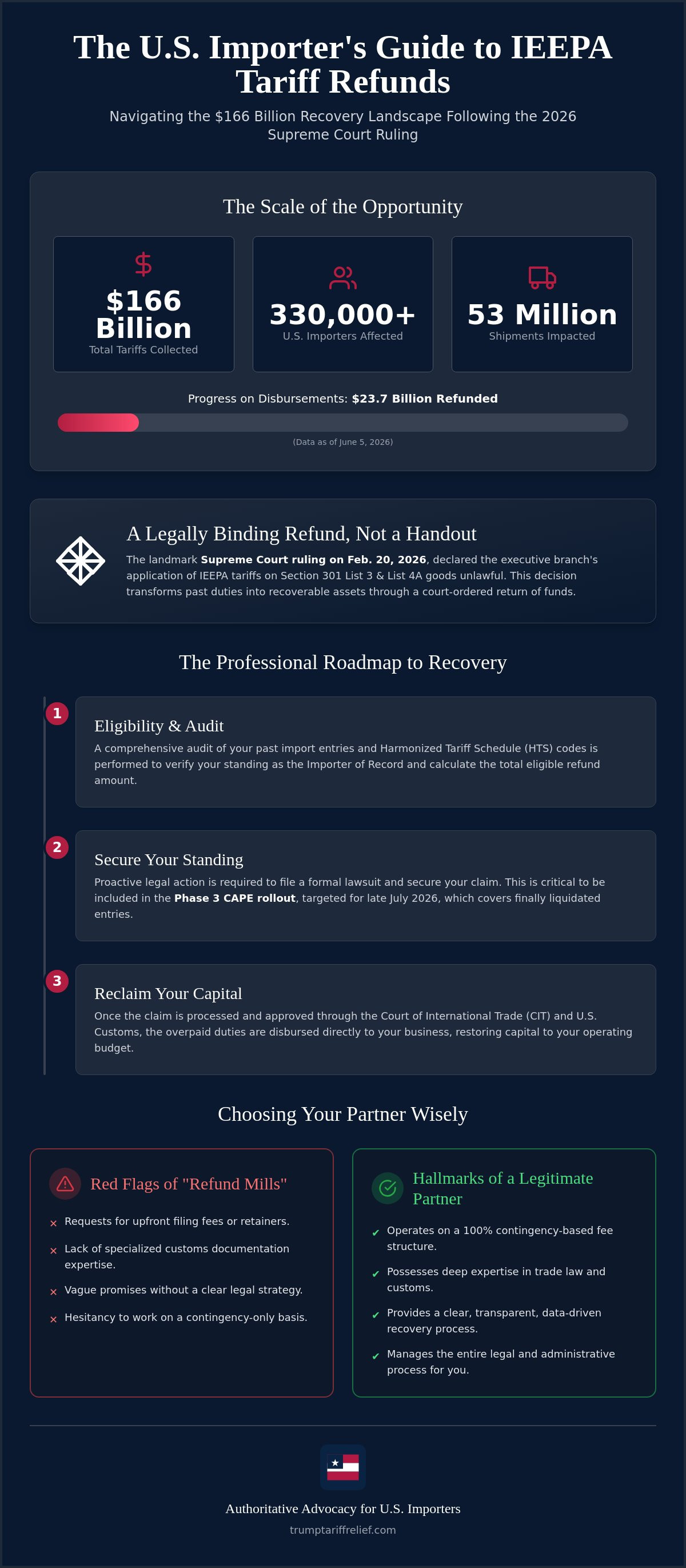
Did you know that as of June 5, 2026, U.S. Customs has already disbursed $23.7 billion in IEEPA tariff refunds? With a total of $166 billion collected from over 330,000 importers, the scale of this financial restoration is unprecedented. It's natural to feel wary of "refund mills" or unsolicited offers, especially when the Department of Justice's June 3 appeal has introduced new layers of uncertainty for those who haven't yet filed a formal lawsuit. If you're searching for legitimate tariff refund help, you aren't just looking for a service; you're looking for a professional partner to navigate a high-stakes legal landscape.
We recognize the anxiety that comes with complex Supreme Court rulings and the fear of missing the Phase 3 CAPE rollout targeted for late July 2026. This article will reveal the legal reality of IEEPA recovery and show you how to identify low-risk, contingency-based services that manage the entire filing process. You'll learn how to verify your standing as the Importer of Record and discover the streamlined path to reclaiming capital lost to Section 301 duties. It's time to move past the confusion and secure the financial justice your business deserves.
Key Takeaways
- Verify the legal standing of your claim following the landmark 2026 Supreme Court ruling that declared IEEPA tariffs on Section 301 List 3 and List 4A unlawful.
- Identify professional, legitimate tariff refund help by recognizing common red flags such as requests for upfront filing fees or a lack of specialized customs documentation expertise.
- Master the professional roadmap for recovery, starting with a comprehensive audit of your HTS codes and past import entries to ensure full eligibility.
- Secure your standing for the Phase 3 CAPE rollout in late July 2026, which covers finally liquidated entries for importers who take proactive legal action.
- Learn why a contingency-based partnership is the most effective way to reclaim lost capital while shifting the legal and administrative heavy lifting to seasoned experts.
Is the IEEPA Tariff Refund Legitimate? Fact-Checking the 2026 Recovery Landscape
A legitimate tariff refund is not a suggestion or a temporary policy; it is a court-ordered return of overpaid Section 301 duties. Following the landmark February 20, 2026, Supreme Court ruling, the legal landscape for U.S. importers changed overnight. While the prospect of reclaiming millions in lost capital often feels too good to be true, the precedent established in 2024 and finalized this year confirms that the government's collection of these duties was unlawful. Thousands of U.S. companies are now eligible for significant capital restoration, as the Court of International Trade (CIT) has ordered the return of funds collected between February 1, 2025, and February 23, 2026. The IEEPA refund is a constitutionally backed reclamation of executive overreach.
The scale of this recovery is massive, with an estimated $166 billion collected from over 330,000 importers. As of June 5, 2026, around $23.7 billion has already been paid out to businesses that took proactive steps to secure their claims. This isn't just about small administrative errors; it's about correcting a systemic misapplication of trade authority that impacted 53 million shipments. If your business paid duties on Section 301 List 3 or List 4A goods during the specified window, you're likely sitting on a significant asset that belongs back in your operating budget.
The Distinction Between Scams and Specialized Consultancies
The influx of "China tariff" news has created a chaotic market where opportunists often outnumber experts. Importers searching for legitimate tariff refund help must look past the flashy headlines to find firms that understand the intersection of trade law and customs documentation. Valid claims aren't based on generic requests; they're built on the IEEPA Explained framework, which categorizes eligibility based on specific Harmonized Tariff Schedule (HTS) codes. Specialized consultancies focus on the technical details of the litigation, ensuring that every entry passed through the ACE portal is legally sound. If a firm asks for upfront "consulting fees" without a clear path to recovery, it's a red flag that they lack the confidence to work on a contingency basis.
Why "Legitimate" Means Legally Binding
The recovery process is anchored in the International Emergency Economic Powers Act, a statute the executive branch used to justify these widespread levies. However, the CIT has determined that the government misapplied this authority, making your right to a refund legally binding. This isn't a matter of administrative grace or a government stimulus program. The CIT now monitors the Consolidated Administration and Processing of Entries (CAPE) system to ensure that U.S. Customs and Border Protection (CBP) processes these disbursements fairly. Before sharing your sensitive business data, you must confirm that your partner has the legal gravitas to navigate this federal bureaucracy. With the Department of Justice filing an appeal on June 3, 2026, having legitimate tariff refund help is more critical than ever to protect your claim against further legal challenges.
The Legal Catalyst: How the Supreme Court Validated Your Right to a Refund
Litigation surrounding Section 301 List 3 and List 4A goods didn't happen overnight. It was the culmination of years of legal friction between the trade community and federal authorities. On February 20, 2026, the highest court in the land confirmed what many trade experts already suspected. The executive branch had overstepped its bounds. This isn't a government gift; it's a mandatory correction of a regulatory error. If you're seeking legitimate tariff refund help, understanding this timeline is the first step in asserting your rights. The ruling established that the government lacked the statutory authority to expand these duties indefinitely without following proper procedural safeguards.
This legal victory transformed billions of dollars in "sunk costs" back into recoverable assets. It's a high-stakes correction of justice that rights a financial wrong for over 330,000 importers. However, this isn't an open-ended opportunity. The three-year statute of limitations creates a strict deadline for those who haven't yet joined the litigation. Every day you delay is a day closer to losing your claim forever. The window is narrow, but for those who act, the path to capital restoration is now constitutionally protected.
Understanding the IEEPA Overreach
The International Emergency Economic Powers Act (IEEPA) was never intended to be a blank check for indefinite trade wars. The Supreme Court's tariff decision highlighted how the government bypassed necessary procedural requirements when expanding duties on consumer goods and industrial components. This overreach specifically targeted List 3 and List 4A categories, which encompass everything from electronics to textiles. Because these tariffs were ruled unlawful, the clock is now ticking. You have a limited window of opportunity to file your claim before the statute of limitations expires. For many, this represents the single largest recovery opportunity in their company's history.
The Role of the US Court of International Trade
The U.S. Court of International Trade (CIT) acts as the final gatekeeper for these massive refund pools. While the Supreme Court sets the precedent, the CIT manages the practical execution of the CAPE system. Their recent decisions have transformed potential recoveries into enforceable claims by forcing U.S. Customs to automate the disbursement process. Securing legitimate tariff refund help ensures that your documentation aligns with the CIT's strict standards. This legal infrastructure ensures that importers are treated as victims of a procedural error rather than applicants for a handout. The CIT's oversight is the reason these refunds are now being processed with such urgency.
Recovery is a matter of legal standing. If your entries fall within the window of February 1, 2025, to February 23, 2026, you're part of a select group of businesses entitled to capital restoration. It's vital to act before the Phase 3 deadlines in late July 2026. You can begin by securing a preliminary eligibility assessment to see where your business stands in this evolving legal landscape.
4 Red Flags of Fraudulent Tariff Recovery Services
With billions of dollars currently being disbursed by U.S. Customs, the trade industry has seen a surge in "refund mills" looking to capitalize on importer anxiety. These opportunists often lack the legal foundation required to navigate the Court of International Trade. Identifying legitimate tariff refund help is essential to protect your business from predatory practices that could jeopardize your actual recovery. Scammers don't just waste your time; they can expose your sensitive trade data to unverified third parties. Be on the lookout for these four warning signs when evaluating a potential recovery partner.
- Requests for Upfront Fees: If a firm asks for "consulting" or "filing" fees before you receive a dime, walk away. Legitimate recovery is built on results, not administrative overhead.
- Ambiguous Expertise: Trade law is highly specialized. A firm that can't explain the nuances of HTS code eligibility or the specific impact of the 2026 Supreme Court ruling isn't an expert; they're a middleman.
- Premature Guarantees: Any service promising a specific refund amount before conducting a deep-dive audit is being dishonest. Your recovery depends on precise entry data and liquidation status.
- Manufactured Urgency: While deadlines are real, scammers often use high-pressure tactics that ignore the actual Tariff Refund Statute of Limitations. They want you to sign before you ask questions.
The Contingency Fee Benchmark
A "no-win, no-fee" model is the gold standard for professional recovery services. This contingency-based approach aligns the consultant’s interests directly with yours. If they don't successfully recover your capital, you don't owe them a cent. This structure removes the financial barrier to entry and ensures the firm is motivated to maximize your claim. Avoid any service provider that suggests hourly billing for tariff recovery audits. Hourly models often lead to bloated invoices regardless of the outcome, whereas contingency models prioritize efficiency and successful reclamation.
Verifying Corporate Legitimacy
Legitimacy isn't just a marketing claim; it's a history of trade litigation support and customs brokerage expertise. You need a partner that understands the inner workings of U.S. Customs and Border Protection (CBP). This "insider" knowledge is non-negotiable when dealing with the Consolidated Administration and Processing of Entries (CAPE) system. Furthermore, verify that the firm utilizes a secure, professional Customs Documentation Management process. Your HTS codes and entry summaries are proprietary business intelligence. A professional partner treats this data with the same level of security as a legal firm, ensuring your recovery is both successful and confidential. Finding legitimate tariff refund help means choosing a partner that takes on the heavy lifting while assuming the financial risk themselves.
The Professional Roadmap: How a Legitimate Claim is Filed
Reclaiming capital from the federal government requires more than just a request; it demands a methodical, data-driven approach. Finding legitimate tariff refund help means moving past the "we'll try" phase and into a structured recovery protocol that aligns with the Court of International Trade's specific requirements. The process is technical, and the margin for error is non-existent. If your documentation doesn't perfectly mirror the government's own entry data, your claim will likely face immediate rejection. A professional recovery partner follows a rigorous four-step roadmap to ensure your capital is returned without unnecessary delays.
- Step 1: Deep-Dive Audit. We analyze every import entry and HTS code within the eligible window of February 1, 2025, to February 23, 2026. This identifies every penny of overpaid duty.
- Step 2: Eligibility Verification. We cross-reference your specific data against Section 301 List 3 and List 4A criteria to confirm that your goods fall under the Supreme Court's invalidation order.
- Step 3: Formal Submission. We prepare and file the formal IEEPA refund protest or claim through the ACE Secure Data Portal, ensuring all legal arguments are constitutionally grounded.
- Step 4: CBP Management. Our team manages all ongoing communication with U.S. Customs and Border Protection (CBP) until the refund is successfully issued to your accounts.
The Importance of a Tariff Refund Assessment
Every successful reclamation starts with a data-driven Tariff Refund Assessment. This initial phase is critical for distinguishing between "low-hanging fruit"—entries that are clearly unliquidated—and complex entries that require a more robust legal defense. We match your Entry Summaries (Form 7501) with current CIT rulings to build a bulletproof case. Without this assessment, you're essentially guessing at your eligibility, which is a high-risk strategy when federal deadlines are looming. A precise assessment provides the clarity you need to move forward with confidence.
Managing the Documentation Burden
Importers often feel overwhelmed by the sheer volume of data required for a successful claim. Professional recovery firms handle the heavy lifting of data extraction, using proprietary software to identify refundable duties across thousands of historical entries. This technology ensures that no eligible shipment is overlooked, maximizing your total recovery. We also ensure full compliance with federal record-keeping requirements throughout the claim process. By managing the legitimate tariff refund help you need, we allow your team to focus on daily operations while we handle the bureaucratic grind. If you're ready to see what's recoverable, you can get started with a preliminary assessment today.
Trump Tariff Relief: Authoritative Advocacy for US Importers
Trump Tariff Relief stands as the specialized engine for IEEPA recovery, offering a level of expertise that general customs brokerages simply can't match. We don't just file paperwork; we navigate the intricate trade litigation framework established by the February 20, 2026, Supreme Court ruling. When you seek legitimate tariff refund help, you need a partner who understands that $166 billion is currently at stake for U.S. importers. With $23.7 billion already disbursed as of June 5, 2026, the opportunity for capital restoration is real and immediate. However, the Department of Justice's June 3 appeal has made it clear that the government will continue to challenge universal payouts. Our no-nonsense approach bypasses federal bureaucracy to ensure your claim is prioritized before the Phase 3 deadlines in late July.
The 2026 filing window is a fleeting opportunity to correct a significant financial wrong. We act as your bold advocate, managing the complex technicalities of the Court of International Trade while you focus on your bottom line. By positioning your business within the Consolidated Administration and Processing of Entries (CAPE) system, we move your entries from "potential" to "paid." This is about more than just a refund; it's about reclaiming the capital that was unlawfully diverted from your operations.
Why Our Contingency Model Protects Your Capital
Our "no-win, no-fee" structure is designed to eliminate the financial barriers that often prevent small and mid-sized importers from pursuing justice. We absorb the significant legal and administrative costs associated with the filing process, assuming all the risk so you don't have to. This transparency is the hallmark of legitimate tariff refund help. Our Success Fee model is straightforward: we only receive a percentage of the actual capital we recover for your business. This ensures our motivations are perfectly aligned with yours, as we work to maximize every dollar of your IEEPA claim without any upfront burden on your cash flow.
Take the First Step: Request a Preliminary Assessment
The path to recovery begins with a clear understanding of where your business stands. We invite you to verify your eligibility without any obligation through our data-driven onboarding process. By reviewing our How It Works guide, you'll see how we streamline the transition from initial audit to final disbursement. Don't let the late July Phase 3 deadline pass while your capital remains in government accounts. It's time to reclaim what is lawfully yours. Secure your preliminary eligibility assessment today and join the thousands of importers who have already successfully regained their lost Section 301 duties.
Secure Your Financial Restoration Today
The window to reclaim overpaid Section 301 duties is narrow, but the legal path is now clear. You've seen how the Supreme Court's landmark ruling transformed billions in "sunk costs" back into recoverable capital. By choosing a partner that operates on a contingency basis, you eliminate financial risk while ensuring your claim is handled by experts who specialize in IEEPA and Section 301 litigation. Finding legitimate tariff refund help means shifting the administrative burden of customs documentation management to a team that understands the inner workings of federal trade bureaucracy.
Success in this landscape requires precision and speed. With the Phase 3 CAPE rollout approaching in late July 2026, there isn't time for trial and error with unverified "refund mills." Our team manages the entire recovery process from audit to disbursement; we ensure your business receives every dollar it's lawfully owed without any upfront costs. Take the first step toward righting this financial wrong and protecting your bottom line. You've already paid the price; now it's time to reclaim your capital.
Get Your Free Tariff Eligibility Assessment
Frequently Asked Questions
Is the IEEPA tariff refund a real government program?
The IEEPA refund is a court-ordered return of capital mandated by the Supreme Court on February 20, 2026. It isn't a discretionary grant or a temporary stimulus; it's a mandatory correction of an unlawful executive action. This ruling invalidated tariffs collected on Section 301 List 3 and 4A goods between February 1, 2025, and February 23, 2026. U.S. Customs is currently executing these disbursements through the CAPE system to restore funds to over 330,000 impacted importers.
How do I know if a tariff recovery company is legitimate?
Legitimacy is defined by specialized trade law expertise and a risk-free financial model. You should verify that a firm has a documented history with the Court of International Trade and utilizes a contingency-based structure. Seeking legitimate tariff refund help means avoiding "refund mills" that demand upfront consulting or filing fees. A professional partner only wins when you successfully recover your capital, ensuring their motivations align with your financial restoration.
Are there any upfront costs to file an IEEPA refund claim?
Professional recovery services require zero upfront capital from the importer to begin the process. These firms absorb all legal, administrative, and data extraction costs, only collecting a success fee once your refund is actually issued. If a provider asks for an "audit fee" or "processing cost" before you receive payment, it's a major red flag. The contingency model ensures that businesses of all sizes can pursue their claims without any impact on their current operating budget.
What is the deadline to file for a Section 301 tariff refund in 2026?
The most critical upcoming deadline is the Phase 3 rollout targeted for late July 2026. This specific window covers finally liquidated entries for importers who have taken proactive legal steps at the Court of International Trade. While a three-year statute of limitations exists for broader claims, the Department of Justice's June 3, 2026, appeal has introduced new legal uncertainties. Acting before the July Phase 3 window is essential to protect your claim from further government challenges.
Can my business claim a refund if we no longer import from China?
Yes, your eligibility is based entirely on your status as the Importer of Record during the specific collection window. Your current business operations or sourcing strategies don't impact your right to reclaim duties paid between February 2025 and February 2026. As long as your company was the party that paid the unlawful IEEPA surcharges on List 3 or List 4A goods, you have a constitutionally protected right to seek a full restoration of that capital.
How long does the legitimate tariff refund process take from filing to payment?
The timeline has accelerated significantly since the April 20, 2026, launch of Phase 1, with over $23.7 billion disbursed as of June 5, 2026. Once your claim passes file validation in the CAPE system, payments are typically issued through the ACE Secure Data Portal. Professional legitimate tariff refund help ensures your documentation is error-free from the start, which is the single most important factor in preventing administrative delays or technical rejections by U.S. Customs.
What documents do I need to prove my eligibility for a refund?
You primarily need your Entry Summaries, also known as CBP Form 7501, and the corresponding commercial invoices. These records must clearly document the HTS codes used and the specific IEEPA duties paid during the eligible period. A professional recovery partner uses proprietary software to extract this data directly from your historical records. This ensures that every refundable shipment is identified and matched against the specific judicial mandates required for a successful claim.
Is it possible to file for a tariff refund without a consultant?
While you can technically file through the ACE Portal, the technical complexity makes self-filing extremely difficult and risky. Managing thousands of entries and ensuring they meet the Court of International Trade's strict standards requires specialized software and trade law expertise. Most importers find that the risk of technical rejection or missing eligible entries far outweighs the cost of a professional, contingency-based partnership that handles all the heavy lifting.
Ready to find out what your business may be owed?
Check My Eligibility