
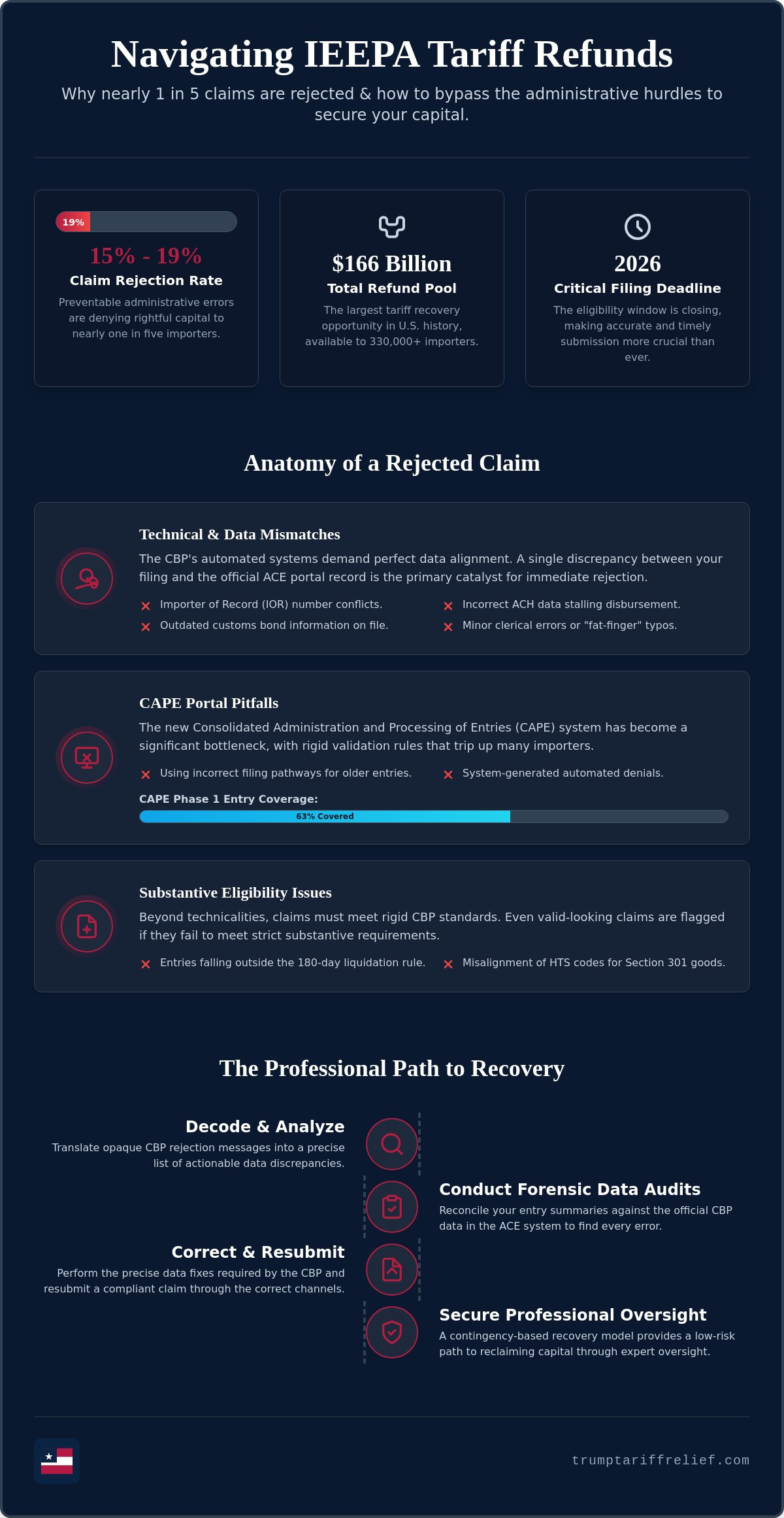
Nearly one in five importers is currently being denied their rightful capital due to preventable administrative errors. With a rejection rate sitting between 15% and 19%, the path to recovering your IEEPA tariff refunds has become a high-stakes minefield of technicalities. You've likely felt the biting frustration of navigating the opaque CAPE portal or the anxiety of watching the 2026 filing deadlines approach while millions of dollars remain trapped in government accounts. It's a common experience for legitimate claims to fail simply because of a minor clerical error or a data mismatch in the ACE system.
This article identifies the common reasons for IEEPA claim rejection and provides the professional strategy you need to bypass these rigid administrative hurdles. You'll gain a clear understanding of why the CBP is issuing these denials and learn the precise fixes required to secure your refund. We'll preview the professional tactics that turn these technical failures into successful recoveries, ensuring your business doesn't leave its capital on the table as the eligibility window closes.
Key Takeaways
- Understand why the 2026 Supreme Court ruling opened a $166 billion refund pool and how the transition to the CAPE system has introduced new administrative hurdles.
- Identify the common reasons for IEEPA claim rejection, including technical Importer of Record mismatches and incorrect ACH data that stall fund disbursement.
- Learn to navigate substantive eligibility issues like the 180-day liquidation rule and HTS code alignment to ensure your claim meets rigid CBP standards.
- Follow a professional remediation roadmap to decode CBP rejection messages and perform the data audits necessary for a successful resubmission.
- Discover how a contingency-based recovery model provides a low-risk path to reclaiming your capital through expert oversight of complex trade documentation.
The IEEPA Refund Landscape: Why 2026 is a Critical Year for Importers
The financial landscape for U.S. importers transformed overnight on February 20, 2026. With the Supreme Court's landmark decision in Learning Resources, Inc. v. Trump, the federal government was forced to acknowledge an unlawful collection of duties, resulting in a staggering $166 billion refund pool. This is not a typical administrative adjustment; it's a fundamental restoration of corporate capital. Over 330,000 importers now have a legal right to reclaim what was taken. However, the complexity of the filing process means that many businesses are failing at the first hurdle. Understanding the common reasons for IEEPA claim rejection is vital because the CBP is applying unprecedented scrutiny to every submission as they manage this massive disbursement.
The Supreme Court Ruling and Your Right to Recovery
The ruling established that the executive branch had misapplied the International Emergency Economic Powers Act (IEEPA) by imposing Section 301 tariffs without following proper legislative timelines and procedural requirements. The IEEPA ruling stands as the largest tariff recovery opportunity in U.S. history. While traditional protests or duty drawbacks focus on clerical errors or product classification, this recovery is based on the total invalidation of the underlying legal authority for the tariffs. It applies specifically to goods on Section 301 List 3 and List 4a that entered the country between February 1, 2025, and February 23, 2026. Because the government is facing a significant budgetary impact as these funds are returned, they've implemented a rigid verification process that triggers high denial rates for the unprepared.
The Role of the CAPE System in Claim Processing
To manage the sheer volume of 53 million affected shipments, the CBP launched the Consolidated Administration and Processing of Entries (CAPE) system on April 20, 2026. This electronic portal replaced the traditional paper-based protest for the vast majority of IEEPA claims. While intended to be efficient, the system has become a significant bottleneck. Currently, Phase 1 of the CAPE rollout only covers approximately 63% of eligible entries, focusing on unliquidated or recently liquidated shipments. Importers with older liquidated entries often find themselves facing immediate automated denials if they don't use the correct specialized filing pathways. You can explore the technical nuances of these entry types in our guide to IEEPA Explained. This digital transition is among the most common reasons for IEEPA claim rejection, as the CAPE system requires a perfect data match with the original ACE records to authorize a disbursement. If there's even a single digit discrepancy in your Importer of Record number or entry data, the system will flag the claim for rejection.
Administrative Pitfalls: Common Technical Reasons for IEEPA Rejections
The bureaucratic reality of reclaiming tariff duties is far less poetic than the legal victory that enabled it. While the Supreme Court opened the door, the Customs and Border Protection (CBP) has built a digital fortress around the actual funds. Administrative errors now rank among the most common reasons for IEEPA claim rejection, often because importers treat the CAPE filing as a simple data entry task rather than a forensic accounting exercise. A single "fat-finger" typo in a million-dollar declaration can trigger an immediate, automated denial that is notoriously difficult to reverse.
The ACE Portal Data Disconnect
Your internal ERP system might show one set of figures, but the CBP only recognizes what's recorded in the Automated Commercial Environment (ACE) portal. Mismatches between your declaration and the ACE records are a primary catalyst for rejection. This often happens when Importer of Record (IOR) numbers have changed or when outdated bond information remains on file. Before initiating a filing, it's essential to reconcile your entry summaries against the official CBP's IEEPA refund process data. If the system detects a discrepancy in the original entry summary versus the CAPE submission, it won't just flag the error; it will invalidate the entire claim.
ACH and Financial Record Discrepancies
Electronic refunds require a seamless digital path for the capital to flow. If your Automated Clearing House (ACH) information is incorrect or inactive, the CBP cannot issue the payment, leading to a status of "rejected" or "pending indefinitely." Many importers fail to update their 5106 form (Importer ID Input Record) after corporate restructuring or banking changes. You must verify your ACH status before every major filing to ensure the government has a valid destination for your funds. Without this confirmation, even a legally perfect claim will stall at the disbursement stage.
Beyond these technical hurdles, the CBP frequently issues a Form 28, a formal Request for Information. Importers often overlook these notices in their digital portals. You have a strict 30-day window to respond with the requested documentation. Missing this deadline is one of the most avoidable yet common reasons for IEEPA claim rejection. To avoid these traps, many firms opt for a preliminary Tariff Eligibility Assessment to ensure their data is bulletproof before it ever reaches a CBP officer.
Substantive Eligibility Issues: Why CBP Flags Valid-Looking Claims
While technical errors are frustrating, substantive eligibility barriers represent a more profound challenge to your recovery. Even a perfectly formatted claim will fail if it violates the rigid legal frameworks governing customs finality. These substantive common reasons for IEEPA claim rejection often stem from a misunderstanding of how the CBP views the lifecycle of an entry. It isn't enough to have paid the tariff; you must prove that the entry remains open for adjustment or that you've followed the specific protest timelines required by law. If your documentation doesn't link the original duty payment directly to the current Importer of Record, the government will retain your capital indefinitely.
Understanding the Liquidation Window
Liquidation is the final calculation of duties by the CBP; it's the moment the government "closes the book" on a specific shipment. The status of your entry is the single most important predictor of success. For unliquidated entries, the process is relatively straightforward through the CAPE portal. However, if an entry was liquidated more than 180 days ago, the system will likely trigger an automatic rejection. In these cases, a standard CAPE declaration is insufficient. You must instead file a formal protest using CBP Form 19. Many importers also struggle with "deemed liquidated" entries, which are shipments that finalized automatically due to administrative delays. These require a specialized legal strategy to reopen, as the CBP's default stance is to deny any refund request for a closed file.
HTS Code and List Mismatches
The Supreme Court ruling specifically targets duties paid on goods classified under Section 301 List 3 and List 4a. If your claim includes HTS codes that fall outside these specific categories, the entire submission may be discarded. A frequent pitfall occurs when an importer has undergone a prior customs audit. If a past audit resulted in a reclassification of your goods from an eligible List 3 code to an ineligible code, your current claim will fail despite what your original paperwork says. You can find detailed information on which specific codes qualify in our FAQ. Accurate HTS alignment is mandatory; the CBP will not perform the reconciliation for you.
Another significant hurdle is the "Double Dipping" trap. If your business already secured a refund for specific shipments through previous Section 301 exclusions or independent protests, you cannot claim those funds again under the IEEPA ruling. The CBP’s database cross-references every new claim against historical disbursements. If the system detects a prior refund, it flags the new submission as a duplicate. This often happens in large organizations where different departments may have filed for exclusions without centralizing the data. To secure your recovery, you must audit your entire protest history to ensure every line item in your IEEPA claim is truly eligible for a new refund.
The Remediation Roadmap: How to Correct and Resubmit a Rejected Claim
Receiving a rejection notice from the CBP is not a final verdict; it is a technical signal that your data requires alignment. Because the CAPE system is a binary environment, even the most valid claim will be discarded if a single data point fails the validation check. To recover your capital, you must move beyond frustration and follow a methodical remediation process. Understanding the common reasons for IEEPA claim rejection allows you to treat the denial as a roadmap for correction rather than a permanent loss of funds.
Decoding CBP Rejection Messages
The first step in your recovery is a forensic analysis of the CSMS message or the rejection code provided in your portal. A "Not Validated" status in the CAPE system often indicates a mismatch between your submission and the original entry summary. You must distinguish between a "Hard Reject" and a "Correction Required" status. While a hard reject often points to substantive eligibility issues like the 180-day liquidation window, a correction status is usually an administrative request for more precise data. Most rejections are simply the government asking for better documentation or a corrected Importer ID. If you see a "Validation Failed" flag, the system has identified a discrepancy that you must resolve before the 2026 deadlines pass.
The Importance of a Trade Audit
You should never resubmit the same data twice without a professional audit. Doing so risks a permanent denial and may trigger a more invasive Form 28 inquiry. A full data audit compares your original entry summary against the CAPE filing to identify the "missing link" in your documentation trail. This involves verifying that your Importer of Record number, bond information, and ACH records in the ACE portal are current and perfectly matched. If your internal records haven't been updated since the 2026 ruling, they likely contain the very errors that triggered the initial rejection. Our Customs Documentation Management process is designed to uncover these hidden technicalities before you attempt a second filing.
- Analyze the Root Cause: Review the specific CBP rejection code to determine if the failure is technical (data mismatch) or substantive (eligibility).
- Perform a Data Audit: Compare the original entry summary line-by-line with your CAPE declaration to find discrepancies.
- Update Financial Records: Ensure your ACH and Importer ID records are fully validated within the ACE portal.
- Draft a Corrected Declaration: Submit a revised CAPE filing that addresses the specific "asks" from the CBP rejection notice.
- Monitor Validation Status: Track the ACE dashboard daily for immediate feedback on your resubmission.
Once you've corrected the underlying data, the path to recovery becomes significantly smoother. The system's automated nature means that once the data matches, the validation happens almost instantly. If you are struggling to decode a complex rejection message, we can help you navigate the process. You can secure your recovery today by requesting a professional Tariff Eligibility Assessment to ensure your next submission is bulletproof.
Securing Your Recovery: Why Professional Oversight Eliminates Rejection Risk
The 2026 trade landscape is too volatile for a "wait and see" approach. Attempting a DIY filing in this environment often leads to the very common reasons for IEEPA claim rejection we've discussed throughout this guide. The CAPE system is designed for automated efficiency, not for human error or data nuance. When your internal team attempts to reconcile years of complex entry data against a rigid government portal, the risk of a permanent denial increases exponentially. One incorrect digit in an Importer of Record number can result in the loss of millions in eligible capital.
Professional oversight transforms this process from a high-stakes gamble into a strategic recovery operation. We match your data to the CBP’s expectations with surgical precision, ensuring that every entry summary aligns with the CAPE portal's rigid validation logic. By handling the forensic data audit and the complex reconciliation of ACE records, we remove the heavy lifting from your compliance department. Your team doesn't have to spend hundreds of hours decoding CSMS messages or verifying ACH status. We take on the administrative burden, allowing your staff to focus on core business operations while we navigate the bureaucracy required to reclaim your capital.
Contingency-Based Recovery vs. Hourly Fees
Many traditional law firms charge high hourly rates for the mere "attempt" to file a claim. This model is fundamentally flawed for the importer. If the claim fails due to technicalities or administrative errors, you're left with a legal bill and no refund. We operate on a contingency model that aligns our interests perfectly with yours. We only get paid when your refund is successfully disbursed into your bank account. This eliminates the financial risk of rejection and ensures that every filing we submit is optimized for immediate approval. For a broader look at the current market and strategic filing timelines, see our Tariff Recovery for Importers: The Strategic Guide.
The Trump Tariff Relief Advantage
Our specialized focus is exclusively on IEEPA and Section 301 recovery. We don't offer general brokerage services; we offer a high-performance partnership focused on financial restoration and corporate justice. We provide a "No Upfront Cost" guarantee for all initial assessments, allowing you to identify your recovery potential without risking a single dollar of your current budget. Because we understand the common reasons for IEEPA claim rejection better than any generalist firm, we can preemptively fix data mismatches and bond errors before they ever reach a CBP officer's desk. This insider expertise is the difference between a stalled claim and a disbursed refund.
Get your free IEEPA eligibility assessment today and secure your share of the $166 billion refund pool before the 2026 deadlines close.
Reclaim Your Capital Before the 2026 Deadlines Close
The path to recovering your tariff duties is paved with rigid administrative requirements and automated system checks. We've identified that technical mismatches, liquidation status, and improper HTS alignment are the common reasons for IEEPA claim rejection in today's high-stakes trade environment. While the government's $166 billion refund pool represents a historic opportunity, the burden of proof remains entirely on your shoulders. You don't have to navigate this digital bureaucracy alone or risk a permanent denial due to a simple clerical oversight.
Our expert trade consultancy specializes in IEEPA and Section 301 recovery, providing comprehensive management of the entire ACE and CAPE filing process. We operate on a contingency-based model, meaning you only pay if we successfully recover your money. There is no financial risk to ensuring your documentation is perfect before it reaches a customs officer. Secure your IEEPA refund with a zero-risk assessment today. It's time to right this financial wrong and restore the capital your business deserves.
Frequently Asked Questions
Can I re-file my IEEPA claim if it was already rejected by CBP?
Yes, you can resubmit a rejected claim once the underlying data discrepancy is resolved. If the rejection was a "soft" validation failure in the CAPE system, you can often correct the record and refile immediately. However, if the rejection was due to substantive eligibility issues like a missed deadline, you must transition to a formal protest to keep the claim alive.
What is the most common technical error in the CAPE system?
Data mismatches between your CAPE declaration and the original ACE entry summary are the most frequent technical hurdles. These often include incorrect Importer of Record (IOR) numbers or outdated Automated Clearing House (ACH) information. These discrepancies are among the most common reasons for IEEPA claim rejection because the system requires a 100% data match to authorize payment.
How long do I have to fix a rejected tariff refund claim?
Your timeline depends on the entry's status and the nature of the rejection. For entries that have already been liquidated, you have exactly 180 days from the date of liquidation to file a formal protest using CBP Form 19. If your CAPE declaration is rejected for a technical error, you should resolve it immediately to ensure you don't miss the 2026 filing deadlines.
Why does CBP say my entry is "liquidated" and therefore ineligible?
CBP uses the term "liquidated" to indicate that the duty calculation for an entry is finalized and the file is closed. If an entry was liquidated more than 180 days ago, it's no longer eligible for the standard electronic CAPE process. In these instances, you must use the protest mechanism to challenge the duty and reopen the entry for a refund.
Is there a fee to appeal a rejected IEEPA refund claim?
There is no government fee to file a CAPE declaration or a formal protest with the CBP. While the administrative process itself is free, the true cost lies in the risk of permanent denial due to clerical errors. Most importers choose professional oversight to avoid leaving millions in capital on the table through preventable mistakes that are difficult to reverse.
What documents do I need to prove my claim if it’s flagged for review?
You must be prepared to provide the original Entry Summary (Form 7501), commercial invoices, and packing lists that verify the HTS classification. Additionally, proof of the original duty payment is essential if the CBP issues a Form 28 Request for Information. Having these documents organized in a digital, audit-ready format is the best defense against a sustained claim rejection.
How does Trump Tariff Relief handle claims that have already been rejected once?
We specialize in forensic remediation for claims that have already stalled or been denied by the government. Our team performs a full data audit to identify the specific trigger for the rejection and corrects the underlying ACE portal records. We then manage the entire resubmission process on a contingency basis, ensuring your interests are fully aligned with a successful recovery.
Will a rejected claim trigger a broader customs audit of my business?
An administrative rejection in the CAPE system doesn't automatically trigger a full customs audit of your entire operation. However, a pattern of inaccurate filings or failing to respond to a Form 28 can lower your compliance profile with the CBP. Utilizing professional Customs Documentation Management ensures that your filings are accurate, reducing the likelihood of attracting unnecessary regulatory scrutiny.
Ready to find out what your business may be owed?
Check My Eligibility