
Your balance sheet is currently carrying a multi-million dollar asset that the federal government is counting on you to ignore. For too long, importers have viewed IEEPA duties as an unavoidable cost of doing business, but recent legal shifts have transformed these payments into a mandatory exercise in tariff recovery for importers. You likely already know that navigating the ACE and CAPE portals is a resource-heavy nightmare, and your internal trade compliance teams are already stretched to their limits. The fear of missing the rigid 2026 filing deadlines is a legitimate concern, yet the prospect of reclaiming significant capital remains the ultimate priority for your fiscal health.
This article provides the definitive roadmap for securing your refunds, showing you exactly how to reclaim unconstitutional tariffs through a risk-free, contingency-based recovery framework. You'll discover a clear path to high-volume refund recovery that restores capital to your balance sheet without the burden of upfront legal fees. We'll preview the specialized recovery audit process and explain how a dedicated partner can handle the complex documentation and legal heavy lifting required to secure your returns before the window of opportunity closes forever.
Key Takeaways
- Grasp the massive scale of unconstitutional duties and why reclaiming these funds is now a vital capital restoration exercise for your balance sheet.
- Discover how the CAPE program's shift to mass-processed declarations simplifies the recovery of millions of individual entries.
- Avoid the administrative traps of DIY filing that risk permanent disqualification from future government refunds.
- Implement a strategic framework for tariff recovery for importers to identify every eligible entry through rigorous ACE data scrubbing.
- Leverage a contingency-based model to eliminate financial risk while outsourcing the complex documentation and legal requirements.
The $166 Billion Opportunity: Understanding IEEPA Tariff Recovery for Importers
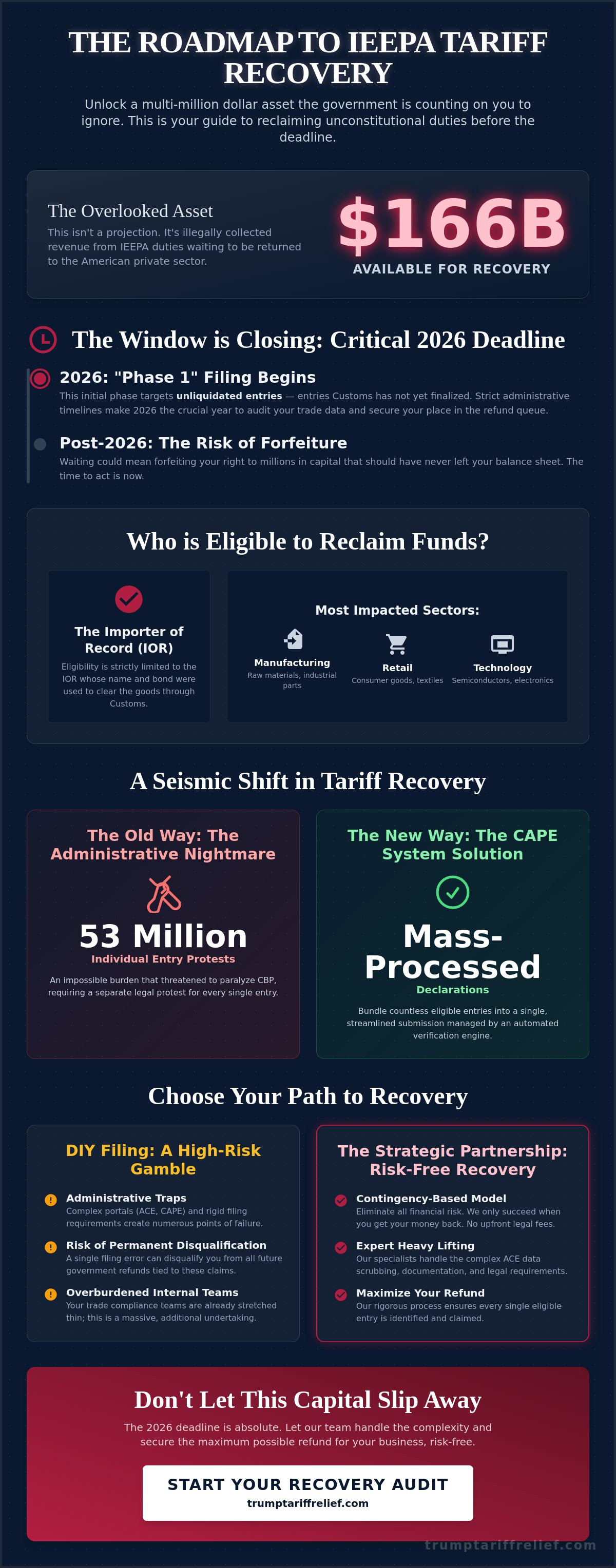
The federal government is currently sitting on $166 billion that belongs to the American private sector. This isn't a projection or a theoretical figure; it represents the total value of duties collected under the International Emergency Economic Powers Act (IEEPA) that have since been challenged as unconstitutional. For many businesses, tariff recovery for importers has shifted from a back-burner compliance issue to a front-and-center financial imperative. Unlike standard duty drawback programs, which typically require proof of exportation or destruction of goods, these refunds are based on the legal invalidation of the tariffs themselves. If you paid these duties, the money is yours to reclaim.
The 2026 calendar year marks the start of "Phase 1" for this recovery effort. This phase specifically targets unliquidated entries, which are entries that Customs hasn't yet finalized. Because the window for filing is tied to strict administrative timelines, 2026 is the critical year for businesses to audit their trade data and secure their place in the CAPE refund queue. Waiting until next year could mean forfeiting your right to millions in capital that should never have left your balance sheet.
The Legal Catalyst: From Supreme Court to Your Balance Sheet
The path to restoration began when the Supreme Court ruled that the executive branch exceeded its statutory authority by indefinitely extending trade penalties. This landmark decision forced the creation of the Consolidated Administration and Processing of Entries (CAPE) system to handle the massive volume of pending claims. The 2026 Supreme Court order invalidated the executive branch's overreach in applying specific trade duties under the IEEPA, effectively mandating the return of billions in illegally collected revenue. This shift means that what was once a sunk cost is now a recoverable asset for those who act quickly.
Which Importers Are Eligible for Recovery?
Eligibility for these refunds is strictly limited to the "Importer of Record" (IOR) at the time of entry. If your company’s name and bond were used to clear the goods through Customs, you're the party entitled to the refund. Downstream buyers who paid a landed cost to a distributor typically don't have standing to file. Implementing a strategy for tariff recovery for importers requires a precise audit of the IOR's historical filings to identify every eligible transaction. The impact is most significant across three key sectors:
Identifying your specific eligibility requires a deep dive into your historical entry data. You can learn more about IEEPA eligibility to see if your specific HTS codes and entry dates qualify for this massive capital restoration. Our team handles the heavy lifting of data extraction and eligibility scrubbing to ensure no capital is left behind.
The CAPE System and the Mechanics of Modern Tariff Claims
The administrative burden of processing 53 million individual entry protests threatened to paralyze the Bureau of Customs and Border Protection (CBP). To prevent a total systemic collapse, the government introduced the Consolidated Administration and Processing of Entries (CAPE) program. This initiative represents a seismic shift in how tariff recovery for importers is executed. Rather than filing a separate legal protest for every single shipping container that entered the country, importers can now bundle eligible entries into mass-processed declarations. This modernization is essential for managing the sheer volume of claims generated by the IEEPA tariff refund process. Once submitted, CBP utilizes an automated verification engine to audit incoming refund claims against historical entry summaries, ensuring that every dollar requested matches a duty payment recorded in the federal ledger.
How CAPE Differs from Traditional Customs Protests
Traditional protests are often slow, paper-heavy, and siloed. CAPE replaces this with a consolidated declaration model that prioritizes speed and scale. While this new framework is significantly faster, it demands an uncompromising level of precision. In the 2026 environment, filing is almost exclusively electronic, leaving no room for the manual corrections allowed in the past. If a single entry line in a batch of thousands contains a clerical error or an incorrect HTS code, the entire declaration can face immediate rejection. These "incomplete declarations" are often barred from refiling, making the initial data scrub the most important step in your recovery journey. Understanding how it works from a technical perspective is the only way to avoid these administrative pitfalls and ensure your capital is actually restored.
The Role of ACE Data in Building Your Claim
Your internal spreadsheets aren't the final word; the Automated Commercial Environment (ACE) Secure Data Portal is. This portal serves as the government's "single source of truth." Discrepancies between your internal records and the official CBP data are common. These gaps are often caused by post-summary corrections, prior disclosures, or liquidation status changes that weren't captured in your internal ERP system. ACE reports provide the foundational data used to calculate total recoverable duties by cross-referencing entry dates with the specific IEEPA-impacted HTS codes. To build a bulletproof claim, you must extract 100% of your IEEPA-specific entry summaries and reconcile them against your financial statements. If the data in your tariff recovery for importers claim doesn't mirror the ACE record exactly, CBP will flag the entry for a manual audit, which can delay your refund by months or years.
DIY Filing vs. Professional Recovery Services: Navigating the Complexity
Attempting to manage tariff recovery for importers internally is often a recipe for administrative paralysis. While government portals suggest a streamlined path, the reality is a maze of millions of entry lines that can overwhelm even the most robust trade compliance departments. The stakes go beyond mere paperwork. An incomplete declaration isn't just a clerical error. It's a potential death sentence for your claim. CBP often implements a permanent bar on future filings for entries submitted with missing or incorrect data. This means a single mistake by an overstretched internal team could cost your business millions in forfeited capital.
Professional firms also provide a critical security layer. CBP has issued explicit warnings regarding scams and fraudulent refund solicitations that target unsuspecting businesses. A legitimate recovery partner serves as a shield, ensuring that all communications and data transfers happen through secure, verified channels. We take on the risk and the heavy lifting, allowing your team to stay focused on your core business while we secure your rightful capital.
The Hidden Costs of Internal Tariff Filing
Why a Recovery Audit Outperforms a Simple Filing
A simple filing is just a data dump, but a recovery audit is a forensic exercise. Our framework scours years of historical data to identify every recoverable dollar that others might miss. We don't just submit forms; we provide active legal advocacy. If the government issues a "denied" status or flags a discrepancy, our team handles the legal pushback to keep your claim alive. See how our recovery process works to understand the depth of our forensic approach and why it's the most effective path to restoration.
The Importer’s Roadmap: Critical 2026 Deadlines and Documentation
Success in tariff recovery for importers isn't just about knowing the law; it's about executing a precise, five-step operational roadmap before the 2026 window slams shut. The government isn't going to hand this money back voluntarily. You must go and get it. This process begins with forensic data extraction from the ACE portal, where we pull every IEEPA-specific entry summary to build your baseline. From there, we move into eligibility scrubbing, filtering thousands of entries by their liquidation status and specific HTS codes to ensure only valid claims are advanced.
The middle stages require rigorous verification. We cross-reference your duty payments with bank records and customs receipts to eliminate any discrepancies that CBP might use as an excuse to deny the claim. Once the data is bulletproof, we execute the CAPE Declaration. This is the "Phase 1" submission that gets your business into the queue for restoration. Finally, we provide post-submission monitoring, tracking the status of your electronic refund issuance until the capital is back on your balance sheet where it belongs.
2026 Deadlines You Cannot Afford to Miss
The 2026 calendar is the most important document in your trade compliance office right now. Phase 1 deadlines are specifically focused on unliquidated entries and those that have liquidated within the last few months. If you're dealing with older entries, the 180-day rule for protests remains a rigid barrier. Many businesses make the fatal mistake of "waiting for a second wave" of court rulings before they act. This is a dangerous financial strategy. By the time a second wave arrives, the statute of limitations on your most valuable entries will likely have expired, permanently barring you from recovery.
The Essential Documentation Checklist
To win, you need a complete evidentiary trail. CBP's automated systems are designed to flag and reject any submission that lacks supporting documentation. Your recovery file must include:
- Entry Summaries (Form 7501): The primary record of the transaction.
- Commercial Invoices: To verify the valuation and nature of the goods.
- Proof of Duty Payment: Bank confirmations or customs receipts showing the IEEPA duties were settled.
- IOR Financial Records: Documentation proving your company acted as the Importer of Record.
The complexity of this documentation is why most internal teams fail to maximize their returns. If you're unsure about your status, you should get a preliminary eligibility assessment to see which deadlines apply to your specific entry history. We handle the documentation management so you don't have to risk missing these critical dates.
Maximizing Your Refund with a Contingency-Based Recovery Strategy
The decision to pursue tariff recovery for importers shouldn't be stalled by internal budget constraints or the fear of sunk legal costs. Traditional legal routes often require massive retainers and hourly billing, which puts the financial risk entirely on your company. A contingency-based strategy flips this dynamic; it places the burden of performance on the recovery partner. By adopting a 'Success Only' model, we align our goals perfectly with yours. We only realize a fee when you successfully reclaim your capital. This transforms a complex regulatory challenge into a performance-based capital gain. The risk is ours. The reward is yours.
Trump Tariff Relief manages the entire lifecycle of the claim, from initial data extraction to the final issuance of the electronic refund. We act as your specialized advocate, navigating the bureaucracy of the CAPE system and defending your entries against government scrutiny. This comprehensive approach is the final step in righting the wrong of unconstitutional tariffs. It's not just about compliance; it's about reclaiming what was unlawfully taken from your business. Our team handles the heavy lifting, ensuring your tariff recovery for importers is thorough, accurate, and finalized before the 2026 deadlines expire.
Zero Upfront Cost: The CFO’s Preferred Recovery Model
Financial leaders often hesitate to authorize large-scale recovery projects because of the risk of 'paying for a denial.' If an internal team or an hourly law firm spends months filing claims that are ultimately rejected by CBP, the company loses twice. Our contingency structure eliminates this risk entirely. There are no upfront consulting packages or hidden administrative fees. This makes the approval process simple for CFOs and controllers because the project is essentially self-funding. Transparency is at the core of our success fee structure; you'll know exactly how the recovery is calculated before any documents are submitted.
Starting Your Preliminary Assessment Today
The window to act is narrowing as the 2026 deadlines approach. We provide a 24-hour eligibility check to determine the potential scale of your refund. To begin your audit, we simply need access to your basic entry summary data from the ACE portal. We do the heavy lifting of scrubbing the data and identifying every recoverable dollar. If you have questions about the specific types of duties that qualify, you can review our Frequently Asked Questions about refunds for more technical details.
Don't leave your capital in the hands of the government. Contact Trump Tariff Relief for a free refund assessment today and let our experts secure the restoration your balance sheet deserves.
Restore Your Balance Sheet and Secure Your Refund
The window to reclaim your share of the $166 billion refund pool is narrow and closing fast. By now, the strategic path forward is clear: navigating the CAPE system requires more than just administrative effort; it demands a specialized forensic approach to your trade data. Opting for professional tariff recovery for importers ensures that every eligible entry is identified and every legal hurdle is cleared without draining your internal resources. You've seen the risks of incomplete declarations and the unforgiving 2026 deadlines that govern this restoration process.
We provide the specialized expertise in IEEPA and CAPE filing necessary to maximize your claim's value through a comprehensive data audit. Because our model is strictly contingency-based, you only pay when you receive your refund. This removes the financial barrier to justice and puts the burden of performance entirely on our team. It's time to take action and reclaim the capital that belongs to your business.
Claim Your Share of the $166 Billion Refund Pool Today
Your business deserves a partner that takes on the risk and the heavy lifting. We're ready to help you win back what's yours.
Frequently Asked Questions
Is the China tariff refund program real and legitimate?
Yes, the refund program is a legitimate federal initiative mandated by legal rulings that invalidated specific duty applications. The government established the CAPE program specifically to process these claims. This isn't a speculative opportunity; it's a structured mechanism for tariff recovery for importers to reclaim capital that was collected under unconstitutional executive orders. Thousands of U.S. businesses are already using this framework to restore their balance sheets.
What is the deadline for filing an IEEPA tariff refund claim in 2026?
The 2026 deadline depends on the liquidation status of your specific entries. Phase 1 focuses on entries that are currently unliquidated or were liquidated within the last 180 days. Because the statute of limitations is rigid; waiting even a few weeks can result in a permanent bar on your ability to reclaim duties. You must file your declaration before these individual entry windows expire to remain eligible.
Can I recover tariffs if I was not the Importer of Record but paid the cost?
Only the legal Importer of Record (IOR) has the standing to file a claim with U.S. Customs and Border Protection. Even if your company paid the final invoice to a middleman or distributor; the refund is legally owed to the entity whose bond was used at the time of entry. We focus on identifying the specific IOR to ensure the claim is filed by the correct legal party with the government.
How long does it take for CBP to process a CAPE refund declaration?
CBP aims to process CAPE refund declarations within an accelerated 45-day window once a complete and accurate filing is received. However; any clerical errors or missing documentation will trigger a manual audit, which can extend the timeline by several months. Our forensic audit process ensures the initial submission is bulletproof to meet this accelerated schedule and avoid unnecessary government delays.
What happens if my entry has already been liquidated?
If your entry has already been liquidated, you must act within 180 days of that liquidation date to file a protest. Once this 180-day window closes; the entry is typically finalized in the eyes of the law. Identifying these specific dates through an ACE data scrub is the first step in determining which portions of your historical duties are still eligible for tariff recovery for importers.
Are there any upfront fees for Trump Tariff Relief's recovery services?
Trump Tariff Relief operates on a strictly contingency-based model with zero upfront fees. We don't sell consulting packages or charge hourly rates for the initial eligibility audit. We only earn a fee when you successfully receive your refund from the government. This ensures our incentives are perfectly aligned with your financial recovery and removes the risk of paying for a denied claim.
Do I need to hire a lawyer to file for a tariff refund?
While you aren't legally required to hire a lawyer, the technical complexity of IEEPA litigation and CAPE portal requirements makes professional advocacy essential. General customs brokers often lack the specialized legal framework needed to manage these specific constitutional claims. A specialized recovery partner handles the legal heavy lifting and documentation management so your internal teams can focus on core operations.
What documents are absolutely required to start the recovery process?
To begin the forensic audit, we require your Entry Summaries (CBP Form 7501), commercial invoices, and proof of duty payment. Additionally; access to your ACE Secure Data Portal reports is necessary to cross-reference your internal records with the government's official ledger. These documents form the evidentiary foundation of a successful recovery claim and are used to calculate the total restoration value for your business.
Ready to find out what your business may be owed?
Check My Eligibility