
With a staggering 40% rejection rate for early filings in the CAPE portal, reclaiming your share of the $175 billion IEEPA refund pool is proving to be a minefield of technicalities. You've already paid these unlawful duties once; the last thing you need is a massive legal bill for a claim that might get denied. This is why proactive importers are pivoting toward a tariff refund success fee model. It shifts the financial burden from your balance sheet to the recovery experts, ensuring that you only pay when capital actually returns to your accounts.
It's frustrating to watch your capital sit in government accounts while you weigh the risk of high upfront legal costs against the complexity of 53 million potential claims. You want a streamlined path to restoration, not another line item on your expense report. This guide compares the financial mechanics of success-based models against traditional billing to ensure you choose the most aggressive, risk-free strategy for your recovery. We'll explore how to navigate the CAPE portal's complexities while securing the maximum refund amount with zero initial outlay.
Key Takeaways
- Understand the scale of the $166 billion refund pool and why 330,000 U.S. companies are now eligible to reclaim capital from unlawful IEEPA duties.
- Contrast the financial impact of a tariff refund success fee against traditional hourly billing to determine which model best preserves your corporate cash flow.
- Identify the hidden costs often embedded in legal billing structures, such as data entry and eligibility research, that can diminish your final recovery amount.
- Leverage professional documentation management and data-scrubbing technology to bypass the CAPE portal's high rejection rates and secure your refund.
- Eliminate "sunk cost" anxiety by choosing a contingency partnership where you owe nothing unless your claim is successfully liquidated and paid.
The Financial Reality of Reclaiming IEEPA Tariff Refunds in 2026
The February 20, 2026, Supreme Court ruling was a watershed moment for American trade. It didn't just change a rule; it declared years of tariff collection unlawful. This created a court-ordered mandate to return $166 billion to the 330,000 U.S. companies that paid these duties. This isn't a government handout. It's your capital, and reclaiming it requires navigating a bureaucracy that isn't designed for speed. Choosing a recovery partner who operates on a tariff refund success fee basis allows you to pursue these funds without adding to your overhead. For importers with high entry volumes, the administrative barrier is the first hurdle. You aren't just filing a claim; you're managing a massive data set where a single error can trigger a rejection.
The Complexity of the CAPE Portal
The Consolidated Administration and Processing of Entries (CAPE) portal is the primary gateway for recovery, yet it's fraught with technical limitations. Files are strictly limited to 9,999 entries per upload. This means a large-scale importer might need to manage dozens of separate files, each perfectly formatted to avoid the 40% rejection rate currently seen in early filings. You must also verify your Importer of Record status across years of historical data to ensure every claim is valid. IEEPA refunds are legally distinct from standard duty drawbacks because they serve as restitution for unconstitutional executive action rather than a discretionary trade incentive.
Why 2026 is the Critical Year for Filing
The window for recovery is closing faster than most realize. The statute of limitations governing these specific refunds is absolute. If you miss the 2026 filing deadlines, that capital is effectively forfeited back to the Treasury. Beyond the legal cutoff, waiting increases the risk of documentation decay. Records get archived, digital files are purged, and the audit trail grows cold. There's also a significant financial incentive to move now: interest accrual. The longer the government holds your money, the more interest they owe, but you can't leverage that capital for growth while it's stuck in a federal account.
To mitigate the risk of high upfront legal costs, many businesses are opting for a contingency fee model. Utilizing a tariff refund success fee aligns your recovery partner's incentives with your bottom line, ensuring you only pay for results, not just hours of data entry. Securing a preliminary eligibility assessment is the only way to confirm your standing before the window shuts and your capital is lost to history.
Success Fees vs. Hourly Billing: Which Model Protects Your Bottom Line?
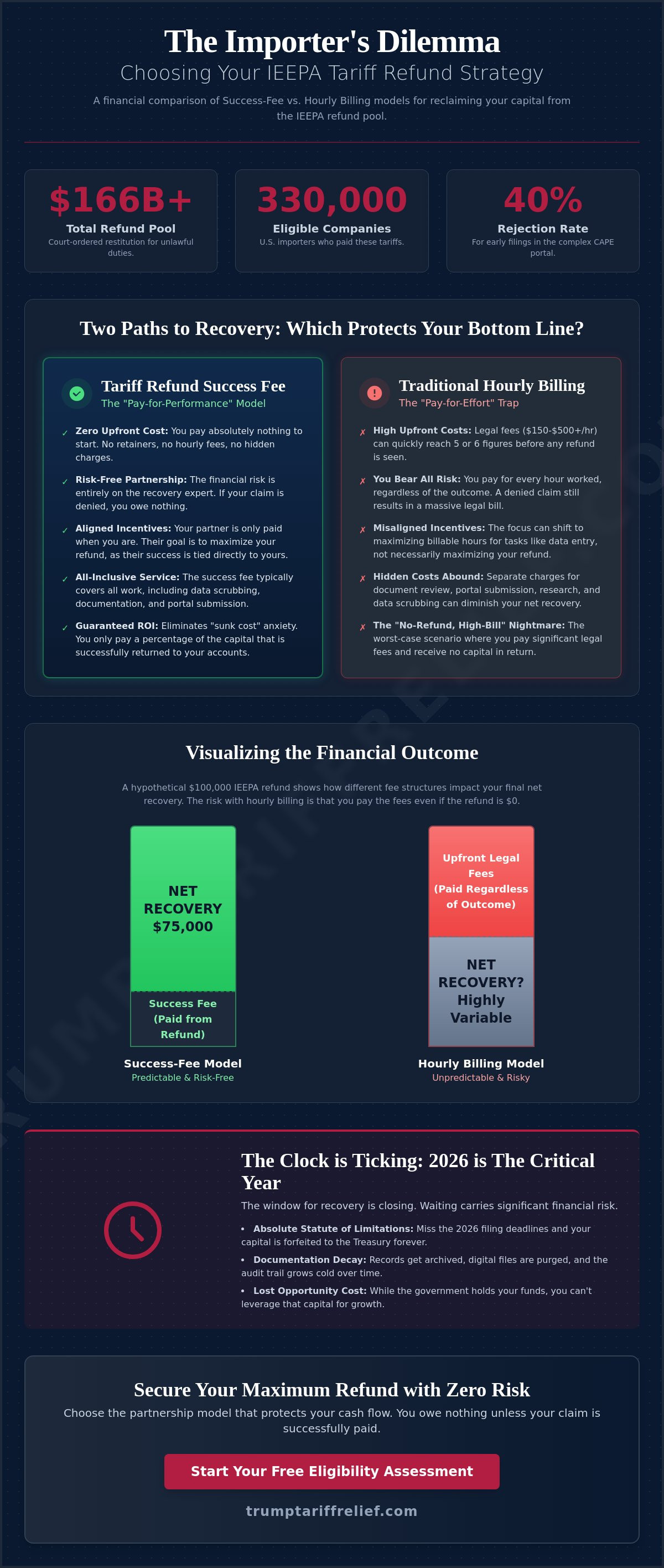
Choosing how to pay for your tariff recovery isn't just a matter of accounting preference. It's a strategic decision that dictates who carries the risk of the government's 40% rejection rate. Traditional legal models operate on a "Pay-for-Effort" basis, where you're billed for every minute a junior associate spends scrubbing data or research. In contrast, a performance-based partnership uses a "Pay-for-Performance" model. If the capital doesn't return to your accounts, you don't pay a dime. This distinction is critical when you consider that accessing the official IEEPA refund information reveals a process so data-intensive that administrative costs can easily spiral out of control.
Hourly billing often hides the true cost of recovery behind a veil of professional services. You might see line items for "document review" or "portal submission," but these hours accumulate regardless of whether the claim is actually liquidated. For importers with high entry volumes, this creates a "No-Refund, High-Bill" nightmare. You end up paying for the attempt, not the result. A tariff refund success fee eliminates this anxiety by shifting the financial burden entirely onto the recovery specialist. This alignment ensures that every eligible dollar is identified, as the consultant's compensation is directly tied to the size of your check.
The Hourly Rate Trap in Customs Law
Data-heavy claims are a goldmine for billable hours but a drain on corporate cash flow. When an attorney charges between $150 and over $500 per hour, the cost of verifying thousands of historical entries can quickly reach five or six figures. There's a fundamental lack of financial alignment in this model; the lawyer is incentivized to be thorough, but not necessarily efficient or successful. If the government denies your claim due to a technicality in the CAPE portal, you're still left holding the bill for the hours spent on the failed filing. Before committing to a fee structure, it's wise to perform a preliminary eligibility assessment to understand the potential scale of your recovery without initial risk.
The Success Fee Advantage
CFOs increasingly prefer the contingency model because it keeps recovery efforts off the balance sheet. There's zero upfront capital requirement, which preserves your working capital for operations or expansion. The consultant becomes a high-performing partner who manages the heavy lifting of documentation and data scrubbing at their own expense. A tariff refund success fee covers all overhead, including the complex data verification required to match Section 301 entries with IEEPA eligibility. This model ensures that the experts are as motivated as you are to win. They don't just file papers; they navigate the bureaucracy with the urgency that only a "no-win, no-fee" structure can provide.
Decoding the Success Fee: What Is Included in a Recovery Contingency?
A tariff refund success fee is far more than a simple commission; it is an all-inclusive service bundle that covers the entire lifecycle of a recovery claim. While hourly firms might bill separately for every data export or government inquiry, a contingency model absorbs these operational costs to ensure the importer remains focused on their core business. This structure transforms the recovery specialist from a vendor into a high-stakes partner. Every hour spent on technical verification is an investment the specialist makes in the claim's success, creating a powerful incentive to exhaust every possible avenue for restoration.
The Comprehensive Eligibility Audit
The foundation of any successful recovery is a rigorous eligibility audit. Specialists use proprietary data-scrubbing technology to scan years of import history, specifically looking for Section 301 List 3 and List 4a matches that overlap with IEEPA authority. This software identifies misclassified entries and missed opportunities that standard accounting audits often overlook. Because the tariff refund success fee covers this initial heavy lifting, importers can start with a preliminary assessment at no cost. This removes the financial barrier to entry, allowing businesses to confirm their standing before committing to the full filing process.
Full-Cycle Claim Management
Once eligibility is confirmed, the focus shifts to the technical requirements of the ACE and CAPE portals. Managing these systems requires a level of precision that goes beyond simple data entry. Specialists must format CSV files to meet the strict 9,999-entry limit per file and ensure total compatibility with CBP's phased rollout requirements. This management includes:
- Government Liaison: Handling all direct inquiries, requests for information (CF28s), or formal audits from U.S. Customs and Border Protection.
- Administrative Appeals: Managing protests and appeals if a claim is initially rejected, ensuring the case is argued with technical trade expertise.
- Interest Calculation: Verifying that the government pays the correct amount of principal plus the court-mandated interest, which can significantly increase the total recovery.
- Documentation Archiving: Organizing and maintaining the audit trail for the duration of the 90-day processing window and beyond.
Having a dedicated trade expert as your single point of contact simplifies a bureaucratic nightmare. They act as the active engine of the recovery, navigating the complexities of the CAPE system while you wait for the capital to return to your accounts. This "we-do-the-work" narrative is the hallmark of a high-performing partnership. It ensures that the technical burden of reclaiming your share of the $166 billion pool never rests on your internal team's shoulders.
Avoiding Upfront Costs: Why the Contingency Model is the Industry Standard
Preserving cash flow is the primary directive for any importer navigating the volatile trade environment of 2026. While U.S. Customs and Border Protection reports that refunds typically take 60 to 90 days to process once accepted, this timeline ignores the weeks of rigorous data preparation required before the first file is even uploaded. By utilizing a tariff refund success fee, you effectively bridge this financial gap. You keep your working capital deployed in inventory and operations while a dedicated partner carries the administrative costs of the recovery. This model eliminates the "Sunk Cost" anxiety that plagues hourly billing. If the government denies a claim due to the high validation standards of the CAPE portal, you owe nothing for the effort expended.
Scalability is another critical advantage of the contingency approach. Filing for your share of the $166 billion pool often involves managing thousands of entries across multiple years. Mid-sized importers rarely have the internal headcount to handle such massive data sets without distracting from daily operations. A performance-based model provides immediate access to elite trade consultants who specialize in high-volume recovery. These experts don't work on small hourly retainers; they align their success with yours. This ensures that even the most complex claims receive the attention they deserve without inflating your legal budget.
The ROI of Performance-Based Recovery
Calculating the true return on investment for your recovery requires looking beyond the fee percentage. You must account for the cost of internal staff time that would otherwise be lost to data entry and portal management. When you factor in the 40% rejection rate for early filings, the value of a tariff refund success fee becomes clear. It's a risk-mitigation strategy that guarantees a positive net benefit. If there's no check, there's no cost. This makes professional recovery accessible to businesses that lack the massive legal departments of Fortune 500 companies.
Vetting Your Success Fee Partner
Not all recovery partnerships are created equal. When evaluating a potential specialist, demand a clear, written contingency agreement that outlines exactly what is included. Be wary of any consultant asking for "administrative," "filing," or "technology" fees upfront. These are significant red flags that suggest the provider isn't confident in their ability to secure your refund. A legitimate partner should provide an all-inclusive service that covers everything from the initial audit to post-filing support. To ensure your business is positioned for maximum recovery, you should start your tariff eligibility assessment today and secure your place in the 2026 filing queue.
Securing Your Refund with Trump Tariff Relief’s Partnership
Reclaiming your capital from the $166 billion IEEPA refund pool requires more than just filling out a form. It demands a high-performing partner who can navigate the technical volatility of the 2026 trade landscape. Trump Tariff Relief operates on a strict "No Recovery, No Fee" promise. We take on the entire financial risk of the filing process, ensuring that your business only pays when the refund check is deposited into your account. This tariff refund success fee structure removes every financial barrier, allowing you to pursue justice for unlawful duties without risking a single dollar of your current operating budget.
Our recovery engine is powered by proprietary data-scrubbing technology specifically engineered to identify overlaps between Section 301 imports and IEEPA eligibility. We don't rely on manual entry or basic spreadsheets. Our systems analyze thousands of historical records in seconds, identifying missed opportunities in List 3 and List 4a entries that generalist firms often overlook. By the time your claim reaches the CAPE portal, it has been rigorously validated to meet the government's strict 2026 processing requirements, significantly reducing the risk of the 40% rejection rates seen in early filings.
Why Importers Trust Trump Tariff Relief
Importers choose us because we aren't a general customs brokerage or a traditional law firm. We are specialists dedicated exclusively to trade recovery and documentation management. While general brokers focus on ongoing shipments, we focus on the complex forensic work of reclaiming past losses. This specialization allows us to move with a speed that traditional firms can't match. We understand that in 2026, time is your greatest enemy due to the strict statute of limitations. See our Tariff Eligibility Assessment process to understand how we streamline the path from data analysis to recovery.
Start Your Zero-Risk Assessment Today
Getting started is a straightforward, secure process designed for busy executives. You provide your historical import data through our encrypted portal, and our team begins a comprehensive audit immediately. You don't need to worry about complex formatting or CSV compatibility; our technology handles the heavy lifting. Within the first 48 hours, you'll receive a preliminary report outlining your potential recovery amount and eligibility status. There's no upfront cost, no consulting fee, and no obligation to proceed unless you're confident in the results. The tariff refund success fee model ensures that we are as motivated as you are to win. Don't let your capital sit in government accounts while the 2026 deadlines approach. Get Your Free Tariff Refund Assessment today and let us start the work of restoring your balance sheet.
Secure Your Recovery Before the 2026 Deadlines Close
Reclaiming your share of the $166 billion pool is a high-stakes race against time and technical complexity. The choice between paying for effort or paying for results determines who carries the burden of the government's 40% rejection rate. Hourly billing models leave you vulnerable to runaway costs regardless of the outcome; however, a tariff refund success fee ensures your interests are perfectly aligned with your recovery partner. You preserve your working capital while experts handle the forensic data scrubbing and CAPE portal management at their own risk.
Trump Tariff Relief provides the specialized IEEPA and Section 301 expertise needed to navigate this fleeting window of opportunity. Our approach includes a comprehensive data audit at no cost, allowing you to identify every eligible dollar before committing to a filing. It's time to restore your balance sheet and reclaim the capital that was unlawfully collected from your operations. We take on the administrative burden so you can stay focused on growth.
Claim Your Refund with No Upfront Costs and let us handle the heavy lifting of your recovery. Your capital belongs in your business; let's go get it back.
Frequently Asked Questions
What is a typical success fee for a tariff refund claim?
Success fees for customs recovery typically range between 10% and 25% of the total capital reclaimed. These rates reflect the complexity of the filing and the risk the specialist assumes by carrying all administrative costs. Because we don't set a universal price, you should evaluate the value of a partnership that manages the entire recovery lifecycle without requiring upfront retainers or consulting payments.
Are there any hidden costs associated with a contingency-based recovery?
A legitimate contingency agreement is all-inclusive and should cover every technical step from the initial eligibility audit to final liquidation. You shouldn't encounter "administrative fees" or "technology surcharges" if the provider is truly performance-based. It's essential to verify that the tariff refund success fee covers responses to government inquiries and document management so your balance sheet remains protected throughout the 90-day processing window.
How much does it cost to file for a tariff refund if I do it myself?
Filing yourself costs nothing in government fees, but the internal resource drain is substantial and carries a high risk of failure. You'll need to allocate significant staff hours to format CSV files for the CAPE portal's 9,999-entry limit and verify Importer of Record status across years of data. Given the 40% rejection rate for early filings, the DIY route often results in lost capital due to technical errors or missed deadlines.
Can I switch from an hourly lawyer to a success-fee consultant mid-process?
You can transition your recovery efforts to a success-based model to stop the drain on your cash flow. If you're tired of paying for billable hours without seeing results, a specialist can step in to manage the existing claim data and documentation. You'll need to settle any outstanding hourly invoices with your previous counsel, but moving forward, your financial risk is eliminated as you only pay for a successful restoration of funds.
What happens if the government denies my refund claim under a success fee agreement?
If the government denies the claim, you owe nothing to the recovery specialist. This "No Recovery, No Fee" structure is designed to protect your bottom line from the uncertainties of the CAPE portal system. The consultant absorbs the cost of all data verification and filing efforts, ensuring that you never face a "Sunk Cost" scenario. This makes the performance-based model the safest way to pursue high-stakes recovery before the 2026 deadlines.
Why do consultants charge a percentage instead of a flat fee?
Percentage-based fees align the consultant's incentives with your maximum recovery. A flat fee might not motivate a specialist to dig through years of complex data to find every eligible Section 301 match. By using a tariff refund success fee, the provider is encouraged to identify every possible dollar, ensuring that both the business and the recovery partner win when the final check is issued.
Is the success fee calculated before or after interest is added to the refund?
The fee is typically calculated based on the total amount recovered, which includes both the principal duties and the court-mandated interest. Since interest can significantly increase the total check size, this ensures the consultant is motivated to expedite the filing and verify that all interest calculations are accurate. You should review your specific contingency agreement to confirm how the interest portion of the recovery is treated.
How do success fees compare to the cost of a full customs audit?
Success fees are generally more cost-effective because they are targeted and performance-driven. A full customs audit often involves broad, upfront consulting fees that don't guarantee a specific financial return. In contrast, a tariff recovery specialist focuses exclusively on reclaiming capital from unconstitutional duties. You get the depth of a technical audit with the financial security of a contingency-based partnership, keeping your overhead low while maximizing restoration.
Ready to find out what your business may be owed?
Check My Eligibility