
Approximately $165 billion in unlawfully collected duties is currently sitting in federal accounts, yet thousands of eligible importers are hesitating because they can't distinguish fact from fiction. You've likely seen the conflicting headlines following the February 2026 Supreme Court ruling, but the surge of questionable solicitations has made it difficult to verify the actual China tariff refund legitimacy for your specific operations. It's understandable to feel anxious about missing strict federal deadlines while fearing you might be targeted by fraudulent recovery services.
You deserve a clear, authoritative path to reclaiming what was taken through unlawful IEEPA enforcement. This guide will clarify the legal reality behind the April 2026 CAPE portal launch and provide the exact criteria required to secure your recovery. We'll preview the critical 80-day filing window for liquidated entries and the specific documentation management needed to navigate the new CBP system before these time-sensitive opportunities vanish.
Key Takeaways
- Verify the specific legal distinction between refundable IEEPA duties and non-eligible Section 301 or Section 232 tariffs to determine your actual recovery potential.
- Confirm China tariff refund legitimacy by identifying the hallmarks of professional recovery services, such as contingency-based models and zero upfront costs.
- Navigate the technical requirements of the new CAPE portal, including the mandatory CSV formatting for entry numbers and active ACE account verification.
- Recognize the critical 180-day protest window for older liquidated entries to ensure your business doesn't miss its final opportunity for restoration.
- Secure a comprehensive eligibility assessment to isolate qualifying imports paid during the 2025 to 2026 window without adding to your team's workload.
Is the China Tariff Refund Real? Separating Fact from Fiction
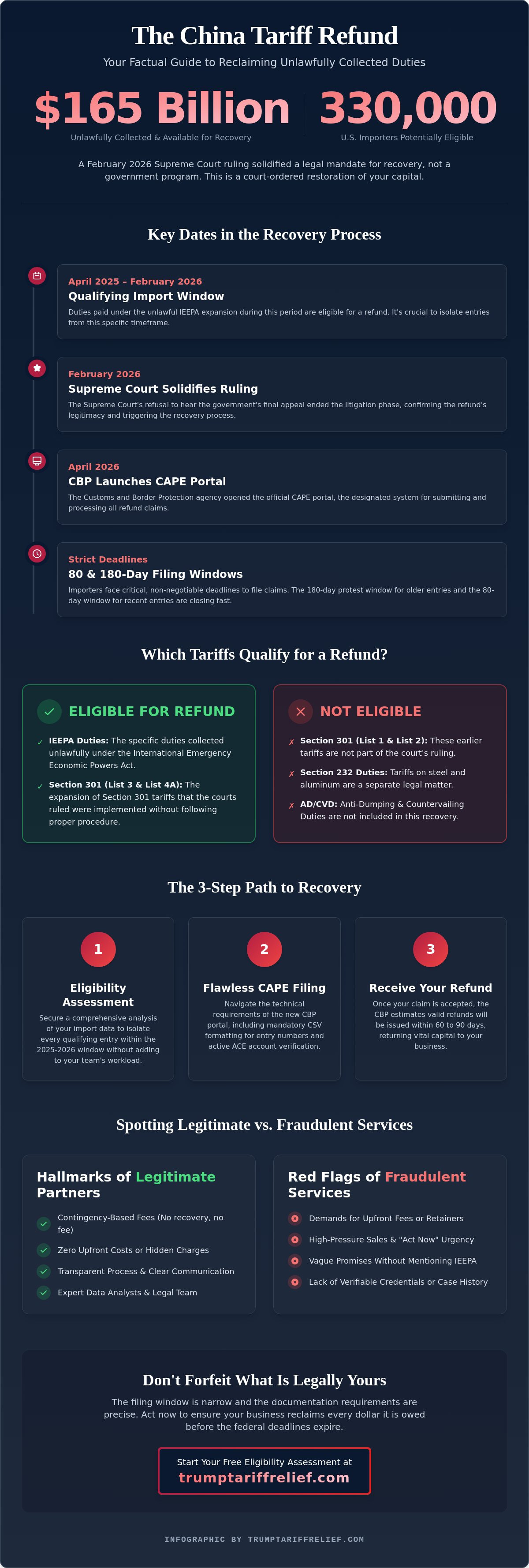
The $165 billion question has a definitive answer. Yes, the refund is real, but it's not a universal gift from the government. It's a precise legal victory for approximately 330,000 U.S. importers who were overcharged under the International Emergency Economic Powers Act (IEEPA). Understanding China tariff refund legitimacy starts with recognizing that this isn't a policy shift; it's a court-mandated restoration of capital. You aren't applying for a grant. You're recovering funds that were unlawfully seized through a specific regulatory overreach.
The U.S. Court of International Trade (CIT) provided the initial foundation, ruling that the executive branch exceeded its statutory authority during the height of trade tensions. This wasn't a minor clerical error. It was a fundamental breach of federal trade law. While the history of the U.S.-China trade war is filled with political maneuvers, this specific recovery opportunity is strictly about the law. The CIT's validation means the debate is over. The only remaining question is whether your business will meet the filing requirements before the deadlines expire.
The Difference Between a Policy Change and a Legal Refund
Don't confuse this with "Duty Drawbacks" or general tariff exclusions. Those are administrative programs designed by the government. This refund is a court-ordered remedy for "illegally collected" duties. It's not a voluntary program the government launched to be helpful; it's a forced repayment. To maintain clarity, you must distinguish between different tariff types. This recovery applies strictly to IEEPA duties. It does not cover:
- Section 301 List 1 or List 2 tariffs
- Section 232 steel and aluminum duties
- Anti-dumping or countervailing duties (AD/CVD)
If your business paid IEEPA duties between April 5, 2025, and February 24, 2026, you're not asking for a favor. You're reclaiming your own property through a specialized Tariff Eligibility Assessment.
Why You Are Seeing More About This in 2026
The landscape shifted dramatically in February 2026 when the Supreme Court refused to hear the government's final appeal. This effectively ended the litigation phase and triggered the execution phase. On April 20, 2026, the CBP launched the CAPE portal specifically to process these claims. The window is narrow. China tariff refund legitimacy is no longer a debate for the courts; it's a logistical race for importers. With a strict statute of limitations and a phased refund approach, the clock is ticking on your ability to file. The CBP estimates valid refunds will be issued within 60 to 90 days after a CAPE Declaration is accepted, but that only happens if your documentation management is flawless.
The Legal Foundation: How the Supreme Court Opened the Door
The transition from active litigation to administrative recovery is now complete. When the U.S. Supreme Court declined to hear the government's appeal in February 2026, it cemented the lower court's decision as the final word on the matter. This isn't just a legal theory. It's a binding mandate that confirms China tariff refund legitimacy for every business that paid duties under the flawed IEEPA expansion. Because this is a judicial ruling based on statutory violations, no future executive order can retroactively legalize these specific collections. The money must be returned to the importers of record.
This landmark ruling focuses specifically on the government's procedural failures. While the executive branch maintains broad powers to regulate trade, those powers aren't absolute. The courts found that the government overstepped its bounds by failing to follow the Administrative Procedure Act when it expanded Section 301 tariffs to include List 3 and List 4A. This failure created a clear path for recovery that didn't exist in previous years of trade litigation. We've moved past the "if" and are now firmly in the "how" of financial restoration.
Understanding the IEEPA Overstep
The core of the government's failure lies in procedural negligence. While the International Emergency Economic Powers Act (IEEPA) grants the President authority during national emergencies, it doesn't allow for the bypass of federal rulemaking standards. The Court of International Trade ruled that when the government applied tariffs to List 3 and List 4A goods, it failed to provide a reasoned basis for the escalation. It didn't adequately justify the inclusion of specific products or respond to the thousands of public comments from concerned businesses. This lack of transparency turned a trade policy into an unlawful seizure of corporate capital, making those specific China tariff refund legitimacy claims ironclad.
The Role of the U.S. Customs and Border Protection (CBP)
U.S. Customs and Border Protection (CBP) is now the executor of this court-ordered restoration. The launch of the CAPE portal on April 20, 2026, marked the official shift from a legal fight to a logistical one. You need to understand the distinction between unliquidated entries and those liquidated more than 80 days ago. For the former, the CAPE system streamlines the process via CSV declarations. For the latter, you must file a Form 19 protest within 180 days of liquidation. If you miss these windows, the legal finality of the Supreme Court ruling won't help you. Before committing your internal resources, it's wise to perform a Tariff Eligibility Assessment to identify which entries are actually recoverable under the new system.
Myth vs. Reality: Which Tariffs Actually Qualify for a Refund?
Misinformation is the greatest barrier to your financial recovery. As the CAPE portal processes thousands of requests, a wave of misconceptions has left many importers paralyzed or, worse, pursuing ineligible claims. Establishing China tariff refund legitimacy requires a cold, hard look at the data. This isn't a general amnesty for all trade war costs. It's a surgical legal remedy targeting specific instances where the government overstepped its bounds. If you don't categorize your imports correctly, you'll waste administrative resources on claims the CBP will reject instantly.
The most dangerous myth is that every product imported from China since 2018 is eligible for a check. This is false. Only duties paid under the International Emergency Economic Powers Act (IEEPA) framework are on the table. Another common fallacy is that the government will automatically mail you a refund. The federal government doesn't volunteer to return capital; you must proactively identify your eligible entries and file a formal declaration. Whether you're a multi-national corporation or a mid-sized distributor, the burden of proof rests entirely on your shoulders.
The "List" Eligibility Framework
Your recovery depends on which "List" your goods fell under. The Supreme Court's focus was narrow. Section 301 List 3, which covered approximately $200 billion in diverse industrial and consumer goods, is the primary driver of these refunds. Section 301 List 4A, the consumer-heavy batch, also qualifies. However, List 1 and List 2 were implemented under a different procedural timeline that the courts haven't invalidated in the same way. If your HTS codes fall under these earlier lists, they don't currently meet the criteria for China tariff refund legitimacy. You must isolate your List 3 and 4A entries to ensure your filing is accurate and defensible.
Documentation: The Key to Legitimacy
Legitimacy isn't just about what you imported; it's about what you can prove. The CBP Form 7501, or the Entry Summary, is your most critical piece of evidence. This document contains the HTS codes, the duty rates paid, and the specific dates of entry that determine your filing window. You must also verify that your bank information in the ACE portal is current, as the CBP will only issue refunds to the Importer of Record (IOR) who paid the duties. Precision is non-negotiable. As seen in the DOJ customs fraud settlement, the government takes documentation errors and tariff evasion schemes seriously. Your recovery effort must be backed by a rigorous Customs Documentation Management process to avoid red flags or compliance audits. Small businesses aren't excluded, but they are held to the same high evidentiary standards as the largest importers.
- List 3 & 4A: Eligible for IEEPA-based recovery.
- List 1 & 2: Currently excluded from this specific refund program.
- Form 7501: The mandatory evidence for every claimed entry.
- Proactive Filing: No recovery occurs without a CAPE Declaration or Form 19 protest.
Spotting the Red Flags: How to Identify Legitimate Recovery Services
The scramble to file claims following the April 20, 2026, CAPE portal launch has created a breeding ground for opportunistic "refund mills." These entities often lack the deep specialized knowledge required to navigate the complexities of the International Emergency Economic Powers Act. As an importer, your primary objective is to distinguish between a high-performing partner and a predatory service provider. Establishing China tariff refund legitimacy isn't just about the law itself. It's about vetting the hands that handle your sensitive customs data.
A major red flag is any request for an "application fee" or upfront payment. Legitimate recovery operations function on a contingency basis, meaning they only generate revenue when you successfully reclaim your capital. If a consultant demands payment before they've even performed a preliminary audit, they're shifting the financial risk onto your business. This contradicts the very nature of professional recovery, which should be a low-risk, high-reward partnership for the Importer of Record.
Be equally wary of "guaranteed" recovery amounts promised during an initial sales call. No reputable firm can provide an exact dollar figure without first conducting a rigorous IEEPA-specific assessment of your entry summaries. Generic accounting firms often miss the technical nuances of List 3 and List 4A eligibility, leading to rejected filings or, worse, compliance audits. You need a partner that understands the intersection of trade law and documentation management, not just a generalist who sees a trending news cycle.
The Anatomy of a Legitimate Recovery Firm
A trustworthy partner operates with complete transparency. They should prioritize a contingency-only model that aligns their success with yours. Beyond the fee structure, verify their specific history with Section 301 and IEEPA litigation. A legitimate firm doesn't just submit a CSV file; they prepare your business for potential CBP inquiries and provide a steady hand through the entire 60 to 90-day processing window. If they can't explain their process for handling a Form 19 protest for older liquidated entries, they're likely unprepared for the administrative burden ahead.
Questions to Ask a Potential Consultant
Before sharing your ACE portal data, put the consultant through a rigorous vetting process. Use these specific questions to gauge their expertise:
- "Do you charge any upfront fees for eligibility assessments or documentation reviews?"
- "How do you handle the data security and encryption of our sensitive customs entry records?"
- "What is your specific success rate with IEEPA-specific filings since the February 2026 ruling?"
- "Will you manage the entire Customs Documentation Management process, or will our internal team be responsible for the heavy lifting?"
Don't leave your recovery to chance or settle for generalist advice. You can secure a professional Tariff Eligibility Assessment today to confirm your recovery potential without any upfront financial risk.
Securing Your Recovery: Why a Contingency-Based Partner is the Logical Step
Complexity isn't just a hurdle; it's a liability. While the CAPE portal offers a streamlined path to recovery, the technical requirements for a valid submission are staggering. Most internal logistics teams are already overstretched by day-to-day operations and lack the bandwidth to cross-reference thousands of entry summaries against shifting HTS codes. This is where China tariff refund legitimacy is truly tested. A single data error in your CSV declaration can result in an immediate rejection or trigger a protracted CBP compliance review. You need a partner that treats this as a high-stakes financial recovery, not a clerical side project.
Trump Tariff Relief functions as the active engine for your restoration. We don't just offer advice; we execute the entire IEEPA Tariff Refund Recovery process from start to finish. Our team handles the heavy lifting of Customs Documentation Management, ensuring every entry number is validated and every declaration meets the specific April 2026 federal guidelines. This allows your business to remain focused on growth while we secure the capital that was unlawfully collected. Moving from skepticism to recovery requires a partner that assumes the risk, allowing you to move forward with professional confidence.
The Advantage of Success-Based Recovery
A contingency-only model is the definitive gold standard for tariff recovery because it shifts the entire financial burden from the importer to the recovery specialist. By aligning incentives, the firm only profits when your business successfully wins its claim. This eliminates the "legal fee" barrier that often prevents small and mid-sized importers from pursuing their rights. If a firm is confident in the China tariff refund legitimacy of your case, they won't ask for a dollar until the government issues your refund. This zero-risk proposition ensures that every importer, regardless of size, has a powerful ally in the fight for financial justice.
How Trump Tariff Relief Validates Your Claim
Our multi-stage audit process leaves nothing to chance. We begin with a rigorous HTS check to isolate qualifying List 3 and 4A imports, followed by a deep dive into your CBP Form 7501 records. We manage the strict 2026 timelines, ensuring that unliquidated entries are processed through the CAPE portal while older entries are protected via Form 19 protests. This methodical approach ensures you don't miss the 180-day window for liquidated duties. Stop wondering if your business qualifies and start the process of reclaiming your capital. Claim your free eligibility assessment today with Trump Tariff Relief.
Reclaim Your Capital Before the Window Closes
The transition from legal debate to administrative recovery is complete. With the Supreme Court ruling finalized and the CAPE portal active as of April 2026, the path to restoration is clear. You've seen that China tariff refund legitimacy is backed by federal law and judicial mandate, not just trade news. The primary challenge now isn't the law; it's the logistics of meeting strict 80 day and 180 day filing deadlines before your opportunity expires.
Success requires more than just an active ACE account. It demands a rigorous audit of your entry summaries and precise documentation management. Trump Tariff Relief takes on this entire burden through an expert led, comprehensive approach. Our team of trade and legal specialists manages every government filing and documentation requirement, ensuring your claim is defensible and accurate. Because we operate on a contingency only basis, there's no financial barrier to starting your recovery. We don't get paid unless you successfully recover your capital.
Don't let your business's capital remain in federal accounts due to administrative complexity. Take the final step toward financial restoration by securing professional guidance. Get Your Free Tariff Eligibility Assessment today and let us handle the heavy lifting for you. Your recovery is waiting.
Frequently Asked Questions
Is the China tariff refund a scam?
The refund is a legitimate legal remedy established by the U.S. Supreme Court's February 2026 decision. While "refund mills" have emerged to exploit the news, the China tariff refund legitimacy is verified by the CBP’s official launch of the CAPE portal on April 20, 2026. Importers should vet any third-party service for a contingency-based model to ensure they aren't paying upfront fees for a court-ordered restoration of capital.
Which specific China tariffs are eligible for a refund in 2026?
Only duties collected under the International Emergency Economic Powers Act (IEEPA) qualify for this specific recovery program. This primarily includes goods classified under Section 301 List 3 and List 4A paid between April 5, 2025, and February 24, 2026. Tariffs under Section 232, anti-dumping duties, or most-favored-nation rates remain ineligible for this refund and should be excluded from your filing to avoid processing delays.
How much does it cost to file a China tariff refund claim?
Filing costs vary depending on your chosen partner, but reputable recovery services operate on a contingency-fee basis. This means you don't pay any upfront consulting fees or application costs. Instead, the service provider takes a percentage of the actual capital recovered. If no refund is issued by the CBP, the business owes nothing, making the recovery process a low-risk financial maneuver for the importer.
What is the deadline for filing an IEEPA tariff refund claim?
Deadlines are split based on the status of your entries. For unliquidated entries or those liquidated within the last 80 days, you must submit a CAPE Declaration through the ACE Portal. For entries liquidated beyond that 80-day window, you have exactly 180 days from the date of liquidation to file a Form 19 protest. Missing these strict federal windows permanently forfeits your right to recovery, so immediate action is required.
Can I file for a tariff refund if I am a small business?
Small businesses are fully eligible to reclaim duties if they are the designated Importer of Record (IOR) who paid the IEEPA duties. The size of the company doesn't impact China tariff refund legitimacy, provided the documentation is accurate. Because specialized firms handle the technical documentation management, small importers can access the same recovery pathways as large corporations without straining their internal logistics or accounting teams.
How long does it take to receive a China tariff refund from the government?
CBP estimates that valid refunds will be issued within 60 to 90 days after your CAPE Declaration is accepted. This timeline assumes that your filing is complete and requires no further compliance review or audit. If the CBP identifies discrepancies in your entry summaries or HTS codes, the process may be delayed as additional documentation is requested to verify the claim’s accuracy before funds are released.
Do I need a lawyer to get my tariff money back?
You don't need a lawyer, but you do need a partner with specialized expertise in trade law and customs documentation. While general corporate legal services handle broad litigation, a recovery specialist focuses specifically on the administrative requirements of the CAPE portal and ACE system. These experts manage the high-volume data analysis required to isolate eligible entries and ensure your filing meets the CBP's technical standards for approval.
What happens if my tariff refund claim is denied?
If a claim is denied, the CBP typically provides a specific reason for the rejection, such as incorrect HTS codes or ineligible entry dates. You may have the opportunity to refile or submit a formal protest if you can prove the denial was based on a clerical or factual error. Working with an expert-led recovery team minimizes this risk by ensuring a rigorous multi-stage audit is performed before the initial filing is submitted.
Ready to find out what your business may be owed?
Check My Eligibility