
Over 300,000 American companies are currently entitled to a share of $166 billion in unlawfully collected duties, yet many owners still believe this capital is lost to federal coffers. Following the landmark February 2026 Supreme Court ruling, the government has already approved nearly 87,000 requests and issued over $35.5 billion in payouts. You likely feel that securing an IEEPA tariff refund for small business is an administrative trap designed to exhaust your limited staff. It's frustrating to watch a fleeting window of opportunity slip away because of complex customs bureaucracy and the technical hurdles of the CAPE system.
This recovery guide provides the exact steps to reclaim your business capital with zero upfront financial risk. You will learn how to navigate the current phase one filing requirements for unliquidated entries and how to properly manage your ACE portal documentation. We will preview the specific evidence required for successful verification, ensuring your claim moves through the federal system without the typical administrative burden or legal friction that stalls most applications.
Key Takeaways
- Identify the specific trade history and legal precedents that invalidated these duties, transforming past expenses into recoverable business assets.
- Navigate the CAPE system's phased rollout to determine if your specific entries qualify under the current April 2026 filing window.
- Evaluate the strict eligibility requirements for an IEEPA tariff refund for small business, ensuring you were the direct importer of record before initiating a claim.
- Avoid the hidden operational costs and audit risks associated with manual customs documentation management by utilizing expert verification.
- Implement a streamlined five step recovery plan to aggregate entry summaries and proof of payment for a successful federal refund check.
Understanding the IEEPA Tariff Refund Opportunity for Small Businesses
The February 2026 Supreme Court decision didn't just change trade policy; it initiated one of the largest financial restoration events in American history. For years, the federal government collected duties under the International Emergency Economic Powers Act (IEEPA), a law originally intended for national security crises, not broad economic engineering. The court's ruling was clear: these tariffs went beyond Congressional intent. This legal pivot has unlocked approximately $166 billion in funds that were effectively overpaid by over 300,000 companies. If you've paid these duties, securing an IEEPA tariff refund for small business isn't just an option; it's a necessary step to reclaim your working capital.
The scale of this recovery is unprecedented. As of mid-May 2026, the government has already approved nearly 87,000 refund requests, returning over $35.5 billion to businesses. These aren't just credits; they're cash payouts that include interest. The window for recovery is open, but the complexity of the federal system means only those who act with precision will see their checks. Small business owners often feel they lack the leverage to challenge federal bureaucracy, but this ruling levels the playing field, provided you have the right documentation in place.
Does Your Small Business Qualify?
Eligibility doesn't depend on your company's headcount or annual revenue. It hinges entirely on your status as the Importer of Record (IOR). If your business directly paid IEEPA duties to U.S. Customs, you're likely eligible for a full recovery. We see the highest concentration of valid claims within the manufacturing and retail sectors, where supply chains were most heavily impacted by the now-invalidated 2025 and 2026 customs entries. You must have paid the duties directly to the government. Companies that merely absorbed higher costs from domestic suppliers don't qualify for this specific program, as they aren't the legal entities that remitted the tax.
The 2026 Legal Landscape
The Supreme Court's February 2026 ruling was a high-stakes moment for American trade. While the majority found the executive branch's use of IEEPA unlawful, Justice Kavanaugh’s dissent highlighted the deep procedural tensions within federal trade law. This ruling forced the creation of the Consolidated Administration and Processing of Entries (CAPE) system, which launched on April 20, 2026. Currently, the process is in phase one. This phase focuses on unliquidated entries or those within a 90-day reliquidation period. Because approximately 63% of entries are currently liquidated, the 2026 filing window is a critical period for small businesses to prepare their documentation. Acting now ensures you're positioned for a successful IEEPA tariff refund for small business as the system expands to cover all affected imports.
The CAPE System and 2026 Refund Phases Explained
The launch of the CAPE system on April 20, 2026, transformed a legal victory into a functional recovery mechanism. Officially known as the Consolidated Administration and Processing of Entries, this platform is the exclusive gateway for reclaiming your capital. Small businesses must recognize that this isn't a separate government website; it's a specialized module within the existing U.S. Customs and Border Protection (CBP) infrastructure. Because the system is built to handle $166 billion in claims, the government has implemented a phased rollout to prevent a total administrative collapse. Understanding where your specific entries fall in this timeline is the difference between a prompt payout and a years-long wait.
Phase One is currently active and focuses on a narrow but high-value window. If your business paid duties on entries from January 30, 2026, through the present, you're likely in the first wave of eligibility. These are categorized as "unliquidated" entries or those within a 90-day reliquidation period. This is the most streamlined path to an IEEPA tariff refund for small business because the funds haven't yet been finalized in the government’s permanent accounts. For entries dating back to 2025, which represent approximately 63% of the total duty pool, the government hasn't yet opened the filing window. These "liquidated" entries will require a more complex protest process in future phases, making it vital to conduct a tariff eligibility assessment now to categorize your claims correctly before the next surge of applications.
Automated Commercial Environment (ACE) Integration
CAPE functions as a direct extension of the ACE Secure Data Portal. To even begin the Official IEEPA Duty Refund Process, your Importer of Record (IOR) information must be current and verified. If you haven't accessed your ACE account in months, you may face a three to four-week delay just to reset credentials or update your profile. We strongly recommend immediate enrollment in the Automated Clearing House (ACH) system. CBP uses ACH to push payments directly to your business bank account, which is significantly faster than waiting for a physical treasury check to arrive by mail.
Anticipated Processing Timelines
CBP is currently operating on a "first-in, first-out" basis. For a standard, error-free claim, the current estimated window for refund delivery is 60 to 90 days. However, documentation errors are the primary cause of small business claim denials. If your entry summaries don't perfectly match the data in the CAPE system, your file is kicked to manual review, which can add months to the timeline. As of May 12, 2026, the government has already approved 87,000 requests. The queue is growing daily. Precision in your initial filing is the only way to bypass the bureaucratic friction that stalls most recovery efforts.
DIY Filing vs. Managed Recovery: A Risk Assessment
Small businesses often view federal refunds as a simple administrative task; however, the reality of the CAPE system is far more volatile. Attempting a DIY filing forces your internal team to become overnight experts in customs law, diverting hundreds of staff hours away from core revenue-generating activities. The technical hurdles of the ACE portal alone can stall a claim for weeks. When you factor in the high probability of filing errors, the "free" DIY route often becomes the most expensive mistake a business can make. Securing an IEEPA tariff refund for small business requires more than just filling out forms; it demands a deep understanding of how CBP validates billion-dollar recovery pools.
Inaccurate filings don't just lead to denials; they invite broader federal scrutiny. CBP views every refund request as a potential red flag. If your documentation is inconsistent, you risk triggering an exhaustive customs audit that extends far beyond your initial IEEPA claim. A specialized recovery partner bridges the "expert gap" by identifying specific HTS code exceptions that generic customs brokers frequently overlook. Most small businesses find that the precision of a managed recovery is the only way to ensure they don't leave money on the table or invite unwanted regulatory attention during this high-stakes 2026 window.
The Complexity of Customs Documentation
The 7501 Entry Summary is the definitive document for your recovery. It acts as the gold standard for all IEEPA claims, but extracting the correct data requires surgical precision. You must accurately isolate IEEPA-specific HTS codes from broader tariff categories. Misidentifying a single code can result in a partial recovery or a total claim rejection. Additionally, the status of "pending" entries is a major hurdle. If an entry hasn't been properly categorized within the CAPE system, your total refund calculation will be fundamentally flawed. Professional customs documentation management ensures every line item is verified against federal records before you hit submit.
The Contingency Advantage
The primary benefit of a specialized partnership is the complete removal of financial risk. By utilizing a "no recovery, no fee" model, you preserve your small business cash flow while the experts handle the heavy lifting. This creates a perfect alignment of interests; your recovery partner only succeeds when your refund check is secured. This model transforms a complex legal battle into a streamlined financial audit. It allows you to focus on growth while we focus on the aggressive pursuit of your IEEPA tariff refund for small business. Key benefits include:
- Zero upfront legal or consulting fees to drain your operating budget.
- Direct access to proprietary eligibility assessment tools that identify hidden recovery opportunities.
- Protection against the administrative burden of federal bureaucracy and ACE technical glitches.
- Expert verification that reduces the likelihood of a customs audit or documentation query.
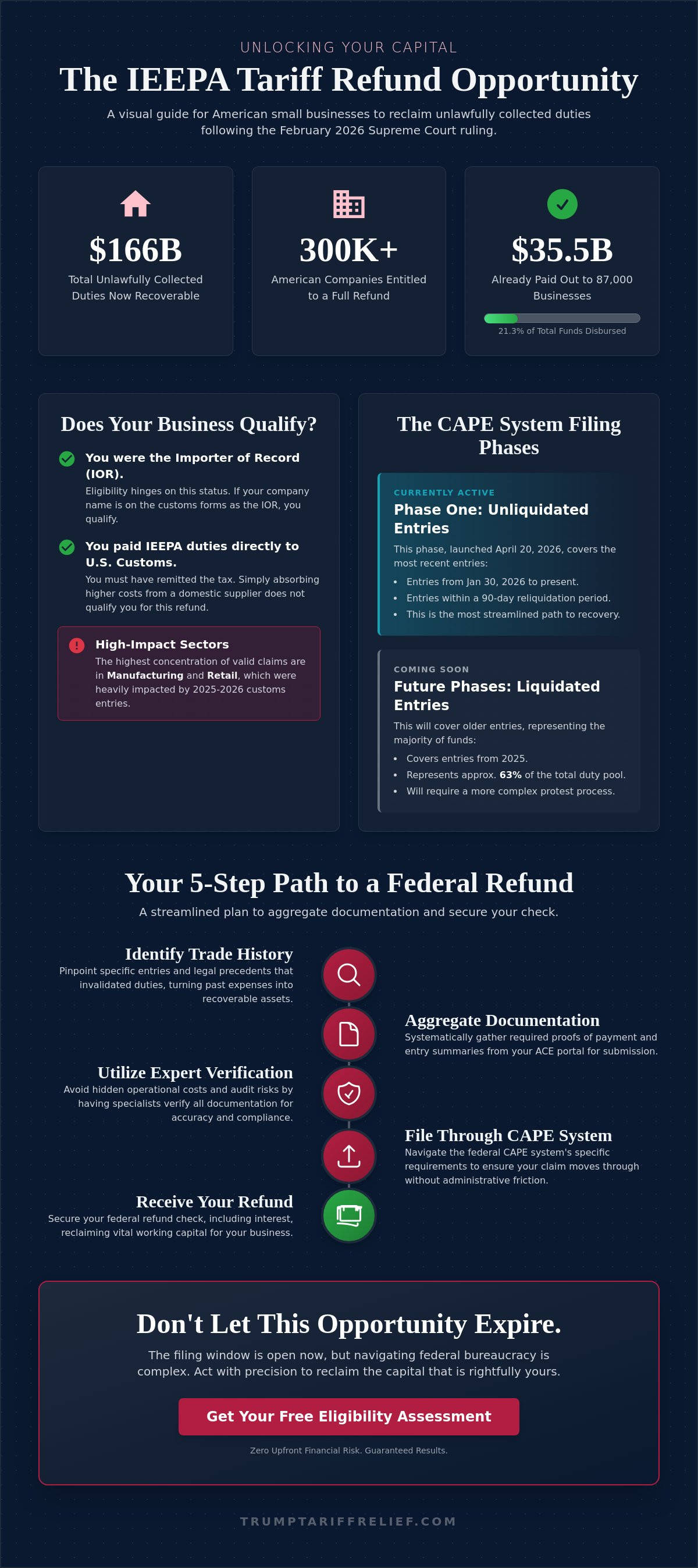
5 Steps to Reclaim Your IEEPA Tariff Refunds
Securing an IEEPA tariff refund for small business requires a methodical offensive against federal bureaucracy. The government isn't going to volunteer these funds; you must proactively identify, prove, and claim what is legally yours. While the CAPE system provides the portal, your internal data provides the ammunition. Following the April 20, 2026, launch of the refund portal, the queue is moving quickly. To ensure your business isn't left behind as the $166 billion pool is disbursed, you must execute these five steps with surgical precision.
Success in this recovery effort depends on the accuracy of your initial submission. A single mismatched entry summary can trigger a denial that takes months to appeal. By treating this process as a high-stakes financial audit rather than a simple clerical task, you protect your company from the common pitfalls that stall DIY applications. If you're ready to bypass the complexity, you can initiate your IEEPA tariff refund recovery today and let our experts handle the heavy lifting.
Step 1: The Audit Phase
The first step is a comprehensive look-back at every customs entry from 2025 through early 2026. You must isolate specific HTS codes that were subject to the now-invalidated IEEPA orders. This is often complicated by overlaps with Section 301 tariffs, such as those found in List 3 and List 4a. You don't want to leave money on the table by missing a code, nor do you want to include ineligible duties that could flag your account for an audit. The goal here is to maximize the claim value by identifying every single eligible dollar paid to U.S. Customs.
Step 2: Documentation Mastery
Once you've identified the entries, you must aggregate your evidence. The 7501 Entry Summary is the gold standard of proof. If you don't have these on hand, contact your customs broker immediately to retrieve them. You'll also need proof of payment, such as ACH records or liquidated entry statements. Verifying the "Liquidation" status of every entry is critical; as discussed previously, phase one only covers unliquidated entries or those within the 90-day window. Organizing these into digital files that meet specific CAPE upload requirements is essential for a smooth filing.
Steps 3-5: Execution and Reconciliation
With your documentation verified, you must then validate your importer identity. Ensure your ACE portal credentials are active and your IOR information is current. Step four is the actual execution of the filing through the CAPE system. Precision here is non-negotiable. Finally, once the claim is submitted, you must monitor the status and reconcile the eventual refund check against your original claim amounts. Remember, these refunds include interest, so your final payout should be higher than the base tariff amount you originally identified.
Partnering with Trump Tariff Relief for Guaranteed Results
Most customs brokers are generalists who focus on daily logistics and routine compliance. While they understand the basics of the ACE portal, they often lack the specialized legal framework and dedicated recovery infrastructure required to challenge federal duty collections. Trump Tariff Relief is not a brokerage; we are a specialized recovery engine. We focus exclusively on recapturing capital lost to unlawful trade policies. Our team of trade experts understands the nuances of the CAPE system and the specific HTS code exceptions that generalists frequently overlook. If you want to secure an IEEPA tariff refund for small business, you need a partner that treats your recovery as a high-stakes financial audit rather than a clerical task.
Our firm provides full-service management that removes the administrative burden from your internal team. We handle the heavy lifting, from the initial identification of eligible entries to the final reconciliation of your refund check. This proactive approach ensures that your claim is positioned correctly within the current 2026 filing window. We don't just file paperwork; we execute a comprehensive recovery strategy designed to maximize the interest and principal returned to your bottom line. By partnering with experts who live and breathe IEEPA recovery, you eliminate the risk of documentation errors that lead to federal denials or unwanted customs scrutiny.
Our Contingency-Based Process
We operate on a "No Recovery, No Fee" promise that perfectly aligns our success with yours. This model is the most capital-efficient path for small businesses because it eliminates the need for upfront legal fees or expensive consulting packages. Our fee structure is transparent and based solely on a percentage of the capital we successfully recover for your business. There are no hourly billing cycles, no retainers, and no hidden administrative costs to drain your operating budget. If we don't win your IEEPA tariff refund for small business, you don't owe us a cent. This transparency builds a foundation of trust and ensures our team remains aggressively motivated to secure every dollar you are owed.
Get Your Free Eligibility Assessment Today
The path to recovery begins with a rapid review of your recent import volume. Our proprietary assessment tools allow us to scan your customs data and identify "hidden" refund opportunities that may have been missed during your standard entry process. We look beyond the surface-level summaries to find every eligible IEEPA-based duty paid during the 2025 and 2026 periods. This preliminary audit is the critical first step in righting a financial wrong and restoring your company's working capital. Don't let federal bureaucracy dictate your financial future. Claim your free assessment and start your recovery now.
Reclaim Your Capital Before the Filing Window Closes
The 2026 Supreme Court ruling transformed trade law into a tangible financial opportunity for importers. You've seen how the CAPE system’s phased approach requires immediate action to protect unliquidated entries before they're finalized. Successfully securing an IEEPA tariff refund for small business isn't a matter of luck; it’s a result of precise documentation and an aggressive audit of your 2025 and 2026 entries.
You don't have to navigate technical ACE portal hurdles alone. Our expert-led team provides a low-friction path to recovery, managing the entire documentation process on your behalf. Because our model is entirely contingency-based, you only pay if we recover your money. There’s no risk to your operating budget and no administrative drain on your lean team. We focus on the bureaucratic heavy lifting so you can focus on growth.
Take the first step toward restoring your working capital today. Start Your Zero-Risk IEEPA Refund Assessment and ensure your business doesn't leave its rightful capital in government hands. You've worked hard for this capital; let’s bring it back to your balance sheet where it belongs.
Frequently Asked Questions
Is the IEEPA tariff refund for small business real?
Yes, this is a legitimate federal recovery process established by the U.S. government following the February 2026 Supreme Court ruling. The government has already approved tens of thousands of requests and disbursed billions of dollars in cash payouts. These refunds are direct results of the court's decision that the specific duties collected were legally unauthorized, making the restoration of these funds a mandatory administrative action for CBP.
What is the deadline for filing an IEEPA tariff refund claim in 2026?
There is no single expiration date for the entire program, but the clock is ticking on specific entries. Phase one is currently limited to unliquidated entries or those within a 90 day reliquidation window. If you miss these narrow windows, your entries may move to a liquidated status. This makes securing an IEEPA tariff refund for small business much more difficult as it requires a complex and lengthy protest process.
How much does it cost to use a tariff recovery service?
Reputable recovery services operate on a contingency basis, so there are no upfront costs, retainers, or hidden consulting fees. You only pay a percentage of the actual capital successfully recovered from the government. This model protects your small business cash flow and ensures that your recovery partner is fully motivated to maximize the total value of your refund check, including all applicable interest payments.
What documents do I need to prove my small business paid IEEPA tariffs?
The 7501 Entry Summary is the primary document required to validate your claim. You will also need commercial invoices and clear proof of payment, such as ACH remittance records or bank statements, to confirm your status as the Importer of Record. These documents must perfectly match the data housed within the CAPE system to avoid manual reviews and ensure your IEEPA tariff refund for small business is processed without delay.
How long will it take to receive my refund check from CBP?
CBP currently estimates a processing window of 60 to 90 days for claims that are submitted without documentation errors. If the CAPE system flags your filing for manual verification due to mismatched HTS codes or missing invoices, this timeline can extend significantly. Enrolling in the Automated Clearing House (ACH) system is the most efficient way to receive your funds, as it bypasses the delays associated with physical treasury checks.
Can I file for a refund if my customs broker already handles my entries?
Yes, you can pursue a refund regardless of your current broker relationship. Most customs brokers focus on daily logistics and compliance rather than the retrospective legal work required for high-stakes recovery. A specialized partner works independently to audit your historical data and manage the CAPE filing process. This ensures you receive expert attention for your refund claim without disrupting your broker's ongoing management of your current imports.
What happens if my business has already closed or changed ownership?
Eligibility for a refund typically remains with the specific legal entity that acted as the Importer of Record when the duties were paid. if your business has undergone a merger or change in ownership, you must provide legal documentation of successor interest to redirect the funds. Even if a business is no longer operational, the legal entity may still be entitled to collect these past overpayments provided the corporate structure still exists.
Does this refund apply to Section 301 China tariffs as well?
No, this recovery program is strictly limited to duties collected under the International Emergency Economic Powers Act. While many businesses paid both types of duties, the legal basis for this refund is the February 2026 ruling that specifically invalidated IEEPA-based authority. You must carefully distinguish between these tariff categories during your audit phase to ensure your claim only includes eligible entries that fall under the Supreme Court's mandate.
Ready to find out what your business may be owed?
Check My Eligibility