
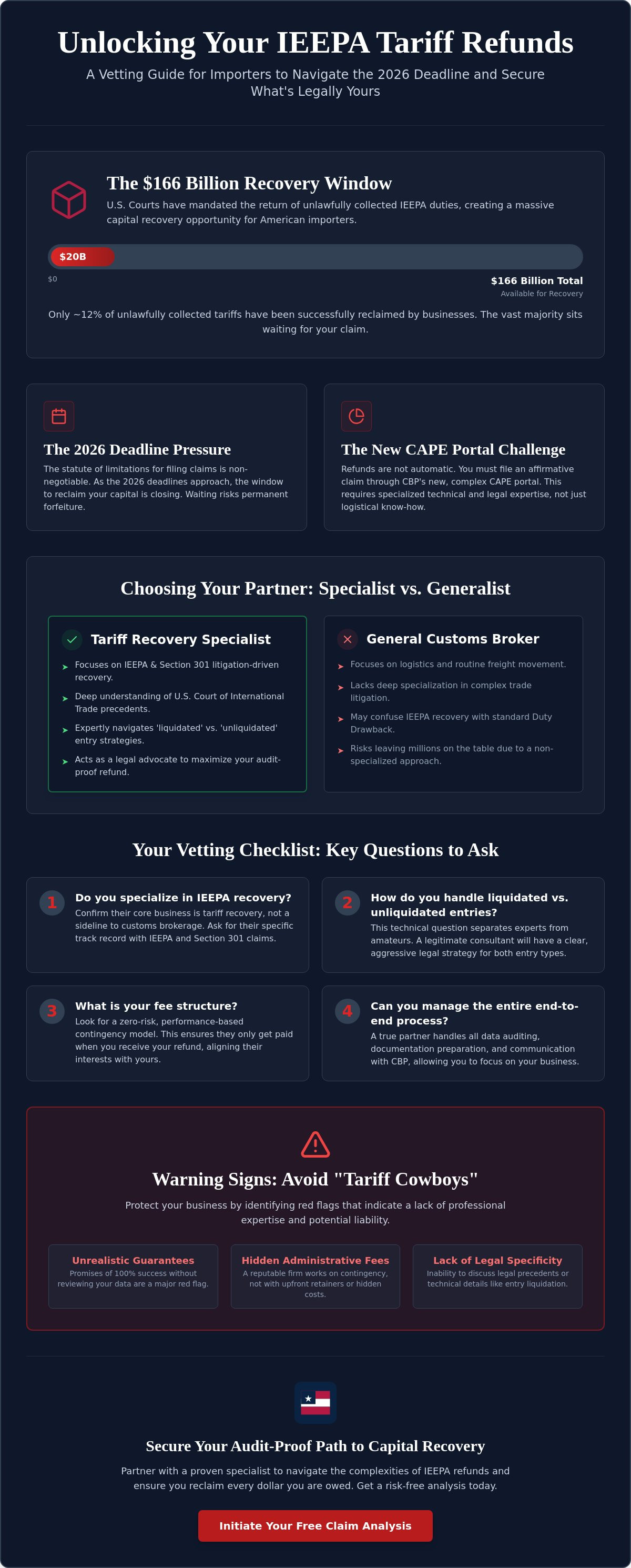
Over $166 billion in unlawfully collected IEEPA duties is currently sitting in government coffers, yet only about $20 billion has actually made its way back to American businesses as of June 2026. It's a staggering figure that represents vital capital your company could be using to scale, but the complexity of the CAPE portal and the fear of "tariff cowboys" making empty promises can feel paralyzing. You've worked hard for your revenue; you shouldn't have to fight a second battle just to reclaim what's legally yours before the final 2026 filing windows close.
Identifying a partner who can distinguish between refundable IEEPA claims and ongoing Section 301 obligations is the only way to ensure your recovery is audit-proof. This guide provides an expert-vetted checklist of the specific questions to ask a tariff refund consultant to ensure you're partnering with a legitimate advocate rather than a liability. We'll break down the technical vetting process so you can secure a risk-free path to capital recovery and let a professional handle the heavy lifting with CBP.
Key Takeaways
- Navigate the shifting 2026 trade landscape by understanding how the new ACE portal deployment affects your IEEPA recovery timeline and eligibility.
- Master the specific questions to ask a tariff refund consultant to ensure your partner has the legal standing and specialized track record required for complex Section 301 claims.
- Protect your business from "tariff cowboys" by identifying red flags like unrealistic success guarantees and hidden administrative fees that suggest a lack of professional expertise.
- Secure an audit-proof path to capital recovery with a partner who manages the entire end-to-end documentation process on a zero-risk, performance-based contingency model.
The 2026 IEEPA Refund Landscape: Why Consultant Choice Matters Now
The U.S. Court of International Trade has fundamentally shifted the trade landscape. By ruling that tariffs imposed under the International Emergency Economic Powers Act (IEEPA) were unlawful, the court opened a $166 billion recovery window for importers. This isn't a suggestion; it's a legal mandate for the return of capital. The April 20, 2026, deployment of the CAPE portal within the ACE system represents a total overhaul in how CBP processes these claims. We've moved from a slow, manual era into a high-speed, centralized electronic environment.
A tariff refund consultant is a specialized trade expert who audits import data to identify and reclaim duties paid under unlawful or expired executive orders. Because the government has centralized this process, your choice of partner is now a technical decision as much as a legal one. Knowing the specific questions to ask a tariff refund consultant before signing a contract will determine whether your claim is accepted or buried in a digital backlog.
The Reality of Non-Automatic Refunds
The government won't simply mail you a check because the law changed. CBP requires an affirmative claim. As the Importer of Record, the responsibility to trigger the recovery process falls entirely on your shoulders. If you don't file, the government keeps your money. Many businesses mistakenly assume their general customs broker will handle this. However, duty recovery is a forensic specialty, not a logistics task. Relying on a generalist often means missing the nuanced legal precedents that maximize a refund. You risk leaving millions on the table by not engaging a specialist who understands the specific IEEPA landscape.
The 2026 Deadline Pressure
The clock is ticking on your eligibility. The tariff refund statute of limitations is non-negotiable. Once these dates pass, your right to reclaim duties is extinguished. We're currently seeing a massive influx of filings as the 2026 deadlines approach. This surge is creating a consultant backlog, meaning the most experienced firms are reaching capacity quickly. Waiting to see how the landscape develops is a recipe for financial loss. Every day you delay is a day closer to a permanent forfeiture of your capital. Securing your place in the filing queue requires immediate action and the right questions to ask a tariff refund consultant to ensure they have the bandwidth to win your case.
Core Expertise: Questions to Ask About Legal Standing and IEEPA Track Record
Vetting a firm's legal standing starts with their specific track record in trade litigation. You must determine if a firm specializes in IEEPA and Section 301 recovery or if this is merely a side-line to their general customs brokerage. A generalist might understand the basics of import entries, but they won't have the deep relationship with U.S. Court of International Trade (CIT) legal precedents necessary to win a contested claim. When evaluating your options, the most vital questions to ask a tariff refund consultant revolve around their technical grasp of the IEEPA tariff ruling beyond the surface-level headlines.
A sophisticated consultant should be able to explain how they handle 'liquidated' versus 'unliquidated' entries in their eligibility assessment. Liquidated entries, where the duty calculation is technically "final" in the eyes of CBP, require a much more aggressive legal strategy than unliquidated ones. If a consultant can't distinguish between these two categories during your first meeting, they aren't equipped to handle the $166 billion recovery window effectively. They must function as a bold advocate who understands exactly which entries are eligible for the various phases of the CAPE portal rollout.
Specialization vs. Generalization
Your standard customs broker is excellent for moving freight, but they aren't litigators. Landmarking Supreme Court-driven claims require a specialized recovery process that differs significantly from routine operations. Importers often confuse 'Duty Drawback' with 'IEEPA Refund Recovery', but these are entirely different animals. Drawback is a recurring process for exported goods; IEEPA recovery is a litigation-driven event based on unlawful executive overreach. This Brookings analysis on IEEPA and Section 301 highlights that the shift to Section 301 investigations requires a specific litigation strategy that most general brokers simply don't possess. Ask: 'What percentage of your current caseload is dedicated specifically to IEEPA claims?' If it isn't their primary focus, your claim is at risk of being deprioritized.
Technical Knowledge of CBP Systems
Proficiency with the new Consolidated Administration and Processing of Entries (CAPE) portal is the baseline for success in 2026. The April 2026 ACE portal updates effectively ended the era of manual, entry-by-entry filings for large-scale recovery. These manual claims are now obsolete, slow, and prone to administrative rejection. One of the primary questions to ask a tariff refund consultant is: 'How is your team preparing for the April 2026 ACE portal updates?' A legitimate partner will demonstrate a seamless electronic filing strategy that ensures your documentation is audit-proof. You can't afford a partner who's still learning the system while your filing window closes. You can begin securing your recovery by reviewing our eligibility assessment criteria to see where your data stands.
The Financial Framework: Questions to Ask About Fees and Risk
The financial structure of your recovery agreement is the ultimate test of a consultant's confidence in their own expertise. If a firm asks for upfront "filing fees" or "administrative retainers," they are shifting the risk of government bureaucracy onto your balance sheet. A contingency fee ensures the consultant only earns revenue if the business successfully recovers capital. This alignment of interests is non-negotiable in high-stakes trade litigation. When evaluating a potential partner, the most critical questions to ask a tariff refund consultant involve the granular details of how they profit from your recovery. You are seeking a partner, not a vendor with a guaranteed paycheck regardless of the outcome.
Contingency vs. Hourly Rates
Hourly billing creates a distinct moral hazard in the complex world of CBP recovery. Because the CAPE portal and IEEPA litigation involve unpredictable timelines, an hourly model incentivizes a consultant to prolong the process rather than resolve it. The benefits of contingency-based recovery are clear; it preserves your business cash flow and places the burden of performance squarely on the expert. You shouldn't be paying for a consultant's learning curve or their administrative overhead. Ask: 'Are there any circumstances where I would owe money if no refund is recovered?' If the answer isn't a definitive "no," you are assuming unnecessary financial risk. In a landscape where $166 billion is owed to importers, the right partner should be willing to bet on their ability to win.
Accounting and Interest Transparency
The U.S. government doesn't just owe you the principal duties; they owe you interest on those unlawfully held funds. With the average effective tariff rate hitting 11.0% in early 2026, the interest portion of a multi-million dollar claim can be substantial. You must clarify how the consultant calculates their "Total Recovery Amount." Does their success fee apply only to the principal, or do they take a cut of the interest as well? Transparency here is vital for your internal tax and accounting teams. Ensure they provide detailed reporting that breaks down principal versus interest to simplify your year-end filings.
What happens if a claim is partially denied? This is a common scenario when specific HTS codes are challenged by CBP or when certain entries fall outside the 80-day liquidation window. A legitimate partner will adjust their fee proportionally to the actual capital returned to your bank account. They should provide a clear framework for how they handle these partial wins. If they expect a full fee for a partial recovery, it's a sign they are prioritizing their margins over your restoration. Your questions to ask a tariff refund consultant must force this level of clarity before any data is shared.
Operational Red Flags: Warning Signs to Avoid in a Consultant
The influx of $166 billion in potential refunds has unfortunately attracted opportunistic "tariff cowboys" looking for a quick payout. These firms often lack the legal gravitas and technical infrastructure required for high-stakes recovery. One of the first questions to ask a tariff refund consultant is whether they require a preliminary tariff refund assessment of your historical data. If they're willing to file without a forensic review of your HTS codes and entry types, they're inviting a customs audit into your business. A legitimate partner won't guess; they'll audit.
Technical ignorance is a massive liability. You should be wary of any firm that cannot explain the nuances between Section 301 List 3 and List 4a eligibility or how those lists intersect with the IEEPA ruling. If they don't have a clear system for documentation management or a track record of handling customs protests, they aren't equipped for the 2026 landscape. Look for these specific red flags during your initial consultation:
- Guarantees of a 100% success rate on all filed entries.
- Pressure to sign a contract before they've reviewed your ACE data.
- Inability to explain the difference between unliquidated entries and those liquidated past the 80-day window.
- Lack of a dedicated legal team specializing in trade litigation.
The 'Guaranteed' Refund Trap
No consultant can control the speed of the U.S. government. CBP has established a multi-phased rollout for the CAPE portal, with Phase 1 launching on April 20, 2026, and Phase 2 following on June 29, 2026. Future phases for more complex, finally liquidated entries are still being scheduled. Any firm that guarantees a specific check-in-hand date is being dishonest about the bureaucracy involved. Ask: 'How do you manage client expectations regarding CBP processing times?' A professional will provide a realistic timeline based on current government throughput rather than a sales pitch. They should focus on the accuracy of the filing to ensure it isn't rejected, not just the speed of the payout.
Data Integrity and Audit Risks
Aggressive filing is a dangerous strategy. If a consultant files a claim for duties that aren't legally refundable under the IEEPA ruling, it flags your company for a broader compliance review. This is why you need a partner who prioritizes customs documentation management and data verification. Ask: 'What is your process for verifying the accuracy of my historical import data?' They should explain how they cross-reference your internal records with ACE data to ensure every claim is audit-proof. Don't let a "cowboy" put your business at risk; secure your recovery with a professional eligibility assessment today.
Securing Your Recovery with Trump Tariff Relief
Choosing the right partner is about more than just checking boxes; it's about reclaiming capital that rightfully belongs to your business. At Trump Tariff Relief, we eliminate the uncertainty that comes with vetting external firms. While many generalists are still trying to understand the nuances of the $166 billion IEEPA recovery window, our team of legal and trade experts is already managing the end-to-end recovery process for hundreds of importers. We don't just provide a list of questions to ask a tariff refund consultant; we provide the definitive answers through assertive action. Our focus remains exclusively on IEEPA and Section 301 duty recovery, positioning us as the specialized choice for businesses navigating the high-stakes 2026 trade landscape.
Our strict contingency-fee model removes all financial barriers to entry. You won't face upfront costs, hourly billing, or hidden administrative fees. This performance-based approach means we only earn a percentage of the funds that actually land in your bank account. We take on the heavy lifting and the regulatory risk, allowing you to focus on your core operations while we battle the bureaucracy of CBP. If we don't recover your capital, you don't owe us a cent. It's a low-risk, high-reward partnership designed to right a financial wrong and restore your company's liquidity.
Our Proven 3-Step Process
We've streamlined the recovery path into a methodical, three-step engine. First, we conduct a Preliminary Eligibility Assessment to quantify your potential recovery based on your historical ACE data. Second, our team performs a comprehensive data audit and prepares all necessary documentation for a compliant CBP filing. Finally, we provide direct management of the ACE portal submission and all subsequent follow-ups. We navigate the technical complexities of the CAPE system so you don't have to, ensuring every entry is filed correctly the first time.
Get Started Before the 2026 Window Closes
The window for recovery is narrowing rapidly. With $85 billion in claims already accepted for processing in the CAPE system as of June 30, 2026, the government is moving through phases quickly. Waiting until the end of the year could result in missing critical filing deadlines or facing a massive administrative backlog that delays your payout. You can request your free eligibility assessment today to determine exactly how much your business is owed. Don't leave your hard-earned capital in the government's hands. Contact our recovery specialists for a no-obligation consultation and secure your path to financial restoration before the 2026 filing windows close forever.
Reclaim Your Capital Before the 2026 Deadline
The window for IEEPA recovery is a fleeting opportunity to restore your company's liquidity. By mastering the right questions to ask a tariff refund consultant, you've taken the first step toward distinguishing elite trade advocates from opportunistic generalists. Success in 2026 requires a partner who understands the technical shift of the ACE portal and the legal weight of Section 301 precedents. Trump Tariff Relief provides the specialized expertise and full management needed to navigate these complex government systems. Our model is built on transparency and results. We handle the heavy lifting while you maintain focus on your core business.
Because we operate on a strict contingency basis, you only pay if we win your claim. There is no upfront cost and zero financial risk to your organization. Don't allow your capital to sit idle in government accounts while the 2026 filing windows close. Take action today to ensure your historical entries are audit-proof and eligible for recovery. Your business deserves a partner that fights for every dollar.
Request Your Free IEEPA Eligibility Assessment and let our recovery specialists identify your path to restoration.
Frequently Asked Questions
Is the China tariff refund real or is it a scam?
The IEEPA tariff refund is a legitimate legal recovery process resulting from the U.S. Supreme Court's February 20, 2026, ruling that certain duties were collected unlawfully. While scammers do target importers with "guaranteed" payouts, the official recovery mechanism is the Consolidated Administration and Processing of Entries (CAPE) portal established by CBP in April 2026. Legitimate consultants focus on forensic data audits and legal standing rather than making unsolicited phone calls or promising immediate checks.
How much do tariff refund consultants typically charge?
Reputable consultants in 2026 almost exclusively utilize a performance-based contingency fee structure. This means the firm earns a percentage of the actual capital recovered and only after the funds are returned to your accounts. You should avoid any firm that requires upfront retainers or administrative filing fees; a legitimate partner assumes the financial risk of the recovery process because they're confident in their ability to win.
What documents will a consultant need from me to start a claim?
A consultant primarily requires access to your ACE (Automated Commercial Environment) data and historical entry summaries, specifically CBP Form 7501. This documentation allows the team to cross-reference your HTS codes against the IEEPA eligibility list. Having your Importer of Record (IOR) number ready is the first step in quantifying your potential recovery and ensuring your data is audit-proof before submission.
Can my current customs broker file for an IEEPA refund?
While an authorized broker can technically file, most general brokerage firms lack the specialized litigation expertise required for IEEPA and Section 301 recovery. One of the primary questions to ask a tariff refund consultant is how they manage the technical nuances of the April 2026 ACE portal updates. Generalists often focus on current freight movement rather than the forensic auditing needed to reclaim millions in past duties.
How long does the tariff refund process take in 2026?
The timeline depends on which phase your entries fall into, with unliquidated entries in Phase 1 processing faster than complex cases in later phases. As of June 30, 2026, roughly $20 billion in refunds have been returned to importers, but administrative backlogs are growing. You can expect the process to take several months as CBP manages the $85 billion in claims currently accepted for processing.
What happens if the government denies my IEEPA refund claim?
If CBP denies a claim, a specialized consultant will file a formal protest to challenge the decision based on established legal precedents. This is why expertise in the U.S. Court of International Trade rulings is vital for your chosen partner. They manage the technical follow-up and provide the necessary documentation to overturn rejections and secure your capital recovery through the appropriate legal channels.
Is there a deadline to hire a consultant for IEEPA recovery?
Yes, the statute of limitations for these claims is non-negotiable and strictly enforced by CBP. The surge in filings during mid-2026 means that top-tier firms are reaching capacity quickly. Waiting to vet the questions to ask a tariff refund consultant could result in missing the final filing windows for entries that are reaching their final liquidation deadlines.
Do I have to pay anything if the consultant fails to get my money back?
Under a standard contingency-based model, you owe nothing if the consultant fails to recover your funds. This "no-win, no-fee" arrangement ensures that your business doesn't assume any financial risk for the audit or filing process. It places the burden of performance entirely on the consultant, aligning their success directly with your capital restoration.
Ready to find out what your business may be owed?
Check My Eligibility