
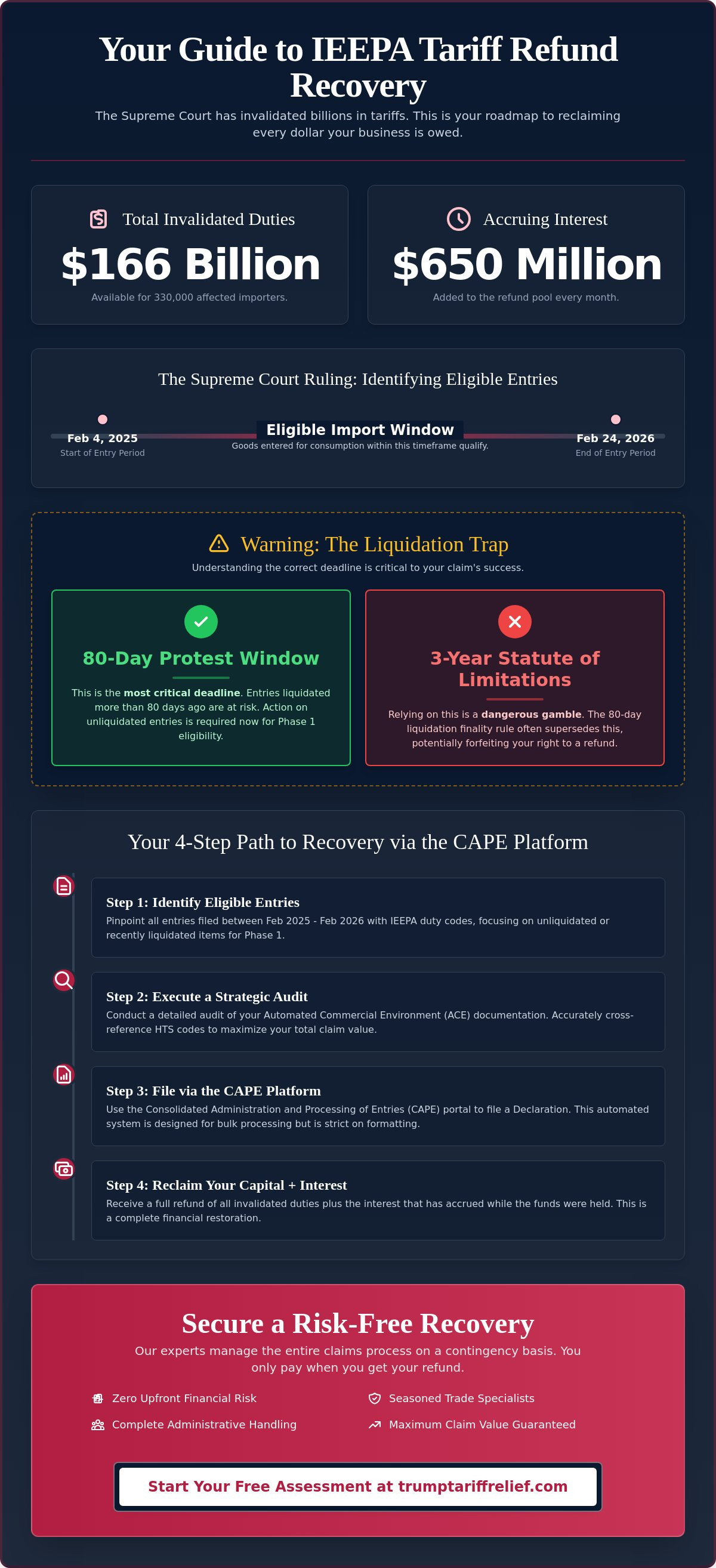
Over $166 billion in invalidated duties is currently sitting in government accounts, and with interest accruing at a staggering $650 million every month, your capital is effectively being held hostage. The Supreme Court’s February 2026 ruling confirmed that these charges were never authorized by law, making IEEPA tariff refund recovery the single most important financial priority for affected importers this year. You’ve likely felt the strain of these unauthorized payments on your bottom line, and while the path to restoration is finally open, the window for action is closing faster than most realize.
This guide reveals how to navigate the complex CAPE platform and reclaim your capital without any upfront financial risk to your business. We’ll explain why relying on a rumored three-year statute of limitations is a dangerous gamble when the 80-day protest window is what actually determines your Phase 1 eligibility. You’ll learn how to manage the Automated Commercial Environment requirements and leverage an expert-led assessment to reclaim every dollar, plus interest, through a completely hands-off process managed by seasoned trade specialists.
Key Takeaways
- Identify which specific 2025 and 2026 import entries fall under the Supreme Court's mandate for full duty restoration.
- Navigate the technical requirements of the CAPE platform to ensure your IEEPA tariff refund recovery is processed without administrative delays.
- Recognize the "Liquidation Trap" and why the 80-day protest window is more critical to your capital than the three-year statute of limitations.
- Execute a strategic audit of your ACE documentation to accurately cross-reference HTS codes and maximize your total claim value.
- Secure a risk-free recovery path using a contingency-based model that eliminates upfront costs and shifts the administrative burden to experts.
Understanding the IEEPA Tariff Invalidation and Your Right to Recovery
The February 20, 2026, Supreme Court decision triggered a massive shift in the U.S. trade landscape. The justices ruled that the executive branch exceeded its authority by imposing duties under the International Emergency Economic Powers Act (IEEPA). This landmark ruling effectively invalidated tariffs paid on approximately 53 million entries between February 4, 2025, and February 24, 2026. For importers, this isn't just a legal victory; it's a mandate for financial restoration. With roughly $166 billion in total duties eligible for recovery across 330,000 importers, the scale of this opportunity is unprecedented.
Distinguishing these refunds from other trade measures is vital for an accurate audit. While Section 301 tariffs on Chinese goods remain in full force, the IEEPA surcharges have been stripped of their legal standing. Because interest is accruing at an estimated $650 million per month, every day of delay represents a direct loss of potential capital. This is the largest tariff refund event in recent history, and the administrative mechanism for IEEPA tariff refund recovery is now live through the automated portal.
The Legal Catalyst: Why the Supreme Court Sided with Importers
The Supreme Court's ruling focused on the strict limits of presidential power. The justices determined that while the act grants the executive branch broad authority to regulate commerce during emergencies, it doesn't provide a blank check to levy tariffs without explicit Congressional approval. This decision upheld the constitutional principle that the power to tax resides solely with the legislature. Following this lead, the Court of International Trade (CIT) issued orders directing U.S. Customs and Border Protection (CBP) to establish a streamlined administrative refund process. The ruling is final. It provides a stable legal foundation that future administrations can't easily dismantle, ensuring your right to recovery is protected.
Identifying Eligible IEEPA Duties
Not all import entries are treated equally under the new CAPE platform. Eligibility depends largely on the timing of your filings and the current status of your entries. Successful recovery requires precise identification of these factors:
- Entry Period: Goods entered for consumption between February 4, 2025, and February 24, 2026.
- Duty Distinction: ACE data must reflect specific IEEPA-related duty codes, separate from Section 301 or Section 232 duties.
- Liquidation Status: Entries that are unliquidated or were liquidated within 80 days of the April 20 launch are the primary focus of the initial recovery wave.
Phase One of the IEEPA tariff refund recovery process, which launched on April 20, 2026, is restricted to unliquidated entries and those liquidated within the previous 80 days. For older entries, the path to recovery requires a more aggressive documentation strategy to avoid the trap of finality during liquidation.
Navigating the CAPE Platform: Phased Rollouts and Filing Requirements
CAPE stands for the Consolidated Administration and Processing of Entries. It's the exclusive automated mechanism through which all IEEPA claims must pass. Following the Supreme Court's tariff decision, U.S. Customs and Border Protection (CBP) launched this platform on April 20, 2026, to manage the unprecedented volume of refunds. While a traditional protest is often a manual legal challenge, a CAPE Declaration allows for the bulk processing of thousands of entries at once. Choosing the right mechanism depends on your entry status; unliquidated entries are handled via Declaration, while older, liquidated entries might still require a protective protest to preserve your legal standing.
Securing an IEEPA tariff refund recovery isn't a passive process. It's an administrative sprint. Importers who fail to categorize their entries correctly within the CAPE framework risk being pushed to the back of a queue that already includes over 330,000 businesses. The platform is designed for speed, but its rigid formatting requirements mean that even a minor data mismatch can lead to an immediate rejection of your entire claim.
The CAPE Declaration Process Explained
The process begins within your ACE Portal account. As the Importer of Record (IOR), you must submit a digital file that contains specific data points for every affected shipment. Each Declaration file can accommodate up to 9,999 entry numbers, making it essential to aggregate your data perfectly before submission. You'll need the exact entry dates, the specific duty amounts paid under IEEPA authority, and the corresponding HTS codes. Common technical hurdles often involve formatting errors in the entry number field or discrepancies between the duties paid and the amounts claimed. These errors trigger automated "soft" rejections that can delay your 60 to 90-day refund window significantly.
Phases of Recovery: Where Does Your Business Stand?
CBP is managing this restoration in distinct waves. Phase One is currently active and targets the most recent transactions, specifically unliquidated entries and those liquidated within the previous 80 days. This phase generally covers payments made starting January 30, 2026, though your specific liquidation cycle determines your exact eligibility. If your entries fall into this category, the clock is already ticking on your 80-day window to act.
Phase Two and Three will address older 2025 entries that are already fully liquidated. Waiting for an official notification from CBP is a strategic error; the government isn't required to invite you to claim your capital. Instead, proactive importers are already conducting a preliminary eligibility assessment to ensure their documentation is audit-ready the moment the next phase opens. This preparation is the only way to bypass the inevitable bottleneck of late-filers and secure your IEEPA tariff refund recovery before the June appeal deadlines.
The 3-Year Deadline: Why Timing is the Greatest Risk to Your Claim
While many trade publications reference a general three-year statute of limitations for federal overpayments, relying on this broad window is a dangerous strategic error for IEEPA tariff refund recovery. In the complex world of customs law, the "liquidation" of an entry is the final administrative act that seals your financial fate. Once an entry liquidates, a much tighter 180-day clock begins for filing a formal protest. If you wait for the three-year mark to approach, you'll likely find that your 2025 entries have long since become final, making them legally unrecoverable regardless of the Supreme Court's ruling.
The year 2026 is the critical threshold for all importers who paid IEEPA duties during the 2025 cycle. Because the CAPE platform processes entries in phases, there's a growing risk of an administrative backlog that could push your claims past their legal expiration dates. With over 53 million entries eligible for restoration, the queue is already massive. Filing early doesn't just put you at the front of the line for the 6% to 7% interest payments; it protects your standing against future Department of Justice appeals or shifts in trade policy that could close the recovery window without notice.
Understanding the Statute of Limitations for Tariff Protests
The standard 180-day protest rule is the primary barrier between your business and its capital. You calculate your "drop-dead" date by identifying the specific liquidation date for each shipment in your ACE portal. While some theoretical legal arguments suggest a longer window, the Court of International Trade prioritizes the established protest timeline. Once an entry is liquidated and the protest period expires, the money is legally gone. This makes the 2026 filing calendar the most important document for your treasury department this year.
The High Cost of Inaction
Internal "wait and see" policies often lead to permanent capital loss. Consider a mid-sized manufacturer that imported industrial components throughout 2025, accruing $500,000 in IEEPA surcharges. If that manufacturer ignores the 180-day protest window while waiting for a Phase Three CAPE announcement, they forfeit their right to that half-million dollars. This isn't a hypothetical scenario; it's a mathematical certainty for those who miss their liquidation deadlines. Given that interest is accruing at $650 million per month across the industry, every week of hesitation costs your business real money. Proactive IEEPA tariff refund recovery is the only way to ensure these funds return to your balance sheet rather than remaining in the government's accounts.
How to Audit Your Import Records for Maximum Recovery
The government’s automated search tools are built for administrative convenience, not for maximizing your return. Relying solely on basic keyword searches within the ACE portal often leaves significant capital on the table. A comprehensive audit requires a structured, five-step methodology to ensure every eligible entry is captured and every cent of interest is accounted for. This isn't just about compliance; it's about reclaiming what is legally yours.
First, aggregate your full Automated Commercial Environment (ACE) data for the 2025-2026 period. This requires pulling deep entry summary reports rather than just glancing at recent invoices. Second, cross-reference your HTS codes against the specific list of invalidated mandates. Third, verify your Importer of Record (IOR) status for each claim to ensure you have the legal standing to receive the funds. Fourth, quantify the total recovery amount, including the applicable interest rates. Finally, prepare a robust evidence package for your CAPE declaration to preemptively address potential CBP inquiries.
Extracting the Right Data from ACE
Identifying the correct data points is the most technical hurdle in the IEEPA tariff refund recovery process. You need to pull the "Entry Summary" reports from the ACE portal, focusing specifically on duty codes that represent the IEEPA surcharges. These charges aren't always explicitly labeled. They're often buried within broader duty calculations. While your customs broker can provide historical summaries, the responsibility for the audit’s accuracy rests with the IOR. A professional review often identifies "hidden" charges that brokers, focused on ongoing compliance rather than retrospective recovery, might overlook.
Documenting the Claim for CBP Approval
CBP’s validation process is notoriously rigid. Your evidence package must include CBP Form 7501, detailed commercial invoices, and definitive proof of payment for the duties in question. Mismatched data between your declaration and the government’s records is the leading cause of claim rejection. Mismatches occur due to rounding errors, incorrect entry numbers, or unauthorized IOR signatures. This is where professional IEEPA tariff refund recovery services provide the most value. Because we specialize in customs documentation management, our audits typically uncover 15% to 20% more recoverable duty than internal corporate reviews. We identify the discrepancies that lead to rejections before you hit "submit," ensuring your capital returns to your balance sheet on the first attempt.
Trump Tariff Relief: Risk-Free IEEPA Recovery on a Contingency Basis
Most importers are currently overwhelmed by the technical demands of the CAPE portal and the looming 180-day liquidation trap. Trump Tariff Relief offers a decisive alternative that removes the administrative weight from your shoulders. We provide a full-service IEEPA tariff refund recovery that manages the entire lifecycle of your claim. Unlike large brokerage firms that only audit entries they personally handled, our team reviews your entire 2025-2026 import history regardless of who managed the original filings. This ensures no eligible entry is overlooked during the phased rollout.
Our approach is built on a foundation of professional confidence and shared risk. We don't believe you should have to pay upfront to reclaim money that was taken through an unconstitutional mandate. By providing a comprehensive Tariff Eligibility Assessment within 48 hours, we give you a clear, data-backed view of your potential recovery before you commit to the process. This speed is essential given the June appeal deadlines and the massive queue of over 330,000 importers currently seeking restoration.
Contingency vs. Hourly: Why Success-Based Fees Align Interests
High hourly legal fees often prevent small and mid-sized businesses from pursuing the capital they're owed. Our contingency-fee model eliminates this barrier entirely. You don't pay for our time; you only pay when we successfully return capital to your balance sheet. This structure ensures our team is aggressively incentivized to identify every eligible HTS code and every cent of accrued interest. There are no hidden filing fees or upfront consulting costs. It's a pure success-based partnership that aligns our goals with your financial restoration.
Your Partner in Financial Restoration
We act as your specialized advocate in the face of federal bureaucracy. Our deep expertise in IEEPA tariff refund recovery means we handle the technical complexities of customs documentation management while your team focuses on core operations. From the initial ACE data pull to the final liquidation of your refund, we provide a "hands-off" experience that prioritizes your time. We've seen how easily entries are lost to administrative errors, and we're here to ensure your capital returns to your accounts where it belongs.
Don't let your capital remain in government accounts while interest continues to accrue for the treasury. Take the first step toward reclaiming your duties without any financial risk. Get Your Free IEEPA Eligibility Assessment Today and secure your place in the recovery queue.
Secure Your Right to Financial Restoration
The Supreme Court’s ruling has created a historic opportunity to reclaim capital that never should've been taken. However, the path to IEEPA tariff refund recovery is paved with administrative hurdles and strict liquidation deadlines that don't wait for your team to get organized. Success requires more than just knowing you’re eligible; it demands a precise audit of your ACE data and an expert-led submission through the CAPE portal. By choosing a partner that operates on a contingency basis, you eliminate the risk of legal fees while ensuring every eligible entry is identified and processed correctly.
Our team handles the entire documentation lifecycle, from the initial comprehensive audit to final liquidation. We're here to restore your balance sheet and right this regulatory wrong. Take action today to ensure your business receives the full interest and duty restoration it deserves. You’ve already paid enough; it’s time to bring that capital back home.
Start Your Risk-Free IEEPA Recovery Assessment Now
Frequently Asked Questions
Is the IEEPA tariff refund legitimate and real?
Yes, the refund process is an active administrative mandate following the Supreme Court’s February 20, 2026, ruling. U.S. Customs and Border Protection launched the CAPE platform on April 20, 2026, specifically to handle these claims. As of May 11, 2026, over 8 million entries have already been fully processed, resulting in approximately $35.46 billion in anticipated refunds. This is a verified legal restoration of capital, not a speculative opportunity.
Who is the Importer of Record (IOR) and why does it matter for my claim?
The Importer of Record is the entity legally responsible for the payment of duties and compliance with customs regulations. Only the IOR has the standing to file for an IEEPA tariff refund recovery. If your business is listed as the IOR on the CBP Form 7501, the right to the refund belongs to you. It doesn't matter who manufactured the goods; the entity that paid the duties owns the claim.
How long does the IEEPA refund process take in 2026?
CBP expects to issue valid refunds within 60 to 90 days after a CAPE Declaration is accepted. The first wave of payments was scheduled for distribution around May 11, 2026. However, the exact timing depends on the accuracy of your submission. Mismatched data or formatting errors in the ACE Portal can lead to rejections that significantly delay your restoration of capital.
Can I claim a refund if my customs broker has already closed my account?
Yes, your eligibility is tied to your IOR number rather than a specific customs broker. You don't need the original broker to file the claim as long as you can access your historical ACE data. A specialized recovery partner can pull your entries and manage the documentation requirements through the CAPE platform even if your previous brokerage relationship has ended.
What happens if I missed the Phase One filing window for January 2026 entries?
Missing the initial window puts your capital at significant risk because liquidated entries become final after 180 days. Phase One is currently limited to unliquidated entries and those liquidated within the last 80 days. If your entries fall outside this window, you must act quickly to file a protective protest before the June 6, 2026, appeal deadline to preserve your legal rights.
Do I need a lawyer to file for an IEEPA tariff refund?
No, you don't need a lawyer to file the administrative declaration, but the technical requirements are demanding. Most importers prefer a specialist who manages the IEEPA tariff refund recovery on a contingency basis. This approach provides expert navigation through the CAPE platform without the high cost of hourly legal fees, ensuring your audit is completed by professionals who understand the specific HTS code invalidations.
Will I receive interest on the tariff duties recovered from the government?
Yes, the government pays interest on every dollar of duties recovered. For the first quarter of 2026, the annual interest rate is 6% for corporate filers and 7% for non-corporate filers. This is a critical factor for your treasury department, as industry-wide interest is currently accruing at an estimated $650 million every month. Delaying your filing directly reduces the total interest you'll collect.
What is the difference between an IEEPA refund and a Section 301 China tariff refund?
These two types of tariffs fall under completely different legal authorities. The current refund process only applies to the global surcharges invalidated by the Supreme Court in February 2026. Section 301 tariffs, which target Chinese imports, were not part of this ruling and remain fully in effect. Importers who paid both must carefully separate the IEEPA portion of their payments during the audit process.
Ready to find out what your business may be owed?
Check My Eligibility