
Up to $175 billion in unauthorized IEEPA tariffs is currently sitting in government accounts, waiting for importers to claim what's rightfully theirs. You've likely felt the sting of these unlawful duties on your bottom line and the mounting pressure to recover that capital before the strict 2026 filing deadlines vanish. Identifying top-rated IEEPA refund specialists is no longer just a tactical move; it's a financial necessity for businesses facing the complexity of the new CAPE system and shifting CIT rulings. You deserve a clear, risk-free path to restoration that doesn't add to your internal operational burden.
This article provides the roadmap you need to identify and partner with the nation's leading recovery experts to reclaim your share of these overpaid tariffs. We'll examine how elite specialists manage the entire customs documentation process to ensure your filings are accurate and timely. You'll learn how to leverage a contingency model that aligns your partner's success with your own capital recovery. We're going to detail the exact steps to navigate the transition from the February 2026 Supreme Court ruling to a successful ACH refund before the window of opportunity closes forever.
Key Takeaways
- Understand why the 2026 Supreme Court ruling has created a finite window for importers to reclaim up to $175 billion in overpaid IEEPA tariffs.
- Learn how to identify top-rated IEEPA refund specialists who possess the technical expertise to navigate complex HTS codes and the new CAPE electronic filing system.
- Discover the benefits of a contingency-based recovery model that eliminates upfront legal costs and ensures your partner only wins when you recover capital.
- Explore the specialized auditing workflow that utilizes ACE data to identify every eligible entry, ensuring no capital is left behind during the quantification phase.
- Recognize why a dedicated focus on IEEPA and Section 301 recovery is essential for overcoming the administrative hurdles of U.S. Customs and Border Protection.
Navigating the 2026 IEEPA Landscape: Why Specialist Recovery is Essential
The U.S. Supreme Court's February 20, 2026, decision fundamentally altered the trade environment by ruling that tariffs imposed under the International Emergency Economic Powers Act (IEEPA) between March 2025 and February 2026 were unauthorized. This landmark ruling didn't just shift policy; it unlocked a massive reservoir of capital. Current data confirms that up to $175 billion in IEEPA tariff refunds is now available to qualifying importers who acted as the Importer of Record. For businesses that have absorbed these costs for over a year, these overpayments represent significant capital that can finally be restored to the balance sheet through aggressive, data-driven recovery efforts.
2026 stands as the pivotal year for recovery because the window for filing is exceptionally narrow and governed by rigid federal systems. U.S. Customs and Border Protection (CBP) deployed the Consolidated Administration and Processing of Entries (CAPE) system in April 2026 specifically to streamline these claims. As of April 26, 2026, over 11 million entries had already passed validation, showing that the system is moving fast. If you don't secure your filing within the 180-day protest window or the one-year clerical error period, your right to that capital expires permanently. Top-rated IEEPA refund specialists serve as the essential bridge between your internal trade data and the Automated Commercial Environment (ACE), ensuring every eligible entry is captured before the statute of limitations closes.
The Legal Catalyst: From Ruling to Refund
The Supreme Court determined that the executive branch exceeded its statutory authority by maintaining these specific duties without congressional approval. While Section 301 tariffs focus on trade practices and remain subject to separate litigation, IEEPA claims are built on a specific invalidation of executive overreach. An IEEPA refund is a constitutionally mandated return of overpaid duties that were collected without proper legislative backing. Partnering with top-rated IEEPA refund specialists ensures your claim is categorized correctly to avoid the immediate rejections that plague generic filings.
Why General Customs Brokers May Fall Short
Your everyday customs broker is an expert in compliance and ongoing entry filing, but retroactive recovery is a "tactical hunt" that requires a different skill set. While brokers focus on keeping goods moving today, recovery specialists focus on auditing what happened yesterday to find every cent you're owed. This process requires deep forensic auditing of ACE data and a mastery of CIT precedents that goes far beyond standard brokerage services. You can find a more detailed breakdown of these differences in our guide on IEEPA explained. Standard brokers often lack the specialized legal infrastructure and the dedicated auditing software required to manage high-stakes recovery projects against strict federal deadlines.
Defining Excellence: What Separates Top-Rated IEEPA Refund Specialists
Finding top-rated IEEPA refund specialists requires looking beyond surface-level consulting. True excellence in this field is defined by a firm's ability to execute a forensic audit of every single entry in your Automated Commercial Environment (ACE) history. Because the Supreme Court's ruling invalidated tariffs based on the misuse of emergency powers, the recovery process is highly technical. It isn't enough for a firm to know general trade law; they must understand the specific HTS codes and NAICS categories that define your business operations. This granularity prevents the misclassification errors that often lead CBP to deny claims during the CAPE validation process.
Top firms leverage technology-driven auditing to process years of entry data in seconds. They don't just look at aggregate totals; they analyze entries line by line to identify every overpaid cent. This level of precision is critical when dealing with the Court of International Trade (CIT) and CBP, where a single documentation error can disqualify a million-dollar claim. Leading specialists also possess the unique capability to handle "downstream" claims. While many consultants only focus on the Importer of Record, elite partners understand how retailers and wholesalers who absorbed these costs can still find a path to recovery through structured negotiations or legal assignments. This distinction is what separates a high-performing partner from a standard service provider.
The Eligibility Assessment Framework
A professional Tariff Eligibility Assessment is the first step in any successful recovery strategy. Top firms use a rigorous framework to verify your right to a refund, distinguishing between those who paid the duties directly and those who were secondary in the supply chain. While the Importer of Record is the primary party eligible for CBP refunds, downstream buyers often face complex internal pressure to recover lost capital. A specialist's role is to untangle these relationships and provide a clear, documented path to capital restoration. Most consultants ignore this downstream complexity, but a true expert knows that these layers of the supply chain often hold the most significant unrecovered assets.
Vetting Your Partner: Key Questions to Ask
When evaluating potential partners, you must look for a dedicated team focused on Customs Documentation Management. Ask about their success rate with complex Section 301 List 3 and List 4a claims, as these often overlap with IEEPA-regulated categories. A top-rated specialist should always offer a preliminary audit at no cost to determine your potential recovery amount. This ensures you're entering a partnership based on verified data rather than speculative promises. Ask if they have the infrastructure to manage the CAPE system's electronic requirements. You can see how it works to get a sense of the transparency and speed required for high-stakes trade recovery in 2026.
The Contingency Model: Why Success-Based Fees Align with Importer Interests
Corporate budgets in 2026 are under intense scrutiny. Pursuing a federal refund shouldn't feel like a gamble with your remaining capital. Traditional legal models often demand thousands in upfront retainers and unpredictable hourly billing. This approach drains your liquidity before you ever see a cent from the government. By contrast, the contingency model used by top-rated IEEPA refund specialists shifts the financial burden from your balance sheet to the recovery partner. It’s a performance-based partnership where the specialist assumes all the risk of the forensic audit and documentation management. If the government doesn't issue a refund, you don't owe a fee. This alignment ensures your interests and the specialist's goals are identical. You both want to maximize the total recovery amount as quickly as possible.
Eliminating Upfront Costs and Hourly Risk
The math behind a success fee is straightforward. Instead of paying for effort through hourly logs, you pay for results via a pre-agreed percentage of the recovered funds. This model has become the gold standard for trade recovery in 2026 because it removes the barrier to entry for small and mid-sized importers. You don't need a massive legal budget to reclaim what's yours. This approach is particularly effective when navigating the complex CAPE system, where the volume of entries can make manual auditing prohibitively expensive. You can learn more about Why Contingency Fees Work for Tariff Recovery and how they protect your bottom line. By removing the hourly clock, specialists can focus on a line-by-line audit to capture every overpaid duty without worrying about billing constraints.
Transparency in the Recovery Agreement
A transparent recovery agreement is the foundation of a high-trust partnership. When you review a contingency contract, look for a success fee that covers the entire lifecycle of the claim. This should include everything from the initial ACE data extraction to the final ACH transfer from CBP. Top-rated IEEPA refund specialists avoid hidden administrative costs or filing fees. The agreement should explicitly state that the client only pays after the government issues the refund check. This no-nonsense approach to business ensures there are no surprises. It forces the recovery firm to be efficient and assertive. They aren't just filing paperwork; they are fighting to win back capital that was unlawfully taken. This model provides the high-stakes advocacy businesses need to right a financial wrong without risking further loss.
From Audit to Recovery: The Specialized Workflow of Leading Trade Consultants
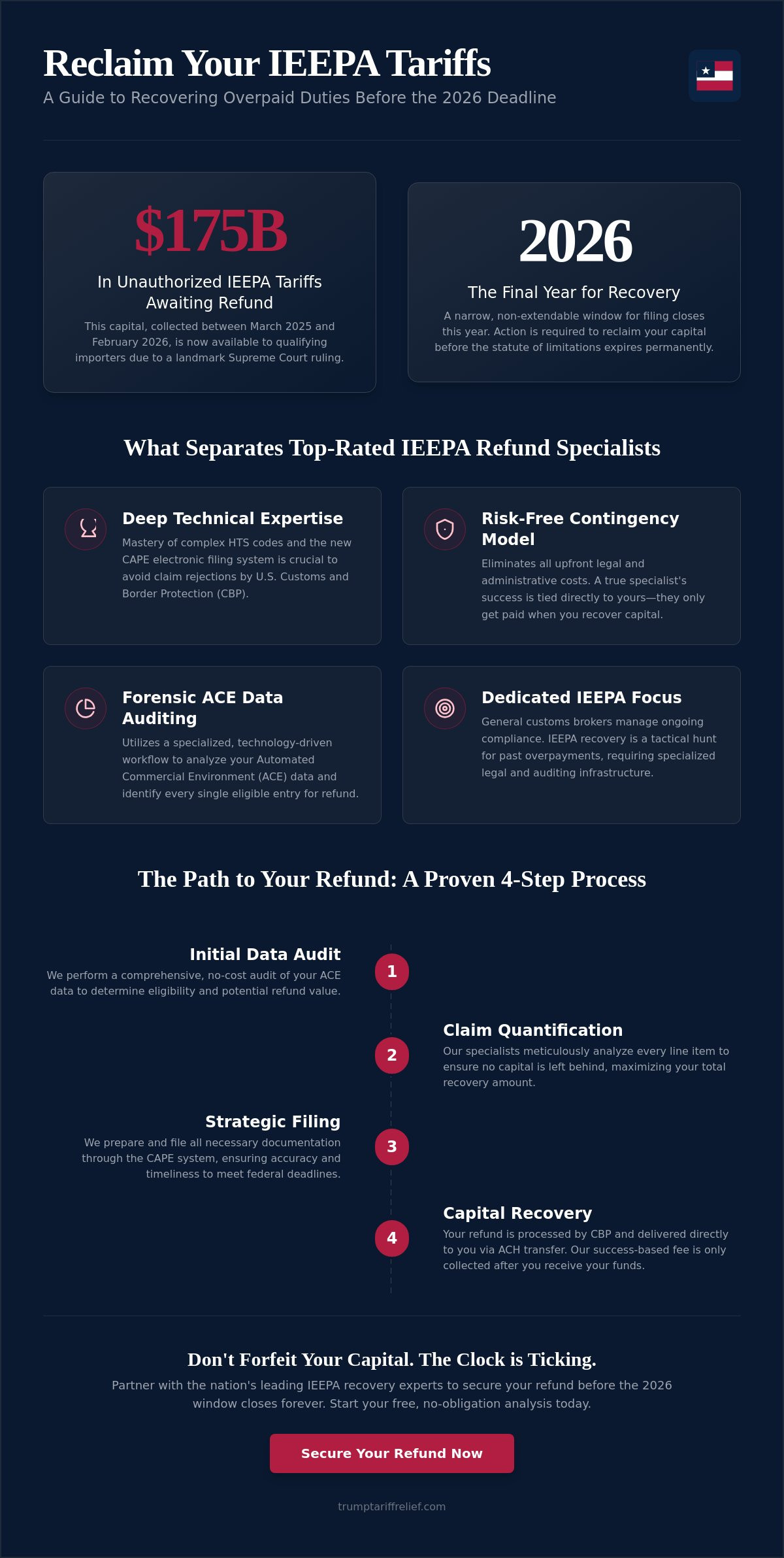
Successful recovery isn't a matter of luck; it's a matter of logic. The top-rated IEEPA refund specialists follow a rigid five-step protocol to bridge the gap between corporate data and government accounts. This process begins with a Comprehensive Data Audit where years of entry data are extracted from the Automated Commercial Environment (ACE). Specialists don't just look for obvious overpayments. They dig for "hidden" entries that internal teams often overlook. Once the data is secured, the Quantification phase begins. Experts identify every overpaid cent by cross-referencing HTS codes with the February 2026 Supreme Court ruling. This ensures that every dollar eligible for restoration is documented.
The third phase involves Documentation Management. This is where legal protests and CAPE filings are prepared with surgical precision to avoid the common rejections seen in the initial rollout of the government's electronic system. Following submission, the specialist acts as your Government Liaison. They manage all communications with CBP and monitor the Court of International Trade (CIT) for new guidance that could impact your claim. Finally, the process concludes with Capital Restoration. The result is an ACH transfer directly to your bank account, issued exclusively via the new electronic systems deployed in April 2026. This streamlined workflow removes the administrative burden from your internal staff while ensuring maximum recovery.
Data Mining: The ACE Portal Advantage
ACE data is the lifeblood of a successful claim. While your internal team might see a simplified view of trade history, top-rated IEEPA refund specialists use advanced mining techniques to uncover eligible entries that have been mislabeled or buried. Tracking the "liquidation status" of each entry is non-negotiable. If an entry liquidates without a protest being filed, the window for recovery can slam shut. You can review the required documents for IEEPA tariff refund to see how this data is organized for submission. Specialists ensure that every piece of evidence meets the high standards required by federal auditors.
Managing the Statute of Limitations
Time is the greatest enemy in 2026. The standard deadline for filing a protest is just 180 days. For tariffs paid more than 180 days ago, recovery is still possible by asserting a clerical error or mistake of fact within a one-year window. Specialists prioritize your entries based on these expiration dates, ensuring that the oldest, most vulnerable claims are filed first. Every day you wait is a day that capital could be lost to the statute of limitations. Check our tariff refund statute of limitations guide to understand these critical deadlines. Secure your capital by initiating a Tariff Eligibility Assessment before your recovery window closes forever.
Trump Tariff Relief: Your National Partner for IEEPA Recovery
Trump Tariff Relief stands as the premier choice for U.S. importers seeking a high-stakes partner in this volatile regulatory environment. While general trade consultants often juggle a wide array of compliance services, we maintain an exclusive, laser-focused expertise on IEEPA and Section 301 tariff refunds. This specialization allows us to serve as top-rated IEEPA refund specialists for businesses across all 50 states from our centralized hub of legal and trade expertise. We understand that your capital has been locked in government accounts for far too long. Our mission is to act as your bold advocate, navigating the federal bureaucracy so you can focus on your core operations. We operate on a strict contingency basis, which means we take on all the financial risk. We don't get paid unless you recover your capital.
Our Proven Recovery Process
Our "we-do-the-work" narrative isn't just a slogan; it's our operational reality. We’ve built a system where we do the heavy lifting while you reap the financial rewards. From the initial ACE data extraction to the final ACH transfer, our team manages every detail of the Customs Documentation Management process. We have extensive experience handling complex claims within the manufacturing, retail, and technology sectors, where HTS code precision is paramount to a successful filing. You can see a detailed visual guide of our end-to-end strategy on our How It Works page. We’ve already seen the pitfalls of the CAPE system and know exactly how to bypass the administrative hurdles that frequently slow down less specialized firms.
Start Your Eligibility Assessment Today
The window to reclaim your share of the $175 billion refund pool is closing with every passing hour. With the Supreme Court's February 2026 ruling setting the clock in motion, every day of delay increases the risk that your oldest entries will hit the statute of limitations and be lost forever. You don't have to navigate this complex landscape alone or under the pressure of internal capital recovery targets. We offer a no-obligation Tariff Eligibility Assessment to audit your potential refund value at no upfront cost. This low-friction first step provides the clarity you need to make an informed business decision without any financial exposure. Don't let your overpaid duties become permanent government revenue. Contact our team of top-rated IEEPA refund specialists today to secure your capital and right this financial wrong before the 2026 deadlines expire. If you have questions about specific eligibility categories, our FAQ provides immediate answers to the most common importer concerns.
Secure Your Financial Restoration Before the Window Closes
Reclaiming your capital requires more than just submitting paperwork; it demands a forensic, data-driven approach to every entry in your trade history. We've detailed how specialized auditing identifies hidden overpayments and why the transition to the CAPE system has made rapid, electronic filing a necessity. By partnering with top-rated IEEPA refund specialists, you ensure that no eligible duty is left behind and that every filing meets the rigorous standards of federal auditors. It's about turning a complex regulatory hurdle into a streamlined financial win for your organization.
Our commitment to your recovery is absolute. We provide a comprehensive ACE data audit and national expertise in IEEPA litigation on a strictly contingency basis. This means there's no recovery and no fee; we assume the risk so you don't have to. The 2026 deadlines are approaching quickly, and the opportunity to right this financial wrong won't last forever. Get Your Free IEEPA Eligibility Assessment Now and let our experts handle the heavy lifting of your capital recovery. You've already paid the price of unauthorized tariffs. It's time to bring that capital back where it belongs.
Frequently Asked Questions
Is the IEEPA tariff refund real and legitimate?
Yes, the refund opportunity is entirely legitimate and stems from the U.S. Supreme Court's February 20, 2026, ruling that certain tariffs were unauthorized. This decision opened a pool of up to $175 billion in potential refunds for importers who paid duties between March 2025 and February 2026. U.S. Customs and Border Protection (CBP) officially began processing these claims through the CAPE system in April 2026, confirming the government’s obligation to return this capital.
How much does an IEEPA refund specialist charge?
The top-rated IEEPA refund specialists typically operate on a contingency basis, meaning they don't charge any upfront fees or hourly retainers. Their compensation is a pre-agreed percentage of the actual capital recovered from the government. This model ensures that the specialist assumes all the financial risk of the audit and documentation process. If the government doesn't issue a refund, the client owes nothing for the services provided.
How long does the IEEPA tariff recovery process take?
Processing times vary based on the complexity of your entry history and the current CBP workload within the CAPE system. While the electronic rollout in April 2026 has streamlined the validation of over 11 million entries, the phased nature of the rollout means some claims move faster than others. A specialist expedites this by ensuring all data is perfectly formatted before submission, which prevents the lengthy delays caused by administrative rejections or manual reviews.
Can I claim a refund if I was not the Importer of Record?
Direct claims can only be filed by the Importer of Record (IOR) listed on the original entry documentation. If you were a downstream buyer who absorbed the cost of the tariffs but weren't the IOR, you cannot file a claim directly with CBP. However, you may be able to negotiate a reimbursement or legal assignment with the IOR who paid the duties. Specialists often help facilitate these complex multi-party recovery strategies to ensure capital is restored to the correct entity.
What is the deadline for filing an IEEPA tariff refund claim in 2026?
The standard window for filing a protest is 180 days from the date of the Supreme Court ruling or the entry liquidation. For tariffs paid more than 180 days ago, businesses may still seek recovery by asserting a clerical error or mistake of fact within a one-year window. Because these deadlines are rigid, top-rated IEEPA refund specialists prioritize filings based on their expiration dates to prevent capital from being permanently forfeited to the government.
What documents do I need to provide to a recovery specialist?
You primarily need to provide access to your ACE (Automated Commercial Environment) portal data and proof of your status as the Importer of Record. While specialists handle the forensic extraction of entry data, having your internal payment records and commercial invoices ready can help verify specific HTS code eligibility. The goal is to create a clear audit trail that links your previous duty payments to the unauthorized IEEPA categories identified in the 2026 ruling.
What happens if my IEEPA refund claim is denied?
If CBP denies a claim, it can often be appealed through a formal protest or by escalating the matter to the Court of International Trade (CIT). Denials typically occur due to documentation errors, misclassified HTS codes, or filing after the statute of limitations has expired. A recovery specialist manages these appeals by analyzing the specific reason for denial and refiling with corrected data or updated legal arguments based on the latest CIT precedents.
Can small businesses qualify for IEEPA tariff recovery services?
Small businesses absolutely qualify if they acted as the Importer of Record for goods subject to these tariffs. The contingency fee model is specifically designed to remove the financial barriers that might otherwise prevent smaller firms from pursuing high-stakes federal litigation. Whether you're reclaiming ten thousand dollars or ten million, the recovery process remains the same. If you paid the unauthorized duties, you have a constitutional right to see that capital returned to your business.
Ready to find out what your business may be owed?
Check My Eligibility