
Why would any business leave their share of a $166 billion government debt on the table simply because they fear the price of the recovery process? It is a valid concern in a landscape where legal fees often overshoot budgets and U.S. Customs filings feel like an impenetrable maze. You have already been impacted by the financial weight of unconstitutional IEEPA tariffs, so the last thing you need is another line item on your expense report. When evaluating your recovery options, the primary question is usually how much do tariff refund services cost and whether the pursuit is worth the administrative headache.
We agree that your focus should remain on growth, not on funding a consultant's billable hours. This article will help you discover how specialized tariff recovery services operate on a no-risk basis to reclaim your capital without any upfront costs. We will provide a clear understanding of the contingency fee model that has become the industry standard following the 2026 Supreme Court ruling. You will learn how to verify that your partner takes on all the financial risk while providing the deep expertise needed to maximize your total refund amount through the CAPE portal.
Key Takeaways
- Learn how to transform unconstitutional tariff payments from sunk costs into liquid capital through a strategic recovery audit.
- Understand exactly how much do tariff refund services cost by comparing the transparency of contingency-based models against the unpredictable nature of hourly legal billing.
- Discover the "No Win, No Fee" guarantee that protects your corporate cash flow while elite trade experts navigate the complexities of the CAPE portal.
- Identify and eliminate "junk fees" and administrative surcharges that common consultants often hide within recovery contracts.
- Gain the confidence to pursue your share of the $166 billion IEEPA debt with a partner who manages the entire documentation and filing lifecycle on your behalf.
Evaluating the True Cost of Reclaiming Your Tariff Capital
For years, American importers treated IEEPA duties as an unavoidable cost of doing business. The Supreme Court's landmark ruling on February 20, 2026, changed that reality overnight, transforming approximately $166 billion in collected duties from a permanent loss into a reclaimable asset. If you're still categorizing these payments as sunk costs, you're misreading your own balance sheet. To grasp the magnitude of this shift, one must first understand what are tariffs in the context of unconstitutional executive overreach. They aren't just taxes; they're capital currently held by the government that belongs back in your operating budget.
A primary hurdle for many firms is the uncertainty surrounding the recovery process. Executives frequently ask how much do tariff refund services cost because they're used to the unpredictable nature of hourly legal billing or high-priced consulting retainers. However, the true cost of recovery isn't found in the service fee. It's found in the risk of filing an incomplete claim or, worse, failing to file before the CAPE portal windows close. Professional recovery is a specialized discipline that bridges the gap between complex customs documentation and high-stakes financial litigation.
The Shift from Compliance Expense to Asset Recovery
In 2026, savvy CFOs are moving IEEPA claims from the "expense" column to "accounts receivable." This isn't just a clerical change; it's a strategic move to improve liquidity. Waiting to file is the most expensive mistake an importer can make. As the process rolls out in phases, unliquidated entries and those within 90 days of liquidation take priority. Specialized consultancies identify these overlooked opportunities by auditing your historical data to find every eligible entry. To see how this process integrates with your existing records, you can review our breakdown of IEEPA explained.
Why "Free" Advice Can Be Costly
Relying on a general customs broker for these specialized claims is a gamble. While brokers are vital for daily logistics, they often lack the forensic legal expertise to maximize a refund under the 2026 ruling. Improper HTS code classification during the refund process can trigger audits or lead to the rejection of valid claims. The IEEPA refund window is strictly defined by the 2024 legal precedents that established the statute of limitations for challenging executive overreach in trade enforcement. If your documentation isn't perfect, you aren't just losing a fee; you're losing the entire refund. Determining how much do tariff refund services cost requires looking at the value of a 100% contingency model where the partner only wins when you reclaim your capital.
The Contingency Fee Model: Eliminating Upfront Financial Risk
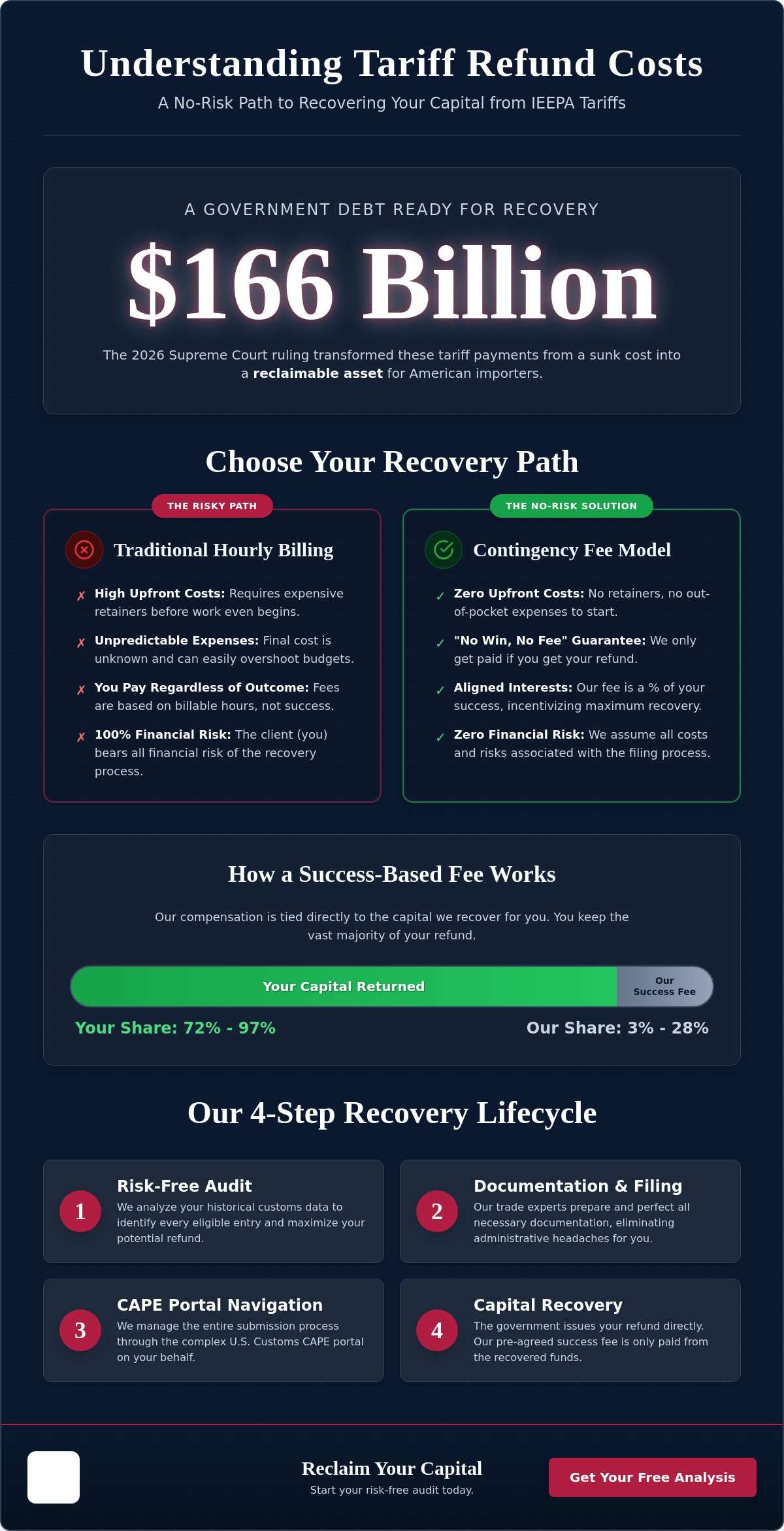
The most significant barrier to reclaiming unconstitutional duties is the fear of compounding financial loss with expensive legal bills. When businesses evaluate how much do tariff refund services cost, they often expect traditional retainers or hourly rates that drain resources before a single dollar is recovered. The 2026 industry standard has shifted decisively toward the contingency fee model. This success-based structure ensures that professional compensation is tied directly to the capital successfully returned to your accounts. It's a "No Win, No Fee" arrangement that prioritizes your cash flow, meaning the service provider only receives payment after the government issues your refund.
This model aligns the interests of both parties with surgical precision. Because the fee is a percentage of the recovered amount, the consultant is incentivized to identify every eligible entry and maximize the interest accrued on those funds. In 2026, industry data shows contingency fees typically range between 3% and 28%, depending on the volume of entries and the complexity of the filing. While you focus on operations, your recovery partner handles the heavy lifting of the CAPE portal. However, it's vital to consult with your financial team regarding the tax consequences of tariff refunds, as these recoveries can impact your taxable income and cost of goods sold.
How Success-Based Recovery Works
The process is transparent and methodical. Once your eligibility is confirmed, the recovery engine audits your customs data, prepares the necessary documentation, and manages the filing through the Automated Commercial Environment (ACE). The fee is only calculated and invoiced after the refund check is cut or the electronic transfer is received. Businesses with high-volume imports benefit significantly from this structure, as the economies of scale allow for a more aggressive pursuit of complex claims. You can learn more about how our process works to see the journey from data audit to capital restoration.
The Absence of Upfront Retainers
Unlike traditional trade law firms that might require thousands in upfront retainers, a true contingency partner absorbs all initial overhead. This includes the cost of the initial assessment, data preparation, and the intensive government liaison work required for IEEPA claims. At Trump Tariff Relief, we take on the financial risk of the investigation so you don't have to. By removing these financial barriers, we ensure that every importer of record has the opportunity to right the wrong of unconstitutional taxation. If you're ready to see what's owed to you, a preliminary eligibility assessment is the first step toward reclaiming your capital.
Success-Based Fees vs. Traditional Hourly Legal Billing
When calculating how much do tariff refund services cost, the most dangerous metric to rely on is the hourly rate of a general law firm. Traditional legal billing models are built on time spent, not results achieved. In the complex landscape of IEEPA litigation, where over 53 million entries are subject to review, an hourly model creates a fundamental misalignment of interests. You pay for every phone call, every document review, and every government delay, regardless of whether a single dollar is ever returned to your company. This unpredictability can quickly turn a potential recovery into a mounting administrative liability.
A specialized recovery partner operates with a different objective. By utilizing a success-based fee, the consultant assumes the entire financial burden of the forensic audit. These audits involve "hidden" hours that standard legal work often ignores, such as cross-referencing years of entry data against evolving CBP guidelines. The total cost of ownership for a contingency model is often lower because it eliminates the risk of paying for a denied claim. Before proceeding, it's essential to understand the tax treatment of tariff refunds, as these recoveries must be correctly accounted for on your balance sheet to avoid future compliance issues.
Quantifying the Risk Difference
The financial downside of a denied claim under hourly billing is a double loss: you lose the refund and you lose the legal fees. This is why the success-fee model is preferred by mid-market manufacturers and retailers who must protect their operational liquidity. If the claim is unsuccessful, your cost is zero. This structure allows you to aggressively pursue your share of the $166 billion government debt without risking your current quarterly budget. You can determine if the IEEPA refund is right for your business by assessing your historical import volume against the unconstitutional duty windows.
Incentivizing Maximum Recovery
Specialists find "pockets" of eligibility that hourly generalists might miss because their compensation depends on it. A generalist might stop at the most obvious entries, while a recovery engine digs into complex HTS code nuances to identify every possible cent. A 20% success fee on a $1M recovery is more valuable to your bottom line than a $50k hourly bill for a $500k recovery because the specialist's expertise has generated an additional $350k in net capital for your business. The percentage you pay is an investment in the depth of the audit and the speed of the filing through the CAPE portal. When the interests of the advocate and the client are identical, the path to capital restoration becomes both faster and more thorough.
Identifying and Avoiding Hidden Expenses in Tariff Claims
Navigating the recovery landscape requires a sharp eye for the fine print. When businesses ask how much do tariff refund services cost, they typically focus on the headline percentage, yet the true expense often lurks in hidden "junk fees" that some providers bury in their contracts. These can include separate software licensing fees, data storage surcharges, or flat filing fees for each entry submitted. A transparent fee agreement is the primary trust signal for any importer; if a provider cannot offer a simple, all-inclusive success fee, the partnership may end up costing more than the value it recovers.
The financial stakes are heightened by the three-year statute of limitations on most IEEPA-related claims. Every day of delay is a day closer to losing your right to reclaim capital forever. This timeline makes the cost of inaction the most expensive hidden expense of all. Professional recovery services absorb the overhead of the customs documentation audit, ensuring that the cost of data preparation is never passed on to the client as an upfront expense. By aligning the cost with the actual recovery, you protect your current budget while pursuing the restoration of your past capital.
The Cost of Documentation Management
Automated recovery platforms are the engine of a modern claim. These systems reduce the administrative overhead for your team by extracting entry data directly from the ACE portal, eliminating hundreds of hours of manual labor. A "clean" audit is essential not just for the refund, but for reducing the risk of future CBP inquiries or post-summary audits. You can prepare your internal team by reviewing the Required Documents for IEEPA Tariff Refund: The 2026 Importer’s Checklist.
Avoiding the DIY Trap
Attempting a DIY tariff refund is often a false economy. When you calculate the internal labor costs of your trade compliance team and the high price of "missed capital" due to an incomplete eligibility assessment, the DIY route is frequently the most expensive option. Specialists identify nuances in HTS code eligibility that generalists overlook, often increasing the total recovery by significant margins. Before committing internal resources, consult our Tariff Refund Assessment: A Guide to IEEPA Eligibility and Recovery to understand the scope of a professional audit. If you want to avoid hidden surcharges and maximize your return, secure your no-cost eligibility assessment today and let our experts handle the heavy lifting.
Maximizing Your Recovery with Trump Tariff Relief
Securing a recovery partner shouldn't be a gamble. While other firms might hedge their bets with administrative surcharges or hidden software fees, our commitment to a 100% contingency-based fee structure remains absolute. This model answers the persistent question of how much do tariff refund services cost with a simple, results-oriented truth: you pay nothing unless we win. We manage the entire IEEPA recovery lifecycle, from the initial forensic audit of your entries to the final disbursement from the CAPE portal. Our trade experts act as a powerful ally, handling the bureaucratic friction so your internal team can stay focused on core operations.
The speed of your filing is just as critical as its accuracy. Because we've already established a robust pipeline of filings through government channels, our clients benefit from a significant momentum advantage. We understand the nuances of the CAPE system's phased rollout, ensuring your claims are positioned for the earliest possible resolution. The journey begins with a preliminary eligibility assessment. This high-stakes audit identifies every cent of unconstitutional duty you're owed, providing a clear roadmap for capital restoration without any upfront financial commitment.
The Trump Tariff Relief Advantage
Our singular focus on IEEPA and Section 301 recovery makes us the industry leader in 2026. We don't offer general corporate legal services; we offer specialized financial justice. By streamlining the data extraction process, we minimize the time commitment required from your staff. We've built our reputation on transparency and technical precision. If you have specific concerns about the mechanics of the process, you can explore our Frequently Asked Questions about Tariff Recovery for detailed insights into our methodology.
Your Path to Reclaiming Capital
The onboarding process is designed for maximum efficiency. Once you provide access to your basic import data, our recovery engine takes over the documentation and filing requirements. Understanding how much do tariff refund services cost is about more than just the percentage; it's about the value of the expertise applied to your specific case to ensure no capital is left behind. The 2026 deadlines are firm, and the government's phased refund schedule makes immediate action a financial necessity. Don't let your capital remain in the hands of the treasury. Get your free tariff eligibility assessment today and partner with a team that values your recovery as much as you do.
Secure Your Share of the $166 Billion IEEPA Debt
The landscape of trade finance shifted permanently following the February 20, 2026, Supreme Court ruling. You no longer have to wonder how much do tariff refund services cost because the industry standard has moved toward a transparent, success-based framework. By choosing a contingency model, you eliminate the unpredictability of hourly legal bills and ensure that your recovery partner is fully incentivized to maximize your return. Specialized IEEPA expertise, backed by landmark legal precedents, identifies eligibility that general customs brokers simply aren't equipped to find.
This is a no-risk, zero-upfront-cost partnership designed specifically for U.S. importers. Our contingency-based fees mean you only pay when we successfully recover your money. There's no reason to let unconstitutional taxes sit in government accounts when a professional audit can restore that capital to your balance sheet. Take the first step toward financial restoration before the CAPE portal windows close. Request Your Free Tariff Eligibility Assessment and let our experts handle the heavy lifting of your recovery journey. Your capital belongs in your business; it's time to bring it home.
Frequently Asked Questions
Is there any upfront cost to start a tariff refund claim with Trump Tariff Relief?
No, there are zero upfront costs to initiate your recovery journey with us. We operate on a strict contingency basis, meaning we fund the entire investigative and filing process ourselves. You only pay a fee if we successfully secure your refund from the government. This ensures that your operational budget is never at risk while we pursue your reclaimable capital.
What percentage do tariff refund services typically charge in 2026?
The market for recovery services has stabilized with contingency fees typically ranging between 3% and 28% of the recovered amount. This sliding scale often depends on the complexity of your documentation and your total import volume. When evaluating how much do tariff refund services cost, remember that higher expertise often leads to a more thorough audit and a higher net recovery.
Are there any hidden administrative or software fees in the contingency model?
Our model is all-inclusive, meaning we don't pass on "junk fees" for software licensing or data storage to our clients. While some firms might add surcharges for portal access or document management, we absorb these operational costs. Transparency is our primary trust signal, ensuring your recovery isn't eroded by administrative overhead or unexpected line items in your contract.
What happens if the government denies my IEEPA tariff refund claim?
If your claim is denied, you owe us nothing. The financial risk of the audit, filing, and government liaison work rests entirely on our shoulders. This "No Win, No Fee" guarantee ensures that your current cash flow is never compromised by the pursuit of your past capital. We only succeed when you see the funds returned to your accounts.
How much money can a typical mid-sized manufacturer expect to recover?
Recovery amounts vary significantly based on your historical import volume of goods subject to IEEPA duties. With over $166 billion in unconstitutional tariffs collected by the government, even mid-sized operations often find they're owed substantial sums plus interest. A preliminary eligibility assessment is the only way to accurately quantify your specific recovery potential based on your unique entry history.
Can I file for a tariff refund on my own to save on service costs?
You have the legal right to file independently through the CAPE portal, but the technical complexity is high. DIY attempts often lead to rejected claims due to HTS code errors or missed documentation deadlines. The perceived savings from avoiding a success fee are frequently offset by the high price of missed capital and the internal labor costs of a forensic audit.
How long does the recovery process take before I receive my refund?
The CBP began processing refunds on April 20, 2026, through a phased rollout system. Unliquidated entries and those within 90 days of liquidation are prioritized first, followed by older entries as the system scales. While the timeline depends on the government's processing speed, our established filings move as quickly as the regulatory framework and the CAPE portal allow.
Does the service fee cover the cost of a customs documentation audit?
Yes, our success-based fee covers the entire cost of the forensic customs documentation audit. We use automated platforms to extract and verify your entry data from the ACE portal without charging you a separate fee for the assessment. This ensures that the question of how much do tariff refund services cost is answered by a single, transparent percentage that includes every stage of the recovery lifecycle.
Ready to find out what your business may be owed?
Check My Eligibility