
The U.S. government collected approximately $166 billion in IEEPA duties that the Supreme Court ruled were illegal on February 20, 2026. If your business was among the thousands of importers forced to pay these unauthorized tariffs, that capital belongs on your balance sheet. Most executives hesitate to act because they fear the high cost of legal battles and the complexity of CBP documentation. A pay-on-success tariff refund claim eliminates that barrier, allowing you to pursue the recovery of millions without risking a single dollar of your current budget.
We know that your margins are already under pressure from the new 15% global tariffs and the technical hurdles of the CAPE portal. It's exhausting. A single paperwork error can lead to a summary rejection. This article will show you how to secure your risk-free capital recovery through professional management of your filings and a clear timeline for your refund receipt. You'll learn how to identify eligible liquidated entries and meet the strict 180-day protest deadlines to ensure your business doesn't leave its money on the table.
Key Takeaways
- Understand the legal grounds of the Learning Resources, Inc. v. Trump decision and how it unlocked a billion-dollar refund pool for eligible importers.
- Compare the financial advantages of a pay-on-success tariff refund claim against traditional hourly legal billing to ensure your recovery efforts remain profitable.
- Learn the five essential steps to navigate the CAPE portal filing process, starting with a comprehensive Tariff Eligibility Assessment of your HTS codes.
- Identify how to mitigate risk against government delays or claim denials by shifting the administrative burden to a specialized recovery partner.
- Discover why acting within the 2026 window is critical for reclaiming duties before strict liquidation deadlines bar your path to restoration.
What is a Pay-on-Success Tariff Refund Claim?
A pay-on-success tariff refund claim is a performance-driven financial recovery strategy designed to restore capital without the burden of upfront legal fees. In the wake of the February 2026 Supreme Court ruling, the door has opened to reclaim a portion of the $166 billion collected under the International Emergency Economic Powers Act (IEEPA). For years, importers were forced to pay these duties under protest, watching their margins erode. Now that the ruling has confirmed these collections were unauthorized, the path to recovery is clear. However, the complexity of filing through the CAPE portal often requires specialized expertise that many internal teams lack.
The contingency model removes the financial friction that prevents businesses from acting. Traditionally, trade attorneys bill by the hour, creating a situation where the cost of the claim can exceed the value of the refund itself. This is especially true for mid-sized importers who may have hundreds of thousands, rather than millions, at stake. By utilizing a pay-on-success tariff refund claim, you ensure that the recovery firm only receives payment once the refund is finalized and issued via ACH. This "no-win, no-fee" promise aligns the interests of the consultant and the business owner, as both parties are motivated to maximize the total recovery amount in the shortest possible timeframe.
The Mechanics of Contingency Recovery
The mechanics of this model are built on transparency. Instead of a monthly retainer, a success fee is calculated as a fixed percentage of the total amount recovered. The recovery firm takes on the full financial risk of the process. This includes the time-intensive task of identifying eligible HTS codes and managing the rigorous Customs Documentation Management required by CBP. There are no hidden administrative costs or filing fees passed on to the client. If the claim is denied or the government delays the process indefinitely, your business pays nothing. This distinction between success fees and traditional "retainer" models is what makes the 2026 recovery window accessible to all.
Why Businesses are Switching to Success-Based Models
Importers are increasingly switching to success-based models to protect their operational cash flow. With a new 15% global tariff in effect as of February 24, 2026, businesses can't afford to gamble on expensive litigation. Treating recovery as a found-money opportunity changes the internal narrative from a legal risk to a financial audit. It’s about righting a wrong without creating a new budget line item. You can explore how it works to see how our team handles the bureaucratic heavy lifting while you focus on your core business operations.
The IEEPA Ruling: Why the 2026 Window is Critical
The U.S. Supreme Court’s landmark decision in Learning Resources, Inc. v. Trump on February 20, 2026, fundamentally altered the trade landscape by declaring that the executive branch overstepped its authority. The court ruled that the unilateral imposition of duties under IEEPA lacked the necessary legislative foundation, effectively turning $166 billion in collected tariffs into an illegal tax on American importers. This ruling didn't just create a legal precedent; it triggered the launch of the CAPE (Consolidated Administration and Processing of Entries) portal on April 20, 2026. This system is now the primary engine for processing nearly 16 million entries, yet many businesses remain unaware that these refunds are not automatic. If you don't proactively file a pay-on-success tariff refund claim, your capital stays in the Treasury's accounts rather than yours.
Delaying your claim is the most significant risk you face in 2026. While the CAPE system has accepted approximately $85 billion in potential refunds for processing as of May 2026, the window for many entries is closing fast. The federal government operates on strict administrative timelines; once an entry is "finally liquidated" and the protest window expires, that money is legally forfeited. This is a fleeting window of opportunity. Businesses that wait until late 2026 may find that their most valuable entries from the 2018-2022 period are no longer eligible for recovery. A pay-on-success tariff refund claim allows you to jump the queue and secure your spot in the CAPE system without the financial hesitation that often leads to missed deadlines.
Understanding the IEEPA Legal Precedent
The Supreme Court affirmed the invalidation of these tariffs because IEEPA was never intended to be a permanent revenue-generating tool for trade policy. While Section 301 provides specific authority for trade enforcement, IEEPA is restricted to immediate national security emergencies; using it to bypass congressional oversight for long-term tariffs was deemed a violation of the law. You can review our IEEPA Explained guide for a deeper breakdown of how this legal distinction separates these refunds from other ongoing trade disputes.
Statutes of Limitations and Deadlines
Timing is the most significant threat to your recovery. For entries that have already been liquidated, you have a strict 180-day window from the liquidation date to file a CBP Protest (Form 19). For unliquidated entries, the window is even tighter: a Post-Summary Correction (PSC) must be filed within 300 days of the entry date or 15 days before liquidation, whichever comes first. 2026 is the "year of the refund" because the CAPE system is currently prioritizing claims for duties paid between 2018 and 2022. Delaying action risks a permanent loss of capital as these entries reach finality. You can check the critical deadlines for IEEPA claims to ensure your HTS codes are still within the eligibility window. If you're unsure of your status, a quick Tariff Eligibility Assessment can provide the clarity you need to move forward.
Success Fees vs. Hourly Rates: A Financial Comparison
Traditional trade law firms often operate on a billable-hour model that prioritizes activity over outcomes. When you're dealing with the bureaucracy of the CAPE system, those hours add up fast. CBP has up to two years to review a protest; if your legal counsel is billing for every status check and documentation request, a mid-sized claim can become a financial liability before it’s even resolved. Choosing a pay-on-success tariff refund claim flips this dynamic. It forces the recovery partner to bear the costs of the two-year review period, ensuring your business only pays for realized capital, not administrative effort.
This model acts as a powerful risk mitigation tool. In the world of customs, claim denials are a reality, often due to technicalities in the CAPE portal or shifting interpretations of HTS eligibility. Under an hourly structure, you pay for the loss. Under a contingency structure, the recovery firm absorbs the cost of the failed filing. This transparency ensures that if we don't win, you don't pay. It’s a straightforward contract that aligns our motivation with your bottom line, creating a partnership built on high-stakes advocacy rather than passive consulting.
The Math of a Successful Claim
The financial disparity between these two models becomes clear when you look at the total recovery. For a hypothetical $100,000 refund, an hourly firm might charge for research, filing, and follow-up, potentially costing $20,000 or more regardless of the result. A 25% success fee partner only receives payment if the $100,000 check is cut. More importantly, we factor in the interest. Under 19 U.S.C. § 1505(b), the government must pay interest on overpayments of duties. A contingency partner fights for every cent of that interest because it increases the total recovery for both parties. This "Zero-Risk" guarantee means your current cash flow remains untouched while we pursue your capital.
Choosing the Right Fee Structure for Your Volume
While hourly billing might make sense for ongoing compliance or general corporate legal services, it’s rarely the right choice for the high-volume, retroactive nature of IEEPA claims. Large importers prefer the contingency model because it keeps legal budgets predictable and scalable. You aren't guessing what the final bill will be; you're simply waiting for a percentage of a found-money windfall. You can read more about Why Contingency Fees Work for Tariff Recovery to see how this structure protects your margins during the 2026 recovery cycle.
Navigating the Filing Process Without Financial Risk
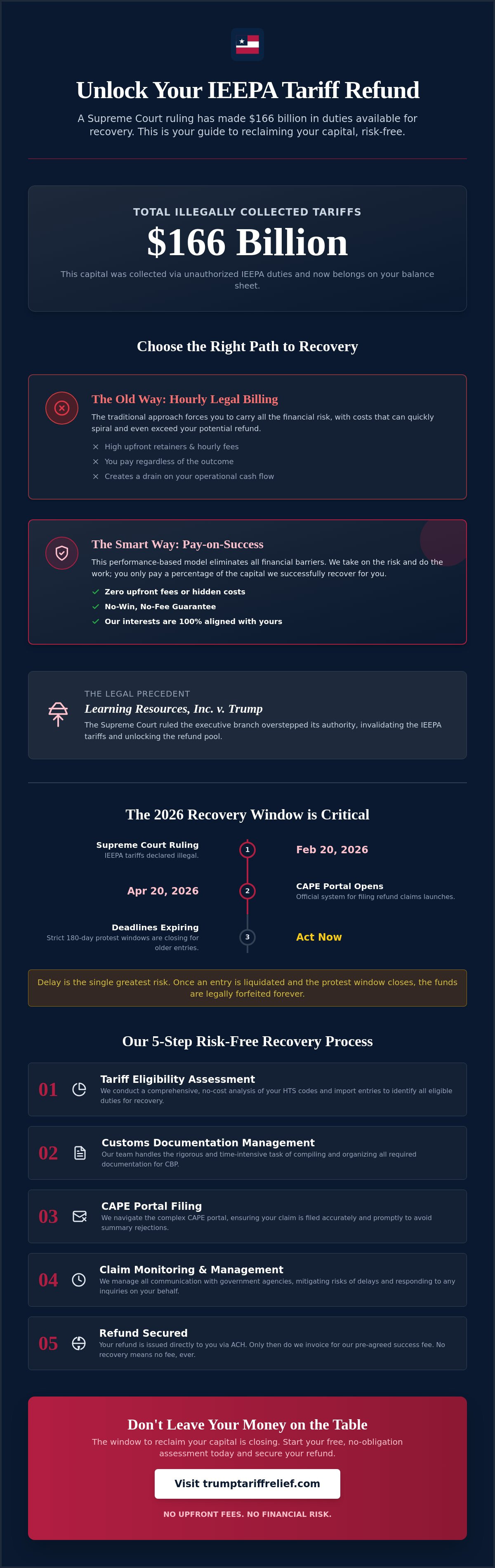
Recovering capital through the CAPE system isn't a matter of simply clicking a button. It requires a methodical approach that balances technical precision with regulatory compliance. The roadmap to a successful pay-on-success tariff refund claim is built on five distinct phases, each designed to move your case through the bureaucracy without requiring an upfront investment from your firm.
- Step 1: Tariff Eligibility Assessment. We begin by cross-referencing your historic HTS codes against the specific categories invalidated by the Supreme Court ruling. This identifies exactly which entries are eligible for recovery.
- Step 2: Customs Documentation Management. Our team gathers your 7501 forms and entry summaries. These documents are the bedrock of your claim; any discrepancy here is an automatic grounds for rejection.
- Step 3: Filing the Protest or CAPE Submission. Depending on whether your entries are liquidated or unliquidated, we file the appropriate Protest (Form 19) or Post-Summary Correction (PSC) through the digital portal.
- Step 4: Government Validation and Audit. CBP often issues inquiries during the review period. We handle all communication with the agency, defending the accuracy of your data against federal scrutiny.
- Step 5: Capital Disbursement. Once the claim is finalized, the Treasury issues your refund plus interest via ACH. Only at this point is the success fee earned.
Gathering Essential Documentation
The success of your filing hinges on data integrity. You'll need your Importer of Record (IOR) number and precise entry dates for every transaction between 2018 and 2022. If your internal records are incomplete, we use automated customs data pulls to bridge the gaps. This ensures no eligible entry is left behind due to lost paperwork. You can review our Required Documents for IEEPA Tariff Refund checklist to see how to prepare your files for a pay-on-success tariff refund claim.
The Role of CAPE Validation
The CAPE system, launched on April 20, 2026, was designed for efficiency, yet it’s notorious for rejecting valid claims due to minor formatting errors or automated government offsets. These offsets occur when CBP attempts to apply your refund toward other outstanding duties. A professional partner navigates these pitfalls, ensuring your capital is protected from being swallowed by unrelated administrative debts. If you have specific technical questions, our FAQ on the CAPE system provides immediate answers. Don't let a software error cost you millions; start your Customs Documentation Management review today to secure your recovery.
Partnering with Trump Tariff Relief for Maximum Recovery
Securing a pay-on-success tariff refund claim requires more than just administrative filing; it demands a partner who understands the high stakes of trade law. Trump Tariff Relief has established itself as the leader in IEEPA contingency recovery by combining deep legal gravitas with aggressive business advocacy. Our "Righting the Wrong" philosophy is the engine behind every case we take. We believe that the billions in unauthorized duties collected between 2018 and 2022 represent a fundamental injustice to American importers. Our team of trade experts, legal counsel, and data analysts works tirelessly to restore that capital to your balance sheet where it belongs.
We don't just submit forms; we build an ironclad case for your recovery. Our data analysts utilize sophisticated algorithms to cross-reference your historical entry data with the latest CBP rulings, ensuring that every eligible dollar is identified. We navigate the intricate technical requirements of the CAPE portal to ensure your claim survives rigorous government scrutiny. This specialized approach is why we've become the preferred partner for businesses seeking to reclaim lost margins without adding a single dollar to their current legal spend. We act as your high-performing advocate, taking on the heavy lifting while you maintain focus on your core operations.
Our Success-Based Commitment
The core of our partnership is a total removal of financial barriers. There are no upfront fees, no hidden administrative costs, and no hourly billing. We've structured our entire operation around a commitment to performance. We only get paid when the refund hits your bank account via ACH. This model ensures that our professional advocacy goes far beyond simple portal submissions; we're fully invested in the final outcome of every entry. If CBP issues a request for information or an automated rejection, we handle the resolution at our own expense. This no-nonsense approach builds trust and ensures that our goals are perfectly aligned with your financial restoration.
Your Recovery Starts Here
The onboarding process is designed for maximum efficiency. It begins with a zero-cost Tariff Eligibility Assessment to determine the exact value of your potential recovery. Once we've identified the qualifying entries, our team takes over the comprehensive task of Customs Documentation Management, bridging any gaps in your historical records. Waiting until 2027 to act is a multi-million dollar mistake because the strict 180-day protest windows and the expiration of CAPE portal phases will permanently bar your path to restoration. You can secure your free tariff refund assessment now to ensure your business doesn't miss this critical 2026 window.
Secure Your Capital Restoration Today
The February 2026 Supreme Court ruling transformed $166 billion in IEEPA duties from a sunk cost into a recoverable asset. However, the administrative window is closing fast. Every day you delay, liquidated entries move closer to finality, risking a permanent loss of capital. Navigating the CAPE portal requires technical precision and full customs documentation management to overcome automated rejections and government offsets. By initiating a pay-on-success tariff refund claim, you shift the financial risk to us. We only get paid when your capital is back in your bank account.
Our expertise in IEEPA and Section 301 litigation ensures that your business receives every dollar it's owed, including mandated interest payments. Don't let your hard-earned margins remain in the Treasury's accounts while new global tariffs pressure your bottom line. It's time to right the wrong and reclaim what belongs to your business. Reclaim Your Capital: Start Your Free Assessment. Your path to a risk-free financial recovery is ready, and we're prepared to lead the way.
Frequently Asked Questions
Is the China tariff refund real and how does the IEEPA ruling impact it?
The China tariff refund is a confirmed legal reality following the U.S. Supreme Court's February 20, 2026, ruling that IEEPA duties were imposed without proper authority. This landmark decision invalidated billions in tariffs collected between 2018 and 2022. While Section 301 duties are separate, many were expanded using IEEPA powers, making them eligible for recovery. Importers must now use the CAPE portal to proactively reclaim these unauthorized payments before liquidation deadlines expire.
What is a typical success fee for a pay-on-success tariff refund claim?
Success fees for a pay-on-success tariff refund claim generally range between 20% and 30% of the total capital recovered from the government. This percentage covers the entire cost of the recovery process, including data analysis, legal filings, and documentation management. Because it's a contingency model, the fee is only paid after the Treasury issues your refund via ACH. It’s a transparent structure that keeps your operational budget safe from upfront legal risks.
How long does the IEEPA refund process take from filing to payment?
The timeline for receiving an IEEPA refund typically spans from several months to two years depending on the complexity of your entries. CBP has a regulatory window of up to two years to review a formal protest, though the CAPE portal, launched on April 20, 2026, aims to accelerate digital processing. We often file for accelerated disposition, which forces a response from CBP within 30 days or allows us to escalate the claim to the Court of International Trade.
Can I file for a tariff refund if my company is no longer importing from China?
Yes, your current business operations don't affect your right to reclaim duties paid in previous years. Eligibility is based strictly on whether your company was the Importer of Record at the time the illegal IEEPA tariffs were collected. Even if you've closed those specific supply chains or shifted production to other regions, you're legally entitled to the restoration of that capital. We specialize in reconstructing historical data for companies that have moved on from past vendors.
What happens if my claim is denied—do I still owe Trump Tariff Relief a fee?
You owe absolutely nothing if your claim is denied. Our contingency-based model means that Trump Tariff Relief bears all the financial risk of the filing and audit process. We only earn our fee when we successfully secure your refund and the capital hits your bank account. This "no-win, no-fee" commitment ensures that your business can pursue a pay-on-success tariff refund claim without worrying about wasted administrative costs or failed litigation expenses.
Does the IEEPA ruling apply to Section 301 List 3 and List 4a duties?
The IEEPA ruling directly impacts Section 301 List 3 and List 4a duties because the government cited IEEPA authority to justify the expansion and timing of those specific tariffs. The Supreme Court found that this use of emergency powers was an overreach of executive authority. However, not every entry under these lists is automatically eligible. A technical Tariff Eligibility Assessment is required to verify that your specific entries and HTS codes were impacted by the invalidation.
What documents are absolutely required to start a pay-on-success claim?
To begin the process, you must provide your Importer of Record (IOR) number and your CBP Form 7501 Entry Summaries for the relevant period. These documents are the primary evidence required by the CAPE system to verify duty payments and HTS code eligibility. If your internal records are missing or incomplete, our team can perform automated data pulls from the ACE Secure Data Portal. This ensures that every eligible entry from 2018 to 2022 is included in your filing.
Is there a minimum claim amount required for contingency-based recovery?
Most professional recovery efforts prioritize claims with a total potential refund of $50,000 or more. This threshold ensures that the specialized Customs Documentation Management and legal advocacy required for a successful claim remain economically viable for all parties. However, we encourage any business that paid significant IEEPA duties to undergo an audit. Smaller claims can sometimes be bundled or streamlined to ensure that no business is forced to leave its rightful capital in the government's hands.
Ready to find out what your business may be owed?
Check My Eligibility