
The U.S. Supreme Court's landmark February 20, 2026, decision has effectively unlocked a $175 billion vault of unlawfully collected IEEPA duties. While $20.6 billion has already been returned to importers as of June 2026, many businesses are still hesitating. You've likely felt the financial weight of these tariffs for years, and the thought of sinking even more capital into hourly legal fees to navigate the complex CAPE portal is a risk you aren't willing to take. You know the money belongs back in your accounts, but the administrative hurdles and the technical nuances of the ACE system feel like a secondary burden.
There's a more strategic path to financial restoration. By utilizing a performance-based tariff refund filing model, you can offload the entire recovery process to specialists without any upfront costs or administrative complexity. This article will show you how to leverage this no-risk contingency framework to manage the ACE Secure Data Portal requirements and beat the strict 180-day protest deadlines for liquidated entries. We'll break down the transition from Phase 1 eligibility to successful capital recovery, ensuring your business doesn't miss out on this fleeting window of professional justice.
Key Takeaways
- Analyze the 2026 Supreme Court ruling that invalidated billions in IEEPA duties and established your legal right to a full refund of unauthorized tariffs.
- Learn why performance-based tariff refund filing is the superior alternative to traditional hourly legal models; it ensures you only pay when your capital's successfully recovered.
- Master the technical distinctions between liquidated and unliquidated entries within the new CAPE system to maximize your organization's total refund potential.
- Avoid the costly mistake of waiting for subsequent portal phases by understanding the strict 180-day protest window and the overarching statute of limitations.
- Discover how a 100% contingency-based partnership manages the entire documentation and filing process, removing the administrative burden from your internal teams.
The 2026 IEEPA Ruling: Why Performance-Based Filing is Now Essential
The landscape of American trade changed forever on February 20, 2026. In a decisive 6-3 ruling, the U.S. Supreme Court stripped the executive branch of its perceived authority to impose sweeping, indefinite duties under the guise of emergency powers. This wasn't just a minor regulatory tweak; it was a total invalidation of the "fentanyl" and "reciprocal" tariffs that had burdened U.S. importers for years. For the 330,000 businesses that collectively paid an estimated $166 billion in these duties, the ruling transformed a massive financial loss into a massive legal debt owed back to them by the government.
The court was clear. The International Emergency Economic Powers Act (IEEPA) serves as a framework for managing immediate national threats, but it isn't a blank check for permanent trade policy. Because these tariffs were deemed unauthorized from their inception, every dollar collected is now subject to reclamation. As of June 2026, U.S. Customs and Border Protection (CBP) has already issued $20.6 billion in refunds, but this is only a fraction of the $175 billion projected total. To secure your share, you need a strategy that prioritizes speed and precision without draining your remaining liquidity.
The Legal Catalyst for Your Refund
The 2026 ruling specifically targeted tariffs that lacked a clear, time-bound emergency justification. This includes the broad duties applied to goods from China, Mexico, and Canada during the 2025-2026 trade disputes. The IEEPA explained in the court's opinion highlights that the president cannot use emergency declarations to bypass Congressional authority over international commerce. If your business imported goods under these specific trade categories, you're likely eligible for a full recovery of those duties plus interest. The window to act is open, but the administrative complexity of the new CAPE portal means that simple errors can lead to immediate denials.
Why Importers are Switching to Contingency Models
Traditional trade counsel often demands heavy retainers and hourly billing regardless of the outcome. In the wake of the 2026 ruling, many importers find this "pay-to-play" model unacceptable. You've already lost capital to unlawful tariffs; you shouldn't have to risk more on uncertain legal fees. This is why performance-based tariff refund filing has become the industry standard for smart recovery.
A performance-based model aligns your interests with ours. We don't charge upfront consulting fees or administrative retainers. Instead, our recovery experts handle the entire process, from the initial Tariff Eligibility Assessment to the final Documentation Management, and we only receive a success fee once your refund is issued via the Automated Clearing House (ACH). It's a high-stakes narrative where we take on the risk, allowing your business to focus on operations while we right the financial wrong of the last two years. This approach eliminates the "sunk cost" fear and ensures that your path to restoration is entirely risk-free.
Performance-Based vs. Hourly Filing: A Financial Comparison
Choosing the right partner for your capital recovery is as critical as the legal ruling itself. Most corporate legal departments face a fork in the road: the traditional hourly billing model or a modern contingency framework. While hourly trade counsel provides a familiar structure, it places the entire financial burden on your shoulders before a single dollar is recovered. In contrast, performance-based tariff refund filing shifts the risk from the importer to the recovery specialist, ensuring that professional fees are only incurred once the government has actually returned your capital.
Hourly billing creates a "sunk cost" scenario. You pay for research, documentation, and filing even if U.S. Customs and Border Protection (CBP) denies the claim. For many mid-market importers, this uncertainty is a barrier to entry. A success fee model, however, protects your cash flow. It keeps the recovery off the balance sheet as a liability and instead positions it as a pure asset gain. Because the provider’s compensation is a percentage of the actual recovery, they're aggressively incentivized to audit every historical entry and identify every possible cent of overpaid duties.
The Cost of Doing It Yourself
Attempting to manage the Consolidated Administration and Processing of Entries (CAPE) system internally often results in diminishing returns. The administrative burden on your finance and logistics teams is immense, pulling them away from core revenue-generating activities. Beyond the time commitment, the risk of filing errors is high. A single clerical mistake in the ACE portal can trigger a CBP audit or lead to a permanent rejection of your claim. This opportunity cost, coupled with the potential for lost capital due to technicalities, makes internal filing a high-risk gamble.
Maximizing Recovery Amounts
Specialized trade experts bring a level of forensic auditing that internal teams simply cannot match. They look beyond the surface level, examining how goods were classified following the original Section 301 investigation and subsequent IEEPA applications. By identifying misclassified entries or missed exemptions, these experts often uncover significantly higher refund totals than a standard internal review would suggest. You can learn how it works by reviewing our proprietary framework for historical duty auditing. This level of expertise ensures that no eligible capital is left on the table during the filing process.
Securing a professional partner for performance-based tariff refund filing isn't just a legal choice; it's a strategic financial decision that protects your enterprise from unnecessary risk. If you're unsure which entries qualify, a preliminary eligibility assessment can clarify your path forward without any initial investment.
Technical Requirements: ACE, CAPE, and Entry Liquidation
Successful capital recovery depends on your ability to navigate the digital architecture of U.S. Customs and Border Protection (CBP). While the legal victory is won, the administrative battle takes place within the Automated Commercial Environment (ACE). Specifically, the launch of the Consolidated Administration and Processing of Entries (CAPE) portal on April 20, 2026, introduced a specialized pathway for these claims. The CAPE system is the specific ACE functionality designed for IEEPA consolidated processing. If your internal teams aren't familiar with these technical layers, the risk of a procedural denial increases significantly, which is why performance-based tariff refund filing has become the preferred choice for high-volume importers.
To begin, your documentation must be flawless. CBP requires detailed entry summaries via CBP Form 7501 and verifiable proof of payment for every duty you intend to reclaim. This technical burden is often where internal filings fail. Experts in the field manage this documentation at scale, ensuring every data point aligns with the historical legal challenge to Section 301 tariffs and the subsequent IEEPA invalidation. This level of precision is mandatory for moving from a pending claim to an actual ACH deposit.
Navigating the ACE Portal for IEEPA Claims
Your first technical priority is ensuring your Importer Record Information is current within the ACE Secure Data Portal. Any discrepancy between your current corporate identity and the record on file for historical entries will cause immediate delays. Furthermore, you must enroll in the ACH Refund program. Since February 6, 2026, CBP has moved exclusively to electronic refunds. Without a properly configured ACH account, your capital remains trapped in the federal treasury even after a claim is approved. Our team handles these configurations as part of the performance-based tariff refund filing service, removing the technical guesswork from your recovery roadmap.
Handling Liquidated vs. Unliquidated Entries
The status of your entries determines your recovery strategy. Unliquidated entries are essentially "open" files where duties haven't been finalized; these are the low-hanging fruit of the CAPE Phase 1 rollout. However, most entries liquidate within an average of 314 days. Once an entry liquidates, a strict 180-day clock begins. If you don't file a formal protest within this window, you lose the administrative right to a refund. You can read more about how entry status impacts your claim in our guide on IEEPA explained. We specialize in identifying these windows and filing the necessary protests before your rights expire, ensuring that even finalized entries are eligible for full restoration.
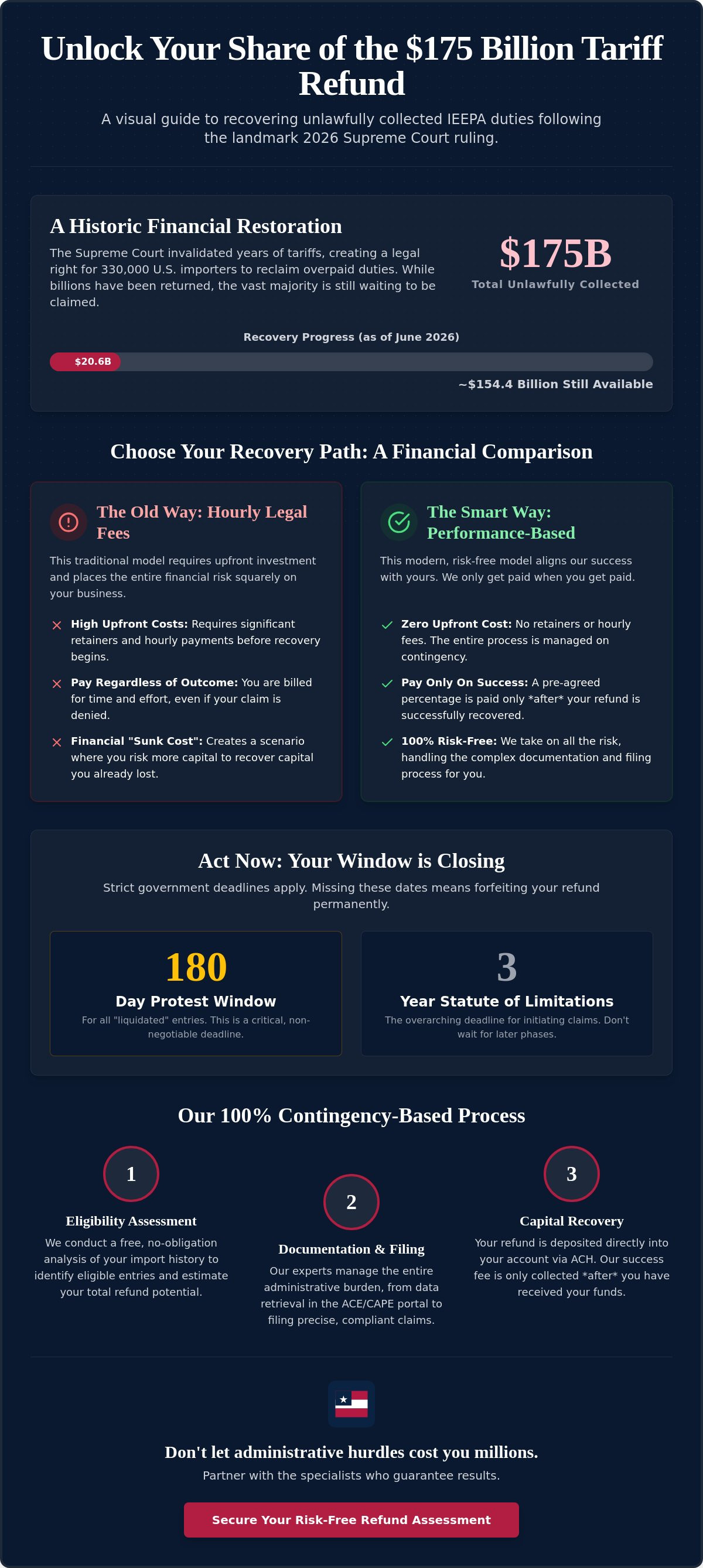
The 3-Year Deadline: Why Your Window is Closing
Time is the most significant adversary in the pursuit of capital recovery. While the Supreme Court's February 2026 decision opened the vault, it didn't remove the regulatory clocks that govern federal duty reclamation. The $175 billion projected in total refunds represents a finite pool of capital, and the administrative pathways to reach it are narrowing. If you're operating under the assumption that Phase Two of the CAPE portal will simplify your claim later, you're making a high-stakes gamble with your company's liquidity. Waiting for future government "simplification" is often a recipe for permanent forfeiture.
The administrative backlog is already tangible. As of late May 2026, U.S. Customs and Border Protection (CBP) had already processed over 157,000 declarations. As the realization of this recovery opportunity spreads, the "bottleneck" effect in the ACE system will only intensify. Utilizing performance-based tariff refund filing allows you to bypass the internal learning curve and move straight to the front of the queue. We ensure your documentation is verified and "audit-ready" before the system reaches its breaking point, protecting you from the delays that will inevitably plague late filers.
Statutes of Limitations and Filing Deadlines
Calculating your specific deadline requires a forensic analysis of your entry and liquidation dates. While general trade lawsuits typically operate on a two-year window, the three-year statute of limitations for specific IEEPA-related administrative claims creates a hard ceiling for many importers. If you fail to file before the 2026-2027 cutoff, your legal right to that capital expires permanently. You can find a detailed breakdown of these critical windows in our guide on the Tariff Refund Statute of Limitations. Proactive filing isn't just a suggestion; it's a requirement for restoration.
The 'First-Mover' Advantage in CAPE Processing
Importers who act now secure the most efficient path through the Consolidated Administration and Processing of Entries (CAPE) system. Early filers avoid the massive influx of claims expected as the primary statute of limitations approaches. By submitting now, you ensure your claim is processed while CBP resources are still focused on the initial Phase 1 rollout. Delaying your application only increases the risk of your claim being caught in a years-long administrative logjam. Review our 2026 recovery guide to understand how to position your business for immediate processing.
Don't let federal bureaucracy dictate your financial future. Secure your preliminary assessment today to lock in your filing window before the 2026 deadlines expire.
Securing Your Recovery with Trump Tariff Relief
The path to reclaiming your capital doesn't have to be a secondary administrative burden. While the legal victory against unauthorized IEEPA duties is settled, the actual recovery of those funds requires a high-performance partner who understands the friction points of federal bureaucracy. We built our firm on a 100% contingency-based model because we believe importers shouldn't have to pay for the government's mistakes. Our performance-based tariff refund filing service ensures that our incentives are perfectly aligned with your financial restoration; we only receive a success fee when your capital is back in your accounts.
By offloading the recovery process to our team, you protect your internal finance and logistics departments from the technical exhaustion of the ACE and CAPE systems. We act as the engine of your recovery, performing forensic audits of your historical customs data to identify every eligible entry summary (CBP Form 7501). This deep-dive approach often uncovers reclaimed capital that standard internal reviews miss, maximizing the total value of your refund while you stay focused on your core business operations.
Our Performance-Based Process
We've streamlined the recovery roadmap into three decisive stages to ensure speed and compliance:
- Step 1: Free Eligibility Assessment: We conduct an exhaustive review of your entry data to determine exactly which duties qualify for reclamation under the 2026 ruling.
- Step 2: Documentation Validation: Our team gathers and validates all necessary proof of payment and entry summaries, ensuring your filing is "audit-ready" for CBP scrutiny.
- Step 3: Execution and Management: We handle the final submission through the CAPE portal and manage all subsequent CBP inquiries or requests for information until the refund is issued via ACH.
Why Trust Our Trade Experts?
Our team possesses a deep specialization in the intersection of IEEPA authority and Section 301 tariff law. We don't just navigate the system; we master it. This "insider" expertise is critical when managing the strict 180-day protest windows and the complex technical requirements of the new CAPE functionality. We've seen the pitfalls of customs litigation and have developed a proprietary framework to bypass them, ensuring your claim is processed with the highest level of professional legitimacy. If you have specific concerns about your company's eligibility or the security of the filing process, check our FAQ for detailed answers from our senior trade counsel.
The opportunity to right this financial wrong is significant, but it's also time-sensitive. Utilizing performance-based tariff refund filing is the most aggressive and risk-mitigated way to secure your company's share of the $175 billion refund pool. Don't let your capital sit in the federal treasury when it could be fueling your next quarter's growth. Let us take on the risk and the heavy lifting to bring your money home.
Reclaim Your Capital Before the Window Closes
The path to recovering your unlawfully collected IEEPA duties is clear, but it's governed by strict 2026-2027 deadlines and complex technical requirements. You've already navigated the financial strain of these tariffs. You shouldn't have to navigate the administrative burden alone. By choosing performance-based tariff refund filing, you align your business with a partner that only wins when you do. This model removes the financial barrier to entry, allowing you to pursue justice without risking a single dollar of additional capital.
Our firm provides comprehensive national U.S. coverage and deep specialization in the nuances of IEEPA legal recovery. We operate on a 100% contingency-based model, meaning we take on all the risk while our expert specialists manage every aspect of the CAPE portal for you. We've seen how these tariffs impacted corporate balance sheets, and we're dedicated to righting that wrong through meticulous documentation and forensic auditing. It's time to restore your liquidity and move forward with the capital that's rightfully yours. We're ready to help you win back what you've overpaid.
Secure Your Free Tariff Eligibility Assessment Now
Frequently Asked Questions
What exactly is a performance-based tariff refund filing?
Performance-based tariff refund filing is a contingency-based recovery model where you only pay a success fee after your capital is successfully recovered from U.S. Customs and Border Protection. Unlike traditional law firms that charge hourly rates regardless of the outcome, this approach shifts all financial risk to the recovery specialist. We handle the technical complexities of the CAPE system and documentation while you focus on operations; it ensures our goals are perfectly aligned with your financial restoration.
How much does it cost to start an IEEPA refund claim with your firm?
There are zero upfront costs to initiate your IEEPA refund claim with our firm. We operate on a pure contingency basis, providing a free initial Tariff Eligibility Assessment to determine the potential value of your recovery. You won't face administrative fees, consulting retainers, or hidden charges. Our compensation is entirely dependent on our ability to successfully secure your refund via the Automated Clearing House (ACH).
Is the China tariff refund real or is it a scam?
The IEEPA tariff refund is a legitimate legal remedy resulting from the U.S. Supreme Court's February 20, 2026, ruling that invalidated unauthorized duties. As of June 2, 2026, CBP has already issued $20.6 billion in refunds to importers. While the term "Trump Tariff Relief" is often used in business advocacy, the recovery process is a formal government action facilitated through the CAPE portal within the Automated Commercial Environment (ACE) Secure Data Portal.
What documents do I need to provide for a performance-based assessment?
You need to provide your historical entry data and CBP Form 7501 entry summaries for the impacted periods. These documents allow us to conduct a forensic audit of the duties paid and verify your eligibility under the 2026 ruling. Additionally, having proof of payment ready helps accelerate the verification process once we move into the formal filing stage. Our team manages the Customs Documentation Management process to ensure your package is audit-ready.
How long does the IEEPA refund process typically take in 2026?
The timeline for recovery varies based on the status of your entries and the current CBP backlog. Since the launch of the CAPE portal on April 20, 2026, the government has been processing Phase 1 claims for unliquidated and recently liquidated entries. While some early filers have seen results within months, the sheer volume of 157,402 declarations received as of late May 2026 suggests that acting early is critical to avoiding longer administrative delays.
Can I file for a refund if my entries have already liquidated?
Yes, you can still file for a refund on liquidated entries, provided you act within the 180-day protest window following the liquidation date. Liquidation is the final calculation of duties by CBP, typically occurring 314 days after entry. If your entries fall outside this 180-day window, the recovery process becomes significantly more complex and may require specialized legal intervention to preserve your rights under the overarching statute of limitations.
What happens if my tariff refund claim is denied by CBP?
If your protest is denied, you have 180 days to file a lawsuit in the U.S. Court of International Trade to contest the decision. Because we utilize a performance-based tariff refund filing model, our experts are incentivized to ensure your initial documentation is flawless to prevent denials. We stay with you through the entire inquiry process, managing CBP communications to resolve technical discrepancies before they escalate to a formal denial.
Do you handle Section 301 tariff recovery as well as IEEPA?
Our primary focus is the recovery of duties invalidated by the 2026 Supreme Court ruling, which specifically targeted tariffs imposed under IEEPA authority. While these are often related to the broader Section 301 landscape, the current refund opportunity is tied to the unauthorized use of emergency powers. We perform a comprehensive Tariff Eligibility Assessment to identify which of your specific entries fall under the invalidated categories, ensuring your claim targets the most viable capital.
Ready to find out what your business may be owed?
Check My Eligibility