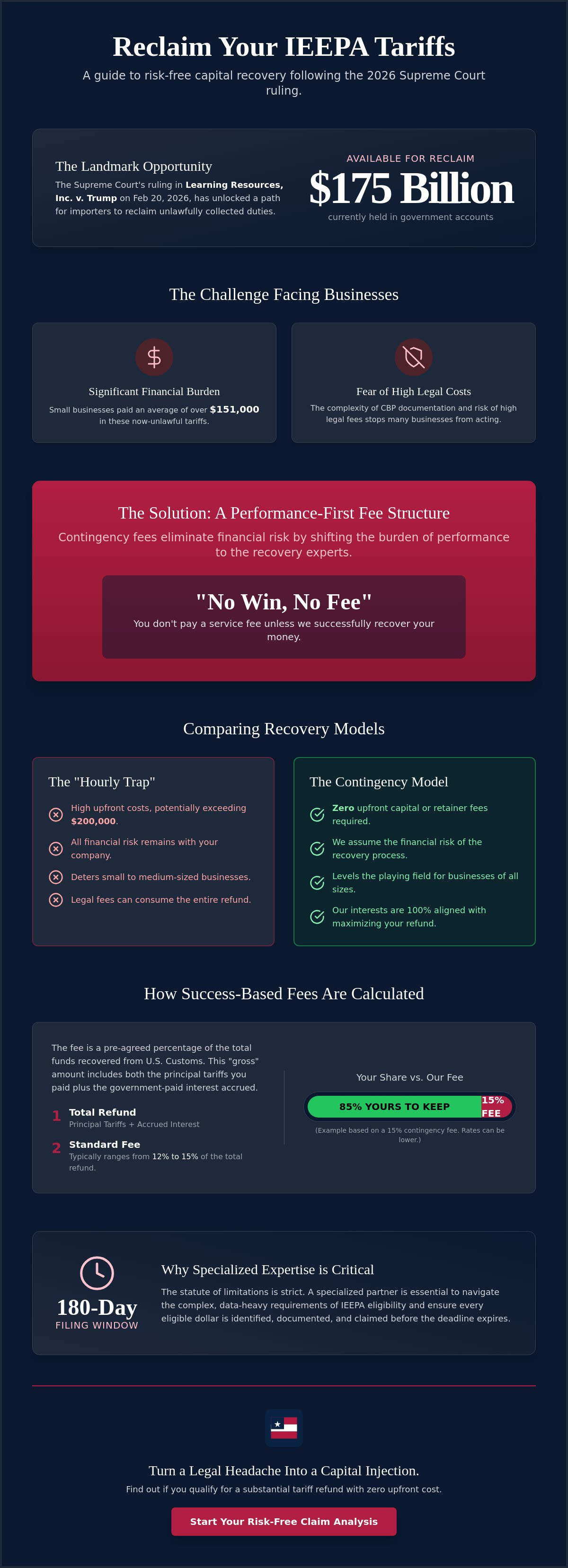
Did you know that an estimated $175 billion in unlawfully collected IEEPA tariffs is currently sitting in government accounts, waiting for importers to reclaim it? Following the landmark Supreme Court ruling in Learning Resources, Inc. v. Trump on February 20, 2026, small businesses that paid an average of over $151,000 in these duties finally have a path to restoration. However, the fear of high legal burn rates and complex CBP documentation often stops recovery efforts before they start. This leads many savvy executives to ask: what is a contingency fee for tariff recovery?
If you're tired of the "pay-to-play" model that favors bureaucracy over business, you're in the right place. We agree that your company shouldn't have to gamble even more capital just to get back what was rightfully yours. This guide will show you how contingency fees eliminate financial risk by shifting the burden of performance onto the recovery experts. You'll discover how to reclaim millions in IEEPA tariffs without a cent of upfront capital. We'll preview the mechanics of these fee structures, the urgency of the 180-day filing window, and how specialized recovery can turn a legal headache into a significant capital injection.
Key Takeaways
- Eliminate upfront financial risk by shifting the burden of legal costs to a success-based model that prioritizes your bottom line.
- Understand exactly what is a contingency fee for tariff recovery and how it applies to reclaiming IEEPA duties following the 2026 Supreme Court ruling.
- Avoid the "hourly trap" by comparing traditional legal billing to performance-first structures that ensure your refund isn't consumed by legal fees.
- Identify potential administrative costs and court filing fees to maintain full transparency throughout the capital reclamation process.
- Discover why specialized expertise is critical for navigating the 180-day filing window and the complex documentation requirements of CBP.
Understanding Contingency Fees in the Context of IEEPA Tariff Recovery
A contingency fee is a performance-driven arrangement where professional fees are only due if a financial recovery is successfully secured for the client. In the high-stakes world of trade law, this success-based model has become the primary vehicle for importers seeking to reclaim capital following the Supreme Court's February 20, 2026, ruling in Learning Resources, Inc. v. Trump. When business owners ask what is a contingency fee for tariff recovery, they're essentially looking for a risk-mitigation strategy that aligns their interests with those of their legal advocates. If the recovery expert doesn't win your money back, you don't owe them a service fee.
This model is particularly critical for claims involving the International Emergency Economic Powers Act (IEEPA). Because the U.S. government won't automatically issue refunds for the billions in tariffs now deemed unlawful, the burden of action falls entirely on the importer. For many, the "No Win, No Fee" promise serves as a powerful corporate risk management tool. It transforms a potential legal liability into a structured opportunity for capital restoration, ensuring that the pursuit of justice doesn't create a new financial drain on the company's balance sheet.
The Legal Basis for Success-Based Recovery
The U.S. Court of International Trade (CIT) recognizes contingency arrangements as a vital mechanism for businesses to access specialized justice. While traditional general counsel provides excellent broad oversight, they often lack the technical infrastructure required to manage high-volume entry claims. If your business has thousands of individual entries, then a specialized partner is necessary to navigate the data-heavy requirements of IEEPA eligibility. This specialized approach ensures that every eligible dollar is identified, documented, and claimed before the strict statute of limitations expires.
Reclaiming Capital Without Budgetary Strain
The primary advantage of this structure is the total elimination of the "hourly trap." Traditional legal billing can easily exceed $200,000 for complex trade cases, a cost that often deters smaller importers. By removing the need for a dedicated legal budget, contingency fees allow SMEs to compete on a level playing field with major importers. This model shifts the financial risk and the burden of proof to the expert partner. It provides a psychological and financial safety net, allowing executives to focus on operations while we handle the heavy lifting of reclaiming their share of the estimated $175 billion in available refunds. This is a high-performing partnership designed to right a financial wrong without adding to your overhead.
How Success-Based Fees are Calculated for Major Importers
Calculating the potential return on a tariff claim requires a clear understanding of the "bottom line" impact. When importers ask what is a contingency fee for tariff recovery, they're often seeking clarity on the exact percentage deducted from their refund check. In the current 2026 market, standard contingency fees typically range between 12% and 15% of the total recovered amount. Some arrangements utilize a sliding scale where clients retain between 72% and 97% of the funds, depending on the volume and complexity of the entries. This performance-based model ensures that the recovery firm is incentivized to maximize every possible dollar of your claim.
A critical distinction often overlooked by competitors is the difference between gross and net recovery. A "gross" calculation applies the fee percentage to the total amount returned by U.S. Customs and Border Protection (CBP). This total includes both the principal tariff amount and the accrued interest. Given that the Court of International Trade (CIT) has ordered interest to be paid on these unlawful duties, the interest component can represent a significant portion of the final check. Understanding this Contingency Fee Legal Definition helps clarify that the fee is a direct reflection of the value added by the recovery expert in securing both the refund and the associated interest.
The Anatomy of a Refund Claim Valuation
The total recoverable amount is the sum of the principal tariffs paid plus government interest. The final success fee is subtracted directly from the settlement check issued by CBP before the remaining capital is transferred to your corporate accounts. For major importers with significant entry volumes, tiered contingency structures are common. In these cases, the fee percentage may decrease as the total recovery reaches specific milestones, ensuring the arrangement remains equitable as the scale of the reclamation grows.
Transparency in Fee Agreements
Transparency is the bedrock of a successful partnership. To avoid "fee creep," it's vital to ensure your agreement clearly defines administrative costs. Some firms might attempt to add a separate "administrative percentage" on top of the success fee, which can unexpectedly erode your final return. See how our process works to understand how we maintain absolute transparency in every filing. Identifying which entries qualify for the contingency model versus those that require a flat-fee screening is a necessary first step. It's often best to start with a preliminary assessment to see how these calculations apply to your specific entry data.
Comparing Contingency Fees to Traditional Legal Billing Models
Traditional legal counsel often operates on a billable-hour model that is fundamentally at odds with the goal of rapid capital restoration. For an importer, hourly billing turns a potential refund claim into an ongoing operational expense, regardless of the final outcome. When you ask what is a contingency fee for tariff recovery, you're asking about a paradigm shift in how your company handles regulatory disputes. Instead of treating a tariff protest as a legal liability to be managed, the contingency model treats it as an asset recovery project to be won. This structure ensures that your legal partner only profits when you do, creating a powerful alignment of interests that motivates faster filings and higher recovery amounts.
The impact on your company's balance sheet is immediate. Hourly fees are a drain on current cash flow, often requiring a dedicated legal budget that many SMEs simply don't have. In contrast, a success-based model allows the recovery effort to exist "off-balance-sheet" until the moment the refund is secured. It's the difference between paying for effort and paying for results. While some firms offer flat-fee assessments for initial data screening, the actual litigation and recovery phase is most effective under a what is a contingency fee for tariff recovery framework, where the expert takes on the risk of the government's refusal to pay.
The Risk of the Hourly Model in Trade Law
Analyzing the cost of multi-year litigation in the Court of International Trade (CIT) reveals a stark reality: hourly rates can easily exceed $200,000 before a case even reaches a final hearing. Trade law is notorious for "unforeseen complexity" factors, such as CBP protests that require multiple rounds of documentation or unexpected reliquidations. Under an hourly model, these delays generate more bills for the client. Under a contingency model, these complexities are the recovery partner's burden to solve. This is why many major importers are pivoting away from general counsel toward specialized firms for Section 301 and IEEPA claims.
Efficiency and Speed: The Contingency Advantage
Success-based models prioritize the 180-day liquidation window with surgical precision. Because the recovery firm's compensation is tied to the final check, there is a massive internal incentive to use automated documentation management for faster processing. Delaying a claim doesn't just hurt the client; it hurts the firm's own ROI. This urgency is vital for navigating the complex requirements outlined in our comprehensive IEEPA guide. By shifting the financial burden, businesses can pursue their full refund without the fear of a ballooning legal bill that erodes the final settlement. Speed is profit, and contingency is the engine that drives it.
Evaluating the Risks and "Hidden Costs" of Tariff Recovery Litigation
While the success-based model effectively eliminates the risk of high legal burn rates, a transparent partnership requires understanding the minor out-of-pocket costs associated with federal litigation. When assessing what is a contingency fee for tariff recovery, it's important to distinguish between professional labor and mandatory court-mandated expenses. The primary non-labor cost is the $400 filing fee required by the U.S. Court of International Trade (CIT) for each action. While the contingency fee covers the thousands of hours of specialized legal work, court costs are often separate pass-through expenses. Trump Tariff Relief handles the management of these filings to minimize administrative friction, ensuring your team isn't bogged down by bureaucratic minutiae.
Beyond the $400 filing fee, businesses should account for administrative costs such as documentation retrieval and expert witness fees. However, the most significant "hidden cost" isn't a fee at all; it's the opportunity cost of inaction. Importers have a narrow 180-day window after the liquidation of their entries to file a protest. With small businesses having paid an average of over $151,000 in unlawful tariffs, every day of delay is a step closer to a permanent financial loss. If you miss this window, the government keeps your capital forever, regardless of the February 20, 2026, Supreme Court ruling.
Addressing the $400 Filing Fee and Court Costs
The $400 fee is a mandatory requirement for any importer choosing to escalate their claim to the Court of International Trade. While the contingency fee covers the expert labor involved in the recovery, court costs are often separate pass-through expenses that the client pays to the court system. We streamline this process by identifying exactly which entries provide the highest ROI, ensuring that your court costs are a tiny fraction of the potential millions in recovery. Our goal is to keep the path to restoration as low-friction as possible.
The Non-Financial Risks of Recovery
A common concern among executives is whether filing a claim will trigger a broader customs audit. In reality, filing a targeted IEEPA protest is a standard legal right and does not typically serve as a catalyst for a general audit. The real risk lies in documentation inaccuracy. Submitting a claim without precise data can lead to "frivolous claim" penalties, which is why we emphasize rigorous data management to protect your corporate reputation. You can read our IEEPA FAQ for more details on audit myths and compliance. If you're ready to secure your refund, you should request a preliminary eligibility assessment today to begin the reclamation process.
Why Trump Tariff Relief Uses a Performance-First Fee Structure
Trump Tariff Relief was founded on a singular premise: importers deserve a partner that absorbs the risk of government overreach. While many competitors dilute their value proposition with multiple flat-fee tiers or complex upfront retainers, we remain committed to a performance-first model. This ensures that when you ask what is a contingency fee for tariff recovery, the answer is a direct reflection of our confidence in your claim's success. We cover the entire lifecycle of your recovery, from the initial data audit to the final disbursement from CBP, ensuring you never have to choose between legal action and operational liquidity. Our success is inextricably linked to yours.
The 2026 deadlines are unforgiving. With the 180-day liquidation window closing rapidly on billions in potential refunds, our fee structure is designed to favor immediate, aggressive action. We don't wait for a retainer check to clear before we start analyzing your entry data; we move with the speed that the Supreme Court's Learning Resources ruling demands. This urgency is what distinguishes a high-performing partner from a traditional law firm. We understand that in trade law, a delay of even a few days can result in the permanent loss of hundreds of thousands of dollars in recoverable capital.
A Specialized Partnership for National Importers
We focus exclusively on IEEPA tariff recovery and documentation management rather than general customs brokerage. This specialization allows us to maintain advanced internal systems that can process thousands of entries with surgical precision. Navigating the implications of the Atmus Filtration ruling requires this level of technical depth, as generalists often overlook the specific entry codes that qualify for restoration. If you're managing a national supply chain, you can't afford to leave your recovery to a general counsel who is learning the nuances of trade law on your dime. It's vital to stay ahead of the critical deadlines for IEEPA claims to ensure your entries don't expire before they are protested.
Getting Started: The Zero-Cost Eligibility Assessment
Transparency begins before any contract is signed. We identify your specific "Recovery Threshold" through a preliminary audit of your historical entry data. This initial screening is provided at no cost, allowing you to see the tangible value of your claim before committing to a what is a contingency fee for tariff recovery arrangement. Our onboarding process is streamlined for high-volume importers, requiring minimal time from your internal finance or logistics teams. We do the heavy lifting of identifying eligible entries, managing the CBP portal, and filing the necessary protests. Request your free Tariff Eligibility Assessment today to see exactly how much capital your business is entitled to reclaim under the 2026 ruling.
Reclaim Your Capital and Restore Your Bottom Line
The window to act is narrowing. Following the 2026 Supreme Court ruling, businesses have a historic opportunity to reverse the financial damage of unlawful tariffs. We've explored how a success-based model eliminates the hourly trap and why understanding what is a contingency fee for tariff recovery is essential for any importer looking to protect their cash flow. By shifting the legal risk to us, you can pursue justice without the burden of upfront capital or the fear of a ballooning legal bill.
Our specialized documentation team provides expert management to help you navigate the complex CIT filings required to access the $130B IEEPA refund pool. We manage the entire process. We ensure your entries are identified and protested before the 180-day statute of limitations expires. Contingency-based recovery ensures zero financial risk for your organization, making this a high-reward partnership built on performance. It's time to take back what is yours and reinvest that capital into your company's growth.
Secure Your IEEPA Refund Assessment with No Upfront Cost
Don't let government overreach become a permanent loss for your business. We're here to act as your bold advocate and provide the shortcut you need through the bureaucracy.
Frequently Asked Questions
What is a typical contingency fee percentage for tariff recovery?
Most industry-standard fees for IEEPA recovery range between 12% and 15% of the total settlement. Some firms utilize a sliding scale where the importer retains between 72% and 97% of the recovered funds, depending on the complexity and volume of the entries. This structure ensures that the recovery partner is highly motivated to maximize the total return for your business.
Will I have to pay anything if my tariff refund claim is denied?
You won't owe any professional service fees if your claim is denied by the government. The "No Win, No Fee" model ensures that the financial risk of the litigation and documentation process remains with the consultant. This is the fundamental answer to what is a contingency fee for tariff recovery, as it protects your company’s balance sheet from speculative legal expenses that don't produce a result.
Does the contingency fee apply to the interest the government pays on the refund?
Yes, the contingency fee typically applies to the "gross" recovery, which includes both the principal tariff refund and the accrued interest paid by the government. Since the U.S. Court of International Trade has ordered interest to be paid on these unlawful duties, the interest component can be substantial. Including it in the calculation aligns the consultant's incentives with securing the largest possible total check for your business.
Are there any hidden costs, such as filing fees, that I should know about?
The primary out-of-pocket cost is the $400 filing fee required by the U.S. Court of International Trade for each legal action. While the professional labor is covered by the contingency percentage, court-mandated fees are typically pass-through expenses. You should also account for minor administrative costs like documentation retrieval, though these are often negligible compared to the total refund amount.
How is the contingency fee paid once the refund check arrives?
The fee is usually subtracted directly from the settlement check issued by U.S. Customs and Border Protection. Once the refund and interest are secured, the recovery firm facilitates the transfer of the remaining funds to your accounts. This success-first payment method ensures you never have to come out of pocket to pay for the recovery services or manage complex invoicing during the process.
Can I switch from an hourly lawyer to a contingency-based consultant mid-claim?
You can typically switch to a contingency-based model, but you must first review your existing engagement letter for termination clauses. Many importers realize mid-litigation that hourly bills are eroding their potential refund and pivot to a performance-based partnership. We can often step in to manage the documentation and CIT filings, providing a more cost-effective and urgent path toward the final recovery.
Why do consultants charge a percentage instead of a flat fee for recovery?
A percentage-based fee aligns the consultant’s interests with your goal of a maximum refund. Flat fees often fail to account for the unforeseen complexity of trade law, such as extensive CBP protests or documentation challenges. By charging a percentage, the consultant absorbs the risk of a long, difficult case, ensuring they only profit when they successfully secure your capital.
Is a contingency fee agreement legally binding in the Court of International Trade?
Yes, contingency fee agreements are legally binding and widely recognized by the U.S. Court of International Trade. These arrangements are a standard practice in trade litigation, allowing businesses of all sizes to access specialized expertise without the barrier of high hourly rates. The CIT views these contracts as legitimate means for importers to seek restoration for unlawful government actions.
Ready to find out what your business may be owed?
Check My Eligibility