
Over 330,000 importers are currently sitting on a collective $175 billion in government-held funds, yet many haven't even started the recovery process. You've likely felt the sting of high import costs eroding your margins for years, all while struggling with complex trade laws that seem designed to keep your capital out of reach. It's frustrating to watch your profits disappear into federal coffers, especially when those tariffs were never legally justified to begin with.
This guide will clarify exactly who can claim tariff refunds following the landmark Supreme Court ruling on February 20, 2026. If you've paid duties under the International Emergency Economic Powers Act (IEEPA), you're likely eligible to reclaim thousands in overpaid capital. We'll identify the specific criteria your business must meet to secure a refund before strict federal deadlines close this window of opportunity.
We'll provide clear "Yes/No" eligibility requirements for Importers of Record, explain the new CAPE Declaration system, and outline a low-risk path to identifying the total refund size you're owed.
Key Takeaways
- Identify the Importer of Record’s pivotal role as the primary claimant and why this status is the foundation of your recovery.
- Understand who can claim tariff refunds in complex supply chains, including how downstream retailers can address financial pass-throughs.
- Differentiate between eligible IEEPA duties and other trade measures to ensure your filing targets the most viable recovery opportunities.
- Master the 2026 filing deadlines and the three-year statute of limitations that determines when your window for recovery expires.
- Leverage a results-driven recovery model that handles documentation and filings without requiring upfront capital or financial risk.
Understanding the Importer of Record: The Primary Path to Recovery
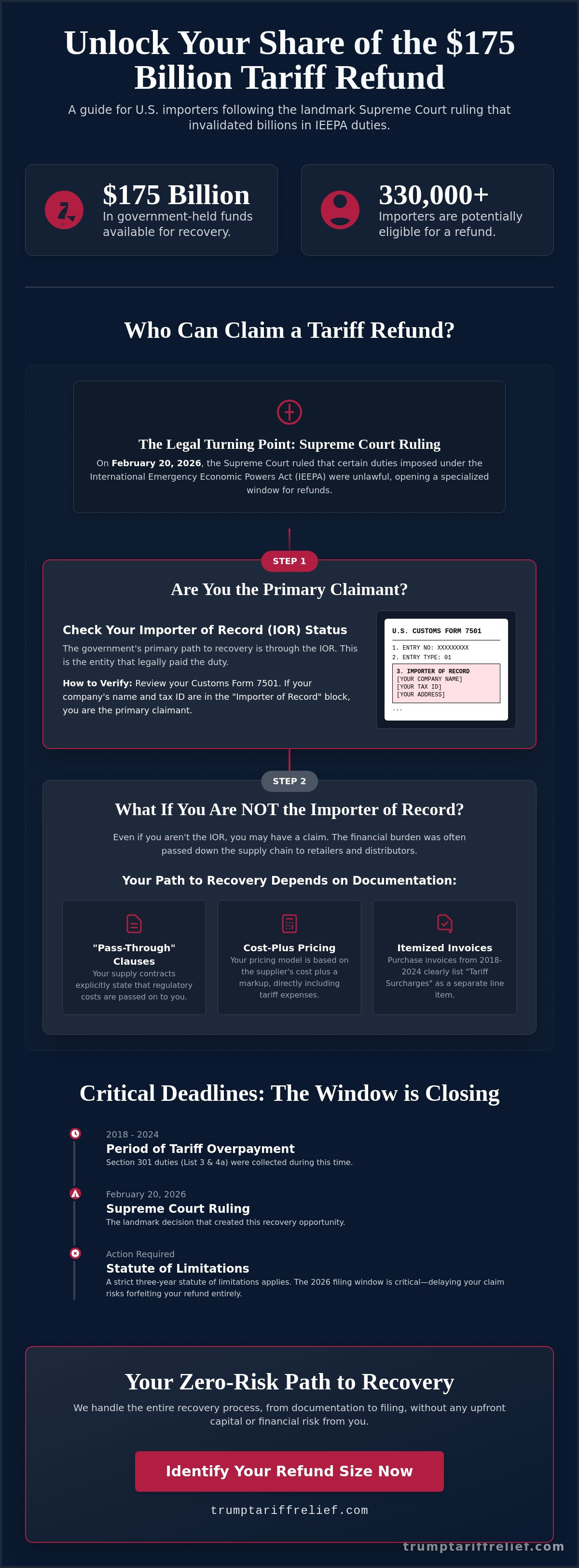
The federal government recognizes one primary entity for financial restoration: the Importer of Record (IOR). By definition, the IOR is the specific individual or business entity officially responsible for clearing goods through U.S. Customs and ensuring all legal requirements are met. When analyzing who can claim tariff refunds, the IOR stands at the front of the line because they're the ones who legally "paid" the duty to the government at the time of entry. Establishing your status as the IOR isn't just a matter of paperwork; it's the foundational requirement for accessing the $175 billion currently available for recovery.
This massive opportunity exists because of the landmark Supreme Court ruling in Learning Resources, Inc. v. Trump on February 20, 2026. The Court determined that certain duties imposed under the International Emergency Economic Powers Act (IEEPA) exceeded executive authority. This decision effectively invalidated billions of dollars in collected taxes. Because these specific duties were levied using IEEPA as the legal mechanism, a specialized refund window has opened for those who bore the initial cost. A foundational step in understanding tariffs and their recovery is recognizing that the government views the IOR as the only party with the standing to file a CAPE Declaration for these specific overpayments.
Identifying Your Importer of Record Status
Determining your eligibility starts with a review of your Customs Form 7501. This document is the definitive record of your import activity. If your company’s name and federal tax ID appear in the "Importer of Record" block, you're the primary candidate for a refund. Most businesses that manage their own Customs Brokerage accounts or have a direct relationship with a customs broker are the IOR. You were the party responsible for the immediate payment of Section 301 duties, meaning the government owes that capital directly back to you. You can learn more about the technical requirements in our detailed IEEPA guide.
Direct Claims for Manufacturers and Tech Firms
Manufacturers and technology companies often face the heaviest financial burden because they frequently act as their own IOR for raw materials and components. If your business imported electronics, industrial machinery, or consumer goods found on List 3 or List 4a, the financial impact of these tariffs likely devastated your margins. Reclaiming these direct duty payments provides an immediate infusion of liquidity. For a manufacturer, a successful claim doesn't just "right a wrong"; it restores the capital necessary for R&D, equipment upgrades, and competitive scaling that was previously lost to unlawful trade measures.
Downstream Eligibility: Can Retailers and Distributors Claim Refunds?
While the Importer of Record (IOR) is the legal gatekeeper for federal recovery, the financial burden of these tariffs rarely stayed with the primary importer. In many cases, manufacturers and wholesalers passed these costs directly to retailers and distributors through "tariff surcharges" or price adjustments. This creates a complex landscape for who can claim tariff refunds. If your business wasn't the one clearing goods through customs, you still have a legitimate financial stake in the billions being returned. The Supreme Court's February 20, 2026, ruling doesn't just benefit the paperwork-holders; it opens the door for anyone who bore the actual economic weight of these duties to seek restoration.
Your ability to recover funds depends heavily on your supply chain agreements. In the eyes of the government, the refund goes to the IOR. However, commercial law and specific contract clauses often dictate that these windfalls must be shared. There are three primary scenarios where a non-importer has a strong claim. First, if your contracts include "pass-through" clauses for regulatory costs. Second, if you operate under cost-plus pricing models. Third, if your supplier issued itemized invoices that explicitly listed tariff costs as a separate fee. A U.S. Chamber of Commerce guide highlights that documentation is the deciding factor in these multi-party recovery efforts.
Identifying Itemized Tariff Surcharges
Success begins with a forensic audit of your historical records. You need to identify every invoice between 2018 and 2024 that contains line items such as "China Surcharge," "Tariff Recovery Fee," or "Section 301 Adjustment." These itemized costs are your "smoking gun." They prove that while you weren't the IOR, you were the party that actually paid the tax. Evidence of price increases that perfectly mirrored the imposition of List 3 and List 4a duties strengthens your position. If you're unsure how to categorize these costs, a professional tariff eligibility assessment can help map your invoices against the specific IEEPA measures eligible for recovery.
Negotiating with Your Importer of Record
Since the government issues the check to the importer, your recovery often involves a direct negotiation with your vendors. Many wholesalers are already preparing to receive these refunds. It's vital to approach them now to establish your claim to a portion of those funds. "Open-book" pricing arrangements often make this obligation legally binding. If your supplier recovered their costs from you, they shouldn't be allowed to "double-dip" by keeping the government refund as well. We help businesses manage these complex customs documentation hurdles to ensure the right parties are made whole.
Specific Criteria: Which Tariffs are Eligible for Refund?
Precision is the only thing standing between a rejected claim and a successful recovery. While many businesses believe all China-related duties are eligible, the current legal window is strictly limited to tariffs authorized via the International Emergency Economic Powers Act (IEEPA). This distinction is vital when determining who can claim tariff refunds. If your imports fall under Section 301 List 3 or List 4a, they were likely subject to the IEEPA-linked measures that the Supreme Court invalidated on February 20, 2026. This creates a specific, high-stakes opportunity for recovery that doesn't apply to general trade enforcement actions. Understanding these nuances is the first step for any business asking who can claim tariff refunds in this current phase.
Success rates are notably high in the retail, consumer technology, and industrial manufacturing sectors. These industries bore the brunt of the $200 billion and $300 billion trade actions. Common products include everything from consumer electronics and furniture to industrial components and textiles. If your business imported these goods between 2018 and 2024, your HTS (Harmonized Tariff Schedule) codes are the definitive evidence needed to unlock your capital. Our IEEPA eligibility assessment can quickly cross-reference your documentation against the master list of qualifying entries. We focus on these high-success categories because the documentation requirements are stringent, and the potential for a six-figure restoration is highest for these specific IORs.
Section 301 List 3 vs. List 4a
List 3 represents the massive $200 billion trade action where duties were increased from 10% to 25%. If you imported goods under these HTS codes, you've likely overpaid by thousands of dollars per entry. List 4a followed as a $300 billion action with its own specific set of exclusions. Verification of your HTS codes is the only way to confirm where your entries sit within these categories. Because the filing dates of the original entries determine your recovery window, you can't afford to guess which list applies to your inventory. We provide the specialized tools needed to audit these codes and ensure every eligible dollar is identified before the 2026 deadline.
Excluded Products and Non-Eligible Categories
It's equally important to know what doesn't qualify. The current IEEPA refund scope does not extend to Section 232 steel and aluminum duties or the initial Section 301 List 1 and List 2 actions. These earlier lists, totaling approximately $50 billion, were implemented under different legal justifications and aren't currently part of this specific refund portal. You should check our frequently asked questions to verify if your specific product category is currently eligible for a CAPE Declaration. Maintaining this level of granular detail is exactly what ensures a low-risk, high-reward filing process.
The 2026 Filing Window: Statutes of Limitations and Deadlines
Time is the most critical variable in the recovery process. While the Supreme Court's February 20, 2026, ruling provided the legal basis for restoration, it didn't pause the ticking clock of federal statutes. Most businesses asking who can claim tariff refunds don't realize that a strict three-year statute of limitations applies to these entries. If your goods were cleared during the peak of the trade war, your window for recovery is closing fast. Waiting for a "final" government announcement or a direct invitation to file is a strategic error that could permanently forfeit your capital. The government opened the official refund portal on April 20, 2026, but they aren't obligated to process claims that fall outside the legal timeline.
The filing date of your original entry determines your specific expiration. Entries made in 2023 are reaching their three-year limit this year. This represents a "last chance" for importers to reclaim duties on high-volume shipments that were subject to the most aggressive IEEPA measures. Identifying who can claim tariff refunds depends entirely on whether your documentation is submitted before these entries become "stale" and legally unrecoverable. Our customs documentation management service automates this audit to ensure no deadlines are missed.
Calculating Your Specific Deadline
Every entry undergoes a process called "liquidation," which is the final calculation of duties by U.S. Customs. Once an entry liquidates, you typically have only 180 days to file a formal protest or a CAPE Declaration. If you miss this 180-day sub-deadline, the entry is considered final. You can't rely on general dates; you must audit every individual entry on your Customs Form 7501 to map out a precise filing schedule. This granular level of detail is what separates a successful recovery from a denied claim.
Why Urgent Action is Required Now
Speed is essential because documentation preparation isn't instantaneous. We must verify HTS codes and payment records against the new CAPE requirements before any filing occurs. As more of the 330,000 eligible importers realize the scale of this opportunity, a massive backlog in the ACE Secure Data Portal is inevitable. Filing now ensures your claim is processed within the standard 60 to 90-day window rather than being buried under a mountain of late-stage applications. You should learn more about the IEEPA timeline to understand how these regulatory gears are moving right now.
Secure your spot in the recovery queue by requesting a preliminary eligibility assessment today to ensure your entries remain legally viable.
The Zero-Risk Path: How Trump Tariff Relief Manages Recovery
The path to financial restoration is often blocked by administrative complexity and the high cost of specialized advocacy. While the federal government has opened the door for recovery, the actual mechanics of the CAPE system and the ACE Secure Data Portal are notoriously difficult to navigate. If you're still questioning who can claim tariff refunds, you don't need to fight the bureaucracy alone. We provide a results-oriented partnership that takes the operational burden off your shoulders. We manage the entire lifecycle of your claim, from the initial audit of your HTS codes to the final submission of your CAPE Declaration.
Our approach differs fundamentally from traditional law firms that charge high hourly fees regardless of the outcome. We operate as a high-performing ally for your business, focusing on the removal of financial barriers. We identify hidden eligibility within complex supply chains, ensuring that even if your documentation is fragmented, we find the path to recovery. For companies managing complex international interests, such as US-Italy cross-border operations, specialized firms like Tosolini, Toniutti & Partners provide essential legal support. This specialized focus on IEEPA measures allows us to move with a level of precision that general corporate legal services can't match. We don't just provide advice; we provide the engine that drives your capital back into your accounts.
What to Expect from a Preliminary Assessment
The recovery process begins with a rigorous data review. We require your historical HTS codes, entry dates, and a record of the total duties paid between 2018 and 2024. This information allows us to verify your eligibility against the Supreme Court's February 20, 2026, ruling and subsequent trade precedents. We cross-reference your entries with the 330,000 potentially eligible importers to determine the exact size of your claim. You can see how our recovery process works in detail to understand the milestones we'll hit together. This assessment is the first step in righting a financial wrong that has impacted your margins for years.
Securing Your Refund on a Contingency Basis
We've eliminated the financial risk of filing a claim through our contingency-based model. You pay nothing for our IEEPA Tariff Refund Recovery services unless we successfully recover your money. This success-fee structure perfectly aligns our interests with yours; we're motivated to maximize your refund and secure it as quickly as possible. By removing the need for upfront consulting packages, we ensure that every business, regardless of current liquidity, can pursue the thousands in overpaid tariffs they're owed. If you're ready to identify who can claim tariff refunds within your organization, the next step is simple. Start your eligibility audit today to ensure you don't miss the 2026 filing window.
In addition to specialized recovery, managing your company's ongoing tax obligations and corporate filings is crucial for long-term stability. For expert assistance with business services and tax strategy, Apex Income Tax & Multiservice LLC provides the professional oversight needed to keep your operations compliant and efficient.
Secure Your Financial Restoration Today
The window to recover your overpaid duties is open, but the federal timeline is unforgiving. We've clarified that the distinction between Importers of Record and downstream participants determines exactly who can claim tariff refunds under the new CAPE system. Success requires a forensic audit of your HTS codes and a precise understanding of the legal landscape following the Supreme Court's decision. Every day you wait is a day closer to the three-year statute of limitations expiring on your entries.
You don't have to navigate this bureaucratic maze alone. Our specialized IEEPA focus and expert trade team handle the heavy lifting; we manage everything from documentation to final government filings. Because we operate on a contingency basis, you face no upfront costs. We only receive a fee once we successfully recover your capital. This is a low-risk, high-reward opportunity to right a financial wrong and restore your business margins.
Don't let your capital remain in federal coffers. Start Your Free Eligibility Assessment Now and take control of your recovery. Your company's financial restoration is within reach.
Frequently Asked Questions
Is the China tariff refund real or a scam?
The refund program is a legitimate federal process established after the Supreme Court's February 20, 2026, ruling. This decision invalidated billions in duties collected under the International Emergency Economic Powers Act. The government officially launched the refund portal on April 20, 2026, to facilitate these payments. You should verify any firm's legitimacy by ensuring they focus on IEEPA measures rather than general marketing terms that lack legal substance.
Can a small business claim a tariff refund if they bought from a wholesaler?
Small businesses that purchased from wholesalers aren't the primary claimants in the eyes of U.S. Customs. The government issues refunds directly to the Importer of Record who cleared the goods. However, if your wholesaler added a "tariff surcharge" to your invoices, you may have a contractual right to those funds. You should review your supply chain agreements for pass-through clauses that mandate the return of these overpayments once recovered.
What is the deadline for filing an IEEPA tariff refund claim in 2026?
The deadline is governed by a strict three-year statute of limitations from the date of entry. Because many of these tariffs were paid in 2023, your window for recovery is closing rapidly throughout 2026. Additionally, entries that liquidated more than 180 days ago require specialized handling to remain viable. Determining who can claim tariff refunds often comes down to who acts before these legal timelines expire and entries become stale.
How much does it cost to hire a consultant for tariff recovery?
Professional recovery firms typically operate on a contingency-based model where you pay nothing upfront. This success-fee structure ensures that your interests are perfectly aligned with the recovery team. You should avoid any provider requesting upfront consulting packages or hourly legal fees. A contingency arrangement removes the financial barrier to entry, allowing you to pursue your refund without risking additional capital on administrative costs or speculative filings.
What documents do I need to prove my eligibility for a refund?
You must provide your Customs Form 7501 and a detailed record of the HTS codes used for each entry. These documents prove you were the Importer of Record and that the goods fell under the invalidated IEEPA measures. You also need verified proof of payment for the duties in question. Maintaining a clear connection between the importing entity and the specific tariff payments is essential for a successful CAPE Declaration submission.
How long does it take for the U.S. government to process a tariff refund?
Valid IEEPA refunds are generally issued within 60 to 90 days after the government accepts your CAPE Declaration. This timeline can be extended if your filing triggers a compliance review or if your documentation is inconsistent. Because the government is processing claims for over 330,000 potential importers, filing early is the only way to avoid the inevitable backlog. We prioritize efficiency to ensure your capital is restored as quickly as possible.
Do I need a lawyer to file a tariff refund claim?
You don't need a lawyer to file, but you do need specialized expertise in customs documentation and the CAPE system. While general corporate legal services offer broad advice, they often lack the technical infrastructure required to audit thousands of HTS codes across years of data. A specialized recovery partner handles the heavy lifting of the filing process. This allows your business to focus on operations while experts manage the regulatory bureaucracy.
What happens if my Importer of Record is no longer in business?
If the original Importer of Record is no longer in business, the ability to claim a refund depends on how the company was dissolved. Successor entities or legal representatives may still have standing to recover these funds from the government. These situations are highly technical and require a thorough who can claim tariff refunds assessment to determine the legal path forward. You should gather all remaining corporate records to prove your right to the defunct entity's assets.
Ready to find out what your business may be owed?
Check My Eligibility