
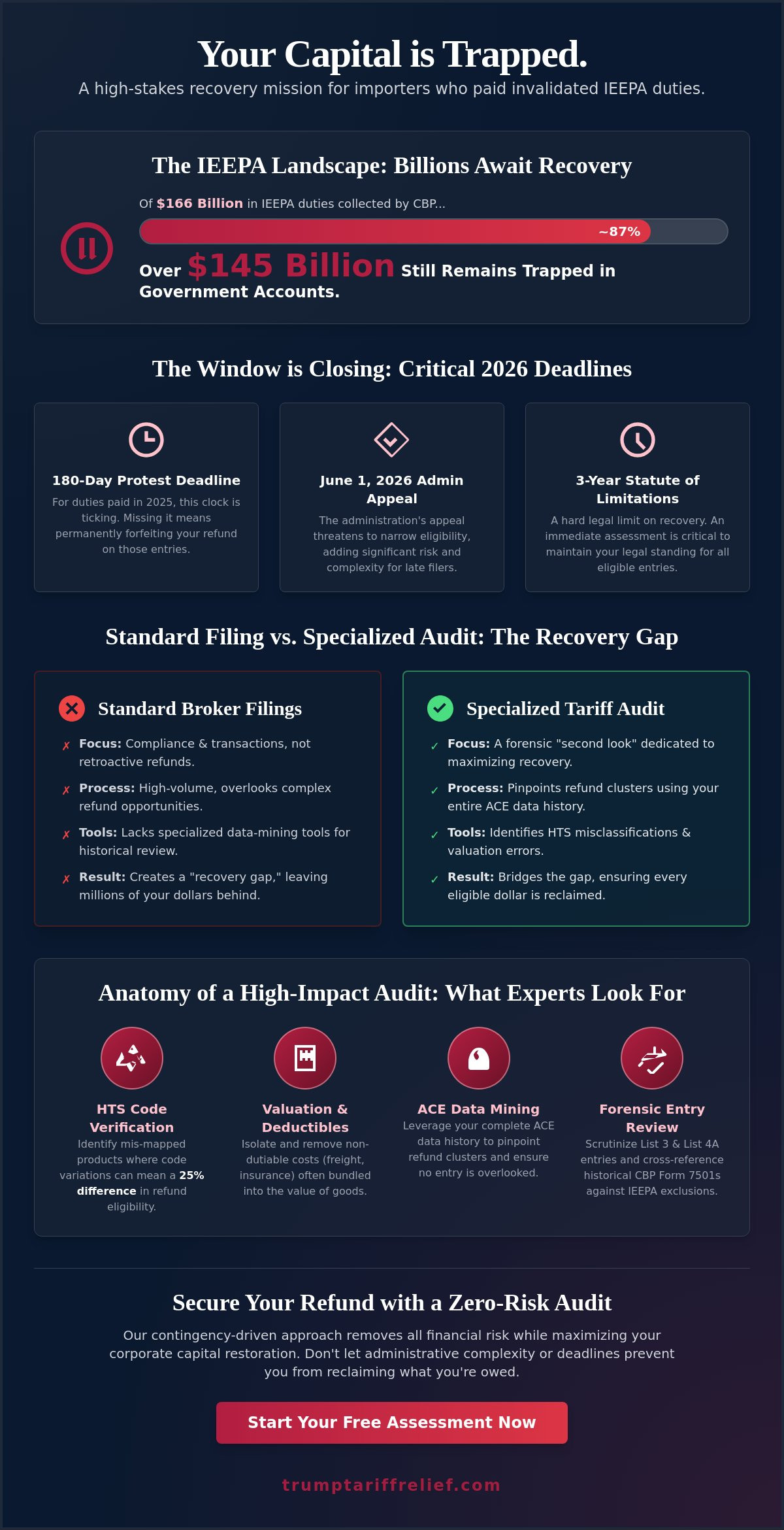
Did you know that of the $166 billion in IEEPA duties collected by CBP, over $145 billion still remains trapped in government accounts as of June 2026? With the administration's June 1st appeal threatening to restrict broad eligibility, the window to secure your capital is closing. A professional tariff refund claim audit is no longer just a compliance check; it's a high-stakes recovery mission for any business that paid these invalidated duties throughout 2025. You've likely felt the frustration of watching your capital sit idle while legal battles and the new CAPE system create layers of administrative confusion.
It's natural to worry about leaving money on the table or triggering unnecessary regulatory scrutiny during this period of uncertainty. This guide explains how a specialized tariff refund claim audit identifies missed capital and ensures your IEEPA recovery is fully optimized before the 180-day protest deadlines pass. We'll examine the impact of the latest Supreme Court ruling, the mechanics of the CAPE system, and the streamlined path to reclaiming your funds without the typical bureaucratic headache.
Key Takeaways
- Identify the specific regulatory triggers that differentiate routine customs entries from high-value retroactive recovery opportunities.
- See how a professional tariff refund claim audit performs a forensic review of your HTS codes and valuation data to capture every dollar owed.
- Recognize why high-volume customs brokers often overlook these complex refund opportunities and how specialized expertise bridges that gap.
- Learn the step-by-step process for leveraging ACE data to pinpoint refund clusters and meet strict 2026 administrative deadlines.
- Discover a streamlined, contingency-driven approach to IEEPA recovery that removes financial risk while maximizing your corporate capital restoration.
Why Every Importer Needs a Tariff Refund Claim Audit Now
The SCOTUS ruling on February 20, 2026, fundamentally shifted the trade landscape. It confirmed that the International Emergency Economic Powers Act does not grant the executive branch the authority to levy U.S. customs duties. This decision unlocked a path to reclaiming billions, yet the administration’s June 1, 2026, appeal has injected a fresh layer of risk into the process. If you rely on standard administrative filings, you're likely leaving capital behind. A professional tariff refund claim audit is the only mechanism that ensures every eligible entry is captured before the government attempts to narrow the scope of these refunds. The complexity of the new CAPE system means that errors in initial filings can lead to immediate rejections, making precision more valuable than ever.
The IEEPA Landscape in 2026
The legal victory in February was historic, but it isn't a permanent guarantee of payment. While the CAPE system launched on April 20, 2026, to streamline processing, it primarily targets unliquidated entries. For duties paid in early 2025, the 180-day protest deadline is a ticking clock that could permanently bar your recovery. Trump Tariff Relief specializes in navigating this specific legal precedent, ensuring that your claims are filed with the precision required to withstand government appeals. Many importers don't realize that a three-year statute of limitations applies to these recoveries, making an immediate assessment critical for maintaining your legal standing. Waiting until the final deadline is not a strategy; it's a high-risk gamble with your company's liquidity.
Audit vs. Standard Filing: The Financial Difference
Standard customs filings are designed for compliance, not for identifying retroactive refund potential. Brokers are transactional partners; they focus on moving goods through ports efficiently. They often lack the specialized tools to look back at years of data to find HTS misclassifications that lead to larger refunds. This creates a "recovery gap" where significant capital is ignored. An audit acts as a "second look" at your entire ACE history to find hidden errors that standard systems miss. You can learn more about how we bridge this gap through our specialized assessment process. A tariff refund claim audit is a comprehensive forensic review of entry data.
The Anatomy of a High-Impact Tariff Audit: What Experts Look For
A successful recovery isn't achieved through simple data entry. It requires a forensic deep dive into the technical details of your trade history. While many accounting firms treat refunds as a tax line item, a professional tariff refund claim audit focuses on the specific trade data points that define your eligibility. Experts scrutinize List 3 and List 4A entries, cross-referencing your historical entry summaries (CBP Form 7501) against specific IEEPA exclusions that were often ignored during the initial filing. We verify 'Country of Origin' declarations to ensure your goods meet the precise criteria for relief, as even minor discrepancies in documentation can cause CBP to flag a claim for rejection.
HTS Code Verification and Reclassification
Precision in classification is everything. The Harmonized Tariff Schedule of the United States is a complex web where minor code variations can result in 25% differences in refund eligibility. Our audit process identifies 'mis-mapped' products where a more accurate HTS code would've exempted the item from IEEPA duties entirely. Consider industrial components; many were categorized under broad headers that triggered maximum tariffs. By reclassifying these specific parts into more accurate sub-headings, firms can unlock full IEEPA recovery on entries they previously thought were ineligible. If you're unsure if your products were correctly mapped, you can review our eligibility FAQ to see how we handle technical reclassifications.
Valuation and Deductible Costs
Overpaying on duties often stems from inflated 'Value of Goods' declarations. A high-impact audit identifies non-dutiable charges hidden within your entry values. International freight, insurance, and foreign inland shipping costs shouldn't be part of the dutiable value, yet they're frequently bundled by high-volume brokers. We also analyze 'first sale' valuations to ensure your duty was calculated on the manufacturer’s price rather than a middleman’s markup. This optimization is critical for your bottom line. While firms like PwC have highlighted the significant 'gross vs. net' impact on corporate liquidity, our goal is to ensure your firm is on the winning side of that equation. Identifying these valuation errors often turns a standard refund into a massive capital restoration event.
Internal Filing vs. Specialized Audit: Why Your Broker Might Miss Millions
Many importers assume their customs broker is already handling their IEEPA recovery. This assumption is often a multi-million dollar mistake. Brokers are high-volume transactional partners. Their business model is built on the speed of clearing goods through ports, not on the forensic investigation of historical entries. A tariff refund claim audit operates on an entirely different plane of scrutiny. While your broker focuses on today’s compliance, a specialized audit scans years of historical data to uncover capital that standard filing processes systematically overlook. This is particularly crucial for companies importing high-value technical assets, such as the advanced power quality systems from Energy Control Systems, where classification errors are common. If your broker failed to flag an error in 2025, they're unlikely to highlight it now; doing so would admit to a past filing mistake. This inherent conflict of interest often leaves businesses blind to their true recovery potential.
The Limitations of Standard Customs Brokerage
Standard brokerage software is designed for "clearing," not for "reclaiming." These systems are optimized to ensure goods meet current regulatory requirements to avoid delays at the border. They rarely possess the sophisticated algorithms needed to identify IEEPA-specific refund triggers across thousands of historical entries. Because the legal landscape has shifted so rapidly, most generalist brokers lack the deep-dive expertise found in a specialized IEEPA explained framework. Relying on a generalist for a specialized recovery mission is like asking a tax preparer to handle a complex international litigation case. The tools and the objectives simply don't align.
The Strategic Advantage of a Specialized Recovery Firm
A specialized recovery firm brings proprietary technology to the table that can scan thousands of ACE reports in seconds. This speed is vital given the administrative uncertainty following the administration’s June 1, 2026, appeal. We don't just file papers; we build "defense-ready" files that anticipate CBP inquiries and CAPE system validations. For corporate treasury departments, the contingency-based model is the ultimate advantage. Since we only receive a percentage of the actual refund disbursed by the Treasury, our interests are perfectly aligned with yours. There are no upfront costs, which eliminates the traditional "cost-benefit" barrier that often stalls capital recovery projects in large organizations. We take the risk, so you can focus on your core operations.
Executing the Audit: A Strategic Framework for 2026 Compliance
Success in reclaiming IEEPA duties depends on a methodical execution that standard administrative filings simply cannot match. A professional tariff refund claim audit follows a rigorous five-step framework designed to withstand the scrutiny of the new CAPE system. We begin with comprehensive data extraction from the Automated Commercial Environment (ACE), which serves as the definitive record of your import history. Once we have this data, we move to a preliminary assessment to identify high-probability refund clusters where HTS codes or valuations likely resulted in overpayments. This isn't a random search. It's a targeted strike on specific entries that meet the 2026 legal criteria for restoration.
The middle stages of the audit involve documentation substantiation and final verification. We match your commercial invoices and packing lists directly to entry summaries (CBP Form 7501) to ensure every claim is airtight. This level of detail is essential because the administration’s June 1, 2026, appeal means that CBP will likely look for any reason to deny or delay disbursements. Finally, once we verify that all claims meet strict IEEPA legal requirements, we handle the formal submission of the protest or refund request. This end-to-end process ensures that you aren't just asking for money; you're proving your entitlement to it with forensic evidence.
Gathering the Necessary Documentation
Your recovery mission starts with the ACE portal. It's the single source of truth for your audit, containing the raw data CBP uses to validate your claims. To move forward, you'll need to gather essential documents including commercial invoices, packing lists, and your original Form 7501s. These documents provide the "why" behind the numbers, proving that the goods imported actually qualify for the refunds identified in the data scan. If you're missing specific records, don't panic. You can check our FAQ for a full document checklist and instructions on how to retrieve historical reports from the ACE system. Start your tariff refund claim audit today to ensure you don't miss the 180-day protest window.
Mitigating Risk and Ensuring Audit-Ready Claims
A high-impact audit does more than find money; it protects your firm from future liability. We coordinate with your team on 'transfer pricing' to ensure that your refund claims don't conflict with your internal tax strategies. This level of coordination is a hallmark of professional recovery and is often ignored by generalist brokers. By documenting every step of the audit process, we create a "defense-ready" file that satisfies potential IRS or CBP inquiries long after the refund check has cleared. We also handle the legal precision of 'gross vs. net' calculations, ensuring that your recovery is optimized for corporate liquidity without overstepping regulatory boundaries. For companies or individuals navigating broader financial distress, the specialized debt relief and asset protection services of Fridman Legal can provide an essential strategic layer. This proactive approach turns a complex government mandate into a streamlined financial win for your organization.
Zero-Risk Recovery: Leveraging Trump Tariff Relief’s Contingency Audit
Navigating the aftermath of the $166 billion IEEPA collection requires more than just administrative filing; it demands a partner who assumes the risk of the process. While traditional firms may burden your balance sheet with hourly rates regardless of the outcome, our tariff refund claim audit operates on a pure contingency basis. We only receive a fee when your company receives its refund check from the U.S. Treasury. This model effectively removes the "cost-benefit" barrier that often prevents corporate finance teams from pursuing legitimate claims. We manage the entire lifecycle of the recovery, from the initial data extraction to the final government filing, allowing your team to focus on daily operations while we secure your capital.
Our specialized focus on IEEPA makes us the elite partner for this specific recovery mission. This level of niche expertise is similar to how companies hire demolition contractors charleston sc for high-stakes regulatory projects like asbestos abatement. Unlike generalist brokers who handle thousands of different regulatory tasks, we dedicate our resources to the forensic precision required for tariff restoration. We take on the heavy lifting, ensuring that every entry is scrutinized and every documentation gap is closed. This results in a "hands-off" process for the client, transforming a complex legal challenge into a streamlined financial win.
The 'No Upfront Cost' Advantage
Hourly billing is the natural enemy of a thorough recovery. When consultants charge by the hour, there is a subtle incentive to prioritize billable time over the actual identification of every possible dollar. Our interests are 100% aligned with yours. If we don't find a path to recovery, you don't pay. This alignment ensures that our forensic team leaves no entry unexamined in your ACE history. You can learn more about how it works and how our specialized IEEPA focus differentiates us from generalist accounting firms. We provide the elite specialized knowledge required to navigate the administration's June 1, 2026, appeal, ensuring your claim remains viable in an evolving legal landscape.
Your Next Steps: The Preliminary Assessment
Securing your refund doesn't have to be a complex internal project. The process begins with a simple ACE data pull, which provides us with the raw material needed for our proprietary analysis. Once we receive your data, here is what you can expect in the first 14 days of the process:
- Initial Data Scan: Our software identifies high-probability refund clusters within your 2025 import history.
- Eligibility Validation: We cross-reference your specific HTS codes against the latest IEEPA legal precedents and exclusions.
- Recovery Roadmap: You receive a detailed report outlining the total potential capital available for restoration.
The window for action is narrow. With the 180-day protest deadline looming for entries liquidated in early 2025, any delay increases the risk of permanent capital loss. A professional tariff refund claim audit is the most effective way to ensure your IEEPA recovery is fully optimized before the government closes the door on these historic refunds. Secure your corporate capital today by initiating your preliminary assessment.
Secure Your Capital Before the Recovery Window Closes
The era of IEEPA tariff overcollection has ended, but the battle for capital restoration is just beginning. Relying on routine customs filings in this high-stakes environment is a strategy that often leaves millions on the table. A professional tariff refund claim audit provides the forensic deep dive necessary to bypass bureaucratic hurdles and correct historical filing errors. Our team of specialized IEEPA legal and trade experts utilizes comprehensive ACE data forensic analysis to pinpoint every eligible entry, ensuring your recovery is both maximized and defense-ready against government appeals.
We operate on a strictly contingency-based model; if there's no recovery, there's no fee. This eliminates the financial risk and allows your organization to pursue justice without upfront costs. Don't let the administration's recent appeals or shifting CAPE regulations stand between you and your rightfully owned capital. Start Your Zero-Risk Tariff Audit Assessment Now and reclaim the liquidity your business needs to thrive in 2026. Your path to financial restoration starts with a single data-driven step.
Frequently Asked Questions
What exactly is a tariff refund claim audit?
A tariff refund claim audit is a forensic review of an importer's historical ACE data to identify overpaid duties resulting from invalidated legal authorities. Unlike a general accounting review, it focuses on technical trade elements like HTS codes, valuation, and country of origin to ensure every dollar of IEEPA recovery is captured. It serves as a strategic "second look" to catch the high-value opportunities that standard customs brokers often overlook during routine filings.
How does the IEEPA ruling affect my previous Section 301 tariff payments?
The February 20, 2026, Supreme Court ruling specifically invalidated tariffs imposed under the International Emergency Economic Powers Act, which is a separate legal authority from Section 301. While Section 301 duties remain under a different framework, the IEEPA ruling opens a massive recovery window for duties paid on List 3 and List 4A goods that were justified under IEEPA. Our assessment helps distinguish these categories to isolate your eligible capital.
Is it too late to start a tariff audit for 2026?
It isn't too late, but the window is closing rapidly due to the 180-day protest deadline following liquidation. For entries liquidated in early 2025, the time to protect your rights is now. The administration's June 1, 2026, appeal of the broad refund order adds significant urgency, as future eligibility may be restricted to those who have already initiated their tariff refund claim audit and filed formal protests.
Will a tariff refund audit trigger a wider government investigation into my business?
No, a professional audit is designed to ensure accuracy and compliance, which actually reduces the risk of future government scrutiny. By using a defense-ready framework to substantiate your claims with commercial invoices and Form 7501s, you provide CBP with the exact documentation they require. This proactive approach ensures that your recovery is viewed as a legitimate correction of a legal error rather than a red flag.
How long does the audit process take before a claim is filed?
The preliminary assessment typically takes about 14 days once your ACE data is extracted and provided to our team. During this two-week period, we identify high-probability refund clusters and validate your HTS codes against the latest legal precedents. Once the assessment is complete and your documentation is matched, we move quickly to file the formal protest or refund request through the CAPE system.
What is the difference between a duty drawback and a tariff refund audit?
Duty drawback is a refund of duties paid on imported goods that are later exported or destroyed, whereas a tariff refund audit reclaims duties paid under invalidated legal authorities. A tariff refund claim audit doesn't require the goods to leave the country; it focuses on the fact that the tax was levied without proper authority at the point of entry. Both are valuable, but they serve entirely different financial recovery goals.
Can I perform a tariff refund audit internally without outside help?
While internal teams can pull ACE reports, they often lack the proprietary software and specialized legal knowledge required to identify complex IEEPA-specific refund triggers. Most corporate finance departments aren't equipped to perform the forensic HTS reclassifications that maximize recovery. Utilizing an elite partner—much like how businesses work with Recoup Capital for specialized R&D tax credits and corporate finance consultancy—ensures that you don't leave capital on the table or miss the critical 2026 administrative deadlines that bar future claims.
What happens if the audit finds that we underpaid tariffs instead of overpaying?
A specialized audit is a recovery-focused mission, not a general compliance risk assessment. If our forensic analysis indicates that an entry was correctly filed or doesn't meet the high-probability threshold for a refund, we simply exclude it from the claim. Our contingency model means we only proceed with claims that have a high likelihood of success, ensuring your business is protected and your liquidity is prioritized throughout the process.
Ready to find out what your business may be owed?
Check My Eligibility