
The February 2026 Supreme Court invalidation of IEEPA tariffs unlocked a staggering $166 billion in owed capital, yet the distance between a legal victory and a deposited refund is wider than many CFOs realize. You're likely facing intense pressure to finalize 2026 budget forecasts while navigating the technical hurdles of the mandatory CAPE portal. It's a high-stakes environment where uncertainty regarding the question of how long does a tariff refund take can stall your operational growth and leave your recovery at risk.
We understand the frustration of watching your capital sit in government hands while administrative deadlines loom. This guide provides the definitive roadmap for your financial restoration, moving beyond general estimates to provide a realistic timeline for your capital injection. You'll gain a clear understanding of the CAPE system's phased rollout, from the initial 60 to 90 day CBP processing baseline to the specific documentation variables that ensure your claim isn't rejected on a technicality. It's time to replace government stalling with a sophisticated strategy for reclaiming what's yours.
Key Takeaways
- Learn why the official 60–90 day window only triggers after your CAPE Declaration is accepted, rather than upon initial submission.
- Identify if your entries qualify for the current Phase 1 rollout or if they are subject to the upcoming Phase 2 schedule for older, liquidated entries.
- Analyze the administrative and technical variables, such as ACE Portal glitches, that dictate exactly how long does a tariff refund take for your organization.
- Shorten your recovery window by preparing essential CBP Form 7501 documentation and proof of payment during a proactive internal audit.
- Avoid the common 120-day delays inherent in unassisted filings by leveraging a results-oriented recovery strategy.
Understanding the 60–90 Day Baseline for IEEPA Tariff Refunds
The U.S. Customs and Border Protection (CBP) has established a clear baseline for capital recovery: a 60 to 90 day processing window. While this timeframe offers a sense of predictability, business owners often ask exactly how long does a tariff refund take when billions in liquidity are at stake. This window represents a significant acceleration compared to historical manual protests, which frequently languished for years. The transition to the Automated Commercial Environment (ACE) Portal and the new CAPE system has digitized the process, allowing for rapid data validation and faster payouts.
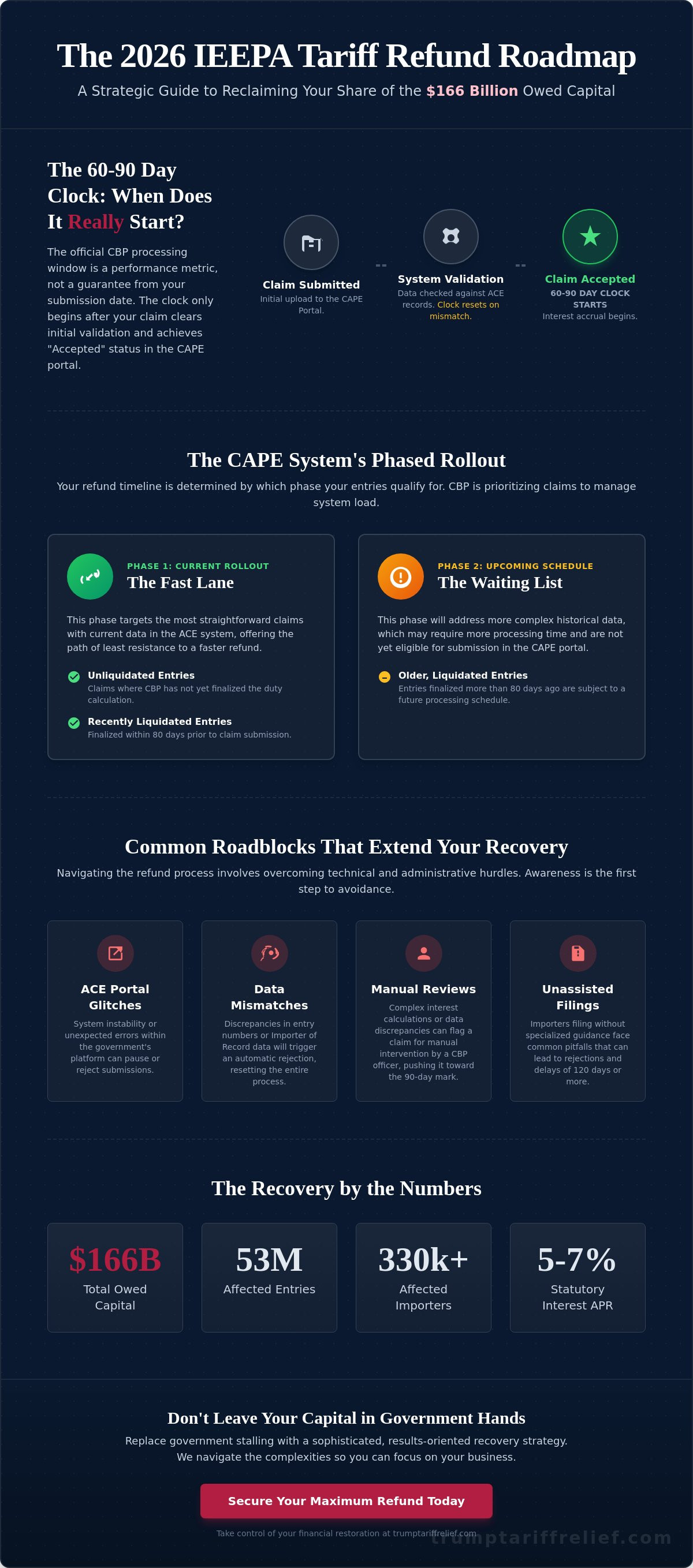
This expedited timeline is a direct result of the March 4, 2026, nationwide refund order following the invalidation of tariffs under the International Emergency Economic Powers Act (IEEPA). By automating the workflow, the government aims to return an estimated $166 billion to over 330,000 affected importers. However, the 60-day clock is not a guarantee from the moment of filing. It is a performance metric that only activates once specific administrative criteria are met. You can find more details on the underlying legal shifts at our IEEPA explained resource.
The Definition of an "Accepted" Claim
Submitting your claim through the CAPE portal is merely the first step. There is a critical distinction between a "Submitted" status and an "Accepted" status. When you upload your declaration, the system performs initial validation checks to ensure entry numbers, liquidated values, and Importer of Record data align with existing ACE records. If the system detects a mismatch, the clock resets before it even begins. The "Acceptance Date" is the true trigger for refund interest accrual and the start of the 60-day processing window. Until the CBP verifies that the entry is eligible under the February 20, 2026, Supreme Court ruling, your claim remains in a state of administrative limbo.
Why Interest Calculations Add Complexity
The complexity of these refunds stems from the requirement to treat invalidated duties as if they were never owed. The system must recalculate the duty for each of the 53 million affected entries while simultaneously applying statutory interest. This interest is based on the Treasury underpayment rate, which is approximately 5% to 7% APR. While the CAPE system automates much of this, discrepancies can trigger a manual review. If the calculated interest doesn't match the historical payment data in the ACE portal, a CBP officer must intervene. This human element can push the recovery timeline toward the 90-day mark. Once CBP authorizes the refund, the Treasury Department must certify the payment for electronic ACH deposit, as paper checks were officially phased out on February 6, 2026.
The CAPE System and the Phased Rollout of 2026
The launch of the Consolidated Administration and Processing of Entries (CAPE) system on April 20, 2026, marked a turning point for importers seeking capital restoration. This platform was specifically engineered to manage the unprecedented volume of 53 million entries impacted by the Supreme Court’s decision. However, the government isn't opening the floodgates all at once. CBP is utilizing a phased rollout to maintain system stability, which directly impacts the answer to how long does a tariff refund take for your specific business. By prioritizing certain entry types, the agency is attempting to clear the most straightforward claims before tackling more complex, historical data.
Your "Importer of Record" (IOR) status serves as the primary gatekeeper in this process. Only the IOR has the legal standing to submit a CAPE Declaration. While authorized customs brokers play a vital role in data preparation and submission, the liability and the eventual ACH deposit remain tied to the IOR's banking information in the ACE portal. If you haven't yet verified your eligibility status, you can explore our detailed guide on how the recovery process works to ensure your documentation is audit-ready.
Phase 1 Eligibility: Unliquidated vs. Recently Liquidated
Phase 1 is strictly limited to unliquidated entries and those that liquidated within 80 days prior to the refund claim submission. In the context of the 2026 ruling, an unliquidated entry is one where the CBP has not yet finalized the duty calculation and "closed" the file. These entries offer the path of least resistance. Because the data is current and actively sitting in the ACE system's "open" queue, Phase 1 filers saw the first refunds deposited as early as May 12, 2026. This group represents the fastest liquidity injection in the history of U.S. trade law.
The Outlook for Later Phases
Phase 2 and Phase 3 will address the vast backlog of older entries, specifically those associated with List 3 and List 4a. These entries often require deeper verification because they have already been liquidated, sometimes years ago. Administrative fatigue is a significant concern here. As the volume of claims from over 330,000 importers hits the CAPE system, manual reviews for older data will likely increase. This means companies with older entry portfolios should prepare for a timeline that extends beyond the 60 to 90 day baseline. Success in these later phases depends on impeccable Customs Documentation Management to prevent technical rejections that could push your payment into late 2026.
Variables That Extend the Refund Clock: Liquidation and Technical Hurdles
While the CBP's 60-day baseline provides a target for capital recovery, the question of how long does a tariff refund take often depends on the specific risk profile of your entry portfolio. High-volume importers, particularly those with thousands of entries across multiple lists, frequently face extended audit cycles. The CBP's automated system is efficient, but any anomaly in a large dataset can trigger an "Additional Review" flag. This manual intervention by a port director or specialized agency staff immediately pushes your recovery window beyond the 90-day threshold. These delays aren't just administrative; they're often a byproduct of the system's inability to reconcile complex historical data without human oversight.
Administrative and Political Resistance
The sheer scale of the $166 billion refund pool has created significant political friction within the administration. The White House has issued public statements suggesting a desire to reduce the total refund liability, potentially by citing "alternative authorities" to justify a secondary review process. Specifically, there is an ongoing risk that the government may attempt to offset these refunds against the new 10% global tariff imposed on February 24, 2026, under Section 122 of the Trade Act of 1974. If the administration successfully petitions for court-ordered stays on specific refund categories, the timeline for those segments could freeze while legal challenges resolve. This creates a high-stakes environment where your capital remains at the mercy of shifting trade policies.
Technical Friction in the ACE Portal
The CAPE system is a new infrastructure, and like any massive government database, it's prone to technical bottlenecks. Importers have reported synchronization issues between their bank account verification in the ACE Secure Data Portal and their CAPE Declaration status. If the ACH information isn't perfectly mirrored across both modules, the system will halt the payment authorization process. Handling these portal error messages requires a disciplined approach to avoid resetting your position in the processing queue. You should observe a 48-hour "cooling period" after encountering portal errors before attempting to re-submit your documentation. This allows the server-side caches to clear and prevents duplicate entries that could trigger automated fraud alerts. When you're managing frequently asked questions regarding technical errors, speed is often the enemy of accuracy.
Strategic Preparation: Reducing Delays in Your Recovery Claim
The 60 to 90 day CBP clock is merely the finish line. To understand the full scope of how long does a tariff refund take, you must first account for the 2 to 4 weeks of intensive internal auditing required before a single document is uploaded. This preparatory phase is where most claims are won or lost. If your data is incomplete or your HTS codes are inconsistently applied across List 3 and List 4a entries, you aren't just delaying your payment; you're inviting a manual CBP review that could stall your capital for months.
Strategic recovery begins with the consolidation of your Entry Summaries, specifically CBP Form 7501, and definitive proof of payment. These documents serve as the evidentiary foundation of your claim. Any classification errors discovered during this audit must be rectified before submission. Filing a CAPE Declaration with known discrepancies is a high-risk gamble that often triggers automated red flags in the ACE Portal. Additionally, you must verify that your banking information is current within the ACE Secure Data Portal. Since the government transitioned to an electronic-only ACH model on February 6, 2026, a missing or outdated bank record will halt your refund regardless of its approval status.
The Pre-Filing Documentation Checklist
Efficiency in the CAPE system requires a methodical approach to data organization. Your internal team must identify every eligible HTS code used for List 3 and List 4a imports while simultaneously verifying Importer of Record (IOR) numbers for every legal entity under your corporate umbrella. Digital records must be formatted to meet specific CAPE upload requirements to prevent server-side rejection. This level of precision ensures that once you hit "submit," the 60-day clock stays on track.
Leveraging How It Works
Navigating this bureaucracy alone often creates "internal drag" that siphons resources from your core business. By understanding how it works from an insider's perspective, you can leverage external expertise to compress the 4-week audit window into a matter of days. A contingency-based partner acts as a high-performing engine, performing the heavy lifting of Tariff Eligibility Assessment and Customs Documentation Management. This partnership ensures your claim is validated before the government's clock even starts, maximizing your chances of a technicality-free recovery. If you want to secure your place in the 2026 refund pool, you should begin your preliminary assessment to identify every dollar owed to your firm.
Navigating the Final Recovery Phase with Specialized Advocacy
The final mile of capital recovery is where most internal trade departments encounter unforeseen friction. While the 60 to 90 day CBP window serves as the official benchmark, a "do-it-yourself" approach frequently results in 120+ day delays. This isn't due to a lack of internal effort but rather a lack of specialized IEEPA precedent knowledge. When millions in liquidity are at stake, the steep learning curve of the new CAPE tool becomes a significant liability. Specialized advocacy bypasses this curve, ensuring that the question of how long does a tariff refund take is answered by your bank balance rather than a generic government status bar.
The Risk of DIY Filing Errors
Clerical errors are the primary catalyst for indefinite claim suspension. A single mismatched entry number or an incorrect HTS code application can trigger a manual review cycle that resets your timeline. Most internal teams are optimized for ongoing customs brokerage, not the high-stakes, retrospective recovery of billions in invalidated duties. Having a partner who only gets paid when you get paid provides a protective layer of accountability. It ensures every Tariff Eligibility Assessment is bulletproof before it reaches a CBP officer's desk. This low-risk, high-reward structure removes the financial barriers to elite-level representation.
Securing Your Place in the $166 Billion Queue
The $166 billion refund pool is substantial, but it isn't infinite. With over 330,000 importers potentially eligible for refunds across 53 million entries, the queue is growing daily. The 2026 filing window is a fleeting opportunity that requires immediate, assertive action. You can check our FAQ for specific deadline updates to ensure you don't miss the administrative cutoff. It's time to reclaim your working capital before administrative windows close or the refund pool faces further government scrutiny. Start your Free Eligibility Assessment today to move your claim to the front of the line and secure the capital injection your business deserves.
Accelerate Your Path to Capital Recovery
The journey toward reclaiming your share of the $166 billion refund pool is defined by administrative precision and technical compliance. While the CBP baseline offers a target, the reality of how long does a tariff refund take is ultimately determined by the accuracy of your internal audit and the speed of your CAPE portal submission. You've seen how unliquidated entries in Phase 1 offer the fastest route to liquidity, while older, liquidated entries face the friction of manual reviews and potential political resistance. Success requires more than just waiting; it demands a flawless ACH setup and a sophisticated verification of every affected entry.
Our expert team of trade and legal specialists takes on the heavy lifting, managing your CAPE portal submissions directly to ensure you bypass the common 120 day delays. We operate on a contingency basis, meaning there are no upfront costs for this high-stakes recovery. Don't let your working capital sit in government accounts while administrative windows close. It's time to right this financial wrong and inject vital liquidity back into your 2026 operations. Start Your Free IEEPA Eligibility Assessment and secure your place in the recovery queue today. Your business is entitled to this restoration, and we're here to ensure you receive it.
Frequently Asked Questions
How long does the IEEPA tariff refund process take from start to finish?
The total timeline typically spans 90 to 120 days when accounting for pre-filing preparation and the official 60 to 90 day CBP processing window. This assumes your CAPE Declaration is accepted without technical errors on the first attempt. The clock only starts once the system validates your entry data, so any initial mismatches will extend the wait. It's a structured process that moves from submission to acceptance and finally to ACH deposit.
Can the government delay my refund beyond the 90-day window?
Administrative delays are possible if the administration invokes "alternative authorities" or if the sheer volume of claims triggers system-wide slowdowns. While the 90-day window is the baseline for accepted claims, manual reviews for high-volume importers are becoming more common. These interventions allow the government to scrutinize large-scale capital outflows, especially when interest calculations add complexity to the final payout. It's a high-stakes environment where political resistance can manifest as administrative friction.
What is the deadline for filing an IEEPA tariff refund claim in 2026?
Importers should prioritize filing throughout 2026 to align with the current phased rollout of the CAPE system and avoid administrative fatigue. While CBP hasn't issued a final cutoff date for the $166 billion pool, the first refunds were issued on May 12, 2026. Delaying your submission increases the risk of being caught in a backlog as more of the 330,000 eligible importers enter the queue. Prompt action is the only way to secure your place in the current recovery cycle.
Does the 60-90 day timeline include the time to gather documentation?
No, the processing window only accounts for the time after your claim is "Accepted" in the CAPE portal. You should budget an additional 2 to 4 weeks for internal auditing and customs documentation management before you're ready to file. Understanding exactly how long does a tariff refund take requires looking at the entire lifecycle, starting from the moment you begin organizing your CBP Form 7501 summaries. Preparation is the most critical variable you can control.
What happens if my claim is flagged for additional review?
A claim flagged for additional review is removed from the automated queue and sent for manual inspection by a CBP officer or port director. This typically happens if HTS codes or liquidated values don't match historical ACE records exactly. This manual process can extend your recovery timeline by several months depending on the complexity of the discrepancy. Avoiding these flags requires a perfect alignment of data before you hit the submit button in the portal.
Is there a faster way to get my tariff refund back?
The most effective way to accelerate your recovery is to ensure your submission is technically perfect to avoid automated rejections or "cooling periods." Precision in your initial assessment prevents the resets that plague DIY filers who lack specialized IEEPA precedent knowledge. In the CAPE system, speed is a byproduct of accuracy. By eliminating clerical errors at the start, you ensure the question of how long does a tariff refund take is answered by the fastest possible government processing window.
Do I need a customs broker to file through the CAPE portal?
You don't technically need a customs broker to file, but specialized recovery partners are highly recommended for managing the technical nuances of the CAPE portal. Most internal teams are optimized for ongoing trade, not the high-stakes, retrospective recovery of invalidated IEEPA duties. Specialized advocacy ensures your claim isn't suspended on a clerical technicality that your internal team might miss. This professional guidance acts as a shortcut through a complex, newly built bureaucracy.
What if my entries were liquidated more than 80 days ago?
Entries liquidated more than 80 days ago are generally processed in Phase 2 or Phase 3 of the CAPE rollout. While Phase 1 focuses on unliquidated and recently liquidated entries, older claims require more rigorous verification of historical data. This distinction is critical for managing your company's 2026 budget expectations and cash flow forecasts. Importers with older portfolios should expect a longer administrative tail as the system works through the most complex historical entries.
Ready to find out what your business may be owed?
Check My Eligibility