
The U.S. government is finally being forced to return an estimated $170 billion in unlawfully collected duties, but the speed of your recovery depends on navigating a bureaucracy that just changed its entire processing architecture. You've likely felt the sting of financial uncertainty while asking exactly how long does a tariff refund take, especially as administrative hurdles threaten to keep your capital out of reach. It's frustrating to manage a budget when your cash flow is tied up in regulatory limbo, but the Supreme Court's February 2026 ruling has finally opened the door for justice and restoration.
You need a reliable timeline for your financial forecasting and the absolute assurance that your claim is audit-ready. This guide reveals the exact windows for IEEPA tariff recovery and the critical factors that determine when your business receives its refund. We'll break down the CAPE system's phased rollout, explain the 60 to 90 day processing target, and show you how to bypass the inevitable backlogs that will define the second half of 2026.
Key Takeaways
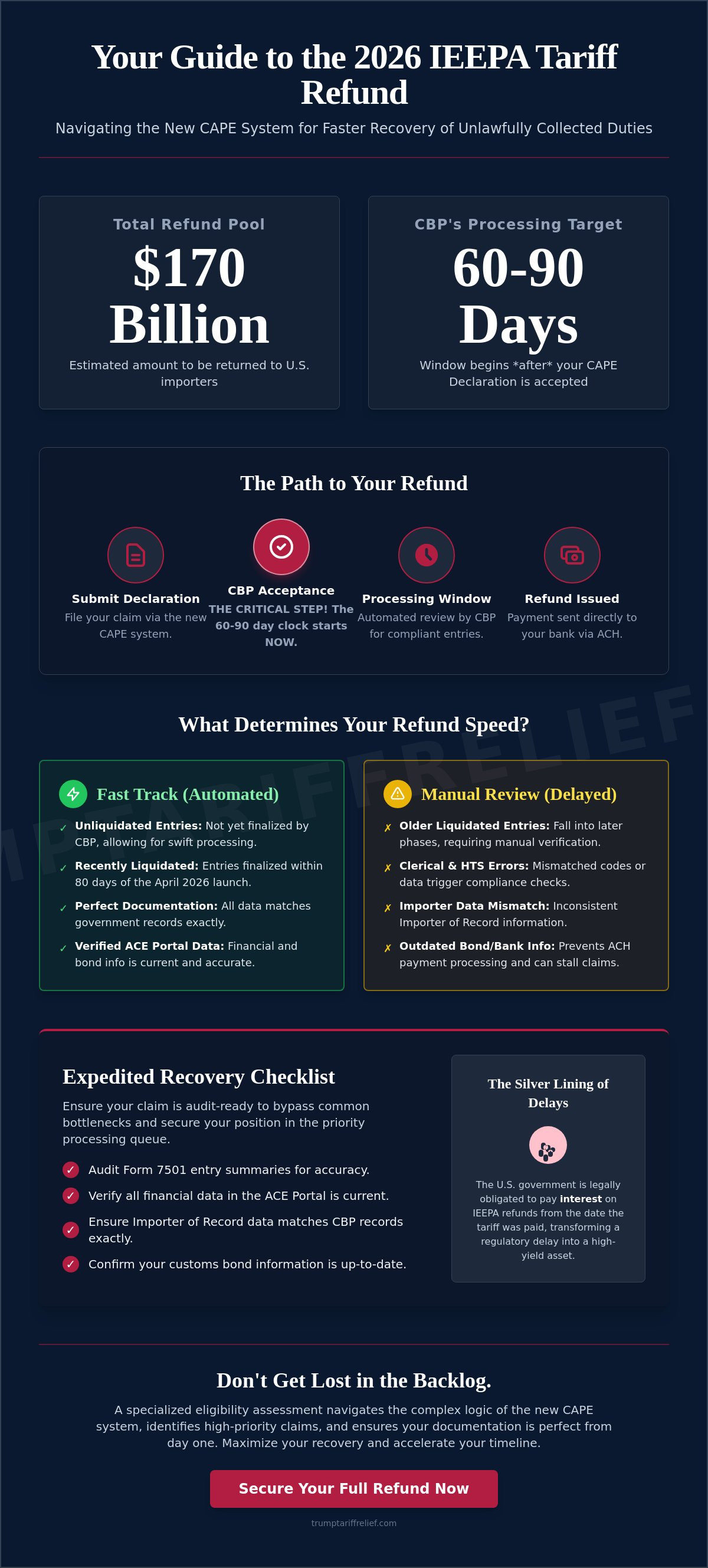
- Expect a 60 to 90 day processing window once CBP accepts your CAPE Declaration, with all payments issued electronically via ACH.
- Determine your eligibility for Phase 1, which focuses on entries liquidated within the 80 days prior to the April 2026 system launch.
- Learn exactly how long does a tariff refund take when factors like entry liquidation status and HTS code accuracy trigger manual review delays.
- Secure your recovery by auditing Form 7501 entry summaries and ensuring your ACE Portal financial data is verified for immediate transfer.
- Understand how a specialized eligibility assessment identifies high-priority claims and navigates the complex logic of the new CAPE system.
The Estimated Timeline: How Long Does a Tariff Refund Take?
The primary question for every importer of record right now is simple: how long does a tariff refund take? While U.S. Customs and Border Protection (CBP) has established a target window of 60 to 90 days, the reality of your recovery timeline depends on technical milestones within the new CAPE system. It's vital to understand that the clock doesn't start when you begin your application or even when you hit "submit." The countdown only begins once CBP formally accepts your CAPE Declaration. This distinction is where many businesses fail in their financial forecasting; if your documentation contains even a minor clerical error, your claim sits in a "pending" status rather than moving into the processing queue.
With an estimated $166 billion to $170 billion in total refunds owed to importers, the sheer volume of claims is unprecedented. As of mid-May 2026, the government had already validated over 86,000 applications, signaling a massive administrative load. The CAPE system launch on April 20, 2026, initiated a phased rollout designed to handle this volume, but the first refunds only began reaching bank accounts around May 11, 2026. If you want to avoid being buried in the Phase 2 backlog, ensuring your claim is "clean" and audit-ready is the only way to maintain a predictable cash flow schedule.
The 60-90 Day Window Explained
The 60 to 90 day timeline is the administrative standard for entries that pass through the ACE Portal without triggering a manual compliance review. This process is significantly more streamlined than the traditional duty drawback system, which can often take years to finalize. In the CAPE tool environment, "acceptance" means your entry data matches the government's liquidation records perfectly. Unlike the Section 301 exclusion process of previous years, which was plagued by years of litigation and opaque status updates, the 2026 IEEPA recovery framework is designed for high-speed electronic distribution via ACH. Understanding how it works is the first step in determining if your entries are eligible for this expedited window.
Interest: The Silver Lining of Processing Delays
While bureaucratic delays are frustrating, they come with a built-in financial benefit: interest accrual. Interest is calculated based on the federal underpayment rate from the date the original tariff was paid until the date the refund is processed. The U.S. government is legally obligated to pay interest on these IEEPA refunds because the Supreme Court deemed the original collection unlawful. For your 2026 financial modeling, this interest component can represent a significant percentage of the total recovery, transforming a regulatory headache into a high-yield asset for your balance sheet. You can review the IEEPA explained resources to see how these legal obligations protect your right to full financial restoration.
Factors That Influence Your Refund Processing Speed
While the baseline 60 to 90 day window provides a helpful benchmark, your actual recovery speed depends on specific administrative gatekeepers. If you are asking how long does a tariff refund take, the answer is often found in your entry's liquidation status. Liquidation is the official process where CBP finalizes the duty calculation on an import. Unliquidated entries move through the system with far greater velocity because they haven't been locked into the government's legacy accounting files. If your documentation isn't perfect, you risk falling into a manual review queue that operates on a much slower track.
Liquidated vs. Unliquidated Entries
Liquidation acts as a speed gate for your capital. The CAPE system, which went live on April 20, 2026, prioritizes Phase 1 entries that were liquidated within the previous 80 days. These recent entries are readily accessible in the ACE Portal, allowing for automated processing and faster approval. If your entries were liquidated years ago, they fall into later phases, which require a more intensive look-back and manual verification. This distinction is critical for your financial restoration; recently liquidated or unliquidated entries are the low-hanging fruit that will define the first $35.5 billion in finalized payouts.
Common Technical Bottlenecks in the ACE Portal
Even a perfectly valid claim can hit a wall due to technical hurdles within the ACE Portal. Early 2026 reports indicated frequent portal error messages during the CAPE Declaration phase, often caused by mismatched importer of record data or outdated bond information. Beyond the initial filing, bank account verification for ACH payments is a silent timeline killer. CBP requires verified bank info on file to issue electronic payments, and establishing this connection can add 10 to 14 days to the tail end of your processing window.
A single clerical error in an entry summary, specifically Form 7501, can trigger a manual review that effectively doubles your wait time. This is why understanding the IEEPA tariff ruling and its specific documentation requirements is mandatory before you hit submit. We help businesses avoid these automated rejections by ensuring every HTS code and valuation matches the government's records exactly. The administrative landscape remains volatile, and potential alternative authorities from the White House could introduce new compliance layers that slow the flow of funds. Securing a professional tariff eligibility assessment now is the best way to ensure your claim is prioritized before the system becomes overwhelmed by Phase 2 volume.
The CAPE System and Phase Rollouts: Where Do You Stand?
The CAPE system isn't a wide-open gateway; it's a tiered engine designed to meter the flow of $170 billion back into the private sector. If you're wondering how long does a tariff refund take for your specific business, the answer is found in which Phase your HTS codes currently occupy. The government launched the Consolidated Administration and Processing of Entries (CAPE) system on April 20, 2026, with a rigid focus on the most recent trade activity. If your entries fall outside these initial parameters, you're looking at a significantly different recovery horizon than those at the front of the line.
As of mid-May 2026, the first $35.5 billion in finalized refunds has already been processed, but this represents only a fraction of the total pool. The phased approach is a deliberate strategy to prevent the ACE Portal from collapsing under the weight of 8.3 million entries. Identifying where your specific HTS codes fall within this rollout is the only way to build an accurate financial forecast for the remainder of the year.
Phase 1 Eligibility Requirements
Phase 1 is currently active and exclusively services entries that were liquidated within the 80 days prior to the system's April launch. This "80-day rule" exists because these entries are still active in the CBP’s immediate accounting cycle, requiring less manual intervention from customs officers. To qualify for this first wave of payouts, you must be the verified Importer of Record with active ACH information already established in the ACE Portal. If you imported goods under the reciprocal tariffs struck down by the Supreme Court in February 2026 and your entries were finalized recently, you're in the optimal position for the standard 60 to 90 day turnaround.
Preparing for Phase 2: The "Early Bird" Strategy
Phase 2 will address the massive volume of older claims, including the highly contested List 3 and List 4a China tariffs. While the government hasn't finalized the exact opening date for this phase, historical backlogs suggest that waiting for the portal to open before organizing your documentation is a recipe for failure. When millions of entries from previous years hit the system simultaneously, we anticipate a "system saturation" that could extend the question of how long does a tariff refund take from a few months to a 6-12 month wait.
The administrative burden of verifying years of historical data means the first businesses to file will be the only ones to avoid the inevitable Phase 2 bottleneck. Our specialized recovery engine is already processing documentation for older entries to ensure our clients are "first-in-line" the moment Phase 2 goes live. You can see how our recovery process works for all phases of the rollout. By conducting a proactive tariff eligibility assessment now, you categorize your HTS codes and prepare your Form 7501 summaries for instant submission, effectively bypassing the administrative chaos that will define the latter half of 2026.
Avoiding Delays: A Checklist for Expedited Recovery
The 60 to 90 day window is an administrative target, not a guarantee. If you want to know how long does a tariff refund take in practice, look at your documentation accuracy. The government’s CAPE system is designed for automated validation; if your filing doesn't mirror the government's internal data, your claim is diverted for manual review. This diversion effectively kills your timeline, moving your recovery from a 90-day cycle to a multi-month bureaucratic holding pattern. To secure your capital, you must adhere to a strict pre-filing protocol.
- Step 1: Audit your Entry Summaries (Form 7501). Verify every HTS code and valuation against your original payment records. Even a minor discrepancy in a decimal point can trigger a system rejection.
- Step 2: Verify ACH payment information. CBP only issues refunds electronically. Ensure your bank details in the ACE Portal are active and verified to avoid the common 10 to 14 day delay associated with account setup.
- Step 3: Consolidate your claims. Minimize administrative friction by grouping related entries into single submissions. This reduces the number of "status checks" you need to monitor and streamlines the approval process.
- Step 4: Conduct a Pre-Filing Verification. We use proprietary logic that mirrors CBP’s automated validation. By identifying errors before you hit submit, you ensure your claim stays on the "fast track."
- Step 5: Monitor the CAPE Information Notice. The system is updated frequently with real-time technical guidance. Staying informed on these "glitches" allows you to adjust your filings before they are rejected.
The "Clean Claim" Standard
The "Clean Claim" standard is a 100% match between ACE data and your declaration. Achieving this standard is the only way to bypass manual reviews, which are the #1 killer of the 60-90 day timeline. When discrepancies in original tariff payment records exist, you must resolve them through a preliminary tariff eligibility assessment before submitting your CAPE Declaration. Failing to reconcile these figures beforehand invites an audit that will freeze your funds indefinitely.
ACE Portal Management
Your authorized customs broker must have the correct permissions within the ACE Portal to manage these specific IEEPA claims. Many importers overlook this technical requirement, assuming their standard brokerage permissions are sufficient. Furthermore, updating your bank info is a hidden delay that often catches businesses off guard. If your ACH information isn't verified at the moment of approval, the system will hold the payment until the verification cycle completes. You can review common questions about the filing process to ensure your portal is properly configured for rapid recovery. Don't let a clerical oversight keep your capital out of reach; start your documentation audit now to ensure your claim meets the "Clean Claim" standard from day one.
Why Partnering with a Recovery Specialist Accelerates the Process
Navigating the CAPE system alone is a high-stakes gamble with your company's liquidity. While generalists provide surface-level advice, a recovery specialist understands the binary "CAPE Logic" that governs automated approvals. The system doesn't negotiate; it either validates your data or flags it for a manual review that can stall your funds for months. We've decoded the specific triggers that lead to automated rejections, allowing us to engineer your declarations for immediate acceptance. By removing the administrative guesswork, we ensure your business isn't left behind as the government processes the remaining $130 billion of the estimated $170 billion recovery pool.
Our contingency model provides a distinct advantage that traditional consulting packages can't match. Because we only receive a fee when your refund is successfully deposited into your bank account, our motivation is perfectly aligned with your need for speed. We don't just manage your customs documentation; we act as an aggressive advocate, pushing through technical glitches and portal errors that typically leave individual importers in a bureaucratic holding pattern. This results-oriented approach transforms a complex legal requirement into a streamlined financial restoration, allowing you to focus on business growth or learn more about The Russell Travel Team (Lightning Travel) for curated luxury travel experiences.
The Cost of "Doing it Yourself"
The financial risk of a "DIY" approach is substantial. A single clerical error in an entry summary can push your refund back by six months or more, as your claim is moved from the automated fast track to a manual compliance queue. CFOs are increasingly outsourcing the documentation heavy lifting because the burden of proof for IEEPA claims is significantly higher than standard trade entries. Unlike general customs brokerage, which focuses on ongoing compliance, our specialized IEEPA tariff refund recovery is built for one purpose: reclaiming your capital with surgical precision. We ensure every claim is defensible, protecting your business if the government attempts a future clawback of issued funds.
Securing Your Spot in the Queue
While Phase 1 is currently processing recently liquidated entries, the real administrative battle begins with Phase 2. We are already conducting proactive tariff eligibility assessments for our clients to ensure they're at the front of the line the moment the portal opens for older China tariff claims. This early bird strategy is vital for bypassing the system saturation that occurs when millions of entries hit the ACE Portal simultaneously. We also handle the complexities of "Alternative Authority" challenges, ensuring your right to a refund remains protected even if the administration attempts to introduce new regulatory hurdles. Don't wait for the backlog to grow; contact Trump Tariff Relief today for a preliminary eligibility assessment and secure your place in the 2026 recovery queue.
Secure Your Restoration Before the Phase 2 Backlog
The $170 billion IEEPA recovery pool represents a massive opportunity to restore your business's capital, but the window for expedited processing is closing fast. While Phase 1 offers a 60 to 90 day turnaround for recent entries, the inevitable Phase 2 backlog will soon overwhelm the CAPE system. You've seen that the answer to how long does a tariff refund take depends entirely on your documentation precision and your ability to bypass manual reviews.
Don't let administrative errors or technical glitches keep your funds in government hands. Our expert team navigates the CAPE portal daily, ensuring every declaration meets the "Clean Claim" standard required for rapid approval. We specialize exclusively in the $166B IEEPA refund pool and operate on a strictly contingency-based model; if we don't recover your funds, you don't pay a fee.
Take the first step toward financial restoration today. Get Your Free Tariff Eligibility Assessment Now and secure your place at the front of the recovery queue. Your business deserves this capital back, and we're ready to win it for you.
Frequently Asked Questions
Is the 60-90 day refund timeline guaranteed by the CBP?
The 60 to 90 day window is an administrative target rather than a legal guarantee. U.S. Customs and Border Protection (CBP) aims to process accepted CAPE Declarations within this timeframe, but technical errors or compliance concerns can extend the period. If your filing triggers a manual review, the timeline resets based on the complexity of the audit.
Can the government delay my refund beyond the 90-day window?
Yes, the government can delay payments if a claim requires further scrutiny or if administrative pauses occur. For example, a federal appeals court recently paused a related ruling on Section 122 tariffs until July 24, 2026, demonstrating how legal shifts can impact the flow of funds. Such delays are exactly why your business needs a defensible, audit-ready declaration from the start.
What happens if there is a glitch in the CAPE portal during my filing?
Portal glitches often result in immediate automated rejections or a "pending" status that prevents your claim from entering the processing queue. Early 2026 reports highlighted frequent error messages caused by mismatched importer data. If you encounter a system error, you must reconcile your ACE Portal information with your Form 7501 records before attempting to refile.
Do I get paid in one lump sum or multiple installments?
Refunds are typically issued as a single lump sum payment per accepted declaration. Because payments are made electronically through the Automated Clearing House (ACH), the funds arrive as a direct deposit once the entire batch of entries in your claim is finalized. This streamlined method avoids the administrative drag of multiple installments and provides immediate liquidity for your operations.
How much interest will be added to my tariff refund?
Interest is calculated based on the federal underpayment rate from the date you originally paid the tariff until the date the refund is issued. With billions in finalized refunds already processed by mid-May 2026, interest has become a substantial component of the total recovery. This legally mandated addition ensures your business is compensated for the time your capital was held unlawfully.
What is the absolute deadline to file for an IEEPA tariff refund in 2026?
There isn't a single absolute deadline for all claims, but the July 24, 2026 court-ordered pause on related duties creates a high-stakes environment for current filings. The phased rollout of the CAPE system means your window depends on when your entries were liquidated. Filing early is the only way to avoid the administrative congestion that will define the second half of the year.
Can I speed up my refund by filing multiple smaller claims?
Filing multiple smaller claims typically slows down the process rather than accelerating it. Each submission creates a new administrative trail that requires separate validation within the CAPE system. Consolidating your entries into a single, clean declaration is the most effective strategy for managing how long does a tariff refund take for your specific business.
What is the difference between a duty drawback and an IEEPA refund timeline?
The IEEPA refund process is significantly faster than the traditional duty drawback system, which can often take years to resolve. While duty drawback requires proving the export or destruction of goods, IEEPA recovery is based on the unlawful nature of the original tariff collection. This allows for the automated 60 to 90 day processing window that the CAPE system was designed to facilitate.
Ready to find out what your business may be owed?
Check My Eligibility