
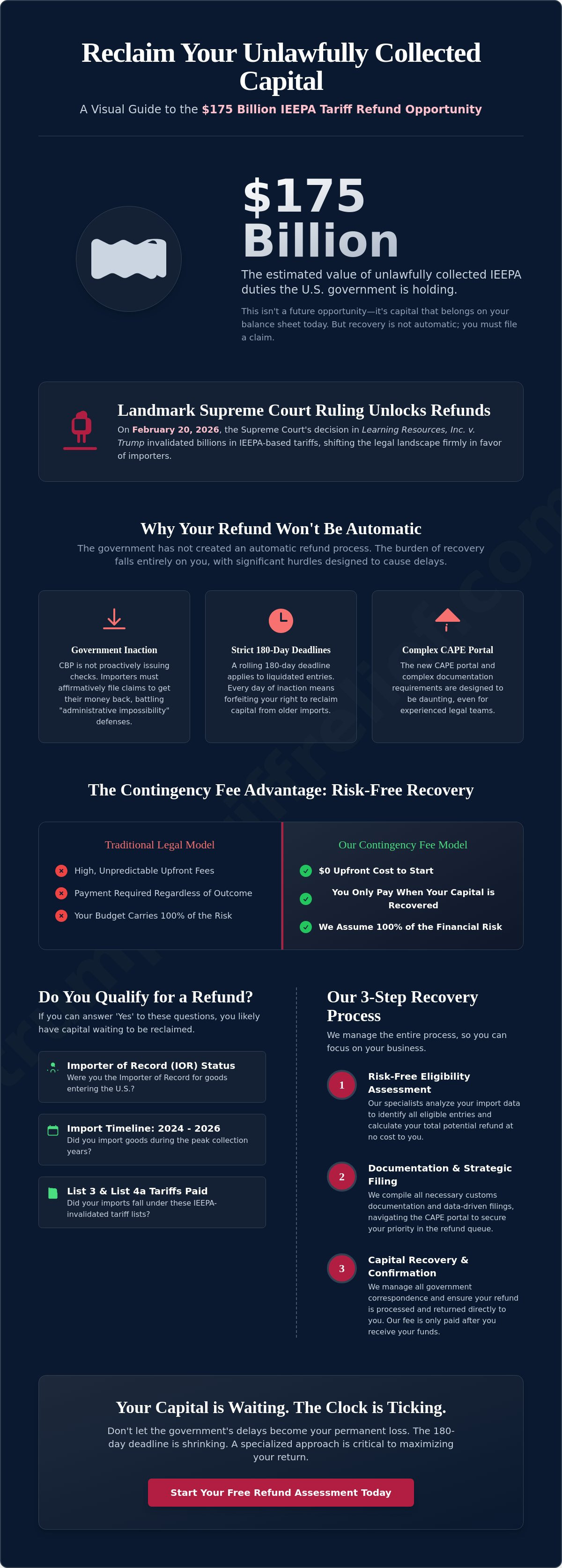
The federal government is currently holding onto as much as $175 billion in unlawfully collected duties, and they aren't going to hand it back voluntarily. Following the Supreme Court’s February 20, 2026, ruling in Learning Resources, Inc. v. Trump, the legal landscape has shifted in favor of the importer, yet the burden of recovery remains yours alone. You've already dealt with the sting of sunk costs and the complexity of federal trade regulations. The last thing your budget needs is more high-priced litigation fees. Using a contingency fee tariff recovery model, you can finally pivot from defense to offense, reclaiming your capital without the fear of upfront costs or government retaliation.
We understand that the prospect of navigating the new CAPE portal and meeting strict 180-day protest deadlines is daunting for any overextended legal team. This article promises to outline a clear, performance-based path to securing your IEEPA refunds while eliminating your financial exposure. We will break down the eligibility assessment process, the technical requirements for customs documentation, and the strategic steps necessary to ensure your business doesn't miss this fleeting window to reclaim its rightful capital.
Key Takeaways
- Understand the legal precedent set by the February 2026 Supreme Court decision that invalidated billions in IEEPA-based tariffs and opened the door for massive capital restoration.
- Learn how contingency fee tariff recovery aligns your financial interests with a results-based model, ensuring you only pay when your capital is successfully returned.
- Identify the specific strategies needed to bypass the government's "administrative impossibility" delays and secure your priority position in the CAPE refund queue.
- Verify your status as an Importer of Record (IOR) to determine which specific entries from 2024 through 2026 qualify for immediate recovery.
- Discover why a specialized approach to customs documentation management and data-driven filing outperforms general corporate legal services in high-volume refund environments.
The 2026 IEEPA Ruling: Why $130 Billion in Tariffs Must Be Reclaimed
On February 20, 2026, the legal foundation for billions in trade duties collapsed. In the landmark case Learning Resources, Inc. v. Trump, the U.S. Supreme Court ruled that the executive branch overstepped its constitutional bounds by unilaterally imposing trade penalties. This decision invalidated tariffs rooted in the International Emergency Economic Powers Act (IEEPA), transforming what was once a mandatory business expense into a massive, reclaimable asset. Estimates from the Penn Wharton Budget Model and other legal analysts suggest the total value of these refunds exceeds $130 billion, with some projections reaching as high as $175 billion. If your business imported goods during the peak of these collections in 2025, you are likely sitting on a significant sum of capital that belongs back on your balance sheet.
The Shift from Section 301 to IEEPA Claims
It's vital to distinguish between the various trade authorities at play. While Section 301 tariffs on Chinese goods have faced their own challenges, the 2026 ruling specifically strikes down the broader, emergency-based tariffs that were expanded under the IEEPA framework. For importers who paid duties on List 3 and List 4a goods during the 2024 and 2025 fiscal years, this ruling is a seismic victory. The court essentially declared that the administration used the wrong legal tool for a long-term trade war. This distinction makes 2025 import data the primary driver for current claims, as that year saw peak collection rates of approximately $500 million per day before the February 2026 intervention. Identifying which specific entries fall under this invalidated authority is the first step in a successful contingency fee tariff recovery strategy.
Why Refunds Are Not Automatic
If you're waiting for U.S. Customs and Border Protection (CBP) to proactively mail a refund check, you're waiting for a day that won't come. Despite the Supreme Court's clear mandate, the government has not established an automatic mechanism to return these funds to every affected business. Importers must take affirmative action to identify eligible entries and file formal protests through the new CAPE portal. The government is currently facing significant logistical hurdles due to the volume of claims, which means only those who navigate the IEEPA-specific filing process with precision will see their capital returned. The 180-day rolling deadline for liquidated entries means your window to act is already shrinking. Inaction is effectively a permanent donation to the Treasury.
Engaging in a contingency fee tariff recovery program ensures that your pursuit of these millions doesn't create a new financial burden. By leveraging a performance-based model, you can deploy a team of trade experts to manage the complex documentation and filing requirements without any upfront risk to your current legal budget. The clock is ticking on the three-year statute of limitations for many of these entries, making immediate assessment a high-priority business necessity.
What is Contingency Fee Tariff Recovery?
This structure creates a radical alignment of interests. While a general corporate law firm might profit from the complexity and duration of a case, a contingency-based partner only profits from your success. The U.S. Department of the Treasury manages the enforcement of these economic sanctions, and navigating their administrative requirements demands high-level expertise. By utilizing a "success fee" model, you ensure that your advocate is motivated to identify every eligible entry and maximize the interest accrued on your overpayments. It’s a high-stakes narrative where the consultant is the engine of restoration and your business is the beneficiary.
The Mechanics of a Performance-Based Claim
The calculation of a contingency fee is straightforward and transparent. It is typically a predetermined percentage of the total recovered amount, which includes both the principal tariff overpayment and the interest mandated by federal law. Unlike hourly billing, which can quickly spiral during a protracted dispute with CBP, this model is inclusive. It covers the entire lifecycle of the claim, from the initial Tariff Eligibility Assessment to final litigation if necessary. You receive regular reporting on claim status without the anxiety of an incoming invoice. This transparency allows your financial team to track potential liquidity injections with precision.
Risk Mitigation for the Importer
The core of this partnership is the "No Recovery, No Fee" guarantee. The consultant absorbs all administrative, data collection, and filing costs throughout the process. If the government successfully defends its retention of your duties, you owe nothing. This effectively moves the recovery effort off your balance sheet as a liability and positions it as a potential asset. You can learn more about how our recovery process works to see how we manage the heavy lifting of data extraction and filing. By removing the financial risk, you empower your business to challenge federal overreach without a second thought. If you believe your imports qualify, it's time to initiate a preliminary assessment and stop leaving your capital in the hands of the Treasury.
Overcoming the Government’s "Administrative Impossibility" Defense
The U.S. government is currently facing a logistical crisis of its own making. Following the February 20, 2026, Supreme Court decision, the Treasury is tasked with processing refunds for an estimated 53 million individual import entries. To manage this, government representatives often lean on a claim of "administrative impossibility," suggesting that the sheer volume of data makes timely refunds unfeasible. This isn't a valid legal shield; it's a strategic delay tactic. While general corporate firms might accept these delays as an inevitable part of bureaucracy, a specialized contingency fee tariff recovery partner views them as a hurdle to be dismantled through superior data management and assertive legal pressure.
Standard customs brokers typically excel at managing day-to-day compliance and forward-looking entries. However, they aren't forensic auditors or trade litigators. Reclaiming years of overpaid duties requires a retrospective, entry-by-entry analysis that most brokerage software simply cannot handle. Overcoming the government’s stall tactics requires a dedicated focus on Customs Documentation Management that bridges the gap between raw import data and actionable legal evidence. If your broker isn't prepared to rebut a government claim that your data is too complex to process, your capital will remain in federal hands indefinitely.
The Power of End-to-End Documentation
Success in the current trade landscape depends entirely on the integrity of your historical data. We manage the massive data load of per-entry claims by verifying your status as the Importer of Record (IOR) for every shipment subject to the invalidated IEEPA tariffs. By building a comprehensive digital audit trail, we can counter CBP correspondence with expert trade evidence that leaves no room for "impossibility" excuses. This level of precision ensures that your claim moves through the Consolidated Administration and Processing of Entries (CAPE) system, which launched on April 20, 2026, without being flagged for administrative errors.
Strategic Litigation in the CIT
When administrative channels fail to produce timely results, the U.S. Court of International Trade (CIT) serves as the ultimate lever for recovery. Filing in the CIT forces the government to address your specific entries on a legal timeline rather than a logistical one. It's also where the role of interest becomes critical. The government doesn't just owe you the principal; it owes you interest on every dollar held since the date of liquidation. See our IEEPA explained guide for deeper legal context on how we use the CIT to accelerate your return. A contingency fee tariff recovery model means we carry the cost of this litigation, aligning our urgency with your immediate liquidity needs.
Eligibility Checklist: Does Your Business Qualify for Recovery?
Determining your eligibility is the first step toward restoring your company’s liquidity. The primary requirement is absolute: your business must be the Importer of Record (IOR) for the entries in question. If your entity's name and tax ID appear on the CBP Form 7501, you hold the legal right to claim the refund. While the Supreme Court's February 2026 ruling applies broadly, your recovery depends on verifying IEEPA-specific duties paid between 2024 and the cessation of collection on February 24, 2026. This is where a contingency fee tariff recovery specialist provides the most value, as we distinguish between invalidated IEEPA charges and other surviving trade authorities like Section 122 or Section 301. If you've already filed prior protests, your eligibility remains intact, but those filings must be audited to ensure they align with the 2026 ruling's specific legal parameters.
Professional recovery is most effective for companies with a high volume of entries or significant duty spend during the 2025 peak. While the CAPE portal has accepted over 11 million entries as of late April 2026, the complexity of these claims often exceeds the capacity of standard accounting departments. Even companies with internal legal teams benefit from external contingency audits. You can review our frequently asked questions regarding eligibility to see how specific entry types are handled under the new regulations.
Industries Most Impacted by IEEPA Tariffs
Manufacturing firms that imported raw materials or intermediate goods from impacted regions often saw their margins decimated by the 2025 collection rates. Retail and e-commerce giants dealing in consumer electronics, apparel, and home goods were also hit hard by the daily collection peak of $500 million. Additionally, technology companies importing semiconductor components and hardware infrastructure represent a massive portion of the entries currently eligible for refund. If your industry relied on high-volume global sourcing during 2024 or 2025, the probability of a successful recovery is exceptionally high.
The Preliminary Assessment Process
We utilize a "low-friction" audit process to scan your 2025 customs entries without disrupting your daily operations. This Tariff Eligibility Assessment identifies "hidden" IEEPA duties that are often buried within complex brokerage statements or miscategorized in internal ledgers. By cross-referencing your data with the latest CBP guidance and the February 2026 ruling, we pinpoint exactly which dollars are reclaimable. Don't let administrative complexity prevent you from reclaiming what you're owed. If you're ready to see the scale of your potential refund, it's time to request a preliminary assessment and begin the recovery process today.
A contingency fee tariff recovery model ensures that this entire audit and verification phase costs you nothing upfront. We only succeed when your capital is returned, making this the most rational path for businesses looking to recover millions without adding to their existing legal budget.
The Trump Tariff Relief Advantage: Maximizing Your Capital Return
General corporate law firms are often ill-equipped to handle the granular complexities of trade recovery. While they may understand the broad strokes of the Supreme Court's ruling, they lack the technical infrastructure to execute at scale. We specialize exclusively in the recovery of overpaid duties, providing a level of precision that generalists cannot match. Our contingency fee tariff recovery model is built on the premise that you shouldn't have to fund the government’s mistakes out of your own pocket. We manage the entire lifecycle of your claim, from the initial deep-dive audit to the moment the refund check is issued, ensuring that no eligible entry is left behind.
The core of our advantage lies in our proprietary data engine. This technology allows us to identify, categorize, and file thousands of individual entries with a speed that manual processing simply cannot achieve. This isn't just about efficiency; it’s about priority. The U.S. Court of International Trade (CIT) operates on a queue system, and early filers are positioned at the front of the line for reliquidation. By leveraging our Customs Documentation Management expertise, we convert your raw brokerage data into a streamlined legal filing that bypasses the common errors that trigger government delays.
Beyond the Filing: Audit Protection and Compliance
A significant concern for many importers is the fear that aggressive refund claims might trigger a broader customs audit. We mitigate this risk by maintaining an uncompromising focus on compliance. Our process ensures that your recovery claim is surgically precise, targeting only the invalidated IEEPA duties while leaving your broader trade profile untouched. We help you maintain a "clean" status with CBP by providing rigorous documentation that justifies every dollar requested. You can check our FAQ for more on audit safety and how we protect your standing as a compliant Importer of Record.
Getting Started with a Success-Based Partner
Time is the most critical factor in your recovery strategy. We offer a 24-hour turnaround for initial eligibility assessments, providing you with a clear picture of your potential refund without any disruption to your current logistics or brokerage teams. Because we operate on a performance-based model, our success is tied directly to your liquidity. We take on the heavy lifting, the technical data extraction, and the legal risk, allowing your internal teams to focus on core operations. The window for IEEPA recovery is finite, and the government's administrative hurdles are only growing more complex. Don't leave your capital in the hands of the Treasury. Schedule your free tariff recovery assessment today and take the first step toward restoring your company’s financial strength.
Reclaim Your Capital and Restore Your Competitive Edge
The window to reclaim your share of the billions in invalidated IEEPA duties is open, but it's narrowing every day. The 2026 Supreme Court ruling transformed these overpayments into a massive potential asset for your balance sheet. However, the government's reliance on administrative delays means that only assertive, data-driven claims will reach the front of the reliquidation queue. By choosing a contingency fee tariff recovery partner, you gain access to specialized expertise in post-2026 litigation without diverting a single dollar from your operational budget.
We provide national coverage for US-based Importers of Record, handling the complex documentation and legal hurdles on your behalf. There are zero upfront costs for qualifying importers, ensuring that your pursuit of financial restoration is entirely risk-free. It's time to stop letting the Treasury hold your liquidity and start the process of righting this regulatory wrong. Your capital belongs back in your business where it can drive growth.
Secure Your No-Risk Tariff Assessment today and let our experts handle the heavy lifting of your recovery.
Frequently Asked Questions
What is a contingency fee in the context of tariff recovery?
A contingency fee is a performance-based payment model where you only pay for successful results. In a contingency fee tariff recovery program, we assume all financial risk for the audit, filing, and litigation. If we don't recover your capital, you don't owe us anything. This structure aligns our interests and ensures we pursue the maximum possible refund including accrued interest.
Is the IEEPA tariff refund program legitimate following the 2026 ruling?
Yes, the program is a direct result of the Supreme Court's February 20, 2026, decision in Learning Resources, Inc. v. Trump. This ruling declared the IEEPA tariffs unconstitutional, and U.S. Customs and Border Protection launched the CAPE portal on April 20, 2026, specifically to process these claims. It's a legitimate legal pathway to reclaim billions in overpaid duties that were collected without proper authority.
How much does it cost to start a claim with Trump Tariff Relief?
It costs nothing to initiate a claim or receive a contingency fee tariff recovery assessment. We don't charge upfront consulting fees or hourly rates for our recovery services. Our model is designed to remove the financial barrier to justice, allowing businesses of all sizes to challenge federal overreach without impacting their current cash flow or existing legal budget.
What happens if my tariff refund claim is denied by the government?
If the government denies your claim, you owe us nothing for the work performed. We absorb all administrative and legal costs associated with the filing and litigation process. This "no recovery, no fee" guarantee ensures that your business faces zero financial exposure while pursuing the millions of dollars you're legally owed following the landmark 2026 ruling.
Can I file for an IEEPA refund if I already used a customs broker?
You can absolutely file a claim even if you have an ongoing relationship with a customs broker. Brokers typically manage forward-looking compliance and daily entries, but they are rarely equipped to handle the retrospective forensic auditing and CIT litigation required for IEEPA recovery. We work independently of your broker to secure your refunds without disrupting your daily logistics operations.
How long does the contingency fee recovery process usually take?
The timeline for recovery depends on the liquidation status of your entries and the current backlog at the Court of International Trade. While the CAPE portal was designed to expedite the process starting in April 2026, complex claims requiring litigation can take longer. We prioritize early filing to ensure your business is positioned at the front of the queue for reliquidation and payment.
Do I need to be a large corporation to qualify for tariff recovery?
You don't need to be a large corporation to qualify, but you must be the legal Importer of Record (IOR). Any business that paid IEEPA-specific duties between 2024 and February 2026 is eligible to file for a refund. We focus on the total value of the overpayment rather than the company size, ensuring mid-market firms receive the same high-level advocacy as conglomerates.
What documents do I need to provide for a contingency fee assessment?
Ready to find out what your business may be owed?
Check My Eligibility