
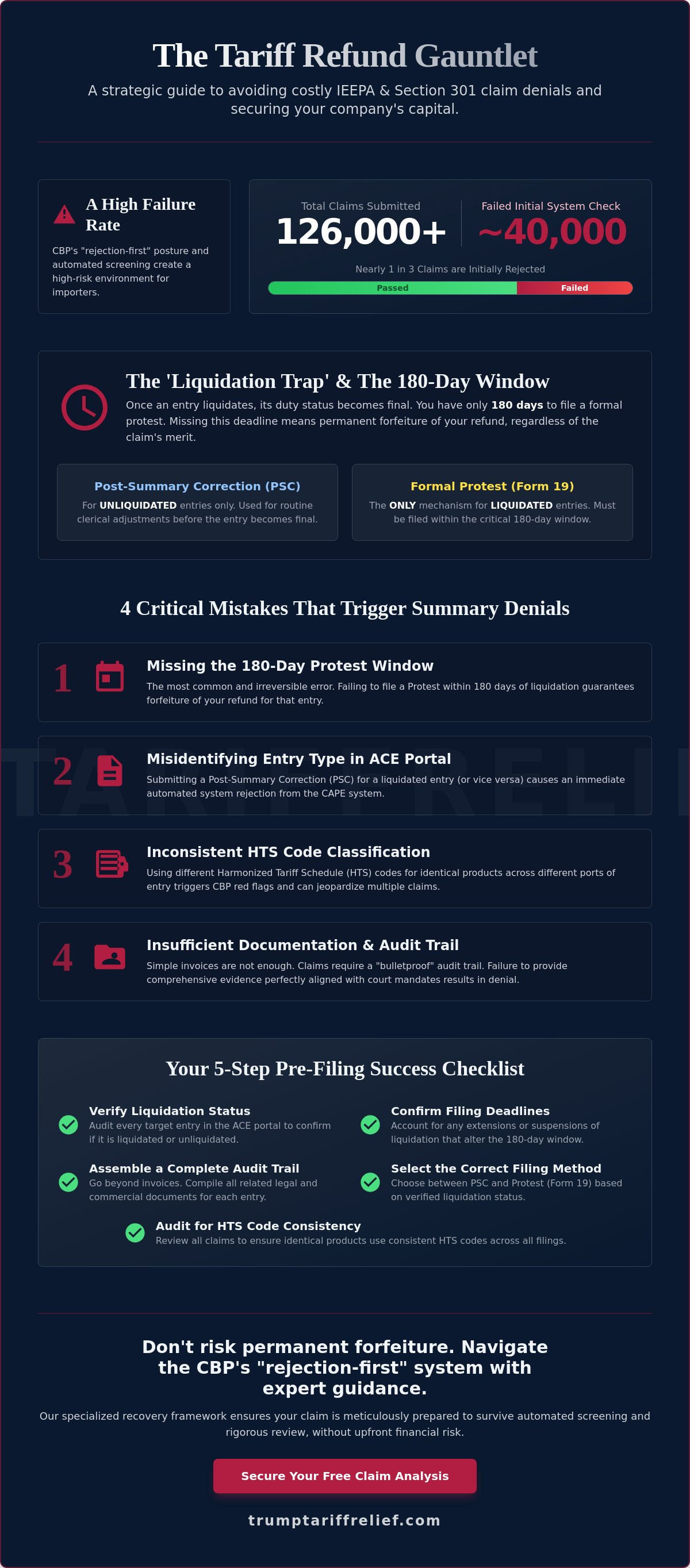
As of May 11, 2026, over 126,000 IEEPA refund claims have been submitted through the CAPE system, yet nearly 40,000 of those entries failed the initial system check. In this high-stakes environment, a single administrative oversight or a 24-hour delay isn't just a minor error; it's a permanent forfeiture of your company's capital. You're likely feeling the pressure of the "liquidation trap" and the overwhelming volume of documentation required to reclaim your share of the $166 billion in collected duties. To secure your recovery, you must understand how to avoid tariff claim mistakes that lead to summary denials from Customs and Border Protection.
This article provides the precise framework you need to identify procedural pitfalls, verify HTS code eligibility, and audit your internal processes before filing. You'll gain a clear, error-free path to a successful refund while navigating the shift from terminated IEEPA duties to the new Section 122 global surcharges. We're breaking down the critical distinctions between filing methods and the exact documentation required to ensure your claim survives the government's rigorous automated screening.
Key Takeaways
- Recognize the narrow 2026 window for reclaiming IEEPA and Section 301 duties before administrative deadlines result in permanent capital loss.
- Master the precise procedural requirements to avoid tariff claim mistakes, specifically regarding the 180-day protest window and ACE portal entry classification.
- Identify the documentation failures that lead to summary denials, moving beyond simple invoices to establish a bulletproof audit trail.
- Apply a rigorous five-step pre-filing checklist to audit your internal claims process and verify the liquidation status of every target entry.
- Leverage a specialized recovery framework to navigate the "rejection-first" posture of Customs and Border Protection without upfront financial risk.
The High Cost of Administrative Errors in Tariff Recovery
The year 2026 represents a watershed moment for U.S. importers. Following the Supreme Court decision on February 20, 2024, and the subsequent termination of IEEPA tariffs on February 24, 2026, the window for financial restoration is officially open but dangerously narrow. Customs and Border Protection (CBP) currently manages a staggering volume of recovery requests; as of May 11, 2026, over 126,237 IEEPA refund claims have flooded the new CAPE system. In this environment, CBP has adopted a "rejection-first" posture. They are not looking for reasons to approve your claim; they are searching for any technicality to deny it. Identifying the procedural gaps early is the only way to avoid tariff claim mistakes that result in the permanent loss of your company's liquid capital.
There is a fundamental distinction between a standard duty correction and the landmark legal recoveries currently available under Section 301 of the Trade Act of 1974 and IEEPA. A typical correction is a routine adjustment of clerical data. A recovery claim, however, is an assertive demand for the return of capital based on invalidated federal authority. Because these claims involve high-value refunds, CBP applies a rigorous standard of review. Minor clerical errors, such as a mismatched entry number or an incorrect HTS code, often trigger "summary denials." These are not mere requests for more information. They are final rejections that frequently leave no room for administrative appeal.
Why the IEEPA Ruling Changed the Stakes
The shift in the trade landscape has moved importers from a defensive position of requesting exemptions to an offensive position of claiming refunds based on established legal precedent. With the phase one refund process activated on April 20, 2026, precision has become the only currency CBP accepts. If your documentation does not perfectly align with the court-ordered liquidation mandates, your claim will be part of the 30% of entries that fail the initial CAPE system check. You must understand the IEEPA ruling to ensure your baseline eligibility is beyond reproach before the government processes your entry.
The Financial Impact of a Denied Claim
A denied claim often triggers the "Permanent Forfeiture" rule. In the complex world of customs law, you typically only get one opportunity to challenge a specific entry's duty status. If that attempt is botched due to poor documentation, that capital is gone forever. This loss creates a massive opportunity cost, especially as companies pivot to manage the new 10% global surcharges under Section 122. The finality of liquidation means that once an entry's status is officially closed by CBP, any unclaimed rights to a refund are extinguished forever unless a timely protest was filed. To avoid tariff claim mistakes, you must treat every submission as a high-stakes legal filing rather than a routine clerical task.
Critical Procedural Mistakes: The 'Liquidation Trap' and Beyond
The path to a successful refund is littered with administrative landmines. The most dangerous of these is the "liquidation trap." When an entry liquidates, the legal finality of that transaction is set in stone unless you act within a specific timeframe. Many importers mistakenly believe that the March 4, 2026, court order to re-liquidate entries automatically protects their interests. It doesn't. To avoid tariff claim mistakes, you must proactively manage your entry lifecycle within the ACE portal. Failure to account for the following four procedural errors will result in a summary denial of your capital recovery.
- Mistake #1: Missing the 180-day post-liquidation protest window.
- Mistake #2: Misidentifying the entry type in the ACE portal, which causes automated system rejections.
- Mistake #3: Failing to account for "extensions" or "suspensions" of liquidation that alter your filing deadlines.
- Mistake #4: Inconsistent HTS classification across different ports of entry, triggering CBP red flags.
Navigating the 180-Day Protest Window
Timing is everything in the 2026 recovery landscape. You must distinguish between a Post-Summary Correction (PSC) and a formal Protest (Form 19). A PSC is used for unliquidated entries, while a Protest is the only mechanism available once an entry has officially liquidated. If you submit a PSC for a liquidated entry, CBP will reject it without prejudice, but you may lose precious days in the process. As U.S. Customs and Border Protection (CBP) explains, these trade remedies are governed by strict statutory timelines. Don't wait for a court to issue a generic ruling; you must preserve your specific claim by tracking liquidation dates with surgical precision. If you aren't sure where your entries stand, our recovery framework can help map your timeline.
HTS Code Inconsistency: The Silent Killer
CBP's automated systems are designed to identify outliers. If your company uses broad HTS categories for Section 301 exclusions but switches to highly specific codes for IEEPA recovery, you're inviting an audit. For 2026 IEEPA filings, you must verify the current HTS 10-digit requirement. Using a 4-digit or 6-digit heading is no longer sufficient; precision is mandatory. Inconsistent HTS classification across different ports of entry is a "silent killer" that leads to "prior disclosure" flags. To avoid tariff claim mistakes, you must ensure that your audit trail from the manufacturer to the final entry is airtight and uniform across all shipping lanes.
This level of technical precision is especially vital for companies importing specialized residential systems; for instance, correctly identifying the specific filtration media used in products from Tradewinds Water Filtration can be the deciding factor between a successful claim and a costly HTS classification error.
Documentation Errors: Why Your Evidence is Failing
A common misconception among importers is that a standard commercial invoice is sufficient to secure a high-value refund. It isn't. In the current "rejection-first" environment, Customs and Border Protection (CBP) requires irrefutable proof that your company actually bore the financial burden of the duties. This "Proof of Payment" gap is where many recovery attempts stall. To avoid tariff claim mistakes, you must demonstrate a direct financial link between the duty payment and your corporate accounts. An invoice shows what you were charged; a bank statement or ACH confirmation proves what you actually paid.
Establishing a clear audit trail from the manufacturer to the final entry is equally critical. If your supply chain involves multiple intermediaries, CBP may challenge the origin of the goods or the legitimacy of the recovery claim. Missing or non-compliant Certificates of Origin for 2026 standards are frequent triggers for denial. Descriptions that fail to match the specific criteria for Section 301 List 3 or List 4a will result in immediate disqualification. Your documentation must leave no room for interpretation or administrative doubt.
For businesses that import materials for custom branding, such as those utilizing Transfers by MoreTranz for their specialized printing needs, this level of documentation is vital to proving the origin and value of every component in the final product.
Building a Bulletproof Evidence Folder
Successful recovery relies on the "Golden Thread" method. This involves linking the Purchase Order (PO), the Commercial Invoice, and the Entry Summary (Form 7501) into a single, cohesive narrative. If your products undergo "substantial transformation" in a third country, you must document every stage of that process to prove eligibility. CBP's electronic refund mandate, finalized on January 2, 2026, requires all claims to be processed via the Automated Clearing House (ACH). Check our FAQ on documentation for specific file format requirements to ensure your digital evidence meets these modern standards.
Common Errors in CBP Form 7501 and Form 19
Precision outperforms volume every time. The risk of "over-claiming" by casting a wide net over ineligible entries often leads to the entire submission being flagged for manual review. This slows your recovery and increases the likelihood of a total denial. Signature authority is another frequent pitfall; only individuals with the specific legal power to bind the company should sign Form 19 or Form 7501. The Description of Merchandise on your claim must mirror the specific exclusion language exactly to prevent automated system rejections. By focusing on these granular details, you can avoid tariff claim mistakes that keep your capital locked in government accounts.
Maintaining the legal integrity of your company is just as important as the accuracy of your claims; professional services like Relay Registered Agent assist businesses in keeping their registrations and compliance documents up to date, which is essential when establishing signature authority for federal filings.
The Ultimate Pre-Filing Checklist: 5 Steps to Success
Success in tariff recovery isn't a matter of luck; it's the result of a simulated government audit conducted before you ever hit "submit." To avoid tariff claim mistakes, your internal team must adopt a "Red Team" mentality. This means actively searching for reasons why Customs and Border Protection (CBP) would deny your entry. This five-step checklist provides the surgical precision required to move your capital from government accounts back to your balance sheet.
- Step 1: Conduct a comprehensive 36-month lookback audit of all Section 301 duties paid to capture the full scope of eligible entries.
- Step 2: Verify the "Liquidation Status" of every target entry in the ACE portal to ensure you aren't filing a Post-Summary Correction (PSC) for a liquidated entry.
- Step 3: Map every entry to a specific legal argument, distinguishing between IEEPA-based recoveries and specific Section 301 exclusions.
- Step 4: Perform a "Red Team" review of your documentation folder to identify "Proof of Payment" gaps or missing manufacturer audit trails.
- Step 5: Confirm the correct filing method (PSC vs. Protest) based on the 180-day clock to prevent immediate timing-based rejections.
Phase 1: The Internal Audit
Data fragmentation is a primary cause of failed claims. If your company utilizes multiple customs brokers, your entry data is likely siloed across different systems. You must aggregate this information into a single recovery master sheet. This process allows you to identify "low-hanging fruit." These are entries with high duty values and airtight documentation that offer the highest probability of success. During this phase, you must also be ruthless in eliminating entries that have already passed the statute of limitations. Attempting to claim expired entries only serves to flag your entire submission for manual review and increased scrutiny.
Phase 2: Final Verification
The "Last Look" protocol is your final defense against summary denials. Automated systems in the CAPE environment are unforgiving. A single typo in an Employer Identification Number (EIN), a transposed digit in an HTS code, or a mismatched dollar amount will trigger an immediate rejection. Ensure that all claims are filed electronically to generate a timestamped receipt. This digital trail is essential for proving you met the critical 2026 deadlines. See how our process works to compare your internal steps to expert standards and ensure you avoid tariff claim mistakes that lead to permanent capital forfeiture.
Initiate your internal audit with professional guidance today.
Why Professional Recovery Outperforms Internal Audits
Internal audits often provide a false sense of security. While your accounting department can identify duty payments, they frequently lack the high-level legal gravitas required to challenge a federal agency like Customs and Border Protection (CBP). The "Contingency" advantage changes the financial equation entirely. By opting for a success-based model, your company eliminates upfront risk while gaining access to a specialized legal engine. This approach allows you to move from a defensive posture of compliance to an offensive strategy of capital reclamation, fueling your 2026 growth initiatives.
The "Broker Gap" is a critical vulnerability that many importers overlook. Your current customs broker is an expert in entry and compliance, but they may have a vested interest in maintaining the status quo. If a recovery claim highlights past classification errors, a broker might be hesitant to pursue it aggressively to avoid admitting a mistake. Professional recovery teams operate independently, focusing solely on maximizing your return without the baggage of past filing decisions. We act as a high-performing partner that takes on the heavy lifting so your team can focus on the bottom line.
The Limits of Internal Resources
Most corporate accounting teams are built for standard tax and balance sheet management, not the nuances of IEEPA and Section 301 litigation. To avoid tariff claim mistakes, you need more than just a spreadsheet; you need a navigator who understands the shifting tides of the U.S. Court of International Trade. Just as a commercial property owner might hire a professional team like Rescue Roofing Tulsa for a roof replacement tulsa ok to safeguard their physical infrastructure, an importer must prioritize expert recovery services to safeguard their financial assets. There is also the risk of "Broker Conflict." Brokers may fear that a successful refund claim will reflect poorly on their original work. A specialized consultant acts as a protective shield, handling the complex dialogue with CBP so your internal teams can stay focused on operations.
The Trump Tariff Relief Solution
Our approach is built on a proprietary methodology designed to identify "hidden" eligibility within Section 301 List 3 and List 4a entries. We don't just look at the surface-level HTS codes; we analyze the underlying legal precedents that govern your specific goods. This success-based model ensures that our motivations are perfectly aligned with yours. We take on the administrative risk and the technical burden, ensuring you avoid tariff claim mistakes that have already led to thousands of system-check failures in 2026. Secure your preliminary assessment today before the current filing windows expire and your capital becomes a permanent government asset.
Secure Your Recovery Before the 2026 Window Closes
The path to reclaiming your capital is defined by strict statutory deadlines and a "rejection-first" posture from Customs and Border Protection. By mastering the 180-day protest window and bridging the "Proof of Payment" gap, your company can move from administrative vulnerability to financial restoration. It's essential to avoid tariff claim mistakes like HTS inconsistency or missing audit trails that lead to the permanent forfeiture of your duty payments. As the 2026 filing windows for IEEPA and Section 301 recoveries continue to narrow, precision and speed are your most valuable assets.
You don't have to navigate this complex bureaucracy alone. Our specialized IEEPA legal expertise provides national coverage for all U.S. importers, ensuring your claims meet the highest standards of technical validity. We operate on a contingency-based recovery model; there is no fee unless we successfully recover your capital. Take the first step toward righting this financial wrong and securing the growth capital your business deserves.
Claim Your Free Tariff Recovery Assessment
Your capital belongs on your balance sheet, not in a government account. We're ready to help you win it back.
Frequently Asked Questions
What is the most common reason a tariff refund claim is rejected by CBP?
The most common reason for rejection is a mismatch between the entry data in the ACE portal and your supporting documentation. CBP automated systems flag discrepancies in HTS codes or Employer Identification Numbers immediately. You must ensure your proof of payment is irrefutable to avoid tariff claim mistakes that lead to summary denials during the initial system check.
Can I still file a claim if the 180-day protest window has closed?
Once the 180-day protest window closes, a liquidated entry is typically deemed final and conclusive under federal law. However, the February 2026 Supreme Court decision and subsequent court orders have created specific phases for re-liquidation that may apply to your entries. You should verify the current liquidation status of your entries before assuming your right to a refund has expired.
How do I know if my China tariffs fall under the IEEPA Supreme Court ruling?
Your China tariffs fall under the IEEPA ruling if they were imposed under the specific executive authorities challenged in the recent Supreme Court litigation. This distinction is critical because standard Section 301 duties and IEEPA-based duties follow different recovery paths. A specialized eligibility assessment is required to distinguish between these distinct legal frameworks and confirm your manufacturer's compliance.
Is it possible to correct a mistake after a claim has been submitted?
Correcting a mistake after submission is difficult and often requires filing a supplemental protest before the initial deadline expires. Once CBP begins processing a claim through the CAPE system, technical errors often trigger an immediate denial rather than a request for additional information. Precision in your initial filing is the only way to ensure your recovery survives the government's rigorous automated screening.
Do I need a lawyer to file a Section 301 tariff refund claim?
You aren't legally required to use a lawyer, but the technical complexity of Section 301 and IEEPA litigation makes professional expertise a strategic necessity. Specialized recovery teams understand the "rejection-first" posture of CBP and can build a bulletproof audit trail. This high-level advocacy is critical to avoid tariff claim mistakes that result in the permanent loss of your company's capital.
What happens if my customs broker made the original mistake in classification?
Importers remain legally responsible for the accuracy of their entries even if a customs broker made the original classification error. You can use the protest process to correct these historical mistakes and reclaim overpaid duties based on the new legal precedents. Professional recovery specialists act as an assertive ally to rectify these broker-driven discrepancies without disrupting your ongoing supply chain operations.
How long does the government have to respond to a tariff protest?
CBP generally has two years to decide on a formal protest, though the new CAPE system activated in April 2026 aims to accelerate this timeline. High-value entries often undergo a more detailed manual review after passing the initial automated system checks. You should expect a digital notification via the Automated Clearing House once your refund has been approved and processed for payment.
Can I claim a refund for tariffs paid back in 2022 or 2023?
You can claim refunds for tariffs paid in 2022 or 2023 if those entries remain unliquidated or fall within the active protest window. The March 4, 2026, court order specifically addressed unliquidated entries from these previous years to ensure importers could reclaim their capital. We recommend a 36-month lookback audit to identify every eligible entry from your historical trade data.
Ready to find out what your business may be owed?
Check My Eligibility