
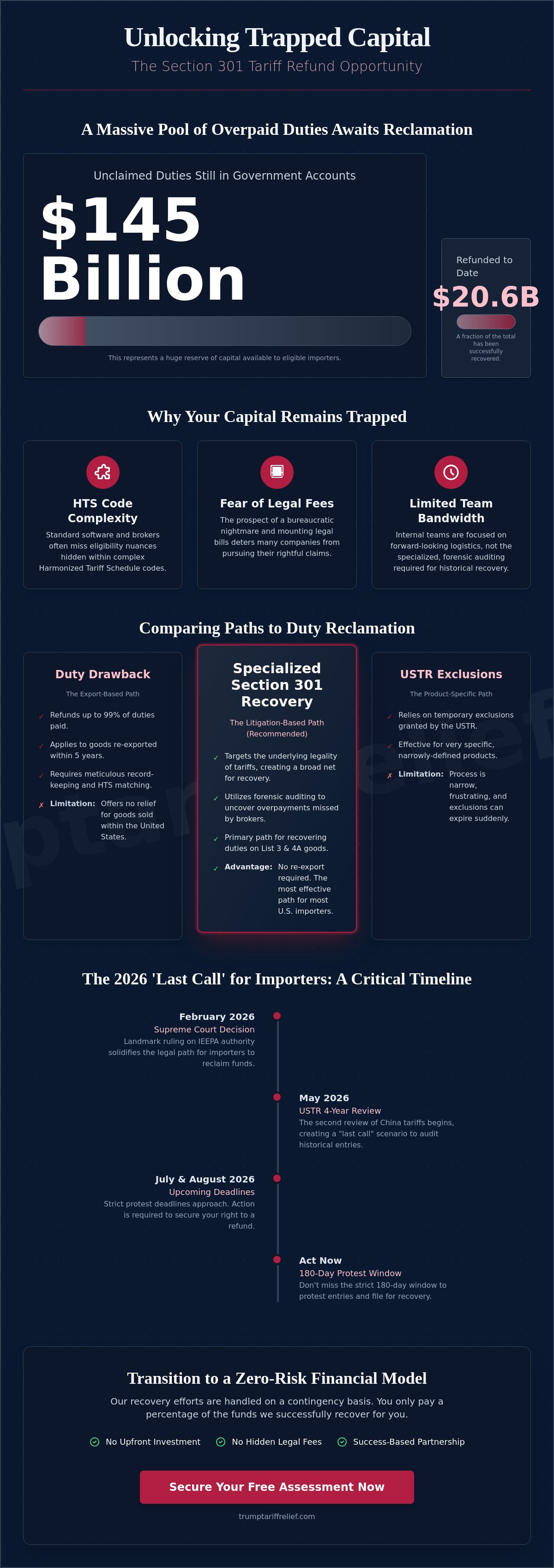
Did you know that while U.S. Customs has already processed over $20.6 billion in certified refunds, an estimated $145 billion in overpaid duties still sits in government accounts? For many importers, this represents a massive amount of capital trapped by the complexity of HTS code eligibility and the fear of mounting legal fees. You probably feel that reclaiming these funds is a bureaucratic nightmare that your team simply doesn't have the bandwidth to handle. Professional Section 301 tariff recovery services exist to bridge this gap, ensuring that your business isn't left behind while others secure their rightful capital.
This guide promises a clear path to restoration. You'll discover how to master the current trade landscape to recover millions in overpaid duties through a hands-off, contingency-based process. We're currently in a critical window as the USTR initiates the second four-year review of China tariffs this May 2026. This article provides a strategic preview of the upcoming July and August deadlines, the impact of recent Supreme Court decisions on IEEPA refunds, and how a specialized partner can turn these regulatory hurdles into a significant cash infusion for your business.
Key Takeaways
- Pinpoint hidden capital reserves within your trade data and learn how forensic auditing identifies overpayments that standard software often misses.
- Compare the primary paths to duty reclamation and see why specialized Section 301 tariff recovery services are essential for navigating the complex IEEPA landscape.
- Assess your specific HTS codes and import volumes to confirm if your claim meets the threshold for a high-probability, high-return recovery operation.
- Secure your right to a refund by understanding the "tolling" effect of current litigation and how to meet the strict 180-day protest deadlines in 2026.
- Transition to a zero-risk financial model where all recovery efforts are handled on a contingency basis, requiring no upfront investment or legal fees from your firm.
The Current Landscape of Section 301 Tariff Recovery in 2026
The financial burden on U.S. manufacturing and retail sectors has reached a critical breaking point. Since 2018, these industries have served as the primary financiers of a prolonged trade conflict, funneling billions into government accounts through additional duties. As of May 2026, the landscape has shifted from passive compliance to active restoration. While many importers once viewed these costs as an unavoidable expense, the tide has turned. Specialized Section 301 of the Trade Act of 1974 mandates are now being scrutinized under new legal lenses that favor the importer.
Today, professional Section 301 tariff recovery services function as a forensic financial process rather than a standard brokerage service. It's about identifying specific legal windows where the government exceeded its authority. Following the Supreme Court’s landmark February 2026 decision, the path to reclaiming these funds has never been clearer. By utilizing professional Section 301 tariff recovery services, companies can move beyond basic customs entries and into the territory of high-stakes financial reclamation. This isn't just about paperwork; it's about identifying overpayments in a system that collected $264 billion in duties during 2025 alone.
The Evolution of the China Trade War Tariffs
The trade conflict began with List 1 in July 2018 and rapidly expanded through Lists 2, 3, and 4A, affecting nearly $500 billion in imported goods. For years, businesses relied on the USTR to grant narrow exclusions. That era has ended. The current recovery model focuses on litigation-based outcomes and the precise identification of HTS code eligibility. With the USTR initiating its second four-year review in May 2026, importers face a "last call" scenario. If you don't act now to audit your historical entries, you're essentially leaving your capital in the federal treasury permanently.
The IEEPA Connection: Why It Matters Now
The International Emergency Economic Powers Act (IEEPA) was originally designed to give the President authority to regulate commerce during national emergencies. However, legal challenges have successfully argued that the government overstepped when it used IEEPA to bypass the strict procedural requirements of Section 301. This "overlap" of powers created a massive opportunity for refunds. If your business paid duties on List 3 or List 4A goods, you're likely eligible for a significant recovery. You can find a deeper dive into these legal mechanics by reviewing our guide on how IEEPA explained the shift in tariff authority. This legal opening is the primary catalyst for the $20.6 billion in refunds already processed by CBP as of May 22, 2026.
Roundup: Comparing Section 301 Tariff Recovery Services
Identifying the most effective path to capital restoration requires a clear understanding of the three primary mechanisms available to importers in 2026. While many businesses assume their standard customs broker is already capturing every available refund, this is rarely the case. Traditional brokerage is built for compliance and forward-looking logistics; it is not designed for the aggressive, forensic auditing required to claw back funds from the federal government. Specialized Section 301 tariff recovery services fill this gap by focusing exclusively on historical overpayments and evolving legal precedents that brokers often overlook.
This need for niche legal expertise is a common thread in global trade; for instance, businesses managing commercial interests or investments between the U.S. and Israel often utilize an Israel Cross Border Law Firm to navigate the complexities of international law.
The effort level and success rate of these services vary significantly based on your business model. For example, a company relying solely on USTR exclusions may find the process frustratingly narrow, as those exclusions are often product-specific and subject to sudden expiration. In contrast, litigation-based recovery targets the underlying legality of the tariffs themselves, offering a much broader net for capital reclamation. Choosing the right service depends on whether you are re-exporting goods or selling exclusively within the United States.
Duty Drawback: The Export-Based Path
Duty drawback remains a reliable tool for companies that re-export China-origin goods. This process allows for a refund of up to 99% of duties paid if those goods, or a commercially interchangeable substitute, are exported within five years of importation. It's a highly technical process that requires meticulous HTS substitution matching and rigorous record-keeping. However, its primary limitation is obvious: it offers no relief for the vast majority of importers who sell their products domestically. If your inventory never leaves U.S. soil, drawback is a dead end for your recovery efforts.
For firms that are not yet active in global sales but wish to leverage duty drawback, working with an export trading company like Global Exclusive Trading (GET) can help bridge the gap between domestic manufacturing and international buyers.
IEEPA Litigation Recovery: The Importer’s Best Bet
For businesses focused on the domestic market, IEEPA litigation recovery has become the gold standard. This path leverages ongoing Court of International Trade (CIT) rulings to argue that the government exceeded its statutory authority when it expanded tariffs under the International Emergency Economic Powers Act. Unlike exclusions, which are limited by specific product descriptions, this litigation targets the validity of List 3 and List 4A duties as a whole. This path offers the highest potential ROI because it applies to a massive range of HTS codes that were never covered by traditional exclusions. Success in this area requires active participation in lead-case filings and the submission of protective protests to keep your claims alive while the courts deliberate.
If you're unsure which category your current entries fall into, you can see how the recovery process works to determine your eligibility. Most importers find that a combination of forensic assessment and litigation advocacy provides the most aggressive path to reclaiming their tied-up capital.
Qualifying for Recovery: Is Your Business Eligible?
Determining eligibility isn't a matter of guesswork; it's a precise calculation based on your import history and HTS classification. Many executives mistakenly believe that if their goods weren't granted a specific USTR exclusion, they're automatically ineligible for a refund. This assumption is costly. In 2026, the focus has shifted toward the systemic legal invalidity of List 3 and List 4a duties. If your firm paid the 25% or 7.5% additional tariffs on these lists, you're likely sitting on significant reclaimable capital. Utilizing professional Section 301 tariff recovery services ensures you don't overlook these high-probability opportunities due to outdated compliance assumptions.
Economic viability is the next hurdle. While every dollar counts, professional recovery is most effective when the volume of overpaid duties justifies a forensic audit. If your total Section 301 duty spend exceeds the six-figure mark, the potential ROI makes a formal assessment essential. Smaller claims often face diminishing returns; however, for mid-market and enterprise-level importers, the recovery of even a fraction of paid duties can result in millions of dollars returned to the balance sheet. It's about identifying the "sweet spot" where the complexity of the claim aligns with the scale of the refund.
Sector-Specific Opportunities
Manufacturing firms often see the highest recovery rates because their imports involve complex machinery and sub-components. These items frequently fall under HTS codes that were caught in the "procedural dragnet" of List 3. Retailers and consumer goods companies, on the other hand, should look closely at List 4a. This list targeted a broad array of finished products, and the legal challenges regarding the government's failure to respond to public comments provide a strong foundation for recovery. Technology sectors face a different challenge: navigating the intricate classifications of electronics. Because HTS codes for tech evolve rapidly, a specialized audit often uncovers misclassified entries that qualify for immediate restoration.
The Self-Assessment Checklist
Before engaging a recovery partner, perform a preliminary internal audit. If you can answer "yes" to these points, your business is a prime candidate for a deeper forensic review:
- Import History: Did your company act as the Importer of Record for goods originating from China between 2018 and the present?
- Documentation: Can you produce the 7501 Entry Summaries for the periods in question? These documents are the "smoking gun" needed for any successful claim.
- Duty Types: Were your goods subject to the additional 25% (List 3) or 7.5% (List 4a) duties?
If you're still uncertain about your specific situation, you can review our FAQ for detailed answers to common eligibility queries. Don't let a simple misunderstanding of trade law prevent your business from reclaiming its rightful capital. Professional Section 301 tariff recovery services are designed to handle this complexity so you don't have to.
The Statute of Limitations: Navigating 2026 Deadlines
Time is the most unforgiving factor in trade law. While many competitors highlight a five-year lookback period for duty drawback, they often fail to mention the razor-sharp 180-day window for specific customs protests. This distinction is where millions of dollars are lost every year. If your entries have liquidated and you haven't filed a protest within 180 days, your legal standing to reclaim those specific duties evaporates. Professional Section 301 tariff recovery services are designed to prevent this exact scenario by implementing "Protective Filings" before your rights expire.
A common mistake is waiting for a "final" court decision before taking action. Many CFOs believe they can simply wait for the Court of International Trade (CIT) to issue a broad ruling and then collect their check. This is a costly misconception. While the "Tolling" effect of lead cases can sometimes extend certain windows, it's rarely a substitute for an individual firm's proactive filing. By the time a "final" ruling is televised, the window for your specific historical entries has likely closed. Once a deadline passes, the money is legally forfeited to the Treasury, and no amount of legal gravitas can bring it back.
Critical Dates for 2026 Filings
The next few months are pivotal for every U.S. importer. For List 1 duties, the window for domestic industry representatives to request continuation ends July 5, 2026. For List 2, the deadline is August 22, 2026. These dates aren't just administrative milestones; they represent a shifting landscape that could trigger a wave of final payouts. You must also account for the danger of "Laches," a legal principle where a court can deny your claim simply because you waited too long to assert your rights. Procrastination is a choice that benefits the government, not your balance sheet.
Managing Documentation Under Pressure
The success of any recovery operation hinges on the quality of your historical data. You need 7501 Entry Summaries and Commercial Invoices for every transaction you wish to challenge. Gathering this documentation from years of historical imports can be a logistical nightmare for internal teams. This is why specialized Section 301 tariff recovery services prioritize customs documentation management as a core offering. Experts handle the heavy lifting of document retrieval and digital record-keeping, ensuring that your claim is backed by bulletproof evidence. This forensic approach ensures that when the CIT milestones are reached, your documentation is already in place to trigger a refund.
Don't let the clock run out on your firm's capital. You can start your tariff eligibility assessment today to secure your place in the recovery queue before the next wave of 2026 deadlines closes your window for good.
Maximizing Refunds with Contingency-Based Recovery
The traditional legal model often creates a financial barrier that prevents importers from pursuing their rightful refunds. Many firms are hesitant to engage in high-level trade litigation when faced with the prospect of massive hourly retainers and no certainty of a return. This is where the "No-Win, No-Fee" model revolutionizes the recovery process. By aligning the incentives of the consultant with those of the client, contingency-based Section 301 tariff recovery services ensure that your partner is as motivated as you are to maximize every dollar reclaimed. If we don't recover capital for your business, you don't owe a fee. This structure shifts the entire financial risk away from your balance sheet and onto our expertise.
Contingency fees represent the most aggressive way to pursue the government. Unlike standard compliance providers who are paid regardless of the outcome, a recovery-focused partner only succeeds when you win. This drives a deeper, more forensic level of investigation into your customs data. We manage the entire lifecycle of the claim, from the initial identification of overpaid duties to the final issuance of the refund check by U.S. Customs and Border Protection (CBP). In a landscape where billions remain unclaimed, the cost of inaction is far higher than the zero-risk path of a professional recovery operation. Every day you wait is a day the government continues to hold your working capital interest-free.
The Trump Tariff Relief Advantage
Our firm provides a specialized focus that general customs brokers simply cannot match. We dedicate our resources exclusively to IEEPA and Section 301 recovery, navigating the dense bureaucracy of CBP with surgical precision. We don't just file paperwork; we build a strategic case for your refund based on the latest CIT rulings and trade precedents. Our expertise in customs documentation management ensures that even the most complex historical entries are organized and presented in a way that minimizes government pushback. You can see how it works to understand how we streamline the path from audit to capital restoration.
Next Steps: Your Preliminary Assessment
The path to recovery begins with a detailed preliminary assessment. During this phase, we analyze your import history to identify the specific HTS codes and entry dates that offer the highest probability of success. We'll provide a clear timeline of what to expect, from the initial filing of protective protests to the eventual issuance of certified refunds. While the legal process moves at the speed of the courts, our team works at the speed of business to ensure your claims are filed before the next 2026 deadline. The government has your money; we have the tools to get it back.
Reclaim Your Capital Before the 2026 Deadlines Close
The window for reclaiming millions in overpaid duties is narrow, and the federal government isn't going to remind you of your eligibility. You now understand how critical the upcoming July and August continuation reviews are for List 1 and List 2, and how the recent legal shifts regarding IEEPA have opened a massive path for restoration. Waiting for a court-ordered windfall without filing your own protective protests is a strategy that leads to permanent forfeiture. By partnering with experts who specialize in Section 301 tariff recovery services, you can offload the burden of forensic auditing and customs documentation management to a team that only wins when you do.
We handle the entire lifecycle of the claim, leveraging deep expertise in IEEPA and Section 301 litigation recovery to ensure no dollar is left behind. It's time to stop letting your working capital sit in the Treasury interest-free. Get Your Free Tariff Eligibility Assessment Today and discover exactly what your business is owed through our contingency-based model. Your capital belongs on your balance sheet, not in a government account. Let's start the recovery process today.
Frequently Asked Questions
Is the Section 301 China tariff refund real?
Yes, the recovery of these funds is an active and verified process. As of May 22, 2026, U.S. Customs and Border Protection has already processed approximately $20.6 billion in certified refunds for invalidated IEEPA tariffs. While Section 301 refunds are often tied to specific litigation and the ongoing four-year review initiated in May 2026, the legal framework for reclaiming this capital is firmly established. It's a legitimate financial restoration for businesses that acted as the importer of record.
How much does a Section 301 tariff recovery service cost?
Professional recovery operations typically utilize a contingency-based model, meaning there are zero upfront costs for your business. This "No-Win, No-Fee" structure ensures that the service provider only receives payment after a successful refund is issued by the government. Since the provider takes on the financial risk of the forensic audit and documentation management, your company can pursue millions in potential refunds without impacting your current operational budget. You should check with your provider for their specific contractual rates.
Can I file for a tariff refund if I already used a customs broker?
You can absolutely pursue a refund even if you have an existing customs broker. Most traditional brokers are built for forward-looking compliance and logistics; they aren't equipped for the aggressive, historical forensic auditing required for a successful claim. Utilizing specialized Section 301 tariff recovery services allows you to reclaim capital without disrupting your daily shipping operations. We focus exclusively on the recovery of overpaid duties, which is a separate specialized field from standard brokerage.
What is the deadline for filing an IEEPA tariff refund claim in 2026?
The 2026 deadlines are critical and depend on the specific tariff list. For the List 1 continuation review, the window for industry requests is May 7, 2026, to July 5, 2026. For List 2, the window runs from June 24, 2026, to August 22, 2026. Because IEEPA refunds are managed through a new court-ordered system following the February 2026 Supreme Court ruling, you must act before these specific windows close to ensure your entries are eligible for restoration.
What documents do I need to start a tariff recovery assessment?
The primary documents required are your 7501 Entry Summaries and Commercial Invoices. These records provide the definitive proof of your imports, the HTS codes used, and the total duties paid to CBP. If your internal team doesn't have these documents readily available, our Section 301 tariff recovery services include comprehensive documentation management to assist in retrieving historical data. Having these records organized is the first step toward a successful forensic audit.
How long does it take to receive a check from the U.S. government?
The timeline for receiving a refund check varies based on the specific type of claim and current CBP processing volumes. While IEEPA refunds are being processed through a dedicated portal following the February 2026 ruling, Section 301 refunds tied to litigation may wait for specific court milestones. We provide a projected timeline during your initial assessment based on the most recent government payout data. Our team manages the entire process to ensure there are no administrative delays once your claim is approved.
Does my company qualify if we only imported small volumes?
Qualification is based on the legality of the duties paid rather than just the size of the company. Any importer of record that paid Section 301 or IEEPA duties can technically qualify for a refund. However, professional recovery is most effective when the total overpayment justifies the forensic audit process. We recommend a preliminary assessment to determine if your specific HTS codes and import volumes reach the threshold for a high-probability, high-return recovery operation.
Can I recover tariffs paid on List 3 and List 4a goods specifically?
Yes, List 3 and List 4a goods are currently the primary focus for recovery efforts. These lists are central to the IEEPA litigation because the government expanded its tariff authority to include them without following the necessary procedural requirements. If your business paid the 25% List 3 duties or the 7.5% List 4a duties, you have a high probability of success. Our tariff eligibility assessment specifically targets these categories to maximize the capital returned to your balance sheet.
Ready to find out what your business may be owed?
Check My Eligibility