
What if the biggest risk to a refund claim isn’t one obvious error, but a mismatch between the claim and the records behind it? Importers asking what triggers a CBP audit of a refund claim often want to know whether a particular discrepancy will lead to scrutiny. CBP doesn’t publish a definitive checklist showing that any single risk signal will trigger an audit.
That doesn’t mean every request for information is a formal audit, or that a discrepancy automatically puts a claim in trouble. It does mean the details matter. Differences between a refund calculation and the original entry data, or inconsistencies in classification, valuation, or country-of-origin records, may prompt closer review. The practical response is to reconcile the evidence before filing rather than assume an audit is inevitable.
This article explains common indicators of additional CBP review, which claim details and records to check, and how routine questions differ from a formal audit. It also outlines a practical way to organize evidence and review eligibility, while recognizing that preparation can’t guarantee CBP won’t ask questions.
Key Takeaways
- Understand what may prompt closer CBP review of a refund claim, without treating any risk signal as a guaranteed audit trigger.
- Distinguish a formal audit from a claim review or request for supporting information before responding.
- Reconcile entry, payment, tariff calculation, and supporting records against the refund claim.
- Use a practical preparation process to organize evidence, preserve claim versions, and track CBP communications.
- Learn how specialized IEEPA refund support can help with eligibility review, documentation, and filing.
What Does a CBP Audit of a Refund Claim Actually Mean?
A CBP audit is a formal examination of an importer’s records or compliance practices. It differs from a question raised while a refund claim is being processed or a request for information about particular entries. Those steps may require a response, but a document request alone doesn’t establish that CBP has opened a broader audit.
This distinction matters for importers pursuing refunds, including refunds connected to IEEPA duties. A discrepancy or unusual claim pattern may lead to questions, but it does not automatically trigger an audit. Nor does a review, by itself, establish an error, ineligibility, or improper conduct.
A possible risk signal may prompt a closer look, but it isn’t a confirmed CBP audit trigger.
Audit, review, and information request: how the terms differ
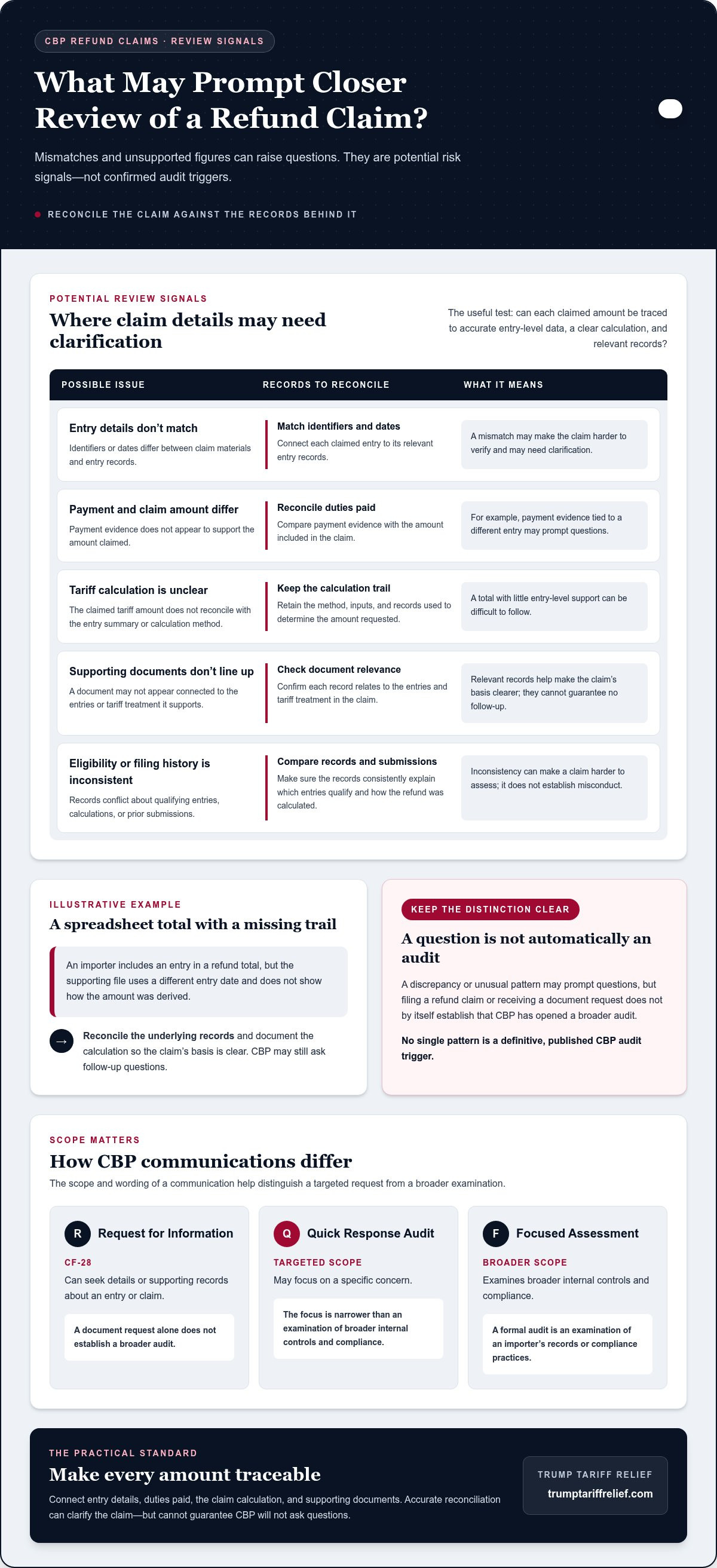
CBP may request information about an entry or claim without conducting a comprehensive examination of an importer’s compliance program. For example, a Request for Information, commonly called a CF-28, can seek details or supporting records. A targeted Quick Response Audit may focus on a specific concern, while a Focused Assessment examines broader internal controls and compliance. The scope and wording of the communication matter. Don’t assume every document request is a formal audit, but don’t ignore it.
Refund claims can also arise under different customs mechanisms. Duty drawback, for example, generally concerns recovery of duties on imported goods that are later exported. This is distinct from the legal basis for an IEEPA-related claim.
Does filing a refund claim automatically trigger an audit?
Filing a refund claim does not, by itself, establish that a formal audit will follow. A claim may be reviewed or prompt a request for supporting information, but filing alone doesn’t prove that CBP will conduct a broader audit. Accuracy and supporting records still matter, and CBP may ask about details that need clarification.
For the legal background behind IEEPA refund developments, see our IEEPA ruling and refund explainer. Understanding the basis of a claim is separate from predicting whether CBP will scrutinize it. Focus on knowing what was filed, how the claim was calculated, and which records support it.
Which Refund-Claim Patterns May Attract Closer CBP Scrutiny?
CBP may look more closely when a refund claim is difficult to reconcile with the underlying entry information or supporting evidence. These are potential risk signals, not guaranteed or exhaustive audit triggers. The useful question isn’t whether a claim looks large or unusual in isolation. It’s whether each amount can be traced to accurate entry-level data, a clear calculation, and relevant records.
Data mismatches and unsupported calculations
Differences in entry numbers, dates, duty amounts, or tariff treatment shown in supporting records can make a claim harder to verify. For example, if a claim identifies one entry but the payment evidence corresponds to another, CBP may need clarification. The same applies when the claimed tariff amount doesn’t reconcile with the entry summary or the calculation method.
For each entry included, make sure you can connect the records:
- Entry details: Match identifiers and dates to the relevant entry records.
- Payment evidence: Reconcile duties paid with the amount included in the claim.
- Claim calculation: Keep the method, inputs, and records used to determine the amount requested.
- Supporting documents: Check that each document relates to the entries and tariff treatment it is intended to support.
A total with little entry-level support may prompt questions because its basis is difficult to follow. Don’t assume that a large claim, by itself, means greater audit risk. What matters in preparing the claim is whether its figures and supporting evidence can be reconciled.
Eligibility, filing history, and unusual claim patterns
Eligibility may draw questions if the records conflict about which entries qualify or how the requested refund was calculated. Inconsistencies between submissions can also make a claim harder to assess. These circumstances don’t establish misconduct; they highlight areas where clear records and explanations can help.
Illustrative example, not an official CBP trigger: An importer’s spreadsheet includes an entry in its refund total, but the supporting file uses a different entry date and doesn’t show how the amount was derived. The mismatch may need an explanation. Reconcile the underlying records and document the calculation so the claim’s basis is clear. This still can’t guarantee CBP won’t ask follow-up questions.
So, what triggers a CBP audit of a refund claim? Inconsistencies or unsupported figures may prompt questions, but no single pattern is a definitive trigger. If reconciling eligibility, entry data, and calculations across a complex claim is burdensome, review how refund documentation and filing support works.
What CBP May Examine, and What a Refund Review Does Not Prove
For a refund claim, the key question is whether the records support the amount requested and connect it to the relevant entries. Depending on the claim and reason for review, CBP may seek entry information, payment evidence, a calculation, or correspondence that clarifies how the claim was prepared. The table shows what those materials may help explain, not what CBP will examine in every case.
| Possible issue | Records that may clarify it | What cannot be inferred |
|---|---|---|
| Claimed amount differs from entry-level figures | Entry records and the calculation showing how the amount was derived | A difference alone does not establish an incorrect claim or wrongdoing |
| Duty payment is unclear | Payment records matched to the entries in the claim | A request for proof does not itself establish that payment was not made |
| Tariff treatment needs explanation | Relevant entry details and records supporting the treatment used in the calculation | A question about the basis of a claim is not a final finding on eligibility |
| Documents or prior communications appear inconsistent | Claim-related correspondence and the versions of supporting records used | An inconsistency does not, by itself, prove intentional misconduct |
Records that help substantiate a refund claim
Start with entry-level records, evidence of payment for the duties claimed, and the calculation connecting those figures to the requested refund. Keep correspondence that explains a decision or clarifies the evidence. Retain the underlying records and the versions used to prepare the claim, so you can trace the calculation instead of reconstructing it from memory.
The documents required can vary by refund mechanism. For IEEPA-specific information, see the IEEPA refund process and claim information. Follow current CBP instructions for the applicable claim process, including what to submit and when. Importers generally must retain records for five years from the date of entry or the activity requiring the record, subject to specific rules and exceptions.
Review activity versus an adverse finding
A question or document request asks for information; it isn’t, by itself, a determination that a claim is invalid or that duties are owed. If records are missing or inconsistent, CBP may need clarification. That gap alone doesn’t establish fraud or intent. Read the communication carefully, identify exactly what it requests, and respond with relevant, organized evidence. The phrase what triggers a CBP audit of a refund claim shouldn’t be confused with what proves liability: a risk signal or review step is not an adverse finding. The applicable CBP decision determines the outcome.
How Importers Can Prepare for a CBP Refund-Claim Audit
Preparation starts before CBP asks a question. Create a record trail that lets someone follow the claim from the entries included to the refund calculation and the supporting evidence. This can make discrepancies easier to find and explain, though it can’t guarantee the claim won’t receive scrutiny.
Reconcile entry data before submission
Work through the claim entry by entry. Match each identifier and amount to the relevant source records, then confirm that the refund calculation uses those records consistently. If an amount changes during preparation, document what changed, why it changed, and which evidence supports the adjustment. Use the fields and format required by the instructions for the applicable filing process.
A traceable claim runs from entry data, through a documented calculation, to the supporting evidence for each amount.
Organize the working file so the relationship between those pieces is clear. Preserve source records, the calculation method, and the versions used to prepare and submit the claim. Version history can help explain how the final figures were reached if questions arise later.
Keep a clear response record if CBP asks questions
If CBP requests information, read the request closely and respond to the points it raises. Maintain a log of the request, relevant dates, documents provided, and the version of each response. Keep copies of what you send. Check that explanations align with the claim methodology and underlying records, and document any correction instead of silently replacing an earlier figure.
- Reconcile: Match claim entries and amounts to source records.
- Organize: Keep evidence, calculations, and correspondence together by claim or entry.
- Document: Record assumptions, adjustments, and the reason for each calculation.
- Track: Preserve CBP requests, response dates, and submitted materials.
Separate record-retention requirements from the materials requested for a particular filing. Importers generally must retain records for five years from the date of entry or the activity requiring the record. Follow current CBP instructions for the claim process and any specific information request. For a filing and documentation overview, see how the refund claim process works.
For IEEPA refund claims, Trump Tariff Relief supports businesses with eligibility assessment, customs documentation management, and government filing work. Get support organizing your IEEPA refund claim.
When Specialized IEEPA Refund Support Can Help
Managing an IEEPA refund claim can become demanding when it spans many entries, relies on records stored across different systems, or competes with limited internal staff time. Specialized support can help when your team needs to reconcile entry information, assess which transactions may qualify, or prepare and manage filing documentation. A coordinated process keeps eligibility decisions, records, calculations, and submissions connected.
What a specialized recovery team can take off your plate
Trump Tariff Relief supports businesses pursuing IEEPA tariff refunds through eligibility assessment, customs documentation management, and government filing work. This can reduce the administrative load on an importer’s team, particularly when documents need to be gathered and organized across many transactions. A consistent record trail also makes it easier to explain how a claim was prepared if questions arise, though organized files can’t guarantee that CBP won’t request more information.
For an overview of the steps involved, review how IEEPA refund support works. The service focuses on refund eligibility, documentation, and filing, not on preventing scrutiny or guaranteeing a particular outcome.
Choose informed preparation, not promises of avoiding scrutiny
No consultant can guarantee that CBP won’t review a claim. There is no definitive public checklist for what triggers a CBP audit of a refund claim, and careful preparation isn’t immunity from questions. Accurate, well-organized records can help a business understand its claim and respond more clearly if CBP seeks clarification.
Trump Tariff Relief uses a contingency-fee model: there are no upfront costs, and the fee is a percentage of the refund successfully recovered. If you’re considering IEEPA refund support, review the process and the eligibility assessment for your claim. Explore the IEEPA refund process.
Prepare Your Claim With Confidence
There’s no definitive public checklist explaining what triggers a CBP audit of a refund claim. Potential risk signals, such as mismatches in claim data or supporting records, may prompt questions, but they don’t guarantee an audit or prove wrongdoing. Make the claim traceable by reconciling entry information, calculations, and payment evidence, and preserving the records used to prepare it.
If transaction volume or documentation demands stretch your team’s capacity, specialized support can help organize the work. Trump Tariff Relief provides eligibility assessment, customs documentation management, and government filing support for businesses pursuing IEEPA refunds. Its contingency-fee model has no upfront costs, with a fee based on refunds successfully recovered. This support can help manage the process, but it can’t guarantee CBP won’t review a claim or guarantee a refund.
Request an IEEPA refund eligibility assessment to take a practical next step toward understanding your claim. Clear records and informed preparation can help your business move forward with greater confidence.
Frequently Asked Questions
What triggers a CBP audit of a refund claim?
There is no exhaustive public checklist of refund-claim audit triggers. Inconsistent entry data, unsupported calculations, or gaps between a claim and its records may prompt questions, but these are possible risk signals, not automatic triggers. For example, an amount that doesn’t match the supporting entry records may need clarification. CBP’s review depends on the applicable process and facts, so don’t treat an example as an official selection criterion.
Does filing an IEEPA tariff refund claim automatically trigger a CBP audit?
Filing a claim does not automatically establish that a CBP audit will follow. A claim may still be reviewed or prompt a request for supporting information, but that doesn’t mean every claim receives the same scrutiny. Keep the claim traceable to its entry-level records and calculations, and follow current CBP instructions for the applicable filing process.
Can CBP audit a refund claim after it has been filed?
CBP may examine customs matters under applicable authorities and procedures, but the scope and process depend on the claim and current rules. Don’t assume filing ends the agency’s ability to ask questions or verify information. If CBP contacts your business, review the request closely and note any stated response requirements. Confirm applicable authority, deadlines, and procedures through current official guidance or qualified counsel familiar with the facts.
What documents should an importer keep for a CBP refund claim review?
Keep records that support the specific claim, including relevant entry information, evidence of duty payment, the calculations used, and related correspondence. Reconcile each claimed amount to its source records and preserve the versions used to prepare the claim. Importers generally must retain records for five years from the date of entry or the activity requiring the record, subject to specific rules and exceptions. Follow current CBP submission and retention requirements for your claim.
Do claim errors or inconsistencies mean CBP will find fraud?
No. An inconsistency or request for clarification doesn’t, by itself, prove fraud or intentional misconduct. It may mean the records need an explanation, additional support, or correction. Respond with accurate information that aligns with the underlying records and claim methodology. Avoid guessing about the outcome or submitting unsupported estimates. If a discrepancy could have legal consequences, seek advice from qualified counsel who can assess the specific facts and applicable requirements.
How can a business prepare if CBP requests more information about a refund claim?
Identify exactly what CBP is asking for and any stated response deadline. Match each response to the relevant claim records and calculation, keep copies of materials submitted, and log communications. Don’t send unsupported estimates or explanations that conflict with source records. The proper response depends on the request and applicable procedures, so verify current requirements and seek qualified help if the request raises complex issues.
Can a tariff refund consultant guarantee that CBP will not audit a claim?
No consultant can guarantee that CBP won’t review a claim. A specialist can help assess eligibility, organize supporting records, and manage filing work, but CBP controls its own review processes. Evaluate support based on the work performed, clear fee terms, and the quality of the documentation process, not promises that scrutiny can be prevented. Trump Tariff Relief uses a contingency-fee model with no upfront costs, charging a percentage of refunds successfully recovered.
Ready to find out what your business may be owed?
Check My Eligibility