
Simplifying the tariff refund application starts with knowing which import entries may be relevant and bringing customs, finance, and shipment records together. For an IEEPA refund claim, scattered records and uncertainty about which details need review can make the work feel harder than it needs to be.
A clear process helps your business organize the work without skipping important checks. This guide explains how to define the scope, gather and reconcile records, assign filing and follow-up responsibilities, and decide whether to manage the process internally or use specialist support.
Trump Tariff Relief assists businesses with eligibility assessment, customs documentation management, and government filings. Its contingency-based fee model has no upfront costs, and a fee applies only if a refund is successfully recovered. Eligibility and outcomes aren’t guaranteed, but an organized review can help your team identify relevant information and determine what needs attention next.
Key Takeaways
- Simplifying the tariff refund application means creating an organized, reviewable workflow, not bypassing eligibility checks or filing requirements.
- Divide the work into clear stages, with an owner, a deliverable, and a completion check for each one.
- Use a central index and consistent file names to connect customs, finance, and logistics records and flag missing information.
- Compare internal coordination, targeted assistance, and end-to-end support by workload, record ownership, procedural familiarity, and visibility.
- Trump Tariff Relief manages eligibility assessment, customs documentation, and government filing through its IEEPA tariff refund recovery service.
Why simplifying the tariff refund application starts with a clear scope
A refund review can involve records held by customs, finance, logistics, and legal teams. Entry information may be in one system, duty-payment evidence in another, and shipment correspondence somewhere else. Without a defined scope, teams can spend time collecting documents without knowing which entries or payments need review.
Simplifying the tariff refund application means organizing eligibility checks, records, responsibilities, and follow-up into a clear, reviewable workflow. It isn’t a shortcut around requirements or a promise of a particular result. The goal is to make the work traceable, so records and decisions can be reviewed against current official guidance.
This guide focuses on recovery of tariffs imposed under the International Emergency Economic Powers Act (IEEPA), not every customs duty or tariff program. Tariffs are duties applied to imported goods; readers who want a high-level overview can explore What is a tariff? A general explanation of tariffs doesn’t determine whether a particular payment belongs in an IEEPA refund claim. That depends on the specific tariff, entry, and applicable legal framework.
What makes a tariff refund application feel complicated?
The administrative work and the eligibility question are related, but they aren’t the same. A business may find entry data and payment evidence yet still need to assess whether those entries are relevant under current rules. Collecting documents alone doesn’t resolve an eligibility question.
Separate the tasks: identify potentially relevant entries, gather supporting records, and flag questions that need claim-specific review. This helps teams avoid treating a complete folder as proof of eligibility, while ensuring uncertainty doesn’t leave records scattered.
Which businesses should organize an application workflow?
Importers in manufacturing, retail, technology, and other sectors can benefit from a structured process when assessing possible IEEPA tariff recovery. This doesn’t mean every importer or entry qualifies. It gives the business a consistent way to identify relevant information and determine what needs review.
Coordination can become more demanding when a business has multiple entries, business units, or record owners. Logistics may hold shipment details while finance tracks payments and another team maintains customs documentation. Assigning responsibility early helps prevent gaps and duplicate work. For a broader overview of the recovery process, see IEEPA tariff refund recovery.
Break the tariff refund application into four manageable workstreams
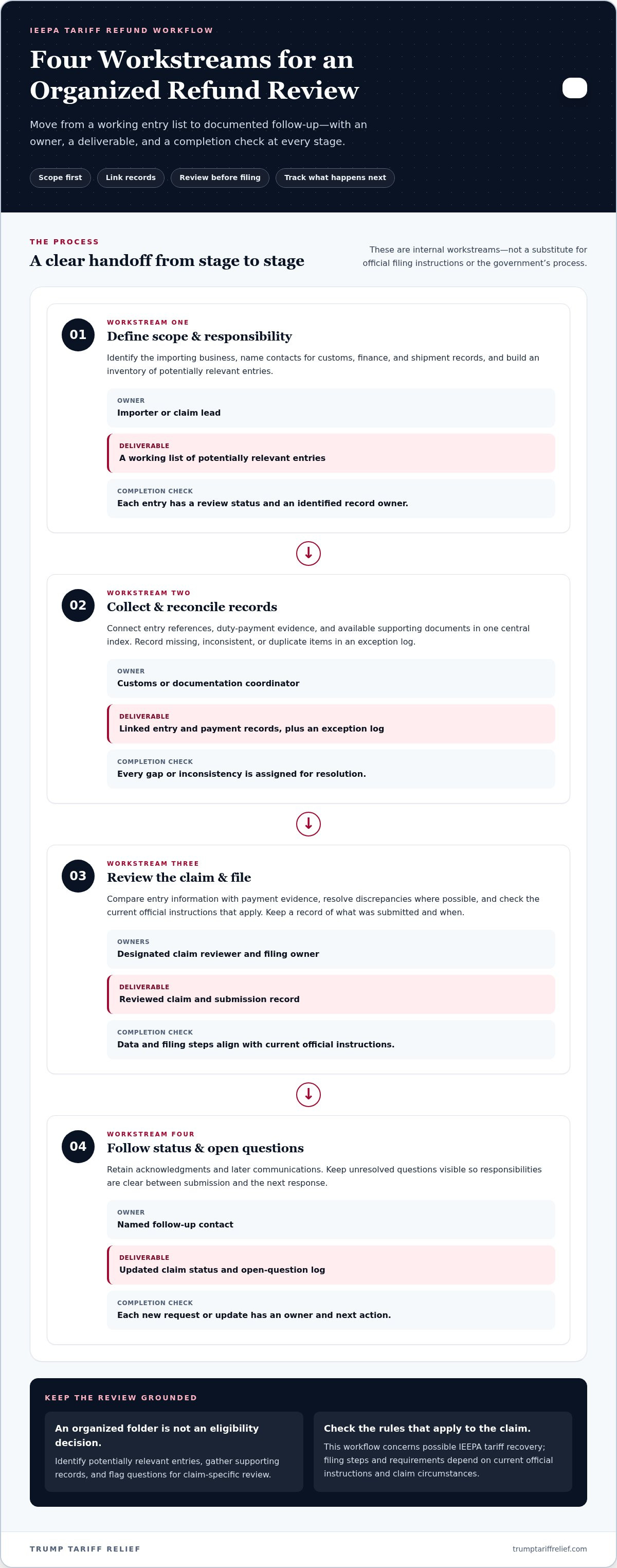
A clear workflow gives each part of the claim an owner and a defined handoff. Organize the work into four stages: initial scope, record collection, claim review and filing, and status follow-up. These are internal workstreams, not a substitute for the government’s process. Filing steps, required records, and available channels depend on current official instructions and the circumstances of the claim.
Start with scope and responsibility
Identify the importing business and name contacts for customs, finance, and shipment records. Then create an inventory of potentially relevant entries. Treat this as a working list, not an eligibility decision. A specialist assessment can help organize the claim review and identify questions or records that need attention before filing.
Collect and reconcile supporting records
Choose a records coordinator to build one index connecting entry references, duty-payment evidence, and available supporting documents. Track missing, inconsistent, or duplicate items in an exception log, and assign someone to resolve each gap. For a more detailed document-gathering reference, consult Required Documents for IEEPA Tariff Refund: The 2026 Importer’s Checklist.
Businesses can also consult the International Trade Administration’s resource on understanding import tariffs and fees for general background. For a refund claim, the relevant entries and records still need to be assessed under applicable IEEPA guidance.
Review, file, and track the claim
Assign a claim reviewer to compare entry information with payment evidence, resolve discrepancies where possible, and check the current instructions that apply. The filing owner should retain a record of what was submitted and when, along with any acknowledgments or later communications. Name a follow-up owner and maintain a list of unresolved questions so nothing is lost between submission and the next response.
- Initial scope: The importer or claim lead owns the entry inventory. Deliverable: a list of potentially relevant entries. Check: each entry has a review status and an identified record owner.
- Record collection: A customs or documentation coordinator owns the index. Deliverable: linked entry and payment records, plus an exception log. Check: gaps and inconsistencies are assigned for resolution.
- Claim review and filing: The designated reviewer and filing owner coordinate the submission. Deliverable: a reviewed claim and submission record. Check: data and filing steps align with current official instructions.
- Status follow-up: A named contact monitors claim communications. Deliverable: an updated status and open-question log. Check: each new request or update has an owner and next action.
This structure makes simplifying the tariff refund application a matter of clear ownership and documented checks, not guesswork. Trump Tariff Relief coordinates eligibility assessment, documentation management, and government filing through its IEEPA recovery service. Learn how the tariff refund recovery process works.
DIY or specialist support: compare ways to simplify the application
Complexity doesn’t automatically mean your business needs outside support. Clear ownership and a documented workflow can make internal coordination workable. Consider whether your team has the capacity to manage the records, claim-specific review, current instructions, filing, and follow-up while maintaining visibility and handling its other responsibilities.
| Approach | Workload | Record ownership | Procedural familiarity | Visibility |
|---|---|---|---|---|
| Internal coordination | Handled by your team alongside its other duties. | Remains within the business, with internal owners needed for each record set. | Your team must check current instructions and requirements that apply to the claim. | Direct control, provided updates and decisions are documented. |
| Targeted assistance | Support is focused on selected tasks, while your team manages the rest. | Shared; agree on who gathers, reviews, and maintains each record. | Specialist input can support defined parts of the review or preparation. | Can remain strong when responsibilities and reporting are clear. |
| End-to-end recovery support | A specialist coordinates assessment, documentation management, and government filing. | Work is centralized with the recovery team, while the business provides relevant information and retains visibility. | Specialists manage the process with attention to applicable instructions. | Set expectations for updates, open questions, and submission records. |
When can an internal team manage the work?
Internal management may suit a business with accessible records, named owners across customs, finance, and logistics, and enough capacity for careful review and follow-up. If those pieces are in place, a central index and documented handoffs can keep the work organized. Your team still needs to check current official instructions and claim-specific requirements. A tidy document set alone doesn’t establish eligibility or ensure acceptance.
What does specialized recovery support change?
Specialized recovery support coordinates eligibility assessment, customs documentation management, and government filings. It focuses on IEEPA tariff refund recovery. Trump Tariff Relief’s specialists manage the process while your business retains visibility into its claim. See how the recovery process works.
How should a business weigh fees and control?
Consider the workload your team can realistically absorb, where records will be held, how decisions and updates will be shared, and who will track unresolved questions. Trump Tariff Relief uses a contingency-fee model with no upfront costs. A fee applies only if a refund is successfully recovered. That structure doesn’t guarantee eligibility or a refund. Before choosing an approach, make sure responsibilities, information sharing, and progress visibility are clear. This assessment makes simplifying the tariff refund application a matter of assigning the right work while maintaining oversight.
Use a practical checklist to reduce application delays and rework
A claim file is easier to review when each record has a clear source, a consistent reference, and an owner. A central index and consistent file names help connect the pieces without requiring a particular software system or file format. Keep original source files identifiable, and distinguish confirmed information from assumptions that still need review.
Build a clean, traceable claim file
Organize records by entry or another verified claim reference. For each document, note where it came from, when it was received, and which internal contact can answer questions about it. Compare key details across available customs and finance records. If entry information and payment evidence don’t align, record the discrepancy and assign it for resolution rather than silently choosing one version.
Track missing records in the same way. Note what’s unavailable, who is looking for it, and whether the gap affects the review. Don’t substitute estimates for missing evidence without a documented basis and appropriate review.
Prevent avoidable handoff problems
Use one shared tracker for record owners, open items, review status, and next actions. Set internal review points so the team can resolve gaps before handoffs or submission. These are your organization’s planning checkpoints, not government deadlines. Time limits and other time-sensitive details can depend on current rules and claim circumstances, so verify dates against authoritative guidance before relying on them.
Know what to verify before submission
Before anything is filed, confirm the current official instructions, the pathway applicable to the claim, and any supporting information required. Check that the business identity and entry-level details are consistent throughout the file. Use this checklist to prepare:
- Ownership: Name the lead and the contacts responsible for customs, finance, and shipment records.
- Entry data: Identify potentially relevant entries using verified references.
- Payment evidence: Link available evidence to the corresponding entry and record its source.
- Gaps and discrepancies: Log missing, duplicate, or conflicting information, assign an owner, and document the resolution or remaining question.
- Review: Separate verified facts from assumptions and check consistency across the claim file.
- Follow-up: Assign a contact to record submission details, monitor communications, and track next actions.
This practical structure supports simplifying the tariff refund application without treating a complete-looking file as proof of eligibility. For help coordinating IEEPA eligibility assessment, documentation management, and filing, explore tariff refund recovery support.
Make the next step in your tariff refund application easier
A manageable application starts with three steps: organize the records you have, identify the questions that remain open, and decide who will handle the next actions. You don’t need to resolve every uncertainty before getting organized. A working entry inventory, available payment evidence, and a short list of questions give an assessment a clearer starting point.
Prepare for an initial assessment
Gather available entry and duty-payment records, then note any gaps or inconsistencies. For example, flag an entry reference that doesn’t match the information in a payment record rather than guessing which detail is correct. Include questions about which entries may be relevant and what information still needs review. An assessment can help identify appropriate next steps, but it doesn’t automatically establish eligibility or guarantee a refund.
For background on the legal framework behind these claims, read IEEPA tariff refunds explained. Keep that context separate from the review of your business’s specific entries and records.
Move from preparation to managed recovery
If your team wants specialist support, Trump Tariff Relief manages IEEPA tariff refund recovery from eligibility assessment through customs documentation management and government filing. The team coordinates the work while your business retains visibility into its claim. This gives your staff a clear point of coordination for the records and questions they’ve gathered.
The service uses a contingency-fee model: there are no upfront costs, and a fee applies only if a refund is successfully recovered. Eligibility, refund amounts, processing times, and outcomes aren’t guaranteed. Current official instructions and the circumstances of each claim remain important to the review.
With records organized and open questions identified, simplifying the tariff refund application becomes a practical sequence rather than an undefined project. Decide whether your team will coordinate the work internally or use specialist recovery support to manage assessment, documentation, and filing.
Request an IEEPA refund assessment
Put your refund application on a clear path
Simplifying the tariff refund application starts with a defined scope, accountable owners, and records that can be traced to relevant entries and payments. A four-stage workflow helps your team move from identifying potentially relevant entries to gathering records, reviewing and filing the claim, and tracking follow-up. A practical checklist also brings missing information and open questions into view before they cause avoidable rework.
Your next step is straightforward: organize the records you have, list what still needs review, and decide who will coordinate the work. Trump Tariff Relief manages IEEPA eligibility assessment, customs documentation, and government filing through its recovery service. There are no upfront costs, and a fee applies only if a refund is successfully recovered. Eligibility and outcomes aren’t guaranteed, but a structured assessment can help clarify the path ahead.
Request an IEEPA refund assessment and take the next step with a clearer process and specialist support behind your claim.
Frequently Asked Questions
How do I simplify a tariff refund application?
Simplify it by defining the claim’s scope, assigning record owners, and tracking review and follow-up in one documented workflow. Start with a working inventory of potentially relevant entries, then connect entry information to available duty-payment evidence. Log missing or inconsistent details for review rather than filling gaps with assumptions. Simplifying the tariff refund application means making each task traceable, not bypassing eligibility checks or current official instructions.
What documents are typically needed for an IEEPA tariff refund application?
Businesses commonly begin with available entry-level customs information, evidence of duty payments, and supporting shipment or import records. Business identity details and relevant communications may also help organize the claim file. The exact information needed depends on the claim and current official instructions, so treat this as a starting list, not a definitive filing requirement. Keep each record linked to its source and the entry it relates to.
Can a business file an IEEPA tariff refund application without outside help?
Yes. A business may manage the work internally if it can access relevant records, assign clear owners, review the claim carefully, and follow current official instructions. For example, finance may locate payment evidence while logistics identifies shipment records, with one coordinator tracking gaps and next steps. Internal filing still requires claim-specific review. Organized documents alone don’t establish eligibility or mean a claim will be accepted.
How can I tell whether a tariff refund application is complete?
Use a checklist based on the current instructions that apply to your claim, then verify that each required item is present, consistent, and connected to the relevant entry. Confirm that business and entry information match across the claim file, and document unresolved discrepancies. A complete set of records is not the same as confirmed eligibility. If information is missing, record the gap and assign it for resolution rather than relying on an estimate.
Does hiring a tariff recovery specialist make the application simpler?
A specialist can coordinate eligibility assessment, customs documentation management, and government filing, reducing the coordination burden on your internal team. Trump Tariff Relief manages IEEPA tariff refund recovery from initial review through filing while businesses retain visibility into their claims. Its contingency-fee model has no upfront costs, and a fee applies only if a refund is successfully recovered. Specialist support doesn’t guarantee eligibility, a refund, or a particular outcome.
Are there deadlines for filing an IEEPA tariff refund application?
Time-sensitive requirements may apply, but relevant dates and filing steps depend on current official instructions and the circumstances of the claim. Don’t rely on a general deadline or an old summary without checking authoritative, current guidance. Identify potentially relevant entries and begin organizing available records while verifying applicable time limits. An internal planning date can help your team stay coordinated, but it isn’t an official filing deadline.
How do I track an IEEPA refund application after filing?
Keep a record of the submitted claim details and any available confirmation, then assign one person to monitor official communications and coordinate responses. Use a central tracker for status, unresolved questions, responsible owners, and next actions. Record each update so customs, finance, and other involved teams are working from the same information. Follow the applicable official channel for status information, and don’t assume a particular processing time or outcome.
Ready to find out what your business may be owed?
Check My Eligibility