
The ACE Portal is the U.S. Customs and Border Protection system used to submit tariff refund declarations and receive eligible refunds electronically. Understanding what the ACE portal does for tariff refunds also means separating portal access from refund eligibility: the entry, importer or authorized filer, and refund payment details all matter. A valid refund is generally expected within 60 to 90 days after CBP accepts a CAPE Declaration, unless further review is required.
It’s reasonable to ask whether claiming a refund creates another charge. Using ACE and getting professional recovery assistance are separate considerations. This article explains how the portal fits into the refund process and how professional fees work. You’ll learn what ACE does, what records help support an IEEPA tariff refund claim, and how Trump Tariff Relief can assist with eligibility review, documentation, and filing.
Key Takeaways
- ACE account access and refund eligibility are separate questions; importer identity and payment setup can affect whether a refund is received.
- Understand the difference between a government refund and fees for professional recovery support before deciding how to proceed.
- IEEPA refund eligibility depends on the entry and its status, and strict deadlines can matter if you need to challenge the amount.
- Organized entry and payment records help a professional assess potential claims and manage the documentation involved.
ACE Portal account and refund eligibility requirements
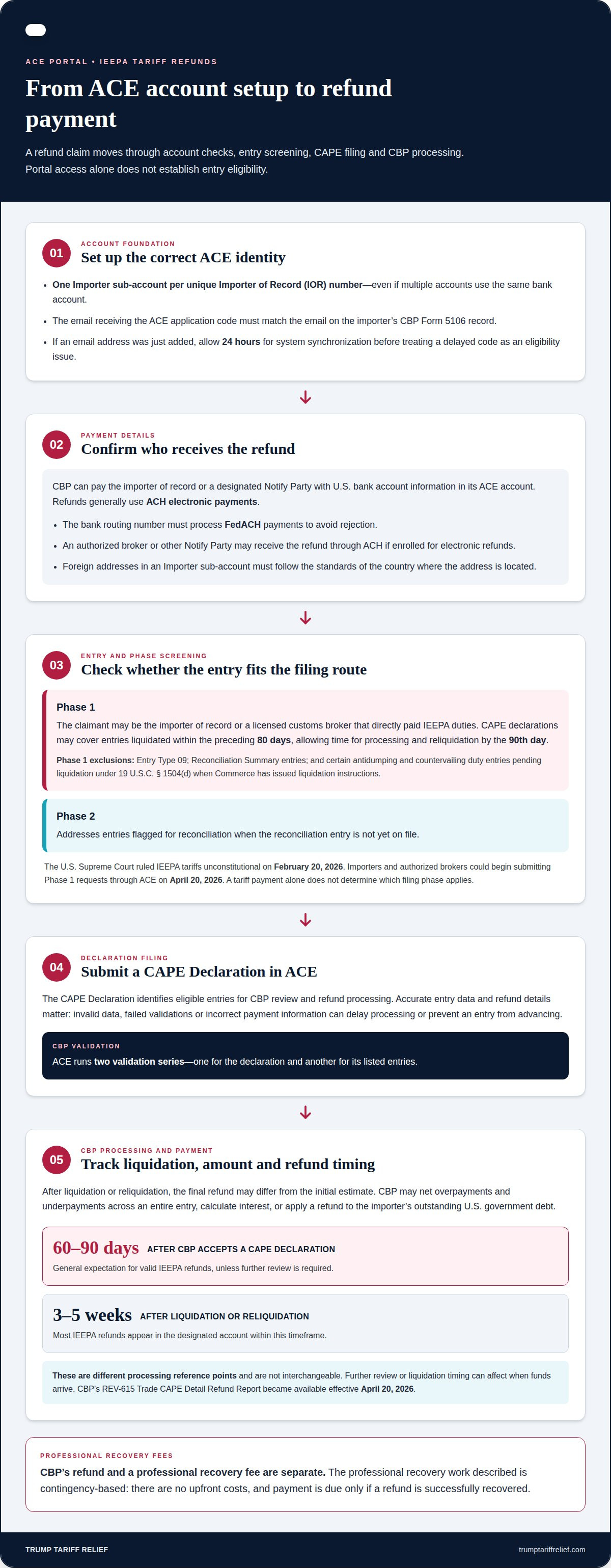
The Automated Commercial Environment, or ACE, is the U.S. Customs and Border Protection portal for customs activity and electronic payments. For businesses asking what the ACE Portal is for tariff refunds, it provides the system used to submit declarations and manage refund arrangements. CBP can pay the importer of record or a designated Notify Party with U.S. bank account information in its ACE Portal account. Each unique Importer of Record number needs its own Importer sub-account, even when several accounts use the same bank account.
Account identity matters at verification. The email receiving an ACE Portal application code must match the email on the importer’s CBP Form 5106 record. If an address was just added, allow 24 hours for system synchronization before treating a delayed code as an eligibility problem. A professional can compare the account and importer records, identify mismatches, and support corrections before a claim is filed. Automated account creation can add a Top Account and Trade Account Owner, then associate an existing 5106 Importer Account. Knowing what the ACE Portal does for tariff refunds helps distinguish account access from entry eligibility.
Refund payments use ACH. The ACE electronic refund enrollment process lets an importer add or update bank information, and the routing number must process FedACH payments to avoid rejection. Foreign addresses in an Importer sub-account must follow the standards of the country where the address is located. An authorized broker or other Notify Party may receive an importer’s refund through ACH if that party is enrolled for electronic refunds. A professional can organize recipient and payment details for the claim; provide the relevant importer number, account contact email, authorized recipient, and bank details through an appropriate secure channel.
Entry status also affects eligibility. CAPE declarations may cover entries liquidated within the preceding 80 days, allowing time for processing and reliquidation by the 90th day. A specialist can assess entry records against this window and manage account application or access issues that could hold up filing. If an application fails, the professional can isolate whether the problem concerns the 5106 email, importer sub-account, recipient authorization, or ACH details, then address that specific record instead of resubmitting blindly.
Are there any fees or charges to receive a tariff refund?
CBP’s refund and a professional’s recovery fee are separate. Professional recovery work here is contingency-based: there are no upfront costs, and payment is due only if a refund is successfully recovered. CBP’s electronic refund process uses Automated Clearing House payments, subject to limited exceptions, under an interim final rule published January 2, 2026.
For accepted CAPE Declarations, valid IEEPA refunds are generally expected within 60 to 90 days, unless CBP requires further review. Most IEEPA refunds appear in the designated account 3 to 5 weeks after liquidation or reliquidation. Those timelines begin at different processing stages, so they aren’t interchangeable.
A professional checks the claim’s status in ACE by reviewing declaration and entry processing results, then matching updates to the filed entries. ACE runs two validation series, one for the declaration and another for its listed entries. CBP’s REV-615 Trade CAPE Detail Refund Report became available effective 4/20/26, providing a further way to review refund details.
How long do ACE tariff refunds take, and how are they paid? CBP generally processes valid claims within 60 to 90 days after CAPE acceptance, with payment sent electronically by ACH in most cases. Further review or liquidation timing can affect when funds arrive.
Common filing risks include invalid entry data, failed validations, and incorrect refund details; these can delay processing or prevent an entry from advancing. A professional reviews the filing and tracks its status. For this recovery work, fees are contingent on a successful refund, rather than charged upfront. A professional refund assessment can help identify processing issues and clarify whether a claim fits this arrangement.
IEEPA tariff refunds
IEEPA refunds address duties collected under tariffs imposed through the International Emergency Economic Powers Act. On February 20, 2026, the U.S. Supreme Court ruled those tariffs unconstitutional and required refunds. The decision affects economic recovery for importers, but an entry’s filer and status still determine its route.
In Phase 1, an entry may qualify if the claimant was the importer of record or a licensed customs broker that directly paid IEEPA duties. Importers and authorized brokers could begin submitting Phase 1 requests through the ACE Portal on April 20, 2026. The system uses a CAPE Declaration to identify eligible entries for review and refund processing.
Phase 1 has exclusions. It does not accept Entry Type 09, or Reconciliation Summary entries. It also excludes certain antidumping and countervailing duty entries pending liquidation under 19 U.S.C. § 1504(d), when the Department of Commerce has issued liquidation instructions. Phase 2 addresses entries flagged for reconciliation when the reconciliation entry is not yet on file. These distinctions matter: a tariff payment alone does not establish that an entry fits the current filing phase.
After CBP liquidates or reliquidates an entry, the final amount may differ from the initial estimate. Under 19 C.F.R. § 159.1, CBP may net overpayments and underpayments across an entire entry. CBP generally calculates interest from the duty deposit or estimated payment through liquidation or reliquidation. It may also apply a refund to the importer’s outstanding U.S. government debt under 19 C.F.R. § 24.72.
U.S. Customs and Border Protection requires an importer or broker to file a protest within 180 days after liquidation or reliquidation to contest the liquidated or reliquidated IEEPA refund amount. That deadline makes post-liquidation review consequential. Understanding IEEPA refund eligibility helps clarify how claimant status, entry phase, and the final calculation fit together.
What information and documents are needed to request a refund in ACE?
A well-organized claim file connects each tariff payment to the correct importer and entry. Identify the Importer of Record, the ACE filer, the affected entries, and the duties paid. Entry summaries and duty statements help establish which shipments and amounts are relevant to the review. Commercial invoices can help connect an entry to the imported goods. Eligibility depends on the import history, documentation, and applicable filing deadlines.
- Entry identifiers: Provide each relevant entry number and its liquidation status. A CAPE Declaration entry number must contain 11 characters, without dashes.
- Importer and filer details: Supply the Importer of Record number and the ACE filer information. For Filer and Organizational Broker accounts, the first three characters of an entry number must match the account’s Filer Code.
- Duty and entry records: Share entry summaries, duty payment records, and available liquidation information. These help the professional reconcile the claimed IEEPA amount with the entry.
- Refund recipient details: Provide the authorized refund recipient and relevant ACH information. The professional can match these details to the importer or designated Notify Party.
For a CAPE filing, the professional organizes eligible entry numbers in a CSV declaration file. The file cannot exceed 1mb, so entry data must be complete and carefully formatted before submission. Importers and customs brokers filing a declaration must be directly associated with the entries through the 3-digit prefix of their ACE filer code. If that relationship does not align, the filing may fail validation. A clear record set lets the specialist identify mismatches before they disrupt processing.
Keep the supporting materials grouped by entry rather than sending an undifferentiated collection of shipment files. For example, pairing an entry summary with its duty payment record helps trace the amount to the right import. Include the correspondence or authorization that identifies a broker or other refund recipient, where relevant. A specialist can then organize the records, reconcile entry details, and prepare the documentation for the refund claim.
To have a professional organize your refund records and filing, request an IEEPA refund review.
Trump Tariff Relief: IEEPA Tariff Refund Recovery
Trump Tariff Relief helps businesses pursue IEEPA tariff refunds through eligibility assessment, customs documentation management, and refund recovery. If your records include entries that may qualify, professional support can help connect importer details, entry documentation, and filing requirements into a coordinated claim.
The service is contingency-based, with no upfront cost: Trump Tariff Relief is paid only as a percentage of funds successfully recovered. This no-win, no-fee arrangement can suit businesses seeking help with the review and filing process without taking on the administrative burden themselves. If you did not pay potentially eligible IEEPA duties, the service may not be relevant.
If you want a professional assessment of your potential claim and support managing the recovery process, contact Trump Tariff Relief.
Move from uncertainty to a clear next step
Understanding what the ACE portal is for tariff refunds is only the starting point. The next decision is how to move from scattered import records to a well-supported claim, with clear responsibility for eligibility review, documentation, and filing coordination. A deliberate assessment can help you decide whether pursuing recovery fits your business priorities and what information should guide that decision. It also gives you a structured way to discuss your situation with a specialist, rather than treating portal access as the whole refund process.
There’s no need to resolve every filing detail alone. If you’re ready to discuss your circumstances and possible next steps, contact Trump Tariff Relief. A focused conversation can help turn the question of potential recovery into a practical path forward for your business.
Frequently Asked Questions
How long will it take for me to get my refund?
A valid IEEPA refund is generally expected within 60 to 90 days after CBP accepts a CAPE Declaration, unless further review is required. Many refunds appear in the designated ACH account 3 to 5 weeks after liquidation or reliquidation. These periods start at different processing milestones, so the acceptance date alone doesn’t show exactly when funds will arrive.
What is the ACE portal and what does ACE stand for?
ACE stands for Automated Commercial Environment, the U.S. Customs and Border Protection portal for trade and customs processes. For tariff refunds, it can be used to submit declarations and receive processing results. A business’s ACE account information helps connect its importer identity and refund arrangements with the entries included in a declaration. Eligibility remains case-specific and depends on import history, documentation, and deadlines.
How does a professional use the ACE portal to request tariff or customs duty refunds?
A professional reviews import records to identify entries relevant to a refund request, then prepares and submits the appropriate declaration through ACE. For a CAPE claim, the filing includes entry numbers in a CSV declaration. The specialist also monitors ACE validation results and follows the entries’ processing status, so a rejected record can be distinguished from one still moving through CBP review.
Who is eligible to claim a tariff refund through ACE?
For Phase 1 IEEPA refunds, the claimant must have been the importer of record or a licensed customs broker that directly paid the IEEPA duties. Eligibility also depends on whether the entry fits the phase’s rules and can be included in the declaration. For example, Entry Type 09 Reconciliation Summary entries aren’t accepted in Phase 1.
What steps does a professional take to file a refund claim in the ACE portal?
A professional first assesses claimant status and entry records, then identifies entries that fit the relevant filing phase. Next, the specialist prepares the CAPE Declaration file, submits it through ACE, and reviews declaration-level and entry-level validation results. The professional then tracks processing and refund status. Keeping each entry’s documentation linked to its identifier helps pinpoint filing errors efficiently.
What deadlines apply to tariff refund claims through ACE?
For CAPE declarations, entries liquidated within the preceding 80 days may be submitted in time for processing and reliquidation by the 90th day. Separately, U.S. Customs and Border Protection says an importer or broker must file a protest within 180 days after liquidation or reliquidation to contest the IEEPA refund amount. The relevant deadline depends on the entry’s status and the action being taken.
Ready to find out what your business may be owed?
Check My Eligibility