
A tariff refund may recover duties, but payment depends on more than filing a claim. Trump Tariff Relief provides professional IEEPA refund support on a contingency basis: there’s no upfront cost, and the firm is paid only as a percentage of funds successfully recovered. When navigating the CBP refund process, keep the government’s refund procedures separate from a professional’s fee arrangement.
It’s reasonable to want clarity before pursuing money tied up in duties. This guide explains who may receive an IEEPA refund, what electronic payment setup requires, how to track a claim, and what affects timing. According to U.S. Customs and Border Protection, valid IEEPA refunds generally will be issued within 60 to 90 days after a CAPE Declaration is accepted, unless a compliance concern leads to further review.
Recipient designations and bank details also affect payment, and an accepted submission does not end CBP’s review. Understanding these steps can help you see what pursuing a refund involves and where professional support can ease the paperwork.
Key Takeaways
- Learn how ACE reports help a professional follow refund submissions and identify when a filing deadline may matter.
- Understand who may receive the funds and why the recipient designation and U.S. bank details are important.
- See which account and ACH enrollment requirements can affect electronic refund delivery.
- Know the expected processing window and the events that determine when a refund may arrive.
How a professional tracks refund status through ACE reports
A professional follows each filing through the Automated Commercial Environment (ACE) portal, matching submission records to entry-level refund details. Since April 20, 2026, ACE account holders can access the REV-615 Trade CAPE Detail Refund Report for consolidated CAPE refund and entry-level information. The professional uses that detail to reconcile reported entries with the claim and flag records that need follow-up.
The REV-603 report can also support status tracking. A professional reviews its refund-related information alongside the ACE filing record, then investigates discrepancies instead of treating a report update as proof of payment. For example, a mismatch between an entry number and the claim record calls for review before the refund is reconciled in company accounts.
What are the deadlines for requesting a CBP refund or protest? U.S. Customs and Border Protection requires a protest contesting a liquidated or reliquidated IEEPA refund amount within 180 days after liquidation or reliquidation. The deadline for a refund request depends on the applicable claim pathway.
Can CBP refunds cover tariffs paid on returned, defective, or misclassified goods? Those circumstances may call for a separate duty-recovery analysis, but they do not automatically establish eligibility for an IEEPA refund. Eligibility depends on the specific import history and documentation. Trump Tariff Relief reviews entry records to assess whether an IEEPA claim may be appropriate.
What kinds of CBP duties, taxes, or fees can be refunded? CBP processes refunds for overpaid customs duties, taxes, fees, and miscellaneous or invalid payments. For an IEEPA claim, the review focuses on IEEPA duties associated with the relevant entries.
How is a CBP refund claim filed, and which form or online portal is used? For CAPE claims, a CAPE Declaration is submitted through the ACE Portal with a CSV file listing the entry numbers. This connects the request to specific customs entries. Trump Tariff Relief assists with IEEPA refund filings and the supporting documentation.
How does a professional request a refund after liquidation or reliquidation? The professional reviews the entry’s liquidation status and, when contesting the IEEPA refund amount, files a protest within the 180-day period. If CBP denies or delays a claim, the professional reviews the ACE status and filing records, identifies the issue, and determines the appropriate next procedural step.
Financial reporting matters as well. Reconcile the refund and entry adjustments against the company’s customs and accounting records. Your business can then assess the reporting treatment based on how it originally recorded the duties and the refund received.
Refund recipients and bank account requirements
For an IEEPA tariff refund, payment eligibility depends on the recipient recorded with U.S. Customs and Border Protection (CBP). CBP can refund duties only to the Importer of Record or the Notify Party designated on CBP Form 4811, provided that party has U.S. bank account information in its ACE Portal account. A professional compares the entry’s importer details with the refund designation before submission. If the company expects a third party to receive payment, the designation must support that arrangement.
CBP requires ACH enrollment for refunds of overpaid customs duties, taxes, fees, and miscellaneous or invalid payments. CAPE refunds are also paid electronically, so a U.S. bank account and U.S. bank routing number are required. The account must be part of the designated recipient’s payment setup. If the ACE record has no ACH account, the refund can be held. The Office of the Federal Register, National Archives and Records Administration, reports that CBP is holding refunds when filers lack an ACH account on file in ACE.
A CBP Form 4811 designation filed before February 6, 2025, remains valid to authorize ACH refunds to the designated third party. For a newer claim, the professional checks that the designation identifies the intended recipient and aligns with the importer’s entry record. This matters when the importer paid the tariff but another authorized party is meant to receive the funds.
Account structure can affect enrollment. ACE Portal owners with more than one suffix code for a federal TIN must submit separate ACH bank account enrollments for each federal TIN and suffix code. A Treasury check is not the standard alternative: importers seeking one must qualify under a waiver circumstance in 31 CFR 208.4. Clear recipient records and matching bank details help prevent payment-routing problems. A structured refund recovery workflow can help align customs documentation with the designated payee and payment record.
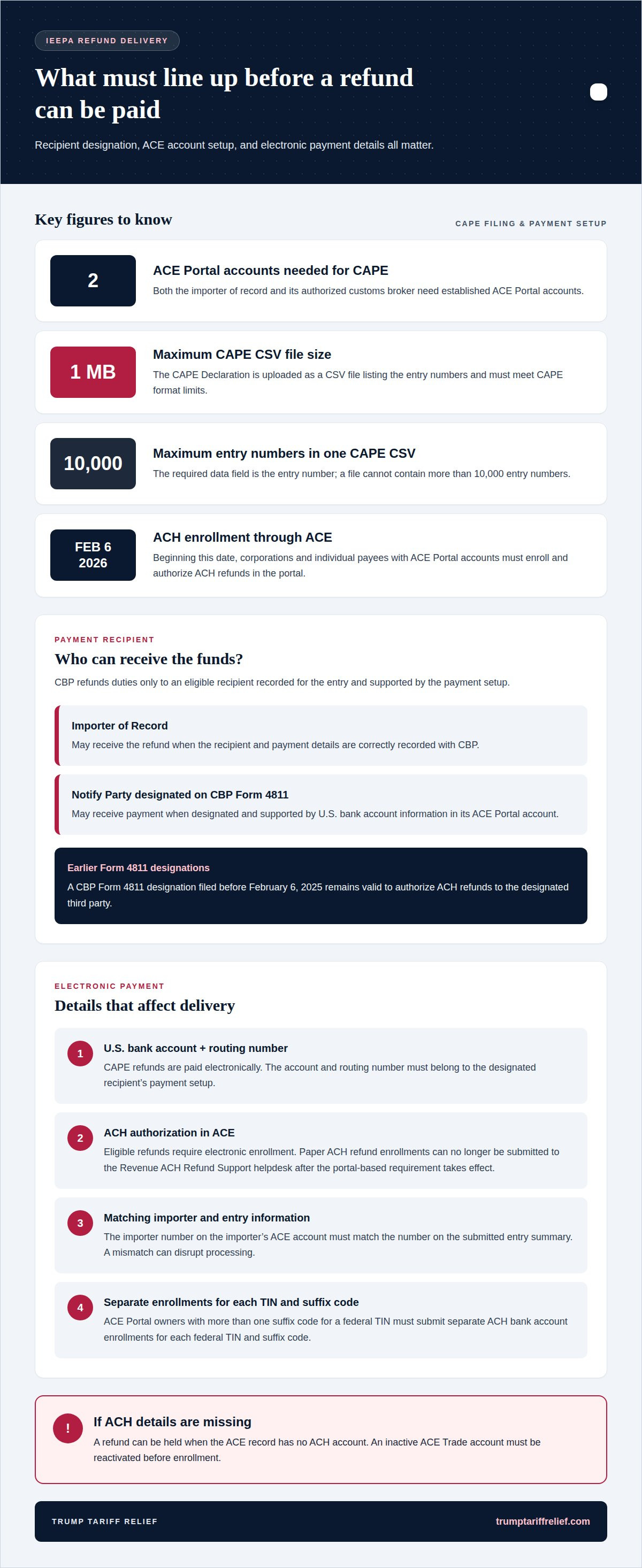
Electronic refund prerequisites
For CAPE, both the importer of record and its authorized customs broker need established ACE Portal accounts. The importer number on the importer’s account must match the number on the submitted entry summary. A mismatch can disrupt processing, so align account details with entry records before filing. Trump Tariff Relief also offers partnership support for customs brokers.
CBP requires electronic enrollment for eligible refunds. Beginning February 6, 2026, corporations and individual payees with ACE Portal accounts must enroll and authorize ACH refunds through the portal’s ACH Refund Authorization tab. ACE account owners can no longer submit paper ACH refund enrollments to the Revenue ACH Refund Support helpdesk. An inactive ACE Trade account must be reactivated before enrollment.
What documents are required for a CBP refund request? For an IEEPA CAPE filing, U.S. Customs and Border Protection requires the importer or broker to upload a CAPE Declaration as a CSV file listing the entry numbers. The entry number is the required data field, and the file must meet CAPE format limits.
A CAPE CSV file cannot exceed 1mb or contain more than 10,000 entry numbers. For Filer and Organizational Broker accounts, each entry number must begin with the account’s three-character Filer Code. A professional checks these formatting details and matches listed entries to the relevant importer records. A correctly prepared file supports validation, but each entry is still reviewed for refund processing.
ACE Portal account owners complete ACH authorization through the Trade Account Owner or an authorized designee. Importers should keep CBP Form 5106 current, including a valid, monitored email contact, so account details and payment communications remain aligned. Where an ACE Trade account has become inactive, reactivation comes before electronic enrollment.
Some eligible payees use a different enrollment route. Non-ACE Portal harmed domestic producers, and individuals receiving refunds for fines or penalties, can enroll through Pay.gov. They should follow the available instructions to complete enrollment. These prerequisites support electronic payment after CBP processes the refund.
Expected refund timing
For businesses navigating the CBP refund process, the key timing question is which milestone starts the clock. U.S. Customs and Border Protection indicates that valid IEEPA refunds generally will be issued within 60 to 90 days after a CAPE Declaration is accepted, unless a compliance concern leads to further review. That period begins at acceptance, not when an importer starts preparing a claim.
A separate estimate measures the time after liquidation or reliquidation: most IEEPA refunds are expected in the designated ACH account 3 to 5 weeks from that date. The two windows have different starting points. A declaration might be accepted before its entries are liquidated or reliquidated, so the payment estimate cannot automatically be counted from the filing date.
CAPE requests became available through the ACE Portal on April 20, 2026, and the first round of IEEPA tariff refunds was scheduled to be transmitted on May 11. Those dates describe the process rollout, not an individual importer’s payment date. The status of each entry and its review determine how the claim proceeds.
Declaration acceptance and entry-level processing are separate milestones. CBP reviews entries individually, so initial file validation does not mean every entry will be accepted for refund processing. Track validation, entry review, liquidation or reliquidation, and payment to identify the outstanding step for each claim. Trump Tariff Relief manages IEEPA refund documentation and filings through the recovery process.
When navigating the CBP refund process, importers should distinguish a pending review from a payment delay. A compliance concern can lead to further review, while missing ACH details can hold payment. Tracking the specific milestone helps clarify what is pending and what follow-up may be appropriate. Get help reviewing a pending refund claim and its supporting records.
Trump Tariff Relief: IEEPA Tariff Refund Recovery
Trump Tariff Relief helps businesses pursue IEEPA tariff refunds through eligibility assessment, customs documentation management, and refund recovery. This support is useful when your company needs help connecting duty payments to specific entries, preparing records, and moving a claim through the filing process.
The process starts with an eligibility review and organizing customs documentation for the claim. If the entries and payment records support a recovery request, Trump Tariff Relief manages the process through the required government filings. This gives importers a clear path when entry details, recipient information, or claim status are difficult to manage internally.
If you’re ready to discuss your IEEPA tariff refund, contact Trump Tariff Relief.
Turn Your Refund Review Into a Clear Next Step
Turn your refund records into a well-supported recovery plan. Navigating the CBP refund process means treating eligibility, documentation, and payment tracking as connected parts of the same effort. Trump Tariff Relief can assess your potential eligibility and manage the paperwork, helping your business make an informed decision about pursuing a claim.
Trump Tariff Relief offers IEEPA Tariff Refund Recovery, Tariff Eligibility Assessment, and Customs Documentation Management. These services cover assessing potential claims and organizing the records behind them. If you’re weighing whether to pursue recovery or need professional support, submit your information to begin a no-cost eligibility check. There’s no upfront cost, and payment is only a percentage of funds recovered.
Contact Trump Tariff Relief to discuss your tariff refund claim and move forward with clarity.
Frequently Asked Questions
Are there any fees or charges to receive a tariff refund?
CBP’s refund payment and a professional’s fee are separate matters. Trump Tariff Relief uses a contingency-based model: there’s no upfront cost, and the firm is paid only as a percentage of funds successfully recovered. For example, if a claim doesn’t result in recovered funds, the firm doesn’t receive a recovery fee. Review the engagement terms to understand how the percentage applies to your claim.
How can a professional help you prepare for a CBP refund claim?
Trump Tariff Relief can assess eligibility, organize supporting records, and prepare the appropriate filing. Useful documents include entry summaries, commercial invoices, transportation documents, and duty statements. An invoice and duty record, for example, can help connect a payment to the relevant entry. The team can identify gaps or inconsistencies before filing, then track the claim through the refund process.
How long will it take for me to get my refund?
U.S. Customs and Border Protection indicates valid IEEPA refunds generally will be issued within 60 to 90 days after accepting a CAPE Declaration, unless a compliance concern leads to further review. A separate estimate places most refunds in the designated ACH account 3 to 5 weeks after liquidation or reliquidation. These periods start at different milestones, so the claim’s entry status affects the relevant timeline.
Who should I contact for questions about CAPE or IEEPA refunds?
For help preparing an IEEPA refund claim, Trump Tariff Relief provides eligibility review and supporting-documentation assistance. For ACE Portal enrollment or banking-information update errors, ACE Portal users can email the ACE Portal accounts helpdesk at ACE.SUPPORT@cbp.dhs.gov. Keep the question specific, such as whether an account enrollment error is preventing an electronic refund from being processed.
Who is eligible to request a refund from U.S. Customs and Border Protection?
Eligibility depends on the duty, entry, and claim basis, so IEEPA refunds aren’t automatic for every importer or shipment. A professional assesses whether the importer’s records support a claim and whether the relevant entries fit the applicable filing path. The payment recipient is generally the Importer of Record or a Notify Party designated on CBP Form 4811, subject to CBP’s refund requirements.
How can a professional track the status of a CBP refund for importers?
Match ACE filing records with refund reports and review the status of individual entries, rather than relying only on the overall declaration status. For example, if a declaration appears accepted but one entry is still awaiting liquidation, that entry’s payment milestone may differ. Trump Tariff Relief tracks IEEPA refund filings and can reconcile report details against the claim record to identify discrepancies or outstanding processing steps.
Ready to find out what your business may be owed?
Check My Eligibility