A federal refund process for certain IEEPA tariffs is active: U.S. Customs and Border Protection activated Phase 1 on April 20, 2026. If you’re figuring out how to get a tariff refund, the first distinction is whether the duty was imposed under IEEPA and whether the entry falls within Phase 1, which covers certain unliquidated entries and certain entries within 80 days of liquidation. That means the process is open, but not every IEEPA entry is covered in its first phase.
If your business paid these duties, you need a clear answer about eligibility, the claim route, and when a refund might arrive. Eligibility generally depends on who was the importer of record or directly paid the tariffs, as well as the entry status and supporting documentation. CBP makes the final determination.
This guide explains how the refund process works, what businesses need to know before submitting a claim, and how federal payments are issued. You’ll also learn what recovered duties and interest mean for U.S. businesses and when professional support can help with eligibility and customs documentation.
Key Takeaways
- Review entry status and CAPE coverage before assuming a shipment qualifies; Phase 1 does not include every IEEPA entry.
- Eligibility depends on who paid the tariffs and whether records such as CBP Form 7501 support the claim.
- According to U.S. Customs and Border Protection, refunds are issued within 60-90 days after a CAPE Declaration is validated, unless the submission needs additional review.
- According to U.S. Customs and Border Protection, importers typically need to file a formal protest within 180 days after liquidation, so timely review of entry records matters.
Is there an approved government refund process for IEEPA?
Yes. U.S. Customs and Border Protection (CBP) activated Phase 1 of its IEEPA refund process on April 20, 2026.
The process covers IEEPA duties, not Section 232, Section 301, anti-dumping, or most-favored-nation tariffs. The Supreme Court ruled 6-3 on February 20, 2026, that the International Emergency Economic Powers Act did not authorize presidential tariffs.
CBP’s Phased Refund Process
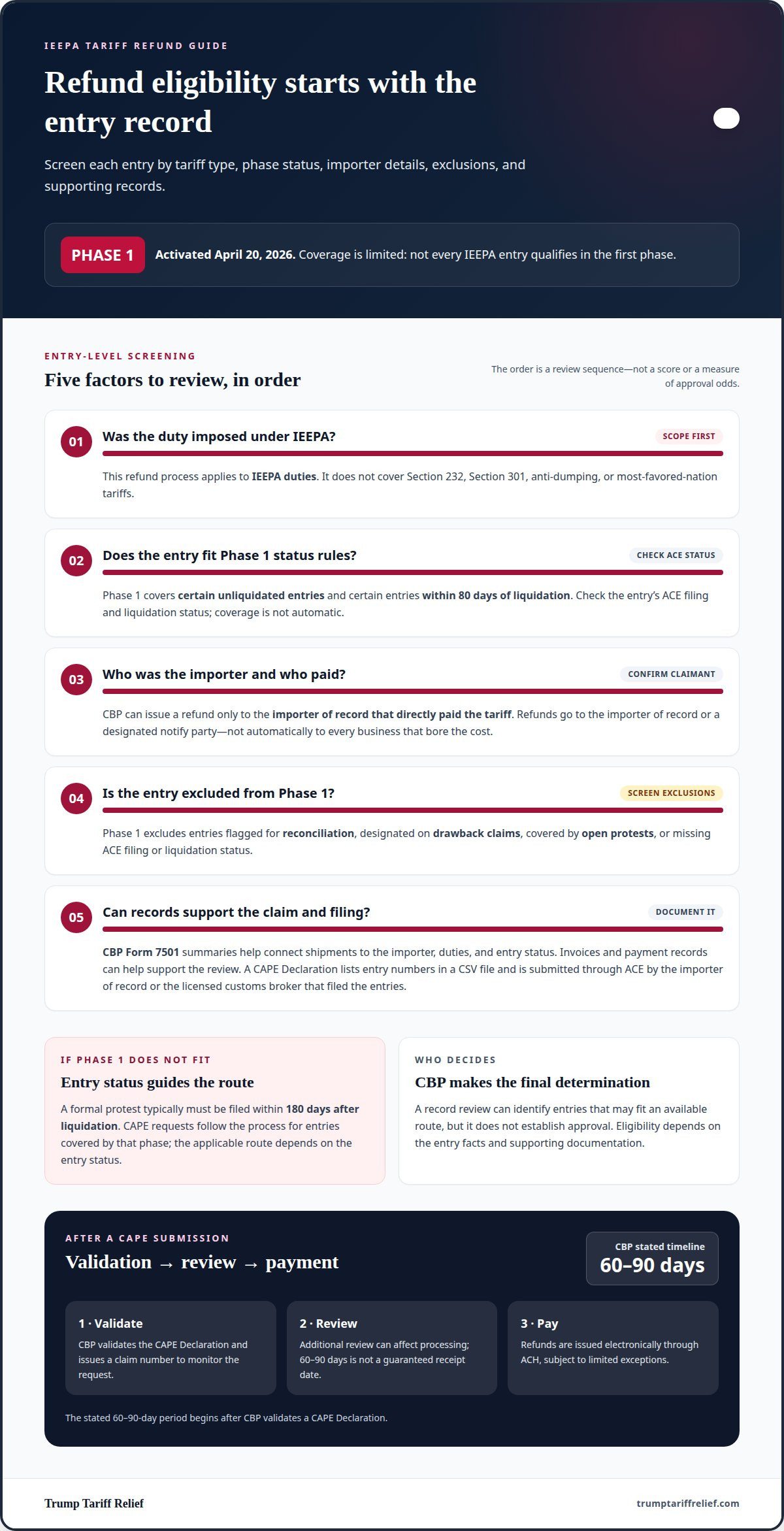
CBP’s phased process organizes refund requests by entry status and other eligibility criteria. Phase 1 covers certain unliquidated entries and certain entries within 80 days of liquidation, so an importer of record needs to distinguish covered entries from those outside the first phase.
CBP created the Automated Commercial Environment (ACE) Portal’s CAPE system for these requests. A CAPE Declaration lists entry numbers in a CSV file, and an eligible importer of record or original broker submits it through ACE. Entries flagged for reconciliation, drawback claims, open protests, or missing ACE filing or liquidation status are excluded from Phase 1.
Refund Processing Timelines
Refund timing depends on the claim’s stage: submission, validation, review, and payment. Once CBP validates a CAPE Declaration, it issues a claim number to monitor the request. Additional review can affect processing.
CBP began issuing refunds electronically through Automated Clearing House (ACH) on February 6, 2026, subject to limited exceptions. Refunds go to the importer of record or a designated notify party, rather than being distributed automatically to every business that bore a tariff’s cost.
Request and Protest Deadlines
Deadlines depend on the refund route and the entry’s status. For a formal protest, U.S. Customs and Border Protection says importers typically need to file within 180 days after liquidation to obtain a tariff refund.
What are the deadlines for requesting a tariff refund or filing a protest? The 180-day protest period runs from liquidation; CAPE requests follow the process for entries covered by its phase. Because the government’s administrative and litigation routes remain distinct, the relevant entry status affects which action applies. Customs records help establish that timeline.
How do I know if I'm eligible for a refund?
Eligibility starts with the entry record and who paid the IEEPA tariffs. CBP can issue a refund only to the importer of record that directly paid the tariff. The agency makes the final eligibility determination.
CBP Form 7501 entry summaries help connect each shipment to its importer, duties, and customs entry status. A professional can organize these summaries with invoices and payment records, then identify which entries may fit the available refund route. The Supreme Court’s IEEPA ruling concerns tariffs imposed under that law, not every customs duty.
Do tariff refunds apply to tariffs struck down by a court or changed by a new law? The process described here applies to IEEPA tariffs affected by the Supreme Court ruling. A change to another tariff or law does not, by itself, establish eligibility for an IEEPA refund.
For CAPE Phase 1, CBP excludes entries flagged for reconciliation, designated on drawback claims, covered by open protests, or lacking an ACE filing or liquidation status in ACE. Certain unliquidated entries and certain entries within 80 days of liquidation may be covered. A professional assessment sorts pending and liquidated entries by status before preparing a filing.
Can a customs broker or attorney file a tariff refund claim for me? Only the importer of record or the licensed customs broker that filed the entries may submit a CAPE Declaration. An attorney may provide legal assistance, but that alone does not authorize them to file a CAPE Declaration.
Can importers pass tariff refund savings on to customers? Importers aren’t legally required to refund customers for tariff costs. A business may keep the recovered funds or choose to pass some savings along.
What should I do if CBP denies my tariff refund claim? Review the denial and relevant entry records promptly. A formal protest denial may carry a 180-day deadline for filing suit, so the reason for denial and applicable route matter.
Careful IEEPA tariff eligibility review helps distinguish potentially eligible entries from excluded ones before filing.
How can a professional help me get a tariff refund?
A refund professional turns customs records into a documented CAPE request, then monitors its government status. For businesses deciding how to get a tariff refund, the work begins by matching entry numbers to IEEPA duties, importer-of-record details, and supporting records. This helps identify gaps before an incomplete filing slows the administration’s review.
A professional organizes eligible entry numbers into a CSV CAPE Declaration and submits it through the CAPE tab in the ACE Portal. Only the importer of record or the licensed customs broker that filed the entries may submit the declaration. The professional coordinates with the authorized filer and tracks the claim number after CBP validates the submission.
U.S. Customs and Border Protection states that it will issue IEEPA tariff refunds within 60-90 days after validating a CAPE Declaration, unless the submission needs additional review. That is a processing timeline, not a guaranteed receipt date. Monitoring the claim helps identify when CBP requests further review.
ACE enrollment and payment details also matter. The importer provides business bank information for electronic refund enrollment and confirms that ACE identifies the importer of record or a CBP Form 4811 notify party with U.S. bank information. A professional can coordinate the documentation and enrollment steps. Refunds are generally paid by ACH, not through a carrier’s payment system.
A FedEx refund-tracking portal does not show the status of a government CAPE claim. Use the CBP CAPE claim number to monitor the request; a carrier reference does not replace it. Knowing how to get a tariff refund through the correct agency keeps follow-up focused on the filing and its status.
For coordinated filing and records management, consider professional IEEPA refund support.
Federal tariff refund payments to U.S. businesses
Federal payments turn an approved IEEPA claim into funds for the eligible importer, not an automatic payment to every business affected by tariffs. CBP activated its first refund phase on April 20, 2026, through the CAPE process. The covered duties were imposed under the International Emergency Economic Powers Act, not every customs tariff. That distinction matters: a business needs a qualifying IEEPA entry and the proper claim route before payment can follow.
U.S. Customs and Border Protection states that importers typically need to file a formal protest within 180 days after liquidation to obtain a tariff refund. CAPE is a separate administrative route for entries covered by its phases. The payment’s recipient is generally the importer of record or a designated notify party, so the company that absorbed higher costs may not receive funds directly.
CBP began issuing refunds electronically through Automated Clearing House (ACH) on February 6, 2026, subject to limited exceptions. The importer’s ACE Portal records must support payment to the importer of record or a notify party designated on CBP Form 4811 with U.S. bank information. Accurate recipient and bank details help connect the refund to the correct business rather than leaving payment details mismatched.
A refund can include IEEPA duties paid and accrued interest. CBP generally calculates interest from the duty deposit or estimated payment through liquidation or reliquidation. The final amount reflects the entry’s payment and processing history, not simply a tariff rate multiplied across all shipments. Reconcile the federal payment against entry-level records and claim information.
For U.S. businesses, a refund is a federal recovery of duties previously paid, with the recipient and entry records central to payment. The government does not charge a fee to process tariff refunds. To assess entries and organize refund documentation, request tariff refund recovery support.
Trump Tariff Relief: IEEPA Tariff Refund Recovery
Trump Tariff Relief helps businesses pursue IEEPA tariff refunds with eligibility assessments, customs documentation management, and refund recovery. This support can help when entry records span multiple shipments, CAPE eligibility is unclear, or preparing a filing requires coordinated documentation.
The process begins by reviewing import records and identifying entries that may qualify. The team then manages supporting customs documentation and government filings, keeping the claim organized from assessment through submission. This assistance focuses on recovering IEEPA duties, not ongoing customs brokerage or general corporate legal services.
The service is contingency-based: there are no upfront costs, and payment is only a percentage of funds successfully recovered. If you want help assessing your entries and pursuing a refund, contact Trump Tariff Relief.
Turn the refund opportunity into a business decision
Understanding how to get a tariff refund is only part of the work. Recovery also raises decisions for finance and operations: how to record incoming funds, reconcile them with import costs, and decide whether recovered value should affect customer pricing. Assigning responsibility early can help ensure the refund is not left as an unexplained line in the accounts.
Keep the recovery process connected to your business records and internal reporting. Clear ownership helps your team understand what a payment represents and how it fits into cash-flow planning. It also gives decision-makers a stronger basis for deciding what comes next, rather than treating the refund as an isolated customs transaction.
If you want a professional partner to assess your situation and manage the recovery work, contact Trump Tariff Relief. A focused next step can help your business move from uncertainty toward a clear recovery plan.
Frequently Asked Questions
Do you have experts who can walk me through the process?
Yes. Trump Tariff Relief’s tariff and trade specialists guide businesses through the refund claim process, from eligibility review to documentation and government filings. Provide basic company information and import history so the team can assess your situation. The initial response to an eligibility check is within one business day; a full assessment takes longer or shorter depending on case complexity.
How can a professional help me prepare for a potential refund of IEEPA duties?
A professional can organize the information needed to assess your import history before claim preparation begins. Trump Tariff Relief asks for basic company data, estimated tariff fees paid, import regions, and information about available documentation. Identifying which records are already accessible helps the team determine what further documentation may be needed for the eligibility review.
How can a professional calculate my company's refund amount?
A professional can estimate duties at the entry level by reconciling duty statements with entry summaries and identifying IEEPA duties tied to potentially eligible entries. The calculation must distinguish these duties from other charges and account for the documentation and entry status supporting each item. Any estimate is separate from CBP’s final review and the amount ultimately approved for payment.
What documentation should I provide to support a refund claim?
Provide available entry summaries, commercial invoices, transportation documents, and duty statements. These records connect imported goods and shipment transactions with the duties paid. Trump Tariff Relief keeps business information strictly confidential and does not share it without explicit consent. If a document is unavailable, identify that gap during the eligibility review so it can be addressed in the documentation process.
Who is eligible for a tariff refund in the United States?
Eligibility generally depends on whether the business was the importer of record or directly paid the IEEPA tariffs, along with the entry’s status and supporting records. For example, a company that paid a supplier’s tariff-related charge but was not the importer of record may not receive the refund directly from CBP. CBP makes the final determination based on the claim and entry information.
How can a professional request a tariff refund from U.S. Customs and Border Protection?
A professional prepares the claim using the route that fits the entries and the importer’s role. For CAPE, the declaration lists the requested entry numbers in a CSV file and is submitted through the ACE Portal by the importer of record or the licensed broker that filed those entries. The professional coordinates records and filing details with the authorized submitter, then tracks the claim’s progress.
Ready to find out what your business may be owed?
Check My Eligibility