
A refund claim is only as defensible as the records behind it. For importers, maintaining compliance during tariff recovery means tying each claim to accurate entry and payment records, checking eligibility, and preventing duplicate or inconsistent submissions. A rushed filing can create avoidable compliance risks, even when the underlying records are available.
The February 20, 2026, Supreme Court ruling invalidated tariffs imposed under the International Emergency Economic Powers Act (IEEPA), and U.S. Customs and Border Protection is processing related refunds through a phased system. That does not make every tariff payment recoverable: this process applies to IEEPA duties, not tariffs imposed under other authorities. Clear claim boundaries matter as much as complete documentation.
This guide covers how to build an audit-ready record trail from import entry to claim submission, use practical controls to check eligibility and accuracy, and track deadlines as procedures evolve. It also explains how finance, trade, and legal teams can coordinate with recovery support while your business retains oversight of its records and compliance responsibilities.
Key Takeaways
- Build each claim around traceable entry, classification, payment, and supporting records.
- Reconcile source systems and define review steps to catch inconsistent data or duplicate submissions before filing.
- Make maintaining compliance during tariff recovery a shared process with clear owners, retained evidence, and documented decisions.
- Follow a controlled workflow from eligibility assessment through filing, with checkpoints for exceptions and deadlines.
- Specialized support can coordinate eligibility assessment, customs documentation, and government filings while your business retains internal oversight.
Why compliance matters when pursuing tariff recovery
Recovering duties and maintaining accurate customs and financial records go hand in hand. A claim needs a clear evidentiary trail. If entry, payment, and claim data do not align, review becomes harder and errors can weaken the submission. Maintaining compliance during tariff recovery means keeping claim information consistent, supportable, and subject to controlled review while following the procedures and deadlines that apply.
Claim compliance means making accurate, documented statements about eligible payments and taking timely action under the applicable recovery process. A possible refund is not automatic. Eligibility depends on the legal basis for the duty, the relevant entry, and the current claim requirements. Recordkeeping controls help preserve and verify evidence, but they do not replace the legal determination of whether a payment qualifies.
What does compliance during tariff recovery mean?
Every claim statement should trace back to reliable source records. Connect the entry data and payment evidence to the business records used to prepare the claim. If reconciliation changes a figure, retain a record of the correction and its basis so that different systems do not show unexplained totals.
Keep two questions separate: can the business substantiate what it paid, and does that payment qualify under the applicable legal framework? Strong recordkeeping helps answer the first question, but does not settle the second. Use general controls to organize and verify records, then check current, claim-specific requirements and agency instructions.
Why recovery claims need clear boundaries
Start by identifying the tariff measure and payment period under review. The current IEEPA refund process concerns duties imposed under the International Emergency Economic Powers Act (IEEPA). The Supreme Court ruled on February 20, 2026, that IEEPA does not authorize the president to impose tariffs, and U.S. Customs and Border Protection is processing related refunds through its phased CAPE system. Read the IEEPA tariff refund explanation for more context on this recovery.
The scope matters. The IEEPA process does not make every import duty recoverable; tariffs under other authorities, including Section 232 and Section 301, were not affected by the ruling. Drawback claims and general customs adjustments also have distinct bases and procedures. Do not combine unrelated programs or assume a payment qualifies just because it appears in the same import ledger. Identify the relevant entries, preserve their supporting records, and follow the instructions and deadlines that apply to the claim.
Build an audit-ready record trail for each tariff recovery claim
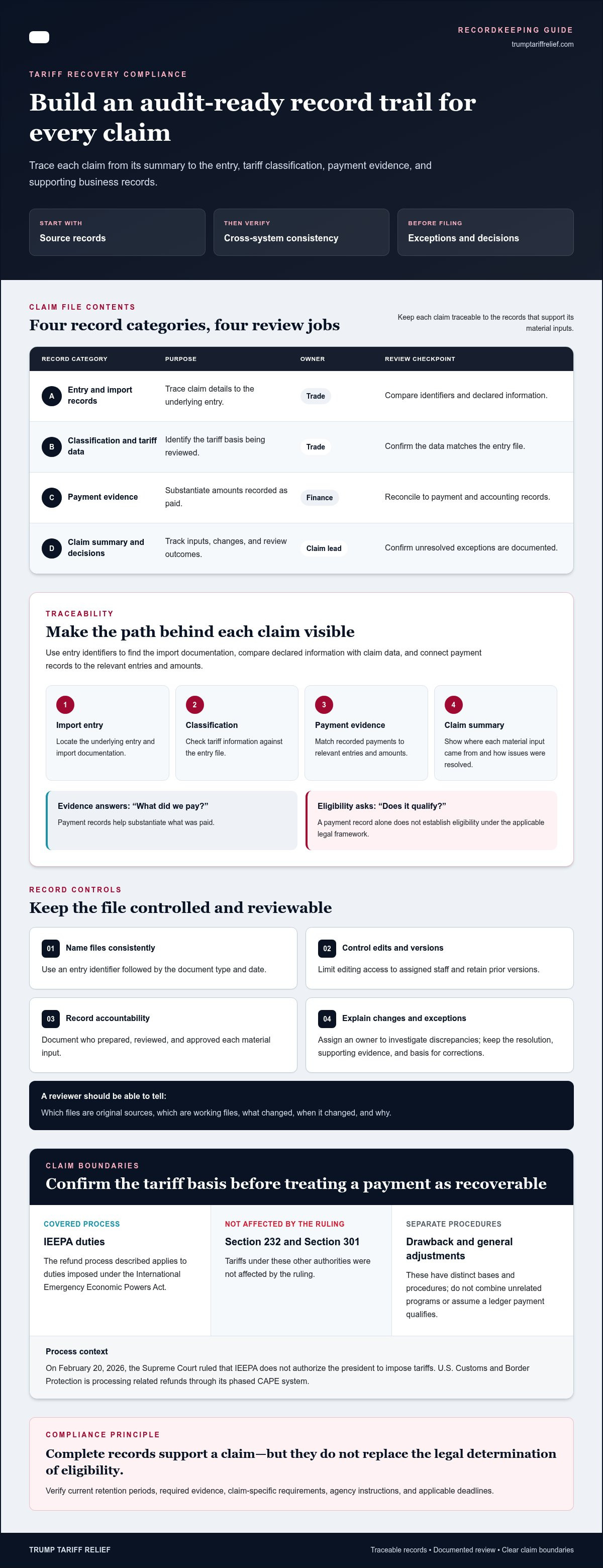
A defensible claim should be traceable from its summary back to the import entry, tariff classification, payment evidence, and supporting business records. Create a claim file or indexed record set for each entry, then reconcile the information across trade and finance systems before submission. The goal is not simply to collect documents. It is to show where each material claim input came from and how discrepancies were resolved.
Connect claim details to source records
Use entry identifiers to locate the underlying import documentation, then compare the declared information with the data used to prepare the claim. Finance can match payment records to the relevant entries and amounts; trade can review entry details and classification information. A payment record helps substantiate what was paid, but does not establish by itself that the payment qualifies for recovery.
Flag missing, inconsistent, or amended records before filing. Assign an owner to investigate each issue, document the resolution and supporting evidence, and preserve the final decision. For a document-by-document overview, consult the site's required-documents article alongside current claim instructions.
| Record category | Purpose | Owner | Review checkpoint |
|---|---|---|---|
| Entry and import records | Trace claim details to the underlying entry | Trade | Compare identifiers and declared information |
| Classification and tariff data | Identify the tariff basis being reviewed | Trade | Confirm the data matches the entry file |
| Payment evidence | Substantiate amounts recorded as paid | Finance | Reconcile to payment and accounting records |
| Claim summary and decisions | Track inputs, changes, and review outcomes | Claim lead | Confirm unresolved exceptions are documented |
Keep records controlled and reviewable
Use a consistent file structure and naming convention, such as an entry identifier followed by the document type and date. Limit editing access to assigned staff, retain prior versions, and record who prepared, reviewed, and approved each material input. A reviewer should be able to distinguish a source document from a working file and see what changed, when it changed, and why.
Set retention practices that preserve the complete claim trail, and verify applicable retention periods and required evidence against current rules and claim procedures. A general filing system supports maintaining compliance during tariff recovery, but it cannot determine eligibility or replace claim-specific requirements. Trump Tariff Relief's recovery process overview explains how eligibility assessment, documentation management, and government filings fit together, while importers retain oversight of their source records.
Reduce compliance risk with claim reviews and clear ownership
A recovery effort should reinforce existing customs controls, not bypass them. Outside support can coordinate eligibility assessment, documentation, and government filings, but the importer still needs accurate underlying business records and clear internal oversight. Assign an internal owner to track claim status, coordinate decisions, and ensure that someone other than the preparer reviews the submission. This makes maintaining compliance during tariff recovery a managed process rather than a last-minute check.
Set roles across trade, finance, and legal teams
Trade staff can verify entry information against source records; finance can reconcile payment data and amounts; legal or compliance staff can review unclear eligibility or material changes in applicable guidance. The internal owner brings those inputs together and records approvals. If trade and finance identify a mismatch, resolve and document it before the information moves into the claim. Pause an affected decision for appropriate review if eligibility is unclear, records are disputed, or guidance has changed.
Responsibility can be organized in three ways. Internal preparation gives the business direct control but requires enough staff capacity and subject-matter review. Specialist support can reduce internal preparation work, while the importer remains responsible for accurate source records and oversight. A coordinated model divides the work: specialists help manage assessment, documentation, and filing tasks, while internal teams validate business data, resolve exceptions, and retain claim records.
| Claim component | Prepares | Validates | Approves | Retains |
|---|---|---|---|---|
| Entry and tariff information | Trade or recovery support | Trade owner against source records | Designated internal approver | Importer |
| Payment data and amount | Finance or recovery support | Finance against payment records | Designated internal approver | Importer |
| Eligibility position and filing inputs | Recovery support with internal input | Assigned reviewer, with escalation as needed | Authorized internal decision-maker | Importer, with filing record maintained |
Choose review controls that fit the claim
A documented peer review may be sufficient for a straightforward claim. Complex claims, material changes, or unresolved exceptions call for a more formal approval checkpoint. Before submission, compare entry identifiers across the claim set to catch duplicates, tie amounts to supporting evidence, and confirm that inconsistent entries or unsupported figures have been resolved or clearly escalated. Keep a record of corrections, reviewer comments, and the final decision.
Review the broader tariff recovery service overview to understand how specialist support fits into the process. Whatever the model, the importer should retain access to claim records, know who approved material inputs, and remain responsible for its underlying business data.
Follow a practical compliance workflow from assessment to filing
A controlled sequence keeps recovery work connected to existing customs and finance records. Assign an owner at each stage, retain evidence of the work performed, and document decisions or exceptions before moving forward. CBP procedures and court-related requirements can change, so verify the current instructions and applicable deadlines for the specific claim before filing.
Prepare and validate before submission
First, define the tariff measure, entries, and payment period under review using current applicable guidance. Gather source records, reconcile identifiers and amounts, and document any mismatch that remains unresolved. Before filing, obtain the required internal approval and preserve the exact reviewed version of the submission materials. If a discrepancy affects claim accuracy or eligibility, escalate it rather than assuming it can be corrected later.
| Stage | Control | Evidence retained | Owner |
|---|---|---|---|
| Define scope | Identify tariff measure, entries, and period against current instructions | Scope note and eligibility decisions or exceptions | Trade lead with compliance or legal input |
| Gather records | Collect source materials tied to selected entries | Indexed entry, payment, and supporting records | Trade and finance |
| Reconcile inputs | Compare identifiers and amounts with source systems; resolve or flag variances | Reconciliation results and exception log | Trade and finance |
| Review | Check completeness, accuracy, duplicates, and approvals | Reviewer notes and approved submission version | Assigned reviewer and internal approver |
| File | Submit through the applicable process and record the filing details | Submission confirmation and filed materials | Filing owner |
| Monitor | Track communications, corrections, deadlines, and next steps | Dated status log and follow-up decisions | Claim coordinator |
Track filing status and changing requirements
Filing is a checkpoint, not the end of the control process. Keep a dated log of submissions, agency communications, requested corrections, and next actions. Assign a named person to monitor relevant CBP instructions and, where applicable, court-related procedures. The IEEPA refund process uses phased handling, so filing steps and timing can depend on the entry category and claim circumstances. Recheck authoritative instructions instead of relying on an old calendar or a prior submission as a guide.
This workflow makes maintaining compliance during tariff recovery measurable: each decision has an owner, each material input has supporting evidence, and each follow-up has a due date. For an overview of how eligibility assessment, documentation management, and government filings fit together, review how the recovery process works.
Use specialized recovery support without losing compliance oversight
Specialist support can help when import records are complex, claims involve many entries, or internal teams need help coordinating assessment, documentation, and filing. Delegate defined work without giving up oversight. Your business should retain accurate source records, understand what is being submitted, and know how decisions and exceptions are recorded.
What specialist support can take off your team's plate
Trump Tariff Relief's legal and trade experts manage the recovery process through eligibility assessment, customs documentation management, and government filings. Organized client records support that work: entry and payment data can be assembled, reviewed, and connected to the claim while your internal team remains responsible for the accuracy of its underlying business information.
Specialist process support does not guarantee that a payment qualifies or that a government filing will produce a refund. Eligibility depends on the applicable requirements, and outcomes are determined through the relevant process. For more detail on how responsibilities and recovery steps fit together, review how the recovery process works.
Keep your business informed and accountable
Before work begins, establish a clear record of claim scope, source documents, assigned responsibilities, and approval points. As the claim progresses, track submission status, communications, corrections, and decisions. This gives finance, trade, and compliance teams a reliable view of what has been prepared and filed, even when specialists coordinate much of the administrative work.
The service uses a contingency-fee model: there are no upfront costs, and the fee is tied to successfully recovered refunds. That structure does not remove your responsibility to provide accurate records, review material claim information, or follow applicable compliance procedures. For common questions about the recovery process and eligibility, see the tariff recovery frequently asked questions.
Maintaining compliance during tariff recovery means pairing specialized support with informed internal oversight. If you are ready to assess your potential claim, request a tariff recovery assessment.
Move Forward With a Clear, Defensible Recovery Process
Tariff recovery is strongest when each claim is tied to reliable entry and payment records, checked for inconsistencies, and managed with clear ownership. A defined workflow helps teams confirm claim scope, approve submission materials, track deadlines, and respond to changing instructions without losing sight of customs compliance.
Specialized support can coordinate eligibility assessment, documentation, and government filings while your business retains oversight of its source records and decisions. Trump Tariff Relief's legal and trade experts manage the process from assessment through filing. The fee is contingent on successfully recovered refunds, with no upfront costs. That structure does not guarantee eligibility or a refund, and it does not remove your responsibility to maintain accurate records.
To understand whether your tariff payments may qualify and what records can support a claim, request a tariff recovery assessment. A disciplined approach to maintaining compliance during tariff recovery helps your team pursue potential refunds with clearer records, defined responsibilities, and a controlled review process.
Frequently Asked Questions
What does maintaining compliance during tariff recovery involve?
It means preparing claims with accurate, supportable information and controlled review. Connect each claim input to relevant entry and payment records, identify the tariff measure and entries under review, and document how discrepancies or changes were resolved. Assign owners for preparation, review, approval, and follow-up. These controls support reliable claim handling, but they do not determine eligibility. The applicable legal framework and current agency instructions govern whether a payment qualifies and how to pursue recovery.
Can a business pursue a tariff refund without disrupting its customs compliance program?
Yes. A recovery claim can fit within existing customs controls when the business uses established recordkeeping, review, and approval practices rather than treating the claim as a shortcut. For example, trade staff can verify entry information while finance reconciles payment data, with an assigned owner coordinating review and exceptions. Keep claim records distinct but connected to source systems, and follow current instructions so recovery activity remains aligned with other compliance work.
What documents should importers retain during tariff recovery?
Retain records that connect each claim to its import entry, tariff information, and payment evidence, along with supporting business records used to prepare the submission. Keep relevant versions, review notes, approvals, correction records, and filing or agency communications together in a controlled file. The exact evidence and retention period can depend on the applicable claim requirements and current rules. Verify those details for the specific recovery process rather than relying on a general checklist.
How can a business prevent duplicate or inaccurate tariff refund claims?
Use a central claim register with entry identifiers, payment amounts, preparation status, and filing status. Check it before submission for repeated entries or overlapping claims. Reconcile identifiers and amounts against trade and finance source systems, then have a reviewer compare the final submission with the supporting records. Record who reviewed and approved the materials. If a discrepancy remains, flag and resolve it before filing rather than allowing inconsistent versions to circulate.
What happens if claim records contain errors or conflicting information?
Pause the affected claim input and identify which source records conflict. Assign an owner to reconcile the information, document the cause and correction, and preserve the supporting evidence and reviewed version. If the discrepancy cannot be resolved internally or may affect eligibility, escalate it for appropriate review before filing or taking further action. How to address an error after submission depends on the applicable procedure, so follow current instructions rather than assuming a correction method.
Do importers remain responsible when a specialist manages tariff recovery filings?
Yes. A specialist can coordinate eligibility assessment, customs documentation, and government filings, but the importer should still provide accurate source records, maintain internal oversight, and track claim decisions and status. Trump Tariff Relief's legal and trade experts manage the process from assessment through filing. Its fee is contingent on successfully recovered refunds, with no upfront costs. That arrangement does not guarantee eligibility or a refund, or remove the importer's compliance responsibilities.
Ready to find out what your business may be owed?
Check My Eligibility