
A court-ordered refund doesn’t mean every customs entry will automatically generate a payment. After the U.S. Supreme Court ruled on February 20, 2026, that IEEPA did not authorize the tariffs, importers still needed to identify affected duties, organize records, and pursue the appropriate refund process. An ieepa tariff refund recovery service can coordinate that work, but it cannot guarantee eligibility, approval, or payment.
If you’re unsure whether duties your business paid relate to an IEEPA claim, start by reviewing the records for those entries and payments. Recovery depends on the details of the transactions and the documentation available to support an assessment.
This guide explains what a specialist service handles, what your business may need to provide, and how to understand the fee arrangement. It also covers how eligibility assessment, customs documentation, and government filings fit together as CBP processes refunds through its phased CAPE system. Trump Tariff Relief uses a contingency-based model with no upfront costs or hourly billing. The fee is tied to funds successfully recovered, but the outcome remains subject to the review and government process.
Key Takeaways
- An ieepa tariff refund recovery service coordinates eligibility assessment, customs documentation, and government filings. The outcome depends on the facts of each case.
- The process generally moves from record review to filing and follow-through. The steps depend on current procedures and the importer’s circumstances.
- Compare in-house handling with managed case coordination by considering staff time, familiarity with customs records, and responsibility for follow-up.
- Gather available entry summaries, duty-payment records, and import transaction information for an initial assessment.
- Understand how a contingency fee is calculated and what it applies to. A fee tied to successful recovery does not guarantee a refund.
What an IEEPA tariff refund recovery service does for importers
An ieepa tariff refund recovery service assesses potentially recoverable duties collected under the International Emergency Economic Powers Act and manages the work of pursuing a refund. Trump Tariff Relief reviews import and payment records, organizes customs documentation, and coordinates government filings. The service is intended for businesses that paid relevant IEEPA tariffs, but an industry label or a large duty bill alone doesn’t establish eligibility. The entries and supporting facts matter.
A recovery consultancy manages a focused refund effort. It is not a government agency that processes or approves refunds, an ongoing customs brokerage, or a general corporate law firm. Government authorities control their procedures and decisions. Specialist case management can organize a complex review, but it cannot ensure a claim qualifies or that a refund will be paid.
Which businesses may consider IEEPA refund support?
Businesses in manufacturing, retail, technology, and other sectors may seek an assessment if they believe they paid duties tied to IEEPA tariff measures. Don’t assume that every tariff on an imported product is covered. Different tariff authorities can apply to the same business or goods, and a company’s sector, country of origin, or import volume does not by itself establish whether a specific payment is within scope.
Start with records that connect a duty payment to an import transaction. Available entry summaries, payment records, and importer information help identify which entries warrant closer review. The practical question is whether the records point to relevant IEEPA duties, not simply whether the company imports goods.
What the recovery service is, and is not
The service brings together three tasks: assessing potential eligibility, organizing customs documentation, and coordinating government filings. This includes reviewing available records, identifying information gaps, preparing the case file, and managing the steps involved in pursuing the appropriate route. The precise process depends on the circumstances and current procedures. Trump Tariff Relief manages the recovery effort, while the relevant government process determines whether a claim is accepted and paid.
The legal background helps frame the review. The International Emergency Economic Powers Act (IEEPA) is the statute at the center of the tariff issue. The IEEPA ruling explanation outlines why that legal context matters to importers. A recovery assessment then focuses on your company’s entries and records.
For an importer, the value is coordinated attention to a specialized process, not an assumption that a refund is automatic. A managed review organizes the evidence, clarifies next steps, and coordinates preparation and filing. It cannot replace the underlying records or control the government’s decision. This distinction helps businesses pursue a potential recovery with a clear view of the work involved and the limits of what a service can promise.
How an IEEPA refund recovery engagement moves from assessment to filing
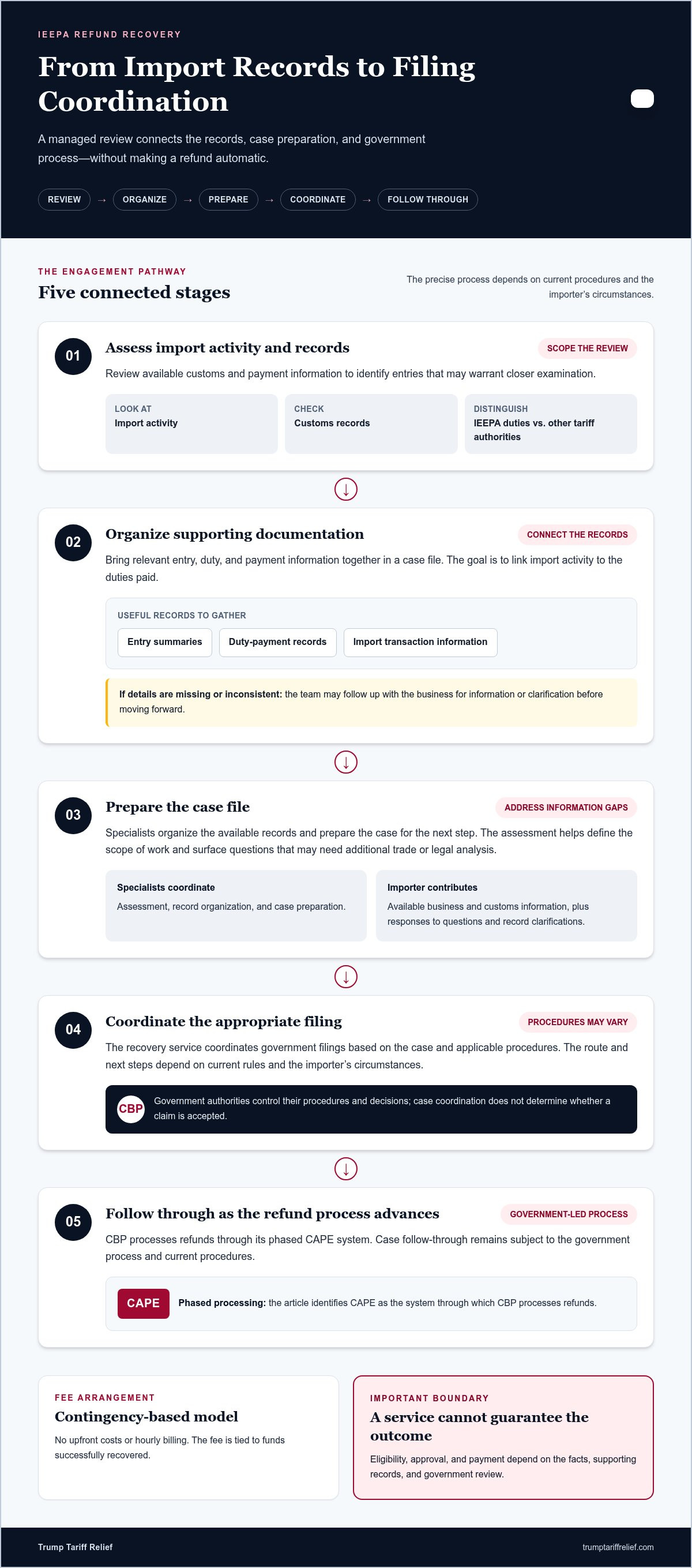
A managed engagement turns a broad refund question into a sequence of review and action. An ieepa tariff refund recovery service begins by assessing import activity and available records, then moves through documentation review, case preparation, filing coordination, and follow-through. The steps and available procedures depend on current rules and the importer’s circumstances, so this sequence is a guide, not a promise of eligibility, timing, or payment.
What happens during an initial tariff eligibility assessment?
At the outset, specialists review relevant import activity and customs records to identify entries that may warrant closer examination. They look for questions that could require additional trade or legal analysis, such as whether the duties in a record relate to IEEPA or a separate tariff authority. That distinction matters in a changing trade environment. The Brookings Institution’s analysis of the post-IEEPA tariff landscape discusses the broader shift in tariff authority.
The assessment defines the scope of the work and identifies information gaps before the case is prepared. The IEEPA refund recovery process moves from this initial review through documentation and filing coordination.
How documentation management supports a filing
Once the review identifies entries for further consideration, documentation management brings relevant entry, duty, and payment information into an organized case file. The aim is to connect the records clearly, not to assume that one fixed checklist applies to every importer. If details are missing or inconsistent, the team follows up with the business for information or clarification before moving forward.
Organized entry and payment records help substantiate a review by linking import activity to the duties paid.
The work is shared. Specialists manage the assessment, record organization, case preparation, and filing coordination. The importer provides available business and customs information, responds to questions, and clarifies records when needed. For example, if payment information and entry details do not appear to align, resolving that discrepancy helps establish what the file supports before it advances. The filing route depends on applicable procedures and the importer’s circumstances.
After preparation, the team coordinates the appropriate filing steps and follows the case as it proceeds. Government agencies control their own review and decisions. Managed support can organize the process, but it cannot control the outcome. For businesses seeking coordinated help assessing records and preparing next steps, the managed recovery process brings assessment, documentation, and filing support together.
Professional recovery service versus handling an IEEPA claim in-house
There isn’t one right operating model for every importer. A business with organized customs records and available trade-compliance staff may be able to coordinate the work internally. If the review would pull finance, trade, and operations teams away from core responsibilities, an ieepa tariff refund recovery service can manage assessment, documentation, and filing coordination as a connected process.
| Consideration | In-house coordination | Specialist case management |
|---|---|---|
| Staff time | Employees divide review and administrative work among existing responsibilities. | A specialist coordinates the recovery work, while employees provide records and clarify business information. |
| Customs-record familiarity | Internal trade staff may know the company’s entry systems and record history well. | Specialists review customs documentation for the recovery assessment and organize case materials. |
| Filing coordination | Employees track the case steps and coordinate information across departments. | The service manages case preparation and government filing coordination based on the applicable process. |
| Follow-up responsibility | The business assigns staff to monitor requests, gather clarifications, and track progress. | The specialist manages case follow-through, with the importer responding to requests for business information or records. |
When internal teams may prefer to manage the work
Keeping the work in-house may suit a business with available trade-compliance staff, accessible entry and payment records, and a clear process for coordinating finance and import teams. The key question is capacity, not company size: can staff review the relevant records, track case-specific requirements, and follow current official guidance without neglecting other responsibilities? If they can, internal coordination may be practical. Not every importer needs outside assistance.
What specialist case management can take off your team’s plate
Specialist support connects eligibility assessment, document review, case preparation, and government filing coordination in one managed engagement. This can reduce handoffs between finance and trade teams, while your employees remain the source for company records and clarifications. The service manages the recovery work, but the importer still needs to provide accurate information. The service cannot guarantee a government decision.
The fee structure is another point of comparison. Trump Tariff Relief charges a percentage of the amount successfully recovered, with no upfront costs or hourly billing. Contingency pricing changes how the service is paid for, not whether the government will approve a claim or issue a refund. Before proceeding, understand how the agreement defines a successful recovery and calculates the fee.
Use your available capacity to guide the choice. If your records are organized and staff can manage the review and follow-through, internal coordination may fit. If ownership is fragmented or specialist assessment and filing coordination would ease the workload, managed support offers a structured alternative. The decision should reflect your records, team bandwidth, and realistic expectations, not an assumption that any approach ensures a refund.
What to prepare before pursuing IEEPA tariff refund recovery
A focused record set can make an initial assessment more efficient. Before engaging an ieepa tariff refund recovery service, gather what your business already has rather than delaying to build a perfect file. The goal is to give reviewers a practical view of the entries, duties, and payments that may be relevant. Not every record below will apply to every importer, and this preparation list is not a definitive filing-document checklist.
Which records can help an initial review?
Start with available customs entry summaries and records showing duty payments. Then connect those materials, where possible, to internal invoices and import tracking information. The relationship between records can clarify which transaction an entry relates to and what the business paid.
- Entry information: available entry summaries or other records that identify relevant imports.
- Payment details: customs duty statements, payment records, or internal accounting entries tied to those imports.
- Transaction context: supplier invoices, purchase records, or import tracking data that help identify the underlying shipment.
- Record notes: references to amended entries, missing documents, or unclear payment details.
These materials are useful starting points, not a guarantee that an entry qualifies or that each item will be needed. Relevance depends on the facts and the review being performed.
How to keep the assessment efficient and accurate
Create a simple inventory of entries your team believes may involve IEEPA duties and the tariff payments it can identify. Assign an internal owner for customs records, another for finance and payment information, and a decision-maker who can resolve questions or approve next steps. Clear ownership helps prevent duplicate requests and keeps unresolved details visible.
- Group available records by entry or import transaction.
- Flag missing documents instead of treating gaps as confirmed facts.
- Note amended entries and explain what changed, if your records show it.
- Mark payment amounts or dates that need reconciliation with finance records.
Keep uncertainties visible. For instance, if an internal payment record doesn’t clearly match an entry summary, flag the mismatch for review rather than drawing a conclusion. A short note describing what your team knows and what it cannot yet verify gives specialists a clearer starting point.
Deadlines and filing requirements need current, case-specific verification. Don’t rely on a general checklist or an old calendar calculation to determine what applies to an entry. The relevant procedure may depend on current rules and the importer’s circumstances. Organizing records supports an assessment, but it doesn’t replace that verification or determine the government’s decision.
If you’re ready to organize your records and assess a potential recovery, start an IEEPA tariff refund assessment.
Choose managed IEEPA tariff refund recovery with clear expectations
Managed recovery may suit a business that wants specialist support coordinating eligibility assessment, customs records, and government filings. Rather than asking separate finance and trade teams to build the process from scratch, an ieepa tariff refund recovery service organizes the work around a case-specific review. Your company still has a role: providing available records, answering questions, and making informed decisions as the assessment develops.
Keep the central distinction clear. A specialist examines the records and coordinates the recovery effort, but eligibility and payment depend on applicable law, the facts shown by the records, current procedures, and government action. A completed assessment or prepared filing is not the same as an approved claim. No service can control the government’s decision or assure a refund.
What businesses should understand about contingency recovery
The fee model is contingency-based: the fee is a percentage of a refund successfully recovered, with no upfront costs or hourly billing. That describes how the service is paid, not the likelihood of a result. Before proceeding, understand the fee basis and the agreement’s terms, including how a successful recovery is treated. Your business must still provide information and respond to case-related requests.
This structure may suit businesses concerned about paying hourly charges while a complex review is underway. It does not remove the need for accurate records, establish that duties qualify, or shift the government’s decision to the service provider. Consider whether you want specialists to manage the assessment and documentation work, and whether your team can supply the necessary business context and clarify uncertainties as they arise.
Start with a case-specific recovery assessment
The practical first step is an assessment, not a promise of refund approval. Share your business context and available tariff-payment records so the review can focus on the entries and facts that may matter. Useful context may include how your company tracks imports, where customs records are maintained, and which internal contacts can answer questions about payments or transactions. The review identifies what the records support and what requires further examination.
Before moving forward, ground your expectations in the process. A specialist coordinates the work and explains the assessment, documentation, and filing stages. The importer remains responsible for supplying accurate information and engaging with the review. The outcome remains subject to applicable rules, available evidence, and government action. That is the basis for pursuing potential recovery responsibly.
If your business wants specialist support reviewing its situation and available records, request an IEEPA tariff refund assessment as the first step toward understanding a potential recovery path.
Put your import records to work
The most useful next step is a clear-eyed review of your company’s records. Instead of guessing whether a tariff payment belongs in a potential recovery effort, organize the relevant facts for an assessment. That can help your business decide how to proceed with better information and realistic expectations.
A specialist ieepa tariff refund recovery service brings focused attention to this question. Trump Tariff Relief’s legal and trade experts coordinate assessment, documentation, and government filings, while your team supplies business context and records. The contingency model has no upfront costs or hourly billing, and its fee is tied to amounts successfully recovered. It does not guarantee eligibility, approval, or payment.
If your company is ready to move from uncertainty to an informed next step, gather the records you have and share the context behind them. Request an IEEPA tariff refund assessment to begin a case-specific review.
Frequently Asked Questions
Is an IEEPA tariff refund recovery service the same as a customs broker?
No. A customs broker and an IEEPA tariff refund recovery service have different roles. A broker supports customs-entry and import processes. A recovery specialist reviews whether duty payments may relate to IEEPA and coordinates a potential refund case. For example, a broker may have handled entry paperwork while the importer later seeks help examining past payments. Recovery support doesn’t replace ongoing brokerage work.
Can a business pursue an IEEPA tariff refund if a customs broker handled its imports?
Yes. Having used a customs broker doesn’t by itself determine whether a business can pursue an assessment. The importer can request copies of entry and payment records internally, then identify who was listed as the importer of record. Those details help establish which business and transactions the records concern. Eligibility still depends on the specific entries, duties paid, applicable requirements, and facts of the case.
Does hiring a recovery service guarantee an IEEPA tariff refund?
No. Hiring a specialist doesn’t guarantee eligibility, government approval, or payment. A recovery team can organize and assess a case, but it can’t control how authorities apply current procedures or decide a claim. Treat an assessment as a review of whether the available facts support pursuing recovery, not as confirmation that money will be returned. Be cautious of any statement that presents a refund as certain before review.
How does a contingency fee for tariff refund recovery work?
A contingency fee is calculated as a percentage of the refund successfully recovered for the business. Under Trump Tariff Relief’s model, there are no upfront costs or hourly billing. The fee structure doesn’t guarantee that a claim will succeed. Before proceeding, review the engagement terms so you understand how the agreement defines a successful recovery and what amount the percentage is based on.
What information should my business gather before an IEEPA refund assessment?
Start with records that connect an import to a duty payment, such as entry summaries, payment evidence, and transaction details. If your business operates through related entities or uses different importer numbers, note which entity appears on each record. That context can help prevent records from being attributed to the wrong business. Include known gaps or mismatches so they can be examined rather than overlooked.
How long does IEEPA tariff refund recovery take?
There isn’t a single reliable timeline for every case. The time involved can depend on available records, the applicable filing path, current government procedures, and whether authorities request additional information. A phased administrative process may also affect when a particular entry can be addressed. A case-specific explanation of the next step and outstanding dependencies is more useful than a general turnaround estimate.
Can a recovery service help with Section 301 tariffs too?
An IEEPA refund assessment concerns duties collected under IEEPA, not Section 301 duties. Section 301 is a separate tariff authority, so those payments aren’t covered through the IEEPA refund pathway. If records show different tariff types, keep them distinct rather than combining all duties into one potential claim. Identifying the authority associated with each payment is a key part of determining what the IEEPA review can address.
Ready to find out what your business may be owed?
Check My Eligibility