Over $175 billion in illegally collected capital is currently sitting in government accounts, and the clock for your business to reclaim its share is already ticking. The Supreme Court's February 20, 2026, decision in Learning Resources, Inc. v. Trump has fundamentally rewritten the rules of American trade, stripping the executive branch of its power to impose tariffs under the International Emergency Economic Powers Act. If you've felt the sting of your capital being held hostage by these measures, you aren't alone. Understanding the IEEPA tariff ruling is no longer just a legal exercise; it's a mandatory financial strategy for any importer looking to recover lost revenue.
You likely feel the anxiety of missing strict filing deadlines while struggling to distinguish between invalidated IEEPA duties and the new Section 122 requirements. We understand that your priority is righting this financial wrong without getting bogged down in bureaucratic red tape. This guide promises to clear the confusion by identifying exactly which tariffs are now refundable and outlining a streamlined, low-risk path to your recovery. We'll explore the Court of International Trade's recent orders and show you how to turn this landmark legal victory into a tangible cash infusion for your operations.
Key Takeaways
- The 2026 SCOTUS decision has invalidated billions in tariffs. This creates a critical window for importers to reclaim capital seized under executive overreach.
- Gain a professional advantage by understanding the IEEPA tariff ruling and how it distinguishes refundable duties from new Section 122 requirements.
- Pinpoint exactly which imports from China, Mexico, and Canada are now eligible for a share of the projected $175 billion refund pool.
- Learn why these refunds aren't automatic. We'll show you how to navigate the protest process to ensure your documentation meets strict CBP standards.
- Discover a streamlined path to recovery that handles the heavy lifting of eligibility audits and documentation management for your business.
What is the IEEPA Tariff Ruling of 2026?
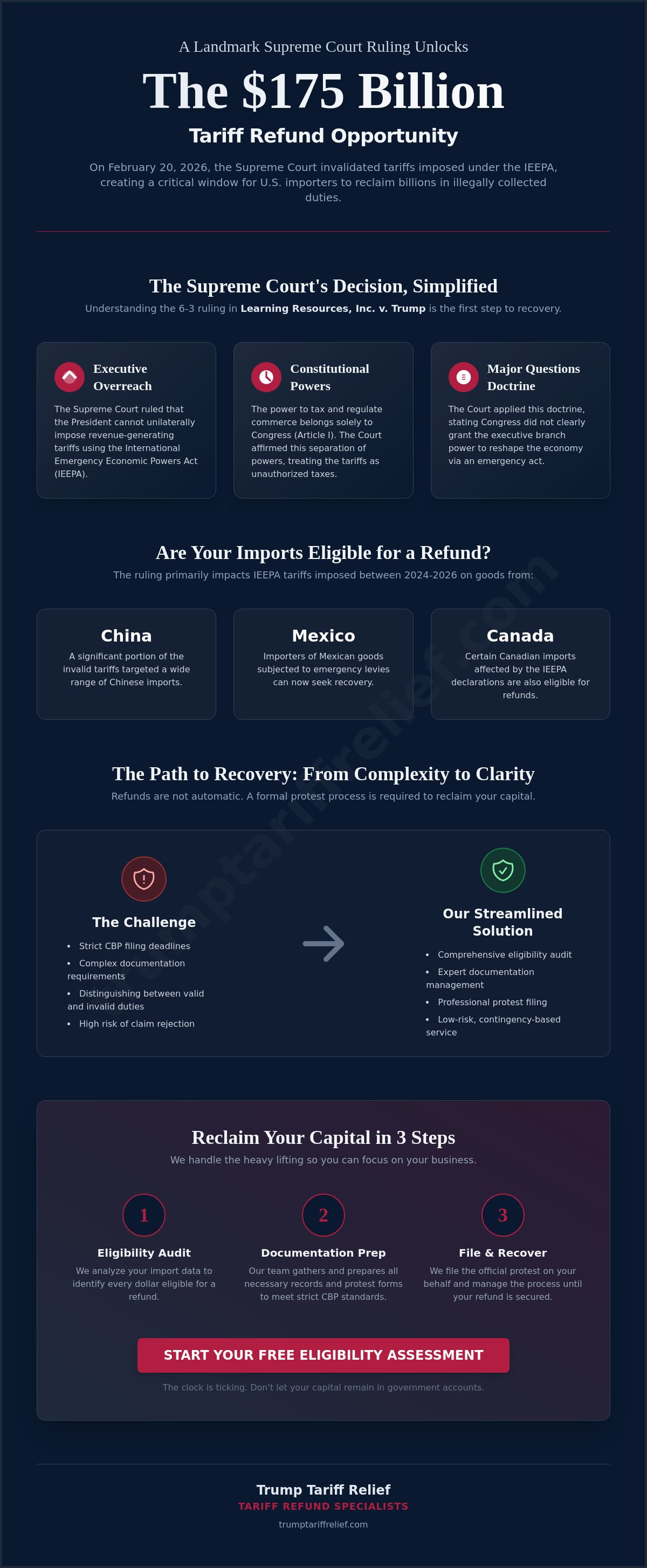
On February 20, 2026, the U.S. Supreme Court delivered a seismic blow to executive trade authority. In a decisive 6-3 ruling, the Court held that the President cannot unilaterally impose tariffs under the International Emergency Economic Powers Act (IEEPA). The cases at the center of this storm, Learning Resources, Inc. v. Trump and Trump v. V.O.S. Selections, Inc., challenged the administration's use of emergency declarations to tax imports from China, Mexico, and Canada. Chief Justice John Roberts, writing for the majority, stated clearly that IEEPA does not authorize the executive branch to create revenue-generating tariffs. For importers, understanding the IEEPA tariff ruling is the first step toward reclaiming billions of dollars in duties that were collected without proper legal standing.
This decision effectively invalidates a massive portion of the trade barriers erected between 2024 and 2026. It marks a mandatory correction of executive overreach that has cost U.S. businesses billions in tied-up capital. If your business has been paying these duties, the Supreme Court has just opened a path for financial restoration. You can find a detailed breakdown of the ruling on our dedicated resource page.
The Core Legal Question: Executive vs. Congressional Power
The fundamental issue rested on Article I of the Constitution, which grants the power to tax and regulate commerce solely to Congress. The administration had argued that "regulating" imports during a declared national emergency included the right to levy tariffs. The Court flatly rejected this. It distinguished between the executive's role in managing trade flows and the legislative branch's unique authority to impose taxes. Because these levies were designed to generate revenue rather than merely restrict specific transactions, they overstepped constitutional boundaries. If a trade measure looks and acts like a tax, it requires a direct mandate from Congress, not a presidential proclamation. This ruling restores the balance of power, ensuring that "emergency" declarations aren't used as a loophole to bypass the legislative process for trade policy.
The Major Questions Doctrine Explained
The Court applied the Major Questions Doctrine to ensure the Executive Branch doesn't decide matters of vast economic or political significance without clear permission from voters' representatives. The Major Questions Doctrine is a judicial rule that requires clear congressional authorization before the Executive Branch can exercise powers that have vast economic or political significance. In this instance, the doctrine was the nail in the coffin for IEEPA-based tariffs. The Court found it implausible that Congress would hide the power to reshape the entire U.S. economy behind a general emergency statute. By invoking this doctrine, the Justices signaled that any future attempts to tax imports must go through the front door of Congress rather than the back door of executive orders.
Why the Supreme Court Invalidated IEEPA Tariffs
The decision to strike down these tariffs wasn't just about trade policy; it was a fundamental defense of the U.S. Constitution. The Court found that the language within the International Emergency Economic Powers Act is far too vague to serve as a legal foundation for taxing imports. By attempting to use this statute to bypass the House and Senate, the executive branch ignored the specific legislative process required for trade policy. This ruling effectively returns the "power of the purse" to Congress, ensuring that future presidents cannot use IEEPA as a unilateral trade weapon. Understanding the IEEPA tariff ruling requires recognizing that the Court viewed these levies as unauthorized taxes rather than legitimate regulatory tools.
For businesses, this means the government overreached, and you paid the price. According to analysis from the Penn Wharton Budget Model, this legal correction has created The $175 Billion Refund Opportunity for importers who were forced to comply with these now-invalidated duties. This precedent creates a mandatory correction for years of financial over-collection. If you've had capital tied up in these illegal levies, a professional tariff eligibility assessment is the most efficient way to identify your path to recovery.
The Failure of the "Emergency" Argument
The government's defense relied on the idea that trade deficits and illicit drug flows constituted national emergencies. While the Court acknowledged the severity of these issues, it ruled they don't grant extra-constitutional taxing powers. Unlike Section 232 tariffs, which are rooted in specific "National Security" statutes with established precedents, IEEPA was never intended to be a revenue generator. If the President wants to tax a specific category of goods, they must now secure a mandate from the legislative branch rather than declaring a state of emergency to justify a price hike. This distinction is vital because it protects the separation of powers and prevents the executive branch from inventing new taxes under the guise of an "emergency."
A Landmark Check on Administrative Overreach
This ruling signals a broader, more assertive shift in how the Court views delegated authority. It serves as a reminder that administrative agencies and the executive branch have strict limits on their power. For trade compliance teams, the "rules of the game" have fundamentally changed overnight. You can no longer assume that a presidential proclamation is the final word on duty rates. It's essential to learn more about the IEEPA legal framework to see how these changes impact your specific import categories. This decision effectively ends the era of "tariff by tweet," forcing a return to a more stable, legislative-led trade environment.
Which Tariffs Are Affected by the Ruling?
The Supreme Court decision doesn't apply to every duty your business has paid, but it does strike down two massive categories of levies imposed between 2024 and 2026. Understanding the IEEPA tariff ruling requires a surgical look at your import history during this window to identify where your capital was illegally seized. The ruling focuses specifically on duties enacted through executive emergency declarations rather than through traditional legislative channels. If your goods were entered or withdrawn from a warehouse for consumption during this period, you likely have a significant recovery opportunity waiting.
It's vital to distinguish these invalidated duties from Section 301 tariffs, which specifically target Chinese imports and are currently under a separate legal review. While Section 301 remains a distinct battleground, the IEEPA ruling provides an immediate and clear path for reclaiming funds from different, broad-reaching categories. Identifying exactly where your products fall within these classifications is the first step toward securing your share of the $175 billion refund pool. You can See common questions about eligible tariff categories to begin narrowing down your potential claim.
The "Fentanyl" Tariffs (China, Mexico, Canada)
The Global "Reciprocal" Tariffs
The $175 Billion Refund Opportunity: How to Claim Your Share
The financial scale of this correction is unprecedented. According to the Penn Wharton Budget Model, the total refund pool for U.S. businesses could reach $175 billion. This isn't just a theoretical number; it represents billions of dollars in actual capital that was stripped from corporate balance sheets under an illegal mandate. However, there's a catch that many importers are overlooking. These refunds are not automatic. The government won't simply mail you a check because the Supreme Court ruled in your favor. Understanding the IEEPA tariff ruling is only the first step. To actually recover your funds, you must take assertive, formal action through the U.S. Customs and Border Protection (CBP) protest process.
The burden of recovery lies entirely on the importer. If you wait for a notification from the government, you'll likely wait forever. The Treasury has no incentive to proactively return these funds. You need a proactive strategy to identify every eligible entry and file the necessary paperwork before your legal rights expire. To see the specific mechanics of this process, you can explore our guide on how the recovery process works.
Understanding the 180-Day Protest Window
Time is your greatest enemy in trade recovery. In the world of customs, "liquidation" refers to the final calculation of duties by CBP for a specific entry. Once an entry liquidates, a strict countdown begins. You generally have only 180 days after a liquidation event to file a formal protest. Many businesses mistakenly believe they can wait for the entire legal saga to conclude before filing, but the law is rigid. Once the 180-day window closes, the money is legally forfeited to the Treasury. You can't appeal a missed deadline, regardless of how clearly the Supreme Court has ruled that the original tariff was illegal. This makes immediate action a mandatory requirement for capital preservation.
5 Steps to Securing Your Tariff Refund
Securing your share of the $175 billion requires a methodical approach to documentation and filing. You don't want to leave money on the table due to administrative errors. Follow these steps to protect your claim:
- Step 1: Audit all import records from 2025 to early 2026 specifically looking for IEEPA-coded duties.
- Step 2: Identify the specific HTS codes that were subject to the invalidated emergency declarations.
- Step 3: Calculate the total duty paid under IEEPA authority to determine the full value of your claim.
- Step 4: Prepare formal protests or "Prior Disclosures" to legally preserve your rights before liquidation windows close.
- Step 5: Partner with a specialist in IEEPA tariff refund recovery to manage the complex government filing process and ensure maximum compliance.
The window of opportunity for these claims is narrow and closing fast. Every day you delay is a day closer to a permanent loss of capital that rightfully belongs on your balance sheet. To ensure you don't miss these critical deadlines, you should start your recovery assessment today and secure your place in the refund queue.
Maximizing Recovery with Trump Tariff Relief
While understanding the IEEPA tariff ruling is essential, translating that knowledge into a recovered check requires a specialized engine. Trump Tariff Relief provides a full-service, contingency-based recovery model designed specifically for U.S. importers. We take on the administrative burden, managing the entire process from the initial eligibility audit to the final delivery of your refund check. Unlike software providers that require high upfront costs and internal expertise to manage, we act as your high-performing partner. Our team of trade experts ensures that no HTS code or eligible entry is overlooked, maximizing the total value of your claim.
Our approach is built on transparency and results. We don't just point you toward the law; we execute the recovery. By handling the complex documentation management and filing requirements, we allow your team to focus on core operations while we focus on righting this financial wrong. It's a streamlined path to capital restoration that removes the friction usually associated with government bureaucracy.
The Advantage of Contingency-Based Recovery
Traditional trade consulting often relies on hourly fees that can drain your recovery before you even see a check. If the process becomes protracted, those costs eat into your bottom line. Our firm operates on a "Success Fee" model, which means our interests are perfectly aligned with yours. We only take a percentage of the actual refund we recover for your business. If we don't win, you don't pay. This low-risk, high-reward partnership removes the financial barriers to entry and allows you to pursue justice without a budget-draining upfront investment. You can see a detailed breakdown of how our recovery process works to understand the efficiency of this model.
Getting Started: Your Preliminary Assessment
The first step toward reclaiming your capital is a non-binding eligibility audit of your recent customs data. We analyze your 2025 and 2026 entries to identify the exact dollar amount your firm is owed according to the SCOTUS ruling. This assessment provides the transparency you need to make an informed business decision without any initial cost. It's a no-nonsense approach to identifying the hidden capital currently sitting in government accounts. Don’t leave your capital on the table; secure your refund before the 180-day protest deadline expires and the Treasury claims your money permanently. Our team is prepared to move quickly, ensuring your documentation is filed with the precision and urgency required to win.
Reclaim Your Capital and Restore Your Balance Sheet
The Supreme Court has spoken, but the government won't return your capital without a formal challenge. The $175 billion refund pool represents a mandatory correction of executive overreach, yet it remains inaccessible to those who fail to act. Understanding the IEEPA tariff ruling is the first step toward financial restoration. However, the 180-day protest window is rigid; once it closes, your right to a refund is legally forfeited. You've already felt the sting of these illegal duties, and you shouldn't let a bureaucratic deadline prevent you from reclaiming what's yours.
Our specialized consultancy team focuses exclusively on this 2026 recovery event. We provide a full-service, contingency-based model that requires no upfront costs from your business. We take on the risk and the administrative burden, ensuring every eligible entry is identified and every protest is filed with precision. We only win when you win. Don't leave your hard-earned capital in the hands of the Treasury. Secure Your Share of the $175 Billion IEEPA Refund Today and start your path to recovery. You've earned this victory, and it's finally time to collect.
Frequently Asked Questions
Is the IEEPA tariff refund real or a scam?
The IEEPA tariff refund is a legitimate legal event resulting from the Supreme Court's February 20, 2026, decision in Learning Resources, Inc. v. Trump. It isn't a scam; it's a mandatory correction of executive overreach that has created a $175 billion recovery opportunity for U.S. importers. This ruling invalidated specific tariffs that were collected without proper congressional authorization, and the Court of International Trade is already processing these liquidations.
Which specific countries were included in the IEEPA tariff ruling?
The ruling primarily impacts goods imported from Canada, Mexico, and China that were subject to specific emergency declarations between 2024 and 2026. These include the "Fentanyl" levies and the broader "Reciprocal" tariffs. If your supply chain involves these partners, you must audit your entries from this period to identify which HTS codes are eligible for recovery.
How long do I have to file a claim for an IEEPA tariff refund?
You generally have 180 days from the date of liquidation to file a formal protest with U.S. Customs and Border Protection. Liquidation is the final processing of your entry, and once that 180-day window closes, your right to a refund is legally forfeited. Because these windows open and close on a rolling basis, understanding the IEEPA tariff ruling timelines is the most critical part of your recovery strategy.
Does the IEEPA ruling apply to Section 301 China tariffs?
No, the IEEPA ruling is distinct from Section 301 China tariffs. While Section 301 duties are under their own legal challenges, they weren't the subject of this specific SCOTUS decision. You must distinguish between these categories to ensure your recovery claims are filed under the correct legal authority and don't get rejected by CBP for misclassification.
What is the difference between IEEPA tariffs and Section 232 tariffs?
IEEPA tariffs were based on presidential emergency powers, which the Court has now restricted because they bypassed Congress's power to tax. Section 232 tariffs are based on national security justifications and remain a separate legal framework. The 2026 decision specifically targeted the use of "emergency" declarations as a loophole for imposing taxes without a legislative mandate.
Can I claim a refund if my customs broker already filed my entries?
Yes, you can still claim a refund. A customs broker facilitate the entry and pays the required duties, but they don't typically file legal protests against the validity of those duties. Filing the initial entry doesn't waive your right to protest the duty later, provided you take action within the 180-day window following liquidation.
What happens if I miss the 180-day protest window?
If you miss the 180-day protest window, your capital is permanently forfeited to the U.S. Treasury. There are no extensions, appeals, or "late filings" allowed in the customs protest process. This makes immediate action a mandatory requirement for any business that wants to recover its share of the $175 billion refund pool before it's too late.
How much does it cost to use a tariff recovery service?
Professional recovery services for IEEPA refunds typically operate on a contingency basis. This success-based model means there are no upfront costs or hourly fees for your firm to worry about. The provider handles the audit and filing, taking a percentage of the actual refund recovered, which ensures their interests are perfectly aligned with your financial restoration.
Ready to find out what your business may be owed?
Check My Eligibility