
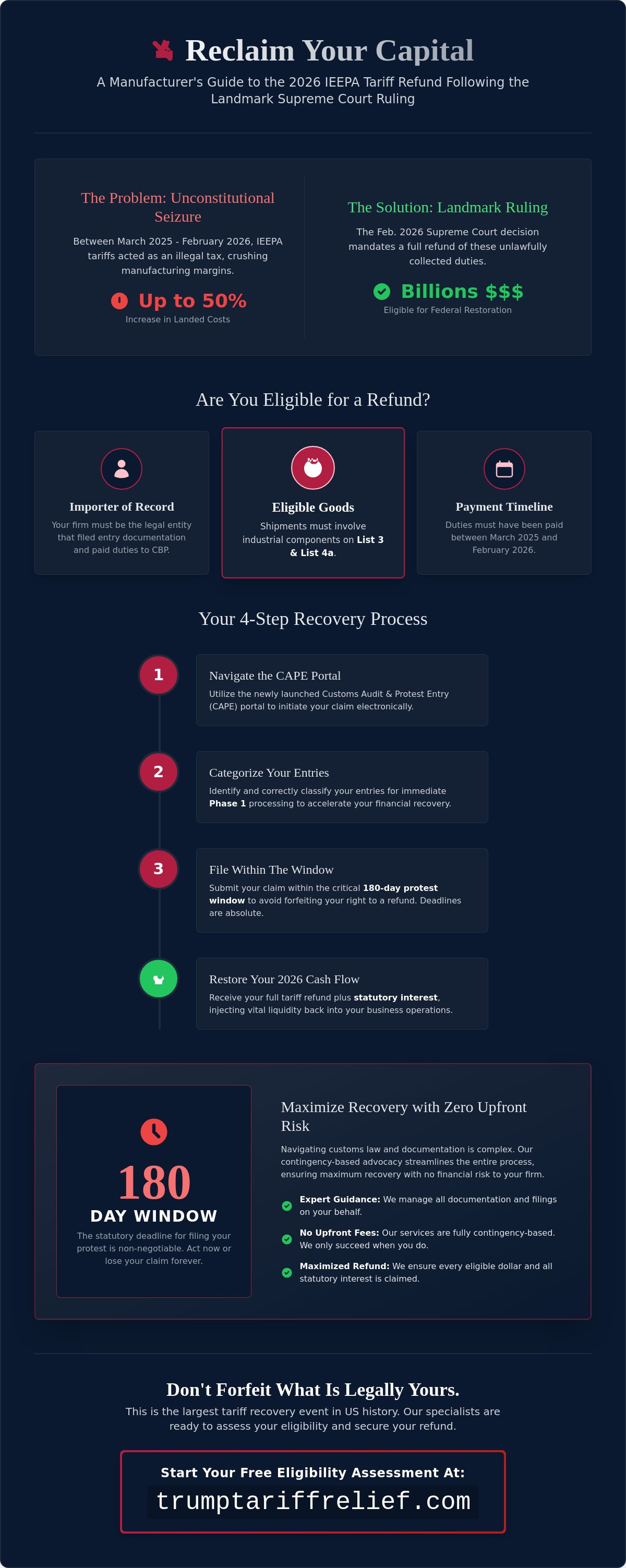
The capital your firm lost to IEEPA tariffs wasn't a standard cost of doing business; it was an unconstitutional seizure of your liquidity. For over a year, manufacturing margins have been crushed by landed cost increases of up to 50 percent, leaving many leaders feeling like they're subsidizing federal overreach. You've likely felt the sting of these shrinking profits and the administrative weight of high import costs. The February 2026 Supreme Court ruling has finally shifted the power back into your hands, confirming that these payments must be returned. This guide reveals exactly how to secure a tariff refund for manufacturers and reclaim what is legally yours.
You'll discover the specific eligibility requirements for payments made between March 2025 and February 2026 and see how to navigate the newly launched CAPE portal. We'll outline how to categorize your entries for Phase 1 processing and ensure your claim includes the statutory interest you're owed. It's time to stop absorbing these costs and start restoring your 2026 cash flow through a disciplined, results-oriented recovery process.
Key Takeaways
- Understand the legal mechanics of the February 2026 Supreme Court ruling and why it mandates the return of unconstitutionally seized manufacturing capital.
- Verify your status as the "Importer of Record" to confirm eligibility for refunds on shipments involving List 3 and List 4a industrial components.
- Act within the critical 180-day protest window to successfully secure a tariff refund for manufacturers before statutory deadlines expire.
- Discover how contingency-based advocacy streamlines the customs documentation management process with zero upfront financial risk to your firm.
- Navigate the phased CAPE portal rollout to identify if your specific entries qualify for immediate Phase 1 processing and financial recovery.
The 2026 Supreme Court Ruling: Why IEEPA Tariffs Were Declared Unconstitutional
In February 2026, the U.S. Supreme Court delivered a decisive verdict that fundamentally altered the trade landscape for American industry. The Court ruled that the executive branch overstepped its constitutional authority by imposing broad duties under the International Emergency Economic Powers Act (IEEPA) without a verified national emergency that met the Act's stringent criteria. Originally intended to provide the President with tools to address specific, time-sensitive foreign threats, the IEEPA was instead utilized as a mechanism for long-term trade policy. The Court found that the specific tariffs implemented in early 2025 lacked a valid legal foundation because they bypassed the legislative oversight required for taxation and trade regulation. This landmark decision has unlocked a path toward a significant tariff refund for manufacturers who were forced to absorb these costs. Billions of dollars in duties paid between March 2025 and February 2026 are now eligible for federal restoration.
The Legal Catalyst for Manufacturer Refunds
The transition from Section 301 duties to IEEPA-based tariffs represented a significant shift in how trade barriers were constructed. While Section 301 focused on addressing specific unfair trade practices, the IEEPA duties were applied more broadly to a vast array of industrial and manufacturing imports, including critical components found on List 3 and List 4a. The Supreme Court identified this as a circumvention of the law. The Court of International Trade (CIT) is now the primary venue for enforcing these recoveries, ensuring that the federal government adheres to the Supreme Court's mandate. Because these tariffs targeted raw materials and intermediate goods, the manufacturing sector bore a disproportionate share of the financial burden. Securing a tariff refund for manufacturers is now a matter of following the specific administrative channels established by the CIT and Customs and Border Protection.
Why This Matters for Your 2026 Balance Sheet
For most firms, these duties weren't just a line item; they were a direct hit to profitability. Duty rates of 20% to 25% eroded margins and stalled capital investment throughout 2025. It is critical to understand that this is not a standard duty drawback, which usually involves the re-exportation of goods. Instead, this is a full restoration of capital seized under an unconstitutional framework. The IEEPA ruling stands as the largest tariff recovery event in US history. Reclaiming these funds is essential for any firm looking to stabilize its 2026 cash flow and reinvest in domestic operations. Waiting to file could result in lost interest or missed deadlines as the government manages the massive influx of claims. Your business has a legal right to this capital, and 2026 is the year to reclaim it.
Identifying Eligible Shipments: Is Your Firm an 'Importer of Record'?
Determining your eligibility for recovery begins with a single legal distinction: the Importer of Record (IOR). In the eyes of U.S. Customs and Border Protection (CBP), the entity that filed the entry documentation and paid the duties is the only party with the standing to reclaim them. If your manufacturing firm managed its own imports and paid IEEPA duties directly to the government, you're the rightful owner of the refund. If you purchased materials through a domestic middleman who handled the importation, that distributor is technically the IOR. In those cases, you'll need to review your supplier contracts for price escalation clauses to determine if you can claim a portion of their eventual recovery. For those who are the IOR, the path to a tariff refund for manufacturers is direct, provided your shipments fall within the specific HTS categories targeted by the 2026 ruling.
The scope of the Supreme Court decision focuses heavily on List 3 and List 4a goods. These lists encompass the vast majority of industrial inputs sourced from abroad during the 2025 period. Whether you absorbed these costs or passed them through to your customers via surcharges, your legal right to the refund remains unchanged. The government doesn't examine your downstream pricing; it only looks at the unconstitutional duty paid at the port of entry. To begin your recovery, a thorough tariff eligibility assessment is the first step in quantifying your firm's total exposure.
Common Manufacturing Goods Eligible for Recovery
Eligibility is dictated by HTS codes and specific entry dates. Most industrial components, raw materials, and machinery imported between March 2025 and February 2026 are covered. Key categories include:
- Electronic Components: Printed circuit boards, sensors, and semiconductors found on List 4a.
- Base Metals: Aluminum and steel articles that were subjected to IEEPA-based increases.
- Industrial Machinery: Tooling, molds, and factory equipment classified under List 3.
If your entry dates align with this window, the capital is likely recoverable. You'll need to verify each HTS code against the unconstitutional mandates to ensure precision in your filing.
The 'Liquidated vs. Unliquidated' Entry Distinction
Understanding the status of your entries is vital for timing your claim. Liquidation is the process where CBP finalizes an entry's duty calculation, usually occurring 314 days after entry. Unliquidated entries are "open" and represent the fastest path to recovery. These are the priority in Phase 1 of the CAPE portal rollout because they don't require a formal protest to adjust. If your entries have already liquidated, you're facing a strict 180-day window to file a protest. Missing this deadline can permanently forfeit your right to the capital. While unliquidated entries offer more certainty, liquidated entries can still be won through aggressive documentation and timely legal challenges. Identifying which category your shipments fall into will define your recovery strategy for the remainder of 2026.
Navigating the CAPE Portal: A Technical Roadmap for Manufacturers
On April 20, 2026, U.S. Customs and Border Protection (CBP) officially opened the Consolidated Administration and Processing of Entries (CAPE) portal. This digital infrastructure serves as the exclusive mechanism for reclaiming unconstitutionally seized capital. For the first time, importers can submit bulk requests for the restoration of duties paid under the IEEPA mandates. However, the system is not a simple automated refund tool. It requires a meticulous alignment of internal trade data with federal records. The 2026 rollout is occurring in distinct phases; Phase 1 is currently processing less complex scenarios, such as unliquidated entries and those liquidated within 80 days of filing. If your firm operates with a high volume of imports, navigating this portal is the only way to secure a tariff refund for manufacturers.
The administrative burden of this process is often the greatest hurdle for internal trade teams. Data integrity isn't optional. You must match every entry number with its corresponding duty payment and HTS classification. Any discrepancy between your records and the Automated Commercial Environment (ACE) data will result in an immediate rejection. This is where customs documentation management becomes a strategic asset. By reconciling your internal ERP data with CBP’s records before submission, you eliminate the friction that typically stalls large-scale recovery efforts.
5 Steps to Initiating Your IEEPA Refund Claim
Success in the CAPE portal requires a disciplined sequence of actions. Follow these steps to prepare your filing:
- Step 1: Conduct a comprehensive audit of all import entries dated between March 2025 and February 2026.
- Step 2: Verify your firm's ACE portal access and confirm your "Importer of Record" status is active.
- Step 3: Aggregate all supporting documentation, specifically focused on commercial invoices and Form 7501s.
- Step 4: Validate that your specific HTS codes fall under the unconstitutional List 3 or List 4a designations.
- Step 5: Submit the formal CAPE Declaration with precise data to trigger the 60-90 day processing window.
Common Hurdles in the CAPE Filing Process
Data discrepancies are the most frequent cause of claim failure. If your internal accounting shows a different duty amount than what CBP has on file, the system will flag the entry for manual review, which can add months to your timeline. Beyond technical errors, firms must also guard against unauthorized "scammer" outreach. Protect your ACE account credentials and only work with verified advocates. Finally, ensure your claim includes statutory interest. The federal government is required to pay interest on these unconstitutional charges, and failing to account for this means leaving significant capital on the table. A successful tariff refund for manufacturers is defined by both the speed of recovery and the precision of the final payout.
Critical Deadlines: Why the Window for Recovery is Closing
Time is the greatest enemy of financial restoration. While the CAPE portal opened on April 20, 2026, the window to act isn't indefinite. The 2026 Supreme Court decision is a victory, but it's a victory with an expiration date. For many firms, the clock started ticking the moment their entries liquidated. U.S. Customs and Border Protection operates on strict regulatory timelines that don't pause for internal delays or administrative confusion. If your manufacturing business paid IEEPA duties between March 2025 and February 2026, you must recognize that the federal government isn't obligated to hold these funds forever. Proactive claiming is the only way to ensure your tariff refund for manufacturers isn't lost to a technicality.
There's also a practical reality to consider: the "first-come, first-served" nature of federal processing. With CBP estimating that it owes refunds to hundreds of thousands of importers nationwide, the queue is already growing. Once a submission is accepted, CBP anticipates a 60-90 day window to issue refunds. Waiting until the final months of 2026 to initiate your claim could push your payout into the next fiscal year or, worse, result in a permanent forfeiture of funds due to exhausted budget allocations or expired protest windows. You've already waited over a year to right this financial wrong; don't let a missed deadline turn a temporary loss into a permanent one. You can begin the process immediately by securing an IEEPA tariff refund recovery assessment to lock in your spot in the recovery queue.
The Statute of Limitations Trap
The date of entry liquidation sets a lethal countdown for your legal rights. For most entries, liquidation occurs approximately 314 days after the date of entry, and once that happens, you have exactly 180 days to file a formal protest. Once a protest window closes, the right to a refund is typically lost forever. Even if you're involved in broader litigation, you must often file "protective protests" to preserve your individual rights. The 2-year statute of limitations for Court of International Trade (CIT) filings provides a secondary backstop, but relying on it is a high-risk strategy that adds years of legal complexity to what could be a straightforward administrative refund.
Internal Audit Deadlines for Manufacturing Teams
To stay ahead of the CBP phases, manufacturing leaders should set a 30-day internal deadline for total data aggregation. This isn't just about finding invoices; it's about coordinating with your customs brokers to ensure every single entry number from the 2025-2026 period is accounted for. Missing even a handful of shipments can result in thousands of dollars left on the table. This audit must also align with your fiscal year-end reporting, as the recognition of a tariff refund for manufacturers will significantly impact your cost of goods sold and overall profit margins. Speed and precision are equally vital during this audit phase to ensure your documentation is portal-ready the moment you're eligible for Phase 1 or Phase 2 filing.
Maximizing Your Recovery: The Advantage of Contingency-Based Advocacy
The restoration of unconstitutionally seized capital shouldn't create a new financial burden for your firm. Many manufacturing executives mistakenly treat the IEEPA recovery process as a routine accounting exercise, but the reality is far more complex. While general corporate counsel might offer to handle the claim, they often lack the specialized trade expertise required to navigate the CAPE portal's technical nuances. More importantly, hourly billing models create a barrier to entry that many firms can't justify during a period of tight liquidity. Choosing a specialized advocate for your tariff refund for manufacturers ensures that your recovery is managed with the same precision as your production line.
By leveraging a contingency-based model, you turn a legal victory into a strategic capital injection without risking a single dollar of your remaining budget. This approach shifts the financial risk entirely away from your business. You aren't just filing a claim; you're engaging in a high-stakes recovery effort where the interests of your advocate are perfectly aligned with your own. This isn't a passive service. It's a results-driven partnership designed to reclaim the capital lost to the 10% to 50% landed cost increases your business endured between March 2025 and February 2026. Reclaiming this capital allows your firm to pivot from defensive cost-cutting to aggressive reinvestment in domestic operations.
Removing the Financial Barrier to Filing
Traditional legal models often require significant retainers or upfront consulting fees before a single document is filed. We eliminate these barriers by operating on a "We Do the Work" model. This means our team handles the heavy lifting of customs documentation management and portal submissions, allowing your internal logistics team to focus on daily operations. You only pay when the refund, including statutory interest, is successfully deposited into your bank account. Transparency is a cornerstone of this process, providing your executive team with real-time tracking of your claim status as it moves through the 60-90 day CBP processing window.
Next Steps for Manufacturing Executives
The window to act is narrowing, and the queue for federal restoration is growing every day. To begin, you'll need to prepare the following items:
- All Form 7501 (Entry Summary) documents for the 2025-2026 period.
- Commercial invoices matching the entries subjected to IEEPA duties.
- A completed tariff eligibility assessment to quantify your total recoverable amount.
Don't let your unconstitutionally seized funds sit in a federal account when they could be fueling your firm's growth through strategic capital reinvestment. Secure your manufacturing firm's refund assessment now with Trump Tariff Relief.
Reclaim Your Capital and Restore Your Manufacturing Margins
The February 2026 Supreme Court ruling isn't just a legal precedent; it's a mandate for financial restoration. Your firm has likely carried the weight of unconstitutional duties for far too long, sacrificing liquidity to a flawed regulatory framework. By identifying your status as the Importer of Record and moving quickly within the strict 180-day protest window, you can stop the erosion of your 2026 margins. Securing a tariff refund for manufacturers requires more than just submitting a form. It demands a strategic alignment of trade data and precise federal compliance to ensure every dollar is accounted for.
You don't have to navigate this bureaucracy alone. Our specialized IEEPA trade experts handle the comprehensive documentation management and technical filing through the CAPE portal on your behalf. We operate on a strict contingency basis; if we don't recover your funds, you don't owe us a fee. This high-performing partnership removes every financial barrier to your recovery, allowing you to focus on production while we focus on the win. Claim Your No-Risk Tariff Eligibility Assessment Today and let us help you win back the capital that belongs to your business. It's time to turn this legal victory into a tangible cash injection for your factory floor.
Frequently Asked Questions
Is the IEEPA tariff refund for manufacturers a real government program?
Yes, it's a formal recovery process established following the February 2026 Supreme Court ruling. U.S. Customs and Border Protection launched the CAPE portal on April 20, 2026, specifically to facilitate these claims. This isn't a discretionary grant but a legal restoration of capital seized under unconstitutional mandates. It represents a structured administrative path for firms to reclaim duties paid between March 2025 and February 2026.
How much can a manufacturing business expect to recover from these refunds?
Your recovery amount is directly tied to the total IEEPA duties paid on eligible List 3 and List 4a entries. Because these tariffs increased landed costs by 10% to 50%, the potential for a significant tariff refund for manufacturers is high. Beyond the principal duty amount, the government's also required to pay statutory interest on the returned funds. A precise assessment of your import records is necessary to determine the exact dollar value of your claim.
What is the difference between Section 301 tariffs and IEEPA tariffs?
Section 301 tariffs are based on trade investigations into unfair practices, while IEEPA tariffs were imposed under the International Emergency Economic Powers Act. The February 2026 ruling specifically targeted the latter, finding that the executive branch lacked the constitutional authority to use IEEPA for broad trade policy in 2025. This distinction is critical because Section 301 duties remain in place, while IEEPA duties are currently eligible for full restoration.
Do I need to hire a lawyer to claim my tariff refund through the CAPE portal?
You aren't legally required to hire a lawyer, but navigating the CAPE portal's technical requirements is exceptionally difficult for internal teams. Most manufacturers find that the administrative burden of matching entry numbers with duty payments exceeds their internal capacity. Specialized trade advocates provide the necessary documentation management and technical expertise to ensure claims don't get rejected due to data discrepancies. Using a contingency based partner allows you to secure these results without upfront legal costs.
How long does it take for the government to process an IEEPA refund check?
CBP anticipates a processing window of approximately 60 to 90 days once a submission's accepted through the CAPE portal. This timeline can vary depending on the complexity of your entries and whether they fall into Phase 1 or later phases of the rollout. Since the portal opened on April 20, 2026, early filers are already seeing momentum. Prompt submission's the most effective way to ensure your firm receives its capital within the current fiscal year.
Can I claim a refund if I passed the tariff costs on to my customers?
Yes, your pricing strategy doesn't impact your legal standing as the Importer of Record. The federal government's obligation is to the entity that paid the unconstitutional duty at the port of entry. Whether you absorbed the costs or utilized surcharges to protect your margins, the right to the refund remains yours. CBP doesn't investigate downstream pricing; it only verifies the validity of the original duty payment against the Supreme Court's mandate.
What happens if my customs broker already filed a protest for these duties?
If a protest has already been filed, your claim may be categorized differently within the CAPE portal. Existing protests can sometimes accelerate the recovery of liquidated entries, provided they were filed within the 180 day window. It's vital to coordinate your current recovery efforts with any previous filings to avoid data conflicts. A specialized assessment can help you reconcile these prior actions with the new 2026 administrative requirements.
What is the deadline to file for an IEEPA tariff refund in 2026?
There isn't a single universal deadline, but individual entry liquidation dates create strict windows for action. Once an entry liquidates, you generally have only 180 days to file a formal protest. While the CAPE portal doesn't have a specified closing date, the first come, first served nature of federal processing makes immediate action essential. Waiting until late 2026 risks missing these critical windows and permanently forfeiting your firm's right to a tariff refund for manufacturers.
Ready to find out what your business may be owed?
Check My Eligibility