
Millions of dollars in corporate capital are currently sitting in government accounts that belong on your balance sheet. For years, automotive importers have treated IEEPA payments as an unavoidable cost of doing business, but a landmark Supreme Court ruling has officially reclassified these collections as unauthorized. This means the window to secure a tariff refund for automotive parts is now open, yet many businesses remain paralyzed by the complexity of federal filing systems. You aren't alone if you're concerned about missing the strict three year statute of limitations or if you're confused by which specific programs qualify for restoration.
We understand the frustration of seeing your liquidity tied up in illegal government collections while navigating a labyrinth of trade regulations. This guide will show you exactly how to verify your eligibility for IEEPA payouts and reclaim what you're owed without the burden of upfront legal fees. We will examine the vital difference between traditional rebates and these court ordered refunds, provide a roadmap for the 2026 filing window, and explain how a contingency based partnership can handle the heavy lifting of documentation for your firm.
Key Takeaways
- Understand why the Supreme Court ruling makes your past IEEPA payments recoverable and why the government's exercise of power was deemed illegal.
- Learn the specific HTS codes and importer status requirements necessary to secure a tariff refund for automotive parts before the 2026 window closes.
- Distinguish between Section 232 manufacturer offsets and direct IEEPA cash refunds to ensure you aren't leaving money on the table.
- Identify the critical documentation needed to beat the three year statute of limitations that could permanently forfeit your corporate capital.
- Discover how to leverage a risk-free contingency model where trade experts manage the entire end-to-end filing process for you.
The Supreme Court Ruling: Why Your Automotive Tariffs Are Now Refundable
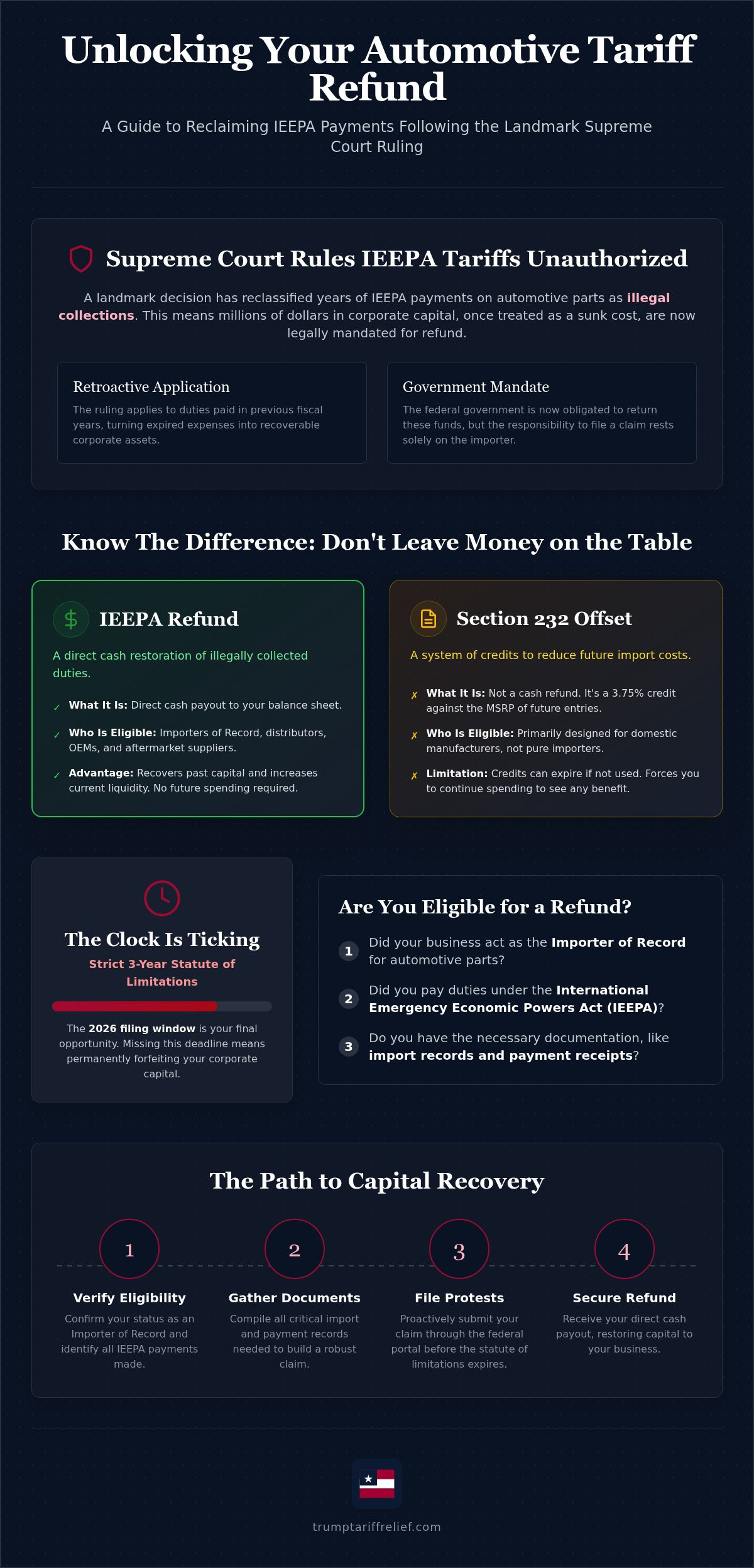
The Supreme Court's decision represents a seismic shift in trade law. By ruling that the executive branch overstepped its constitutional boundaries, the Court effectively invalidated years of unilateral tariff hikes implemented under the International Emergency Economic Powers Act (IEEPA). These weren't standard regulatory adjustments; they were an unauthorized exercise of power that siphoned billions from the private sector. For businesses, this means the tariff refund for automotive parts is no longer a theoretical possibility but a legal mandate for the federal government. This ruling provides a rare opportunity for companies to repair their balance sheets by clawing back capital that was essentially seized without proper legislative backing.
The 2026 IEEPA ruling establishes that automotive importers are legally entitled to the full restoration of duties collected under executive orders that lacked specific Congressional authorization.
The Legal Precedent for Auto Part Importers
The ruling specifically targets a wide array of vehicle components, from complex transmission assemblies to basic electrical sensors. Because the Court found these collections to be illegal from their inception, the ruling applies retroactively. This distinction is critical: standard duties are the cost of trade, but these IEEPA collections are now classified as "illegal collections." This allows your firm to reclaim capital paid out in previous fiscal years that was once considered a sunk cost. If your company paid duties on imported components during the affected periods, those funds are now viewed as a recoverable corporate asset rather than an expired expense. The ruling isn't just for industry giants; it applies to every Importer of Record who was subjected to these specific unauthorized duties.
The Federal Government’s Response and Claim Portal
In response to the mandate, the federal government has been forced to open a dedicated claim portal to facilitate the return of these funds. There are over 330,000 registered importers of record who may be eligible for these payouts, creating a massive administrative queue. You can learn more about the IEEPA ruling to see how these specific legal mechanics apply to your previous shipments. The government's obligation is clear, but the responsibility to initiate the recovery rests entirely on the business owner. You must proactively verify your status and file the necessary protests to secure your tariff refund for automotive parts before the government closes the window on these unauthorized collections. Waiting for the government to reach out is not a strategy; it's a recipe for permanent financial loss.
Section 232 Offsets vs. IEEPA Refunds: Know the Difference
Many automotive businesses mistakenly believe that the only way to recover trade expenses is through the MSRP offset program. While Section 232 provides certain benefits under Proclamation 10925, it's fundamentally different from a direct tariff refund for automotive parts under the IEEPA ruling. Understanding these distinctions is the difference between receiving a direct cash payout and merely reducing a future tax bill. If your firm is also managing broader trade challenges, you should review our guide on how to get money back from China tariffs to ensure no capital is left behind.
The MSRP Offset System Explained
Section 232 offsets are primarily designed for domestic manufacturers rather than pure importers. Under current regulations, eligible companies can apply for a 3.75% aggregate offset against the Manufacturer’s Suggested Retail Price (MSRP) of finished vehicles. However, these offsets aren't "cash back." They act as credits that decrement against future entries. This system requires manufacturers to meticulously identify supply chain partners and prove domestic production value. If your business doesn't have high-volume future imports planned, these credits may expire before they're ever fully utilized. It's a restrictive system that forces you to continue spending money to see any relief.
The IEEPA Cash Recovery Advantage
Unlike the MSRP model, IEEPA claims result in direct cash restoration because the Supreme Court found the original collection to be an unauthorized exercise of power. This program isn't limited to original equipment manufacturers (OEMs). Distributors, aftermarket suppliers, and independent importers who served as the Importer of Record are all eligible to apply for a tariff refund for automotive parts. The advantages of the IEEPA path include:
- Immediate Liquidity: You receive a cash payout for duties already paid, rather than a credit for future use.
- Broader Scope: Aftermarket suppliers and parts distributors qualify, even without a direct manufacturing presence in the U.S.
- Simplified Recovery: There is no need for complex MSRP aggregate calculations; the refund is based on the actual duties collected at the port of entry.
The IEEPA ruling addresses illegal collections, which means the recovery process is about reclaiming your own capital. You can verify your eligibility to ensure you're pursuing the most lucrative recovery path for your specific business model. Don't let the government's administrative complexity prevent you from accessing the liquidity your company has already earned.
Eligibility Criteria for Automotive Part Refund Claims
Identifying your eligibility for a tariff refund for automotive parts begins with a single document: the CBP Form 7501. To qualify for a recovery, your business must be the designated Importer of Record (IOR) for the shipments in question. If your firm’s name appears on the entry summary and you were the party responsible for paying the duties to U.S. Customs and Border Protection, you own the legal claim to the refund. This is true regardless of whether you are a massive manufacturer or a specialized distributor. You can begin with a Tariff Refund Assessment to determine if your specific import history matches the criteria set by the Supreme Court ruling.
The ruling focuses on specific classifications known as List 3 and List 4a. These lists encompass thousands of Harmonized Tariff Schedule (HTS) codes that were subjected to unauthorized duty increases. List 3, which took effect in September 2018, and List 4a, which followed in September 2019, hit the automotive sector particularly hard. If your imports fall under these categories, the capital you paid out is now considered an illegally collected duty. Identifying these codes within your historical data is the first step toward reclaiming your liquidity.
Qualified Automotive Components
The scope of eligible parts is extensive, covering nearly every level of the vehicle supply chain. Unlike narrow manufacturing offsets, the IEEPA recovery includes a wide variety of components. Common qualified items include:
- Core Mechanical Systems: Engine assemblies, transmission parts, and suspension components like shock absorbers and struts.
- Modern Technology: Electrical sensors, wiring harnesses, and EV battery components, including lithium-ion cells and thermal management systems.
- Aftermarket and Repair: Replacement brake pads, filters, spark plugs, and even aesthetic accessories like alloy wheels or trim pieces.
If these components were imported under the List 3 or List 4a designations, they are eligible for a tariff refund for automotive parts. The ruling doesn't distinguish between original equipment and aftermarket replacements; if the duty was paid under the unauthorized IEEPA orders, it's refundable.
Who is Eligible to File?
Contrary to some industry reports, this recovery isn't reserved solely for "auto goliaths" like major OEMs. While domestic manufacturers assembling vehicles with imported components have the largest individual claims, the ruling protects the entire ecosystem. National distributors and retail chains that import parts directly for resale are equally eligible to file. Small-to-medium enterprises (SMEs) that function as Tier 2 or Tier 3 suppliers often have millions in recoverable capital that has been overlooked. If your business paid the duties at the port, the government is legally obligated to return those funds to you, provided you meet the filing deadlines.
The 3-Year Deadline: Deadlines and Documentation
The window for recovery is closing. Federal law is unforgiving when it involves financial reclamation from the Treasury. Every day your firm delays, older entries fall outside the eligible window. The Tariff Refund Statute of Limitations dictates that protests must be filed within a strict timeframe. If you don't act, the government keeps your capital permanently. This isn't just about a one-time filing; it's a race against a rolling deadline that could disqualify millions in potential tariff refund for automotive parts claims. Waiting until the final months of 2026 is a high-stakes gamble that most businesses cannot afford to lose.
To secure your payout, you must produce an airtight evidentiary trail. The core of your claim rests on CBP Form 7501, also known as the Entry Summary. This document proves you were the Importer of Record and confirms the specific duties paid under the illegal IEEPA mandates. You'll also need the original commercial invoices to verify the valuation and HTS classifications. Without these documents, your claim will be rejected during the initial screening process. The burden of proof is entirely on your shoulders; the government will not provide the data you need to claw back your funds.
Step-by-Step Filing Requirements
The recovery process requires a meticulous audit of your import history from the past three years. You must first identify every entry that was subjected to List 3 or List 4a surcharges. Once identified, you need to calculate the exact dollar amount paid specifically due to the unauthorized IEEPA provisions, separating it from standard duties. Finally, these claims must be bundled and submitted through the formal CBP protest portal. Precision is mandatory. Even a minor calculation error can trigger an audit or result in a summary denial of your entire application. The portal is designed for technical accuracy, not user convenience.
Common Documentation Pitfalls
Many automotive importers struggle with data integrity. Missing or incomplete entry records are the most common reason claims fail. If your internal archives are incomplete, you must move quickly to request duplicates from your customs broker. Another significant risk to securing a tariff refund for automotive parts is HTS code inconsistency. If your commercial invoices list a code that differs from the one on your entry summary, the government will use that discrepancy to void the refund. You can review our Required Documents Checklist to ensure your filing is bulletproof before submission.
The complexity of these filings is designed to discourage claims. Don't let administrative hurdles stand between your business and its rightful capital. You can get started with our expert team to ensure your documentation meets every federal requirement before the clock runs out.
Recovering Your Capital with Trump Tariff Relief
The administrative burden of reclaiming your capital shouldn't stop you from pursuing justice. While many firms charge high hourly legal fees regardless of the outcome, we operate on a strictly risk-free, contingency-fee basis. This means if we don't secure your tariff refund for automotive parts, you don't pay us a dime. Our team manages the entire lifecycle of the refund process, from the initial data audit to the final government payout. You can see exactly how the recovery process works to understand how we shield your internal accounting team from the technical complexities of federal filings. By shifting the heavy lifting to our trade experts, your staff can remain focused on core operations while we claw back your unauthorized duty payments.
Our Specialized Automotive Trade Experts
Our team possesses deep knowledge of automotive HTS codes and the specific trade litigation that led to this landmark ruling. We have a proven track record of managing complex customs documentation for high-volume importers who were hit hardest by IEEPA surcharges. We serve as your specialized advocate, utilizing our insider expertise to navigate the intricate federal portals and bureaucracy that often stall independent claims. This high-level advocacy ensures your documentation is bulletproof and your claim is prioritized within the system. We don't just file paperwork; we aggressively pursue the maximum recovery allowed by law for every tariff refund for automotive parts claim we handle.
Get Started with a Preliminary Assessment
The clock is ticking toward the 2026 deadlines, and every day of inaction is a day of lost capital. We provide a streamlined path to verify your potential refund amount through a preliminary assessment. This process identifies exactly which entries are eligible and calculates your total recoverable assets without disrupting your daily operations. If your data shows a valid claim, we move immediately to file the necessary protests before the statute of limitations expires. Secure your capital today-Request your free eligibility assessment to beat the statute of limitations and reclaim the liquidity your business deserves.
Reclaim Your Capital and Restore Financial Justice
The Supreme Court ruling has transformed what was once a sunk cost into a vital corporate asset. If your business has been burdened by unauthorized IEEPA collections, the path to a tariff refund for automotive parts is now legally clear. You've learned that these direct cash payouts offer immediate liquidity far superior to future offsets, but you must act before the three year statute of limitations permanently forfeits your funds. The window for recovery is open, yet it closes a little more with every passing day.
Trump Tariff Relief is ready to serve as your specialized advocate in this complex landscape. We manage the entire lifecycle of your claim, from documentation audits to final government payouts, for the over 330,000 eligible importers affected by these rulings. Our success based contingency model means you pay nothing unless we recover your money, removing every financial barrier to your restoration. We handle the heavy lifting so your team can focus on growth.
Get Your Free Tariff Refund Assessment today to secure your eligibility. Your company has already earned this capital; it's time to bring it home.
Frequently Asked Questions
Is the automotive tariff refund program legitimate?
Yes, the recovery program is fully legitimate and is mandated by a landmark Supreme Court ruling that found certain IEEPA collections to be an unauthorized exercise of executive power. This isn't a discretionary grant or a temporary rebate; it's a court ordered restoration of illegally collected duties. The federal government has already established a formal portal to process these claims for the hundreds of thousands of importers identified as potentially eligible.
How much can I expect to recover for my automotive parts imports?
Your recovery amount is directly tied to the total duties you paid under List 3 and List 4a surcharges during the unauthorized period. While individual payouts vary based on import volume, some large automotive firms have reported expectations of hundreds of millions in restored capital. For most small to medium enterprises, the tariff refund for automotive parts typically covers the full surcharge amount paid plus potential interest, depending on the specific entry dates.
What is the deadline to file for an IEEPA tariff refund in 2026?
The deadline is governed by a strict three year statute of limitations from the date of entry liquidation. Because these unauthorized duties were collected on a rolling basis, the window to file a protest closes daily for older shipments. If you don't file your claim before the three year mark for each specific entry, the Treasury will permanently retain your capital regardless of the Supreme Court's ruling. Immediate action is required to preserve your rights.
Do I need a lawyer to file for a tariff refund?
You aren't legally required to hire a lawyer to file a protest, but the technical complexity of customs documentation makes self filing extremely risky. The government portal requires precise HTS code alignment and specific legal citations to trigger a payout. Most businesses partner with specialized trade experts who manage the end to end documentation and filing process on a contingency basis to ensure accuracy and maximize the recovery amount.
Can I claim a refund if I am a distributor and not a manufacturer?
Yes, distributors are fully eligible to claim a refund if they were the designated Importer of Record for the parts. Eligibility isn't determined by how you used the parts, but rather by who was legally responsible for paying the unauthorized duties at the port of entry. Whether you sold the components to a retail chain or used them for aftermarket repairs, your status as the duty payer secures your claim to the funds.
How long does it take for the government to process the refund check?
Processing times vary depending on the volume of claims currently in the federal queue and the accuracy of your submitted documentation. While the government has opened the portal to streamline applications in 2026, the sheer number of eligible importers means that early filers generally receive their checks faster. Accurate, bulletproof filings typically move through the system with fewer administrative delays, helping you restore your company's liquidity more efficiently.
What happens if I don’t have all my original import documentation?
If you're missing original records, you can often reconstruct your filing data by requesting historical entry summaries from your customs broker. Our team specializes in documentation management and can assist in identifying the specific entries required for a successful tariff refund for automotive parts. It's vital to begin this audit immediately, as missing the three year window while searching for paperwork will result in a total loss of your claim.
Ready to find out what your business may be owed?
Check My Eligibility