
A refund file can look complete and still raise questions if its records don’t agree. A useful tariff refund claim checklist is more than a document pile. It helps you cross-check which duties were paid, which entries may involve IEEPA tariffs, and whether importer and payment details line up.
Records may be spread across finance, logistics, and customs systems, and it may not be clear whether an entry involved IEEPA duties or another tariff. The distinction matters: the Supreme Court ruled on February 20, 2026, that IEEPA doesn’t authorize the tariffs, but that doesn’t mean every tariff or entry qualifies for a refund. Other tariff authorities remain in effect, and eligibility depends on the specific records and applicable procedures.
This checklist helps you locate entry summaries, proof of payment, and Harmonized Tariff Schedule codes, then compare importer-of-record names, entry numbers, dates, and amounts for gaps or inconsistencies. You’ll also learn how to organize a master entry tracker and prepare records for a specialist assessment. Gathering and checking documents is a practical first step, not a guarantee of eligibility, approval, or recovery.
Key Takeaways
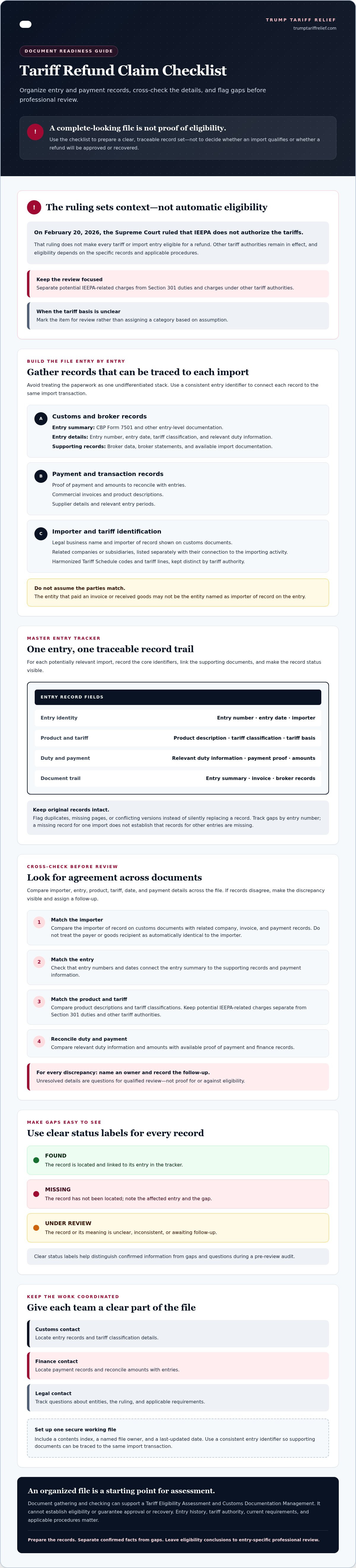
- Track each record as found, missing, or under review so unresolved items don’t get lost between teams.
- Compare importer, entry, product, and tariff details across documents. Assign an owner and follow-up for each discrepancy.
- Use clear status labels in a pre-review audit to separate confirmed information from gaps and questions for professional review.
- Keep the review focused on potential IEEPA-related claims. Tariffs imposed under other authorities aren’t automatically part of the same refund process.
- An organized file can support a Tariff Eligibility Assessment and Customs Documentation Management, but it can’t establish eligibility or guarantee a refund.
Tariff Refund Claim Checklist: What to Confirm Before Gathering Records
Use this checklist to prepare a clear, traceable file for review, not to decide whether your business is entitled to a refund. The focus is on potential claims involving tariffs collected under the International Emergency Economic Powers Act (IEEPA), not every customs duty or tariff payment. The Supreme Court ruled on February 20, 2026, that IEEPA does not authorize the president to impose tariffs. However, that ruling doesn’t make every import entry eligible for a refund. The tariff authority, entry history, and applicable procedures all matter.
For background on the International Emergency Economic Powers Act (IEEPA), see the act’s overview. For context specific to the tariff ruling, read this IEEPA tariff ruling explanation. Use these resources to orient your review, then verify current requirements against official guidance and the facts of each entry.
Identify the importer and the tariffs at issue
Start with the legal business name and importer of record shown on the customs documents. If your records include related companies, subsidiaries, or other business entities, list each separately and note how it connects to the importing activity. The importer of record is an important detail to verify during assessment. Don’t assume the entity that paid an invoice or received the goods is the same one named on the entry.
Next, create an initial inventory of potentially affected imports. Record suppliers, product descriptions, and relevant entry periods, keeping tariff lines distinct. Don’t group IEEPA-related charges with Section 301 duties or charges imposed under other tariff authorities. If a document doesn’t clearly identify the tariff basis, mark it for review rather than assigning a category based on assumption.
Set up a claim-readiness file
Before records arrive from different teams, establish one secure location for the working file. Add a contents index, a named file owner, and a last-updated date. Use a consistent entry identifier in the index so each supporting document can be traced to the same import transaction. Keep original records intact, and flag duplicates, missing pages, or conflicting versions instead of silently replacing them.
- Customs contact: Locate entry records and tariff classification details.
- Finance contact: Locate payment records and reconcile amounts with entries.
- Legal contact: Track questions about entities, the ruling, and applicable requirements.
Eligibility and filing requirements depend on current law and entry-specific facts, including the tariff authority and the entry’s status. Treat unresolved details as questions for a qualified review, not as proof for or against eligibility. An organized file gives a specialist a clearer starting point for assessing records and identifying follow-up needs.
Build the Tariff Refund Claim Checklist Around Entry and Payment Records
Build the file entry by entry, not as one undifferentiated stack of paperwork. For each potentially relevant import, record the entry number, entry date, importer, tariff classification, and duty details. Then mark every item found, missing, or under review. This tariff refund claim checklist helps expose gaps without assuming that a particular document is legally required or that every entry qualifies.
Locate customs and broker records
Search company files for CBP Form 7501 entry summaries and other entry-level documentation. Ask the customs broker for available entry data and supporting records, specifying entry numbers and dates to make the request actionable. Track gaps by entry number. A missing summary for one import doesn’t mean records for other entries are missing too.
- Entry summary: Mark it found, missing, or under review.
- Entry details: Capture the entry number, entry date, tariff classification, and relevant duty information.
- Supporting import records: Locate commercial invoices, product descriptions, and broker statements where available.
Treat entry summaries and entry-level data as central evidence for identifying what was declared. Invoices and broker statements can help clarify a transaction or support a cross-check, but their relevance may vary. Confirm documentation requirements against current official guidance and the facts of the entry before labeling any item mandatory.
Reconcile payment and accounting records
Next, connect the customs records to the money trail. Locate customs payment confirmations, broker statements, invoices, and general-ledger entries where available. Match each record to an entry number or another clear document identifier. If one payment covers multiple entries, record that relationship rather than assigning the full amount to a single import without support.
- Compare payment dates and amounts across available records.
- Flag differences between broker statements and accounting entries for follow-up.
- Record which payment details are confirmed and which still need reconciliation.
A practical tracker might show one entry as “summary found, payment under review” and another as “broker statement missing.” This level of detail helps teams focus follow-up instead of repeatedly searching the same folders. Documents support review, but they don’t independently establish eligibility or replace confirmation of current filing procedures. For businesses managing cross-border transactions that also need support with European accounting and corporate compliance, learn more about TaxSlovenia for specialized tax and bookkeeping guidance.
Once the records are indexed, review how the IEEPA refund process works and consider whether a specialist assessment could clarify next steps. Keep the checklist and source documents together so unresolved entry-level questions are easy to trace.
Cross-Check the Claim: Importer Details, Tariff Lines, and Entry Status
A record can be present and still fail to match the rest of the file. Compare customs entry data with purchase orders, invoices, broker records, and accounting entries using a consistent identifier, ideally the entry number. The tariff refund claim checklist is more useful when it shows what you have, where records conflict, and who will investigate each issue.
| Record | Matching identifier | Discrepancy | Owner | Follow-up |
|---|---|---|---|---|
| Customs entry summary | Entry number and importer name | Importer name differs from internal records | Customs contact | Confirm the entity shown on the source document |
| Invoice or purchase order | Supplier, product, and reference number | Product description or reference is unclear | Procurement contact | Compare against the entry and request clarification |
| Payment or ledger record | Entry number or payment reference | Amount does not reconcile | Finance contact | Trace the payment and document the difference |
| Tariff detail | Entry line and classification | Tariff authority is uncertain | Assigned reviewer | Flag for professional review |
Reconcile records without rewriting history
Check importer names, entry identifiers, product descriptions, tariff classifications, and duty information across source documents. A shortened company name may be a harmless variation, or it may point to a different legal entity. Keep duplicate entry numbers, missing invoice references, and amounts that don’t reconcile visible in the tracker until they’re explained.
Don’t edit original records to force a match. Preserve the source, note the discrepancy, and attach an explanation or follow-up record when available. If a tariff line may involve IEEPA, mark it as uncertain and send it for expert review rather than classifying it yourself. Keep Section 301 and other tariff categories distinct.
Track entry status and time-sensitive questions
For each entry, record any known liquidation, reliquidation, protest, or other procedural status, along with the source and date checked. These details can affect the appropriate next step. Don’t assume one deadline or procedure applies to every entry. Ask a qualified professional to confirm current options and deadlines against the entry’s history and applicable guidance.
Keep unresolved status questions prominent, not buried in notes. For general process context, consult the tariff refund process FAQs, then verify entry-specific requirements before acting.
Pre-Filing Audit: Find Gaps Before Tariff Refund Review
Before sending records for review, audit identity, entry coverage, tariff details, payments, and open questions. Use the same status labels for every entry: confirmed, missing, inconsistent, or needs professional review. This turns your tariff refund claim checklist into a practical handoff, not a conclusion about eligibility or a guarantee of recovery.
Run a five-point evidence check
- Confirm identity. Check that the legal entity and importer of record match the relevant customs documents. Record name variations rather than assuming they refer to the same entity.
- Check entry coverage. Compare your entry list with available customs and broker records. Mark entries with missing summaries or identifiers so each gap is tied to a specific import.
- Review tariff details. Check the recorded classifications and tariff information. If the tariff authority is uncertain, flag it for professional review instead of labeling the charge yourself.
- Reconcile payments. Trace available payment evidence to the related entry or reference. Mark amounts that don’t match accounting or broker records as inconsistent until explained.
- List open questions. Note unknown entry status, unclear payment links, and procedural questions. Ask a qualified professional to confirm current requirements and any applicable deadlines.
Preserve original records in their existing form. For each file, note where it came from, when it was obtained, and which entry it supports. If a record is corrected or supplemented, retain the original and keep the follow-up document separate. A clear audit trail helps a reviewer distinguish source evidence from later explanations.
Prepare a concise handoff for a reviewer
Summarize the potentially affected entries, known tariff categories, record gaps, and the customs, finance, or legal contacts who can answer questions. Separate verified facts from estimates, assumptions, and unresolved legal issues. For example, label a payment amount “confirmed” only when supporting records connect it to the relevant entry. Otherwise, state what still needs to be reconciled.
This preparation helps a specialist focus on entries and discrepancies that need attention. It doesn’t establish eligibility or secure a refund. To understand the review stages, see how the IEEPA refund process works. A clear handoff also makes it easier to identify which records or questions need further review.
After the Checklist: Get Your Tariff Refund Claim Professionally Assessed
An organized file makes review more efficient, but completing a tariff refund claim checklist doesn’t establish eligibility, secure a filing, or guarantee a refund. Have the entry-specific facts and current requirements assessed before treating a potential claim as recoverable. A reviewer can help distinguish records that appear relevant from details that remain unverified.
What a specialist assessment can clarify
A specialist can examine whether records appear relevant to your business’s potential IEEPA claim, identify documentation gaps, and flag entry-level questions that need further verification. For example, your file may contain customs and payment records but still leave uncertainty about which entity imported the goods or which tariff category applies. These are questions for assessment, not assumptions to resolve by relabeling documents.
Trump Tariff Relief provides Tariff Eligibility Assessment, Customs Documentation Management, and government filing support. Its legal and trade experts manage the process from assessment through filing. A review can clarify what may need attention, but it can’t promise eligibility, approval, a particular refund amount, or a processing timeline.
Choose a clear next step
Prepare a short summary of the entries under review, the records available, the gaps you’ve identified, and the questions you want answered. Identify the person authorized to discuss the business’s records and coordinate follow-up. Keep the summary factual by separating verified information from estimates, assumptions, and unresolved legal or procedural questions.
Trump Tariff Relief uses a contingency-based fee model: there are no upfront costs, and the firm charges a percentage of the refund successfully recovered. Confirm the current terms and scope directly before proceeding. Contingency-based service doesn’t mean every claim succeeds, and it isn’t a guarantee of recovery.
Put Your Records in Motion with a Specialist Review
A strong tariff refund claim checklist does more than gather paperwork. It helps your team connect entry and payment records, separate potential IEEPA-related charges from other tariffs, and flag details that still need verification. Keep source documents intact and make gaps visible so a reviewer can see what’s confirmed and what needs follow-up.
Preparation is an important step, but it doesn’t establish eligibility or guarantee a refund. Trump Tariff Relief’s legal and trade experts manage assessment, documentation, and government filings. The firm uses a contingency-based fee model with no upfront costs and charges a percentage of the refund successfully recovered. Confirm current fee terms and service scope directly before proceeding.
If your records are organized, discuss them with a specialist who can assess the potential claim and identify questions that need attention. Request a specialist tariff refund assessment to review your records and discuss the potential claim. The entry facts and applicable requirements determine what can happen next.
Frequently Asked Questions
What documents should I gather for a tariff refund claim?
Gather available customs entry summaries, entry identifiers, broker records, invoices, payment evidence, and related accounting records. The documents that matter depend on the entries and the potential basis for a claim, so treat this as a starting inventory, not a complete list of legal requirements. Organize records by entry, label each found or missing, and ask a qualified professional to confirm current documentation requirements for the specific entries.
Who can prepare a tariff refund claim checklist?
Your customs, finance, and legal contacts can help locate and organize the records each team holds. A customs broker may also be able to provide entry data or documents it handled. For questions about eligibility, applicable procedures, or filing strategy, seek review from a qualified professional. Preparing the checklist is useful groundwork, but gathering paperwork alone doesn’t establish that your business qualifies for a refund.
Can a company claim a refund if its customs broker paid the duties?
The payment route alone doesn’t determine who may receive a refund or what records are needed. Check the entry documents to identify the importer of record, the parties involved, and how the payment was recorded. The official refund process identifies the importer of record as key. Preserve broker statements and payment evidence, then ask a qualified professional to review the entries and current procedures before deciding on next steps.
How do I know whether my records relate to IEEPA tariffs?
Review entry-level tariff information and supporting customs records, but don’t classify a payment using only a product description or country of origin. Tariff categories and entry details can be complex, and documents may require interpretation. Flag uncertain entries for professional review rather than guessing. Before drawing conclusions, confirm the current legal scope and applicable procedures for a potential IEEPA refund process against official guidance and the facts of each entry.
What happens if I am missing an entry summary or payment record?
Mark the document missing and identify the entry it may affect. Don’t assume it’s unrecoverable or unnecessary. Contact the customs broker, finance team, or other record custodian, and note when you requested it and any response. Keep unresolved gaps visible in your tracker. A specialist can help assess whether other records may provide useful support and whether the available evidence is sufficient for further review.
Is a tariff refund claim checklist the same as an eligibility assessment?
No. A tariff refund claim checklist helps organize and cross-check records, while an eligibility assessment considers the relevant legal framework, entry-specific facts, and procedural circumstances. A complete-looking file doesn’t guarantee a claim qualifies, and missing records don’t automatically settle the question either. Use the checklist to prepare for review, then have a qualified professional verify eligibility and current filing requirements before deciding how to proceed.
Do IEEPA and Section 301 tariff refunds use the same claim process?
Don’t assume they use the same process. IEEPA and Section 301 are distinct tariff authorities, and the relevant legal basis, entry facts, procedures, and available remedies may differ. Keep charges in separate categories in your records, and have a qualified professional determine which may be relevant to your situation. Check current official guidance before applying a process for one tariff category to another.
How long should I keep tariff refund claim records?
Keep relevant customs, payment, broker, and accounting records organized and accessible while you seek professional guidance. Retention requirements may depend on the record type, applicable rules, and the status of a potential claim, so this checklist can’t establish one universal retention period. Ask your customs or legal professional to confirm current obligations. Preserve original files and record where each document came from rather than relying only on working copies.
Ready to find out what your business may be owed?
Check My Eligibility