
The 2026 Supreme Court ruling didn't just change trade law; it unlocked a massive vault of capital that belongs back in your company's accounts. Every dollar you paid under IEEPA over the last three years is now potentially recoverable, provided you can prove it. The biggest obstacle standing between your business and a significant refund isn't the law itself, but the specific documentation for tariff refund claim filings that CBP now demands. If your records are incomplete or fail to bridge the gap between bank statements and ACE portal entries, your claim will likely be rejected before it even reaches an auditor's desk.
You're likely staring at a mountain of three-year-old customs entries and wondering which specific files will actually satisfy federal audit standards. It's frustrating to know your money is sitting in government hands while you're buried in administrative red tape. This guide will help you master the exact documentation requirements needed to successfully reclaim your IEEPA payments. We'll provide a streamlined list of essential records, explain how to verify your data against current ACE standards, and show you how to ensure your filing passes the most rigorous CBP scrutiny without the typical headache.
Key Takeaways
- The 2026 Supreme Court ruling opened the door for recovery, but CBP requires a complete verification chain to prove every dollar owed.
- Successful filings depend on mastering the specific documentation for tariff refund claim requirements, specifically linking Form 7501 summaries to your financial payment records.
- Professional verification is critical to identify "ghost entries" and avoid the "unsupported claim" warnings issued by CBP in the wake of the 2026 ruling.
- You can streamline your recovery by securing ACE Trade Account Owner access and downloading comprehensive entry reports for the impacted three-year window.
- A contingency-based recovery partner handles the heavy lifting of data extraction and filing, allowing you to reclaim capital without financial risk or administrative strain.
Why Documentation is the Foundation of Your IEEPA Refund Claim
The February 20, 2026 Supreme Court ruling was a landmark victory for American importers, effectively invalidating specific tariffs levied under the International Emergency Economic Powers Act (IEEPA). However, this legal triumph doesn't mean your money will automatically reappear in your corporate accounts. U.S. Customs and Border Protection (CBP) maintains a strict "burden of proof" standard. This means the responsibility to prove every cent owed falls squarely on the importer of record. Your documentation for tariff refund claim isn't just a pile of paperwork; it's the legal bridge between your past financial losses and your future recovery. If you can't prove the payment, the government won't return it. Incomplete records are the primary driver of claim denials, often turning a clear legal right into an administrative failure.
The 2026 Legal Landscape for Importers
The regulatory environment has shifted rapidly since the ruling. While previous recovery efforts often centered on Section 301 exclusions, the current landscape is specifically focused on IEEPA-driven recovery. This transition requires a specialized set of verification standards that many internal teams haven't encountered before. You must act quickly. The statute of limitations on these entries is unforgiving, making document organization an urgent priority for any business that paid these duties between 2023 and 2025. The ACE portal is now the primary arena for these disputes. Modern recovery requires a digital-first approach. If your internal records don't align perfectly with the data housed in the ACE system, your claim will likely stall in administrative purgatory or face an immediate rejection from CBP auditors.
The Risk of Inadequate Record-Keeping
CBP has already issued warnings regarding "unsupported claims" identified during the CAPE declaration process. These are filings that lack the granular data necessary to verify the original transaction chain. Data gaps are expensive. A single missing entry summary or a minor discrepancy in an ACH payment record can disqualify an entire batch of otherwise eligible entries. Beyond the lost refund, inadequate record-keeping exposes your firm to increased scrutiny and potential audits on future shipments. You aren't just losing the refund; you're losing the time and resources spent on a failed filing. Precision is your only defense. To protect your capital, you must ensure your data is bulletproof before submission. Learn more about the IEEPA ruling to understand the specific legal triggers that necessitate this level of documentary rigor.
The Big Three: Essential Documentation for Tariff Refund Claims
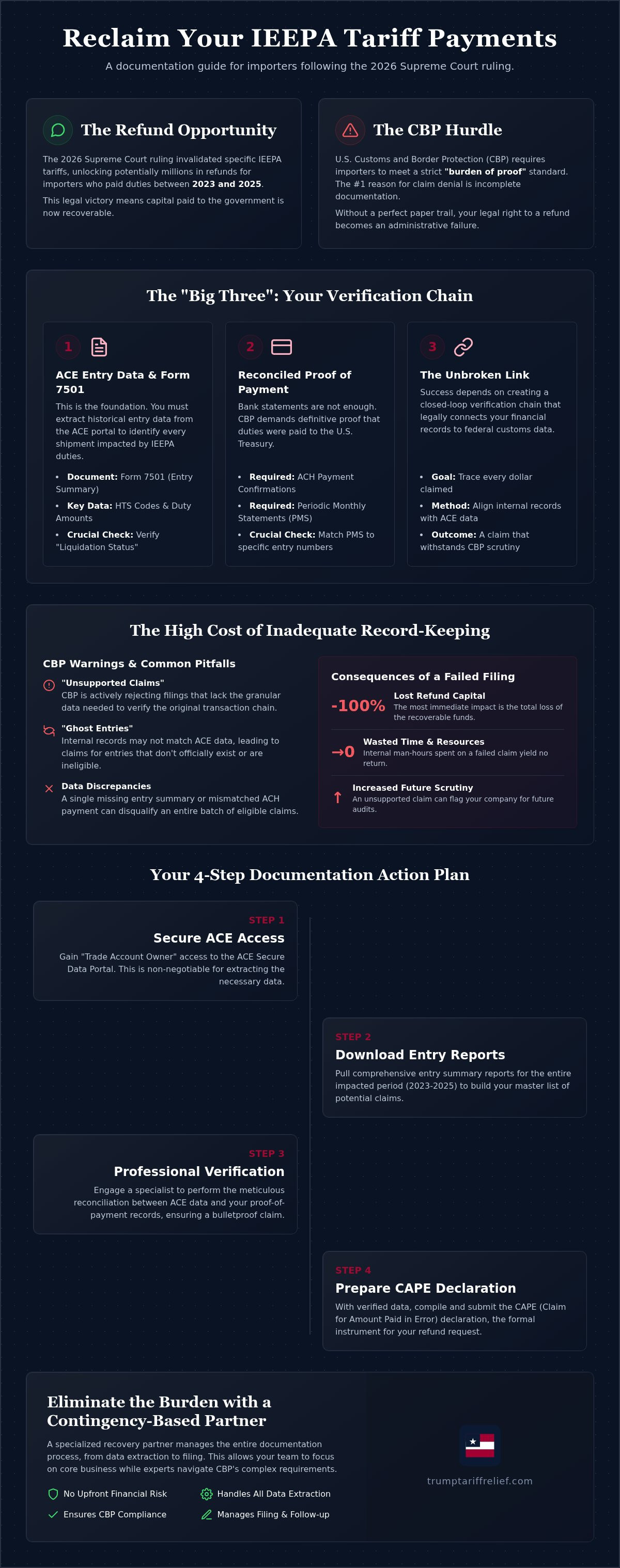
Securing a refund isn't about general eligibility; it's about specific evidence. To win, you must construct a "Verification Chain" that links your internal financial records to federal customs data. Every dollar you attempt to reclaim must be traceable through three distinct categories of evidence. If one link is missing, CBP will likely deny the entire line item. This level of precision is why many internal teams struggle with the documentation for tariff refund claim process. You aren't just submitting forms. You're proving a financial transaction occurred exactly as reported to the government.
Category 1: ACE Entry Data and Form 7501
Your recovery starts with the ACE portal. You need to extract historical entry data to identify every shipment hit with IEEPA duties. The Form 7501, or Entry Summary, is the foundational document here. It lists the specific HTS codes and duty amounts paid at the time of import. However, simply having the form isn't enough. You must verify the "Liquidation Status" of each entry. If an entry hasn't liquidated, or if it's tied up in a prior protest, the filing requirements change. We identify these technical hurdles early to prevent administrative delays.
Category 2: Reconciling Proof of Payment
CBP auditors are notoriously skeptical of simple bank statements. A line item on a ledger showing a wire transfer rarely satisfies their standards for IEEPA recovery. You need the ACH payment confirmations and Periodic Monthly Statement (PMS) records. These documents provide the definitive proof that the duties were actually cleared by the U.S. Treasury. Matching your PMS records to specific entry numbers is non-negotiable. This reconciliation creates a closed loop that proves the money left your account and reached the government's coffers. Without this, your claim is just a request; with it, it's an enforceable demand for repayment.
Category 3: Validating with Commercial Invoices
The final pillar involves commercial support. You must provide invoices, purchase orders, and packing lists that validate the HTS codes used during the initial entry. CBP uses these to ensure the "Country of Origin" and product descriptions align with the invalidated IEEPA categories. Discrepancies here are a major red flag. If you've lost historical purchase orders, you'll need secondary evidence to bridge the gap. We help clients navigate these data gaps by triangulating available records to meet audit standards. Understanding how it works from a data perspective can save your team hundreds of hours of manual labor.
Internal Audit vs. Professional Verification: Avoiding Denials
CBP has turned up the heat. In 2026, the agency issued explicit warnings regarding "unsupported" or "fraudulent" IEEPA recovery attempts. These warnings aren't just bureaucratic noise; they represent a fundamental shift in how the government evaluates your documentation for tariff refund claim. An internal team might see a list of payments and assume they're all eligible. A professional audit, however, identifies "ghost entries" that appear qualifying on the surface but fail to meet the specific "List" criteria of the 2026 ruling. The difference between a "best guess" and a "defensible claim" is the difference between a check in the mail and a formal summons from a customs auditor.
The Danger of Over-Claiming
Claiming ineligible duties is a high-stakes gamble you don't want to take. If you inadvertently include entries that fall outside the invalidated IEEPA categories, you risk triggering a broader, more invasive customs audit of your entire business. This is especially common with "Mixed Entries," where a single shipment contains both refundable and non-refundable items. You can't simply reclaim the total duty paid on the invoice. You must isolate the specific line items that match the court's invalidation. Your transfer pricing documentation must also align with these claims. If your internal valuations don't match your recovery data, CBP will flag the discrepancy immediately. Precision isn't just about getting more money; it's about protecting your company from federal overreach.
Why Professional Scrubbing is Essential
The sheer volume of historical data makes manual verification nearly impossible for most trade departments. We use specialized software to cross-reference thousands of customs entries in minutes, ensuring every piece of documentation for tariff refund claim is backed by a verified document chain. This "scrubbing" process identifies and corrects HTS classification errors before CBP ever sees them. Often, an importer might have used a generic code that doesn't trigger a refund, even if the product itself is eligible. We find these opportunities and rectify the paperwork to maximize your recovery. This level of technical rigor ensures your filing is bulletproof from day one. You can see how our recovery process works to understand how we transform raw data into a successful, low-risk filing.
Professional verification provides the peace of mind that your records will withstand the most rigorous scrutiny. We don't just file paperwork; we build a strategic defense for your capital. By filtering out ineligible data and highlighting every legitimate opportunity, we turn a complex administrative burden into a streamlined financial win for your business.
Action Plan: Preparing Your Records for the CAPE Declaration
The window for IEEPA recovery is open, but it's narrow. You can't afford to stumble through the filing process. To secure your capital, you need a tactical roadmap that turns your archives into a compliant filing. This action plan ensures your documentation for tariff refund claim meets the specific technical requirements of the CAPE Declaration. Precision during this stage prevents the "unsupported claim" flags that stall so many internal efforts. Follow these steps to prepare your data for a successful submission.
- Step 1: Secure or reactivate your ACE Trade Account Owner (TAO) access immediately. Without active TAO status, you can't authorize necessary data transfers or assign a preparer for your declaration.
- Step 2: Download a comprehensive "Entry Summary" report for the impacted years (2023 through 2025). This report serves as your master data set.
- Step 3: Segregate entries by their specific IEEPA duty rates. You'll likely find entries taxed at 25% and others at 7.5%. These must be categorized separately to ensure the refund math is precise.
- Step 4: Digitize every physical commercial invoice. Link each digital file to its corresponding entry number to create an unbreakable audit trail for CBP auditors.
- Step 5: Perform a "pre-filing reconciliation." Check your internal accounting against the ACE data one last time. Discrepancies here are the most common cause of CBP pushback.
Optimizing the ACE Portal for Recovery
The ACE portal is the gatekeeper for your refund. Within your account settings, you must explicitly assign a "CAPE Declaration" preparer. This role allows your recovery partner to upload and manage the technical aspects of the filing without compromising your broader account security. If your account has lapsed or you've lost your TAO credentials, resolving this should be your first priority. You can't file without it. Review our tariff refund assessment guide to verify your specific eligibility before you begin the portal setup.
The Timeline for Preparation
Speed is essential, but haste is dangerous. We recommend you start gathering your records at least 90 days before you intend to file. This buffer allows you to track down missing invoices and resolve any data conflicts found during reconciliation. Setting up a secure data room for your trade consultancy team ensures that sensitive financial information is handled safely during the audit phase. Be mindful of the tariff refund statute of limitations; once the deadline passes, your right to recover this capital is gone forever.
Don't let administrative friction cost you millions. Request a professional data review to ensure your documentation for tariff refund claim is bulletproof before the filing window closes.
Eliminating the Burden: Contingency-Based Documentation Management
Organizing the documentation for tariff refund claim is a massive undertaking that most internal trade departments simply aren't staffed to handle. The 2026 ruling created a significant financial opportunity, but it also created a logistical nightmare. Trump Tariff Relief eliminates this administrative headache by managing the entire lifecycle of your IEEPA recovery. We don't just provide a checklist; we execute the verification. Our team manages the data extraction, cross-references your entries with federal standards, and handles the final filing on your behalf. We transform a complex regulatory hurdle into a streamlined recovery process.
The Value of a Specialized Partner
While you might consider using your existing customs broker, generalists often lack the specific technical infrastructure required for large-scale IEEPA recovery. We maintain a specialized focus on the 2026 ruling, tracking every update to CBP filing phases and CSMS messages in real-time. This "insider" knowledge allows us to bypass the common pitfalls that lead to denials or lengthy delays. We take on the heavy lifting of document verification and audit preparation so your internal team can stay focused on core operations. You shouldn't have to choose between trade compliance and business growth.
A Risk-Free Recovery Model
Unlike traditional consulting firms that charge hourly rates or fixed upfront fees, our business operates on a pure contingency-fee model. This means you only pay a percentage of the actual refund we recover for you. There are zero upfront costs and zero risk to your current operational budget. If we don't secure a refund, you don't owe us a dime. This alignment of interests ensures we're as motivated as you are to find every eligible dollar and defend it against CBP scrutiny. We assume the financial risk so you can reap the rewards.
Get Your Free Eligibility Assessment
The path to recovery begins with a no-obligation review of your potential refund volume. We use secure methods to access your ACE data, allowing us to provide an accurate estimate of what your business is owed without disrupting your daily workflow. This assessment provides the clarity you need to make an informed decision about your capital. It's time to reclaim what's yours without the administrative strain. Contact us today for a free assessment and let us transform your technical documentation for tariff refund claim into a tangible financial asset.
Secure Your Recovery Before the Filing Window Closes
The 2026 Supreme Court ruling represents a rare opportunity to correct a financial injustice, but the government won't make the recovery process easy. Success depends entirely on the integrity of your documentation for tariff refund claim. Linking ACE entry data with definitive financial payment records is the only way to satisfy CBP's rigorous audit standards. Relying on an internal "best guess" invites administrative delays or broader customs scrutiny that your business doesn't need.
Trump Tariff Relief provides the specialized IEEPA expertise required to navigate this high-stakes bureaucratic landscape. We handle every step; from the initial data extraction to the final filing; on a contingency basis. This means we only get paid if you successfully recover your capital. Our comprehensive documentation management removes the administrative burden from your team and eliminates the financial risk to your budget. Don't let your eligible refunds expire in government accounts due to missing paperwork or filing errors.
Reclaim your capital with a risk-free IEEPA assessment today. It's time to restore your operational budget and put your capital back to work where it belongs.
Frequently Asked Questions
What is the most important document for an IEEPA tariff refund claim?
Form 7501, the Entry Summary, is the foundational document for any IEEPA filing. It contains the HTS codes and duty amounts that prove you paid the invalidated tariffs. Without this form, you cannot establish the baseline for your claim. We use this data to build your verification chain, ensuring every line item matches the ACE portal records. It's the first thing an auditor will check.
Can I file a tariff refund claim if I am missing some commercial invoices?
You can still file, but you'll need robust secondary evidence to satisfy audit standards. If commercial invoices are missing, we use packing lists, purchase orders, and bank records to triangulate the country of origin. While missing documentation for tariff refund claim filings makes the process harder, it isn't an automatic disqualifier if we can prove the transaction through other verifiable means.
How far back do I need to go when gathering documentation for IEEPA refunds?
You must gather records for all impacted entries between 2023 and 2025. The 2026 Supreme Court ruling specifically addresses duties paid during this three-year window. Because the statute of limitations is strict, you need to secure these records immediately. Any entry outside this timeframe won't qualify; missing even one month of data from the eligible period means leaving your capital on the table.
What is a CAPE Declaration and why is it required for my refund?
The CAPE Declaration is the mandatory technical filing required by CBP in 2026 to process IEEPA refunds. It acts as a formal certification that your claim is accurate and supported by valid records. Unlike standard protests, this declaration requires a specific ACE account setup. It's the gatekeeper for your refund, designed to filter out unsupported claims while streamlining the return of capital for compliant importers.
Is proof of payment required if the entry is already liquidated in ACE?
Proof of payment remains a non-negotiable requirement even for liquidated entries. CBP needs to verify that the treasury actually received the funds before they issue a refund check. Liquidated status in ACE shows the entry is finalized, but it doesn't always reflect final payment confirmation. We use ACH records and Periodic Monthly Statements to provide the absolute financial proof required to close the loop.
How long should I keep my records after receiving a tariff refund?
You are legally required to maintain all customs records for five years from the date of entry or liquidation. This includes the documentation for tariff refund claim and all supporting commercial files. Since CBP can conduct post-refund audits, keeping an organized digital archive is your best defense. If you can't produce the records during a later check, you may be forced to return the recovered capital.
Can my current customs broker handle the documentation for this claim?
While many brokers offer general services, most aren't equipped for the high-volume data extraction required for IEEPA recovery. This process is a specialized legal and financial audit, not a standard entry filing. We often partner with existing brokers to handle the heavy lifting of documentation management. Our focus is strictly on recovery, ensuring your claim doesn't get buried under your broker's daily operational tasks.
What happens if CBP audits my refund documentation later?
If CBP audits your claim, they will demand a complete verification chain linking your bank records to your customs filings. If your documentation is incomplete or inconsistent, the agency can deny the claim or demand repayment of funds already issued. This is why we emphasize scrubbing your data before filing. A professional audit today prevents a government-mandated financial penalty tomorrow.
Ready to find out what your business may be owed?
Check My Eligibility