
What if a customs claim deadline started before you knew your entry had been liquidated? The statute of limitations for liquidated entry claims is not one universal clock. For a standard protest, the 180-day period generally runs from the liquidation date, while other procedures follow different rules. Missing the deadline that applies to your entry may narrow or close a potential refund route.
If you’re unsure whether to pursue a post-summary correction, file a protest, seek court review, or check eligibility for an IEEPA refund process, start by confirming the entry’s status and identifying the procedure that may apply. This article explains how liquidation, protest deadlines, reliquidation, and Court of International Trade timelines fit together, and which dates and records to verify first. Do not assume that a deadline for one route governs another. For IEEPA tariff refund recovery, an eligibility and documentation review can help clarify what may be available, without promising a particular outcome.
Key Takeaways
- Distinguish the entry date, liquidation date, and whether the entry is finally liquidated before choosing a next step.
- The statute of limitations for liquidated entry claims depends on the procedural route and the event that triggers its deadline.
- Compare a protest, CBP reliquidation, and court action by checking the applicable rule and the records that confirm key dates.
- Use CBP notices and available ACE data to organize entry status, liquidation details, protest decisions, and supporting documents.
- An IEEPA-specific eligibility and documentation assessment can help identify which recovery route may be available for your entries.
What “Liquidated Entry” Means for a Customs Claim
Liquidation is CBP’s formal calculation of the duties, taxes, and fees owed on an entry. The entry’s status and liquidation date can affect which steps remain available to challenge the assessment or pursue a refund. But liquidation does not automatically mean that every issue is beyond review. The applicable process depends on the claim and its procedural history.
Quotable definition: “Liquidation is CBP’s final computation of the duties, taxes, and fees due on an import entry.” See 19 U.S.C. § 1500, which directs CBP to determine the classification, value, and duties and to liquidate the entry. “Final” describes the calculation, not necessarily the end of every available challenge.
What happens when CBP liquidates an entry?
An entry is the import transaction recorded with CBP. Liquidation is the agency’s later determination of the final duty calculation for that entry. Finality describes the legal effect of that determination, which may depend on whether a protest or another permitted procedure applies. The liquidation date can affect the next procedural option, but it does not by itself establish whether a refund claim can proceed.
Do not estimate an entry’s status from the date goods arrived, duties were paid, or a broker sent paperwork. Check the actual CBP entry record and related notices. If a dispute proceeds beyond administrative review, the United States Court of International Trade is the federal court that hears certain customs matters.
Why the entry record matters before calculating time
Before assessing the statute of limitations for liquidated entry claims, collect the entry number, current liquidation status, recorded liquidation date, and any CBP notices or protest decisions. Then match those records to the specific claim. A protest, a request involving reliquidation, and a tariff refund process may follow different rules, so do not assume one deadline controls them all.
Entries from the same shipment or importer can have different liquidation dates and procedural histories. Review each entry individually and preserve the records that support its timeline. For broader context on how refund procedures may differ, see this guide to IEEPA tariffs and refunds. The entry record is the starting point; the claim-specific rules determine what comes next.
How the Deadline for a Liquidated Entry Is Triggered
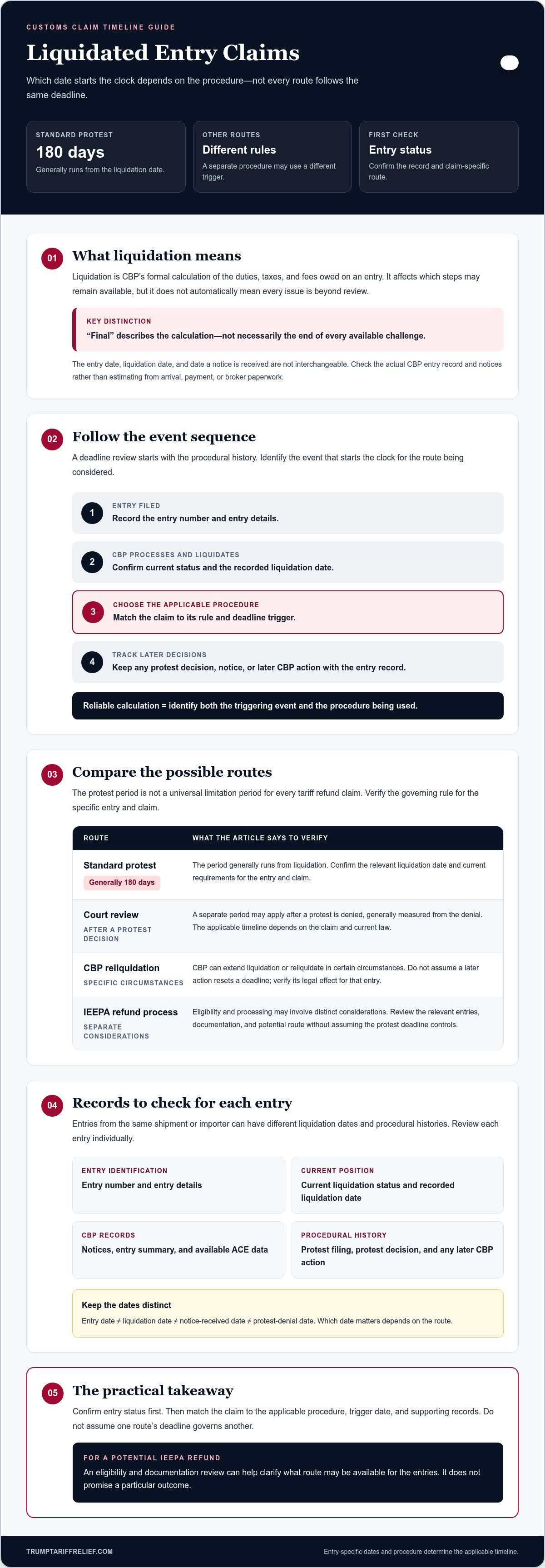
Deadline review starts with a sequence, not a single date. The entry is filed, CBP processes and liquidates it, and the importer may then take an administrative or judicial step if the law allows. Each step can have its own trigger. The entry date, liquidation date, date a notice is received, and date a protest is denied are not interchangeable.
Quotable rule: “A reliable deadline calculation must identify both the event that starts the clock and the procedure the importer plans to use.” That distinction is central to the statute of limitations for liquidated entry claims. The right timeline depends on the specific claim and procedural route.
Which date starts the clock?
For a standard customs protest, current law generally allows 180 days from liquidation to file. The clock is tied to the liquidation date, not to when the importer discovers the entry’s status. CBP explains how to file a Protest under 19 U.S.C. 1514. Confirm the relevant date and requirements against the current rules for the entry and claim.
Other dates may matter later. If a protest is denied, a separate period for seeking court review may apply, generally measured from the denial. CBP can also extend liquidation or reliquidate an entry in certain circumstances. Do not assume an extension or later action automatically resets a deadline. Verify its legal effect for that entry. Keep dated CBP notices, the entry summary, and records showing any liquidation or protest decision.
Does every liquidated-entry claim have the same time limit?
No. A protest, a court challenge, and a refund process based on a separate legal theory may have different rules and triggers. The 180-day protest period is not a universal limitation period for every tariff refund claim. Do not apply a commonly cited time limit without matching it to the governing procedure.
For example, a denied protest may lead to a potential action in the U.S. Court of International Trade, while an IEEPA tariff refund scenario may involve distinct eligibility and processing considerations. The effect of a court ruling and the available route depend on the specific facts and current law. Review the IEEPA tariff ruling explanation for context, then confirm any filing deadline and date calculation with qualified customs counsel. An entry-level review of dates and records can help clarify which recovery route may warrant further assessment.
Protest, Reliquidation, or Court Action: Compare the Routes
These procedures are not interchangeable. A protest asks CBP to review a covered decision. Reliquidation is a limited power for CBP to correct an entry. Court action seeks judicial review through a separate jurisdictional route. The statute of limitations for liquidated entry claims therefore depends on the route, its triggering event, and whether the entry and decision qualify.
| Route | Trigger | Governing authority | General deadline | What to verify |
|---|---|---|---|---|
| Administrative protest | Liquidation or another protestable CBP decision | 19 U.S.C. § 1514 | Generally 180 days from liquidation for a protest of liquidation | Entry status, liquidation date, decision type, exceptions, and current CBP protest instructions |
| CBP reliquidation | Original liquidation | 19 U.S.C. § 1501 | CBP generally may reliquidate on its own initiative within 90 days | Whether CBP acted, the original and later liquidation records, and the basis for the action |
| Court action after protest denial | Denial of a protest | 28 U.S.C. § 1581(a) and 28 U.S.C. § 2636(a)(1) | Generally 180 days from denial to commence an action | Denial date, proof of denial, court jurisdiction, and filing requirements |
Administrative protest after liquidation
A protest under 19 U.S.C. § 1514 is the administrative mechanism for challenging certain CBP decisions, including liquidation. The statute generally makes covered decisions final unless a protest is timely filed, subject to provisions and exceptions that may affect a particular matter. The general 180-day period is measured from liquidation, but confirm the entry, decision, and current rules before applying it.
Reliquidation and judicial review are different procedures
Reliquidation under § 1501 is CBP’s authority to revisit an entry within the statutory period. It is not the same as an importer’s protest. A court action is different again. Under § 1581(a), the Court of International Trade has jurisdiction over certain actions contesting denied protests, and § 2636 generally sets a separate 180-day period from denial. A timely protest does not automatically mean a court case is timely or that every refund theory qualifies for either route.
Confirm the statutory text, notices, and date calculations for the specific entry with qualified customs counsel. This comparison is general information, not a case-specific legal opinion.
Check Your Entry Dates Before a Deadline Passes
A reliable deadline review starts with entry-level records, not a shipment-wide estimate. Build a separate timeline for each entry, then confirm dates against CBP records and available Automated Commercial Environment (ACE) data. A remembered date or internal spreadsheet can help locate documents, but it should not replace the official entry history.
Records to gather for a deadline review
For each entry, collect the documents showing what CBP did and when. Keep them together so you can compare the entry history with any claim or filing already made.
- Entry details: entry number, entry summary, importer of record, and relevant tariff information.
- Liquidation records: current status, liquidation date, and any notice or record of a later change.
- Challenge history: protest submission, proof of filing, CBP decision, and any related correspondence.
- Supporting documents: CBP notices, communications, and records that connect the entry to the duties at issue.
If the entries relate to IEEPA duties, review the IEEPA tariff refund explanation alongside your entry records. Use it to understand the refund context, not as a substitute for checking each entry’s status and dates.
Questions to resolve before choosing a route
Once the records are assembled, work through the facts that determine what may be available:
- Has CBP liquidated the entry? If so, what date appears in the record?
- Did an extension, reliquidation, protest, or other later action affect the entry history?
- Has a protest or another filing already been submitted, and was it accepted, decided, or denied?
- Do the dates and documents support the procedure you’re considering, or is a key record missing?
Do not assume every entry in a shipment shares the same timeline, or that one deadline governs every recovery route. The statute of limitations for liquidated entry claims depends on the applicable procedure and its triggering event. If a deadline may be near or the record is unclear, ask qualified customs counsel to verify the rules and date calculation promptly.
For IEEPA-related entries, an initial tariff eligibility assessment can help organize entry status and supporting customs documentation before you decide which next step may fit. Review how the assessment process works.
Turn a Deadline Review Into an IEEPA Refund Assessment
Once you’ve organized the entry numbers, liquidation dates, notices, and filing history, assess whether an IEEPA tariff refund route may apply. The review should connect each entry’s status and supporting records to the relevant refund process. The phrase statute of limitations for liquidated entry claims does not identify one deadline for every claim. Confirm the current legal position and any filing requirements for your circumstances with qualified customs counsel.
What specialized recovery support can handle
Trump Tariff Relief focuses on IEEPA tariff refund recovery, not general legal services. Its services include tariff eligibility assessment, customs documentation management, and government filing activities. This support can help organize entry records and identify documentation gaps relevant to an assessment, without guaranteeing eligibility or a refund. See how the recovery process works for details about the workflow.
The service operates on a contingency-fee basis, with no upfront costs and a fee due only if a refund is successfully recovered. Confirm the specific terms and scope before authorizing work.
What to confirm before authorizing a claim review
Ask how the assessment will account for entry status, relevant dates, potential procedural deadlines, and missing or inconsistent documents. Clarify which records you’ll need to provide, what filing support is included, and how legal questions or disputed deadlines should be reviewed. A recovery assessment can evaluate eligibility and documentation, but it is not a substitute for qualified legal advice on filing deadlines or litigation strategy.
Deadlines can turn on specific entry and procedural facts. Do not wait to resolve an uncertain liquidation date or assume that one route’s timing applies to another. Confirm the current rules promptly, then decide what recovery step, if any, fits your records.
Request an IEEPA tariff refund assessment to review potential eligibility and customs documentation. Any outcome depends on the applicable rules and the facts of your entries.
Confirm Your Entry Timeline and Protect Your Options
Assess each entry using its own record. Confirm whether it has liquidated, identify the dates and notices tied to it, and distinguish a protest deadline from any later court-review timeline. The statute of limitations for liquidated entry claims depends on the procedure and its triggering event, so do not rely on one assumed deadline for every refund claim.
For potential IEEPA tariff refunds, an eligibility assessment can help connect entry status and timing with supporting customs documentation. Trump Tariff Relief supports eligibility assessment, documentation management, and government filings. Its service is contingency-based, with no upfront costs and a fee due only if a refund is successfully recovered. Eligibility and recovery are not guaranteed, and any legal deadline should be verified for your circumstances.
Reviewing the records can help clarify what options may remain. Request an IEEPA tariff refund assessment to evaluate your entries and documentation.
Frequently Asked Questions
Is there a three-year statute of limitations for liquidated entry claims?
No single three-year period should be assumed to govern every liquidated-entry claim. The applicable deadline depends on the claim’s legal basis, procedural route, and triggering event. A protest deadline tied to liquidation is distinct from a deadline for court review or another refund theory. Before relying on a calculation, match the current statutory requirements to the specific entry and its procedural history, and confirm the analysis with qualified customs counsel.
How long do I have to protest a liquidated entry?
A protest challenging liquidation is generally due within 180 days of the liquidation date under 19 U.S.C. § 1514. That period is not necessarily measured from the day you first notice a possible error. Confirm the current statutory text, which event starts the clock, whether the decision is protestable, and whether an exception affects your circumstances. Check the CBP entry record and notices, then have qualified customs counsel verify the deadline calculation.
Does liquidation make a customs entry final?
Liquidation generally finalizes CBP’s duty assessment, but it does not automatically end every possible challenge or refund route. A timely administrative protest or another valid procedure may remain available, depending on the decision and applicable law. Review the liquidation record, CBP notices, any protest history, and the legal basis for the requested recovery. Entry status alone does not establish eligibility, so verify the procedure and deadlines that apply to your claim.
Can CBP reliquidate an entry after liquidation?
CBP may have authority to reliquidate an entry, but that is a distinct procedure with statutory limits. Under 19 U.S.C. § 1501, CBP generally may voluntarily reliquidate within 90 days of the original liquidation. That does not mean an importer can request reliquidation whenever it chooses or that the procedure fits every dispute. Check the current statute and entry history, and seek case-specific legal guidance before relying on reliquidation.
What is the deadline to sue after CBP denies a protest?
A court challenge may have a deadline separate from the administrative protest period. For certain actions contesting a denied protest, the general deadline is 180 days from the denial under 28 U.S.C. § 2636(a)(1), but jurisdiction and the applicable route must be confirmed. Preserve the denial notice and proof of its date. Do not calculate from memory. Promptly ask qualified customs counsel to verify the trigger, current requirements, and filing deadline.
Does the statute of limitations differ for an IEEPA tariff refund claim?
An IEEPA refund theory may interact with customs entry procedures, but do not automatically assume a separate or extended deadline. The analysis depends on current controlling authority, the entry’s status, and the precise relief sought. Review the IEEPA tariff ruling explanation for context, then obtain a current legal review of your entries and potential route. Confirm any deadlines with qualified customs counsel before acting.
Which records help determine whether a liquidated-entry claim is still timely?
Gather entry summaries, liquidation notices, protest filings and decisions, CBP correspondence, and records showing relevant tariff payments. Match every date to its individual entry and procedural event rather than estimating from a general timeline. These records can help organize an initial assessment, but document review alone does not establish legal eligibility or prove that a claim is timely. Verify entry status and the applicable route with qualified customs counsel.
Ready to find out what your business may be owed?
Check My Eligibility