
Your business has likely been overpaying for international trade for over a year, and the window to reclaim that capital is closing fast. Following the Supreme Court's February 2026 ruling, it's clear that many of the duties collected under emergency powers were legally flawed. Understanding the Section 301 tariff refund process is now the only way to recover capital lost to these shifting regulations. You've felt the sting of these changes, from the suspension of the $800 de minimis exemption to the confusing transition between trade authorities. It's frustrating to watch your margins erode under the weight of bureaucratic hurdles and strict filing deadlines that seem designed to keep your money in the government's hands.
This guide provides a low-risk path to identify your eligibility and secure the capital you're owed. We'll navigate the complexities of the Consolidated Administration and Processing of Entries (CAPE) system, which currently manages refunds for tariffs paid during the recent period of emergency enforcement. You'll learn how to meet the rigorous documentation requirements and understand the 60 to 90 day recovery timeline estimated by Customs. We'll also examine the ongoing legal challenges brought by 25 states, ensuring you're positioned to act as the regulatory landscape shifts once again.
Key Takeaways
- Distinguish between defunct IEEPA tariffs and currently contested Section 301 duties to identify your specific recovery opportunities.
- Master the Section 301 tariff refund process by conducting a comprehensive audit of all import entries and liquidations to isolate refundable capital.
- Secure essential documentation, including Entry Summaries (CBP Form 7501) and commercial invoices, to provide the evidentiary support required for a successful claim.
- Monitor strict statutory deadlines, specifically the three-year window for IEEPA-related claims, to ensure your business doesn't forfeit its right to recovery.
- Leverage a contingency-based partnership to shift the administrative burden and financial risk of government filings onto trade experts while you focus on core operations.
Understanding the 2026 Tariff Refund Landscape: IEEPA vs. Section 301
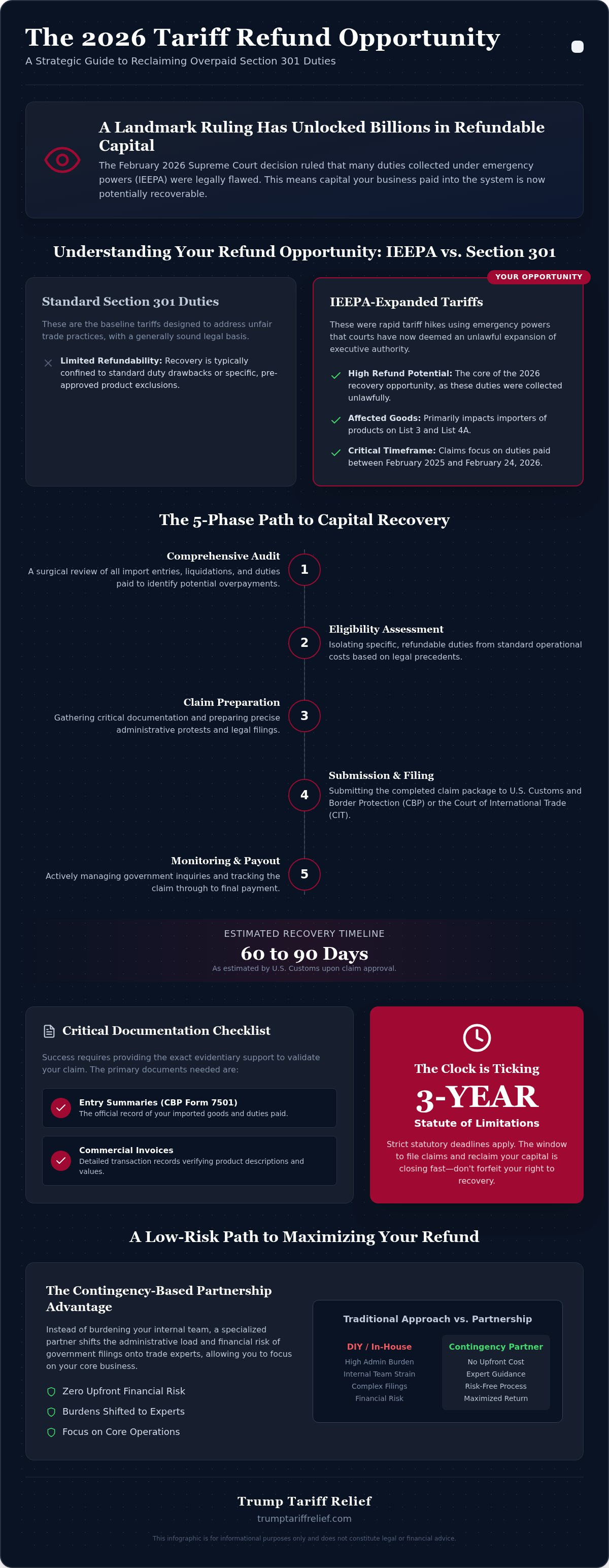
The current trade environment is defined by a massive shift in how the U.S. government collects and retains duties. For years, importers operated under the assumption that tariffs were a fixed cost of doing business. However, the legal foundation for many of these payments has crumbled. To master the Section 301 tariff refund process, you must first distinguish between the original authority of Section 301 of the Trade Act of 1974 and the executive overreach that occurred during the 2025 trade escalations. While Section 301 was designed to address unfair trade practices, the government's subsequent expansion of these duties relied on emergency powers that the courts have now deemed a bridge too far.
Current recovery efforts focus heavily on List 3 and List 4A. These specific categories of goods were subjected to increased duty rates that bypassed traditional legislative oversight. If your business imported electronics, industrial components, or consumer goods falling under these lists between early 2025 and early 2026, you've likely paid into a system that lacked proper legal standing. It's also vital to understand that these refunds are not "duty drawbacks." A standard drawback is a refund of duties paid on imported goods that are later exported or destroyed. In contrast, the Section 301 tariff refund process is a legal reclamation of capital that was collected unlawfully in the first place.
The Role of the International Emergency Economic Powers Act (IEEPA)
The catalyst for the current recovery window was the executive branch's decision to use the IEEPA to expand Section 301 duties without Congressional approval. This maneuver allowed for rapid tariff hikes but created a significant legal vulnerability. In February 2026, the Supreme Court ruled that this specific use of IEEPA authority was an unlawful expansion of executive power. This landmark decision effectively turned billions of dollars in paid duties into refundable capital for businesses that act within the statute of limitations. The most critical timeframe for these claims spans from February 2025 to February 24, 2026, which marks the period of peak IEEPA enforcement before the court intervened.
Section 301 Exclusions and Recovery Pathways
Your path to recovery often depends on whether your products were previously granted exclusions. If an exclusion was already on the books, your potential for a full refund is significantly higher because the government had already acknowledged the specific economic necessity of your imports. Even without a prior exclusion, the 2026 ruling provides a broad pathway for reclamation based on the illegality of the collection method itself. As the government pivots toward new investigations into structural excess capacity and forced labor, securing your past capital becomes even more urgent. For a deeper dive into the regulatory mechanics that make these claims possible, you can review our guide on IEEPA Explained.
The Step-by-Step Section 301 Tariff Refund Process
Reclaiming your capital from the government isn't a matter of simple request; it's a structured administrative mission. The government won't volunteer these funds back to your balance sheet. Success in the Section 301 tariff refund process requires a disciplined, five-phase approach that shifts the burden of proof from your internal team to the regulatory authorities. If you miss a single filing window or misclassify a single entry, the opportunity for recovery vanishes.
The lifecycle of a successful claim follows this linear path:
- Phase 1: A comprehensive audit of all import entries and duties paid.
- Phase 2: A formal eligibility assessment to isolate refundable duties from standard costs.
- Phase 3: Preparation of administrative protests and specific legal filings.
- Phase 4: Submission to U.S. Customs and Border Protection (CBP) or the Court of International Trade (CIT).
- Phase 5: Active monitoring and response to government inquiries through to the final payout.
Step 1: The Eligibility Audit
The first movement in this process requires a surgical review of your trade history. You must identify specific Harmonized Tariff Schedule (HTS) codes that fall within the scope of the 2026 Supreme Court ruling or previous List 3 and List 4A classifications. This isn't just a data export; it's a strategic identification of the 'Duty at Stake.' You need to calculate the exact dollar amount of overpayments to justify the administrative effort. The Importer of Record is legally responsible for verifying the accuracy of all data submitted during this phase.
Step 2: Filing the Protest with CBP
Once the audit identifies the overpayments, the battle moves to the administrative level. Under 19 U.S.C. § 1514, importers have a statutory right to protest CBP decisions, including the assessment of unlawful duties. However, the window for action is narrow. You typically have only 180 days after the liquidation of an entry to file a formal protest. A CSIS analysis of Section 301 tariffs highlights the volatile nature of these trade policies, which makes timely, accurate filings essential. You can see how it works when our team manages these strict deadlines on your behalf.
Phases 3 through 5 involve the heavy lifting of legal advocacy. This includes drafting arguments that address the specific unlawful nature of the duty collection and managing the submission to the CIT if CBP denies the initial protest. Constant monitoring is required because the government often issues requests for information (CF 28s) to delay the payout. Responding with speed and precision ensures your claim remains at the front of the queue. If you're ready to see if your entries qualify, a preliminary tariff eligibility assessment is the most efficient next step.
Critical Documentation: Gathering Evidence for Your Claim
While the legal basis for recovery is established, the government won't issue a check based on a simple request. The Section 301 tariff refund process is an evidentiary battle where success is dictated by the quality of your records. If you can't produce the original paperwork from the date of entry, your claim is dead on arrival. You're essentially auditing the government's collection of your own money, and they require a perfect paper trail before they'll release it.
The Importance of CBP Form 7501
CBP Form 7501, the Entry Summary, is the foundational document for any trade-related recovery. It's the gold standard because it provides the definitive record of the HTS codes used, the value of the goods, and the exact amount of duty paid. If you don't have these on hand, you must immediately contact your customs broker to retrieve them. Many brokers only keep digital records for five years, and retrieving archives can be a slow process that eats into your filing window. You can find more about the regulatory framework governing these filings in our guide on IEEPA explained.
Beyond the entry summary, you need a paper trail that connects your internal logistics to the government's ledgers. This includes:
- Commercial Invoices: These prove the transaction value and the specific nature of the goods imported.
- Packing Lists: These provide granular detail on the items, ensuring they match the HTS codes targeted for refund.
- Proof of Payment: CBP requires evidence that the duties were actually remitted, usually in the form of a bank statement or an ACH confirmation.
- HTS Mapping: Internal records must clearly link your specific product SKUs to the HTS codes that fall under the refundable tariff lists.
Verifying Importer of Record (IOR) Status
Only the Importer of Record (IOR) has the legal standing to initiate the Section 301 tariff refund process. If your company has undergone a merger or acquisition since the duties were paid, the path to recovery is more complex. You must provide legal documentation proving that the right to these claims was specifically transferred to the new entity. This is often where the government attempts to deny valid claims on technicalities. A valid Power of Attorney (POA) is mandatory to allow a recovery partner to act on your behalf and navigate these bureaucratic traps. For official guidance on trade enforcement and current duty structures, refer to the CBP Trade Remedies portal.
Managing this volume of paperwork is the most significant hurdle for most businesses. Our customs documentation management service takes this administrative weight off your team, ensuring every file is audit-ready and every deadline is met.
Deadlines and the Statute of Limitations: Why Time is Critical
Time is the most unforgiving element of the Section 301 tariff refund process. In the world of international trade, the government doesn't grant extensions for "late discovery" or administrative oversight. If you fail to act within the statutory windows, your right to reclaim capital is extinguished permanently. Many importers make the fatal mistake of waiting for a final, perfect ruling before initiating their claims; by the time that ruling arrives, their specific entries have often passed the point of no return.
The 3-Year Deadline Explained
For claims rooted in the unlawful expansion of IEEPA authority, a three-year statute of limitations generally applies. This makes 2026 a pivotal year for your business. With specific Section 301 investigations facing an April 15, 2026, deadline for final action, the window for retroactive claims is narrowing. If you paid duties on entries made in 2023 or 2024, you're currently in the "red zone" where those entries will soon fall outside the recovery window. The clock is tied to the 'Date of Entry,' but it's also accelerated by the process of 'liquidation.' Once U.S. Customs and Border Protection (CBP) liquidates an entry, you have exactly 180 days to file an administrative protest. If that window closes, the duty assessment becomes final and conclusive by law. You can track these specific thresholds in our guide on the Tariff Refund Statute of Limitations.
Avoiding the 'Laches' Defense
The government frequently employs the legal doctrine of 'laches' to defeat valid claims. This argument suggests that even if a claim is filed within the statute of limitations, it should be dismissed if the claimant's "unreasonable delay" prejudiced the government's ability to defend the case. To counter this, we implement a protective filing strategy that establishes your intent to recover funds as early as possible. This prevents the government from claiming you sat on your rights while the regulatory landscape shifted. Deadlines are non-negotiable in trade law; there are no second chances once a date has passed.
There is a massive difference between the 180-day administrative protest window and the two-year window for filing a summons with the Court of International Trade (CIT). Navigating these overlapping timelines requires a steady hand and a proactive approach to documentation. Don't let your capital become a permanent donation to the U.S. Treasury because of a calendar error. You should start your tariff eligibility assessment today to lock in your filing position before these 2026 deadlines expire.
Maximizing Success with a Contingency-Based Recovery Partner
The complexity of the Section 301 tariff refund process often deters businesses from pursuing what's rightfully theirs. Many importers fear that the cost of legal fees and administrative overhead will outweigh the eventual recovery. This is a valid concern in a traditional hourly billing model, where you pay for effort regardless of the outcome. However, a contingency-based partnership eliminates this financial barrier. By shifting the risk to the recovery partner, you ensure that your capital isn't further depleted by the very process meant to restore it. It's a high-reward strategy that turns a legal challenge into a straightforward financial victory.
Contingency vs. Hourly Billing
The ROI of a success-based fee structure is inherently superior for your cash flow. In an hourly arrangement, you face the risk of "sunk costs" if a claim is denied or if the government's response is delayed for months. With Trump Tariff Relief, the interests of the consultant and the client are perfectly aligned; we only succeed when you receive your refund. This model allows our expert team to manage the entire lifecycle of the claim, from the initial audit to government liaising, without any upfront costs. You can learn more about how we evaluate these opportunities in our Tariff Refund Assessment guide.
Burden-shifting is the primary advantage of this partnership. Instead of straining your internal logistics or finance teams, you let trade experts navigate the bureaucratic hurdles. We manage the customs documentation and respond to CBP inquiries, ensuring your case remains active and compliant. This professional advocacy is essential when dealing with the rigid deadlines and technical requirements of the Court of International Trade. We act as the engine of recovery, while you remain the beneficiary.
Starting Your Preliminary Assessment
The first step toward recovery is a streamlined eligibility check. We analyze your trade data to determine your "Duty at Stake" with precision. This initial phase is designed to be fast and non-intrusive, providing you with a clear confirmation of eligibility before any formal filings begin. Given that CBP estimates valid IEEPA refunds are generally issued within 60 to 90 days of an accepted declaration, moving quickly is vital to your bottom line. We handle the heavy lifting so you can focus on your core operations while we work to right this financial wrong.
Don't leave your capital in the government's hands when a no-risk path to recovery exists. Secure your free tariff refund evaluation today.
Reclaim Your Capital Before the 2026 Deadlines Expire
The regulatory landscape of 2026 has shifted the burden of proof back to the government. You now have a definitive, low-risk path to reclaim capital lost to unlawful duty collections. Successfully navigating the Section 301 tariff refund process requires more than just legal theory; it demands precise documentation and an aggressive filing strategy. By auditing your entry summaries and identifying refundable HTS codes now, you protect your business from the 'laches' defense and upcoming statutory cutoffs.
We provide national coverage for all U.S. importers, offering expert management of all customs documentation from the initial assessment to the final payout. Our contingency-based model means you only pay if we win, ensuring this process remains a high-reward partnership for your balance sheet. Don't let your hard-earned capital sit in government accounts while the window for recovery remains open.
Start your free IEEPA tariff eligibility assessment today and take the first step toward righting this financial wrong. You've already paid the price; now it's time to win it back.
Frequently Asked Questions
Is the Section 301 tariff refund real for 2026?
Yes, the refund opportunity is legitimate and stems from the February 2026 Supreme Court ruling that found the use of emergency powers to expand duties was unlawful. This legal precedent has opened a massive window for importers to reclaim billions in overpaid duties. While the government doesn't advertise these opportunities, businesses are actively using the Section 301 tariff refund process to recover capital that was collected without proper authority.
How long does the tariff refund process typically take?
U.S. Customs and Border Protection (CBP) estimates that valid refunds are generally issued within 60 to 90 days after the acceptance of a formal CAPE Declaration. However, the total timeline depends on the complexity of your audit and the speed of documentation retrieval. If the government issues a Request for Information (CF 28), the process can extend as they verify your eligibility. Prompt, accurate filings are the only way to ensure a timely payout.
What is the deadline for filing a Section 301 or IEEPA refund claim?
Deadlines vary based on the type of claim. For IEEPA-related refunds, a three-year statute of limitations generally applies, making 2026 a critical year for entries from 2023. Additionally, certain Section 301 investigations have a final action deadline of April 15, 2026. If your entries have already liquidated, you have exactly 180 days to file an administrative protest. Once these non-negotiable windows close, your right to recover that capital is lost forever.
Do I need a lawyer to file for a tariff refund?
You don't strictly need a lawyer to initiate the Section 301 tariff refund process, but navigating the administrative hurdles requires specialized trade expertise. Most businesses partner with a consultancy like Trump Tariff Relief because we handle the entire lifecycle of the claim. This includes everything from the initial eligibility assessment to documentation management. Expert oversight prevents technical denials and ensures your filings meet the rigorous standards required for a successful recovery.
Which Section 301 Lists are currently eligible for refunds?
Current recovery efforts focus heavily on List 3 and List 4A. These categories were subjected to the expanded duties that the courts later found problematic. If your imports fell under these lists during the 2025-2026 enforcement period, you likely have a high potential for recovery. We conduct a surgical review of your HTS codes to confirm which specific entries qualify for a refund under the current legal framework and Supreme Court precedents.
What happens if my customs broker already filed a protest?
If your broker has already filed a protest, we must review the status and the specific legal arguments used. Many brokers file generic protests that lack the sophisticated legal grounding required for complex Section 301 or IEEPA claims. We can work alongside your existing trade partners to strengthen the claim or manage the transition to a more aggressive recovery strategy if the initial filing was insufficient to secure a final payout.
Can I claim a refund for tariffs paid on goods from countries other than China?
Yes, eligibility isn't limited to Chinese imports. The 2026 landscape includes new Section 301 tariffs affecting 60 different economies, along with the global IEEPA tariffs that were recently struck down. If you paid additional ad valorem duties on imports from any of these regions between early 2025 and early 2026, your business is likely eligible. We assess your entire import history to ensure no refundable capital is left on the table.
What is the cost to start a tariff recovery claim?
There are no upfront costs to begin your recovery claim with Trump Tariff Relief. We operate on a contingency-fee basis; this means we only receive a percentage of the refund if we successfully recover your capital. This model eliminates the financial risk for your business and ensures our team is fully motivated to maximize your payout. You don't pay for hours or efforts; you only pay for results.
Ready to find out what your business may be owed?
Check My Eligibility