
With over $166 billion in IEEPA tariffs declared unconstitutional by the Supreme Court in early 2026, your company's share of that capital is likely sitting in government accounts rather than your own. You've felt the sting of locked-up capital for years, and the complexity of the new CAPE portal only adds to the frustration. Understanding the ROI on tariff refund services is no longer a luxury for CFOs. It is a strategic necessity to reclaim your funds before the strict 180-day protest windows expire on your liquidated entries.
We understand that your internal resources are already stretched thin by the new Section 301 compliance requirements. You shouldn't have to choose between daily operations and complex financial recovery. This guide reveals how a professional, contingency-based model eliminates upfront risk while maximizing your total refund amount. We'll examine the 2026 phased rollout, the benefits of audit-proof documentation, and the fastest path to injecting that capital back into your business. It's time to stop viewing tariff recovery as a burden and start seeing it as the high-return event your bottom line needs.
Key Takeaways
- Calculate the true ROI on tariff refund services by comparing the zero-risk contingency model against the high opportunity costs of internal recovery efforts.
- Learn how advanced data mining identifies 10 to 20 percent more eligible entries than standard audits, ensuring no capital is left behind.
- Explore the workflow for navigating the CAPE portal to bypass technical bottlenecks and accelerate your time-to-capital.
- Recognize the impact of strict 180-day protest windows and the 3-year statute of limitations on your total recoverable assets.
- Understand why audit-proof documentation is the only way to protect your financial restoration from future regulatory challenges.
The ROI Equation: Why Tariff Refund Services Are a Financial Catalyst
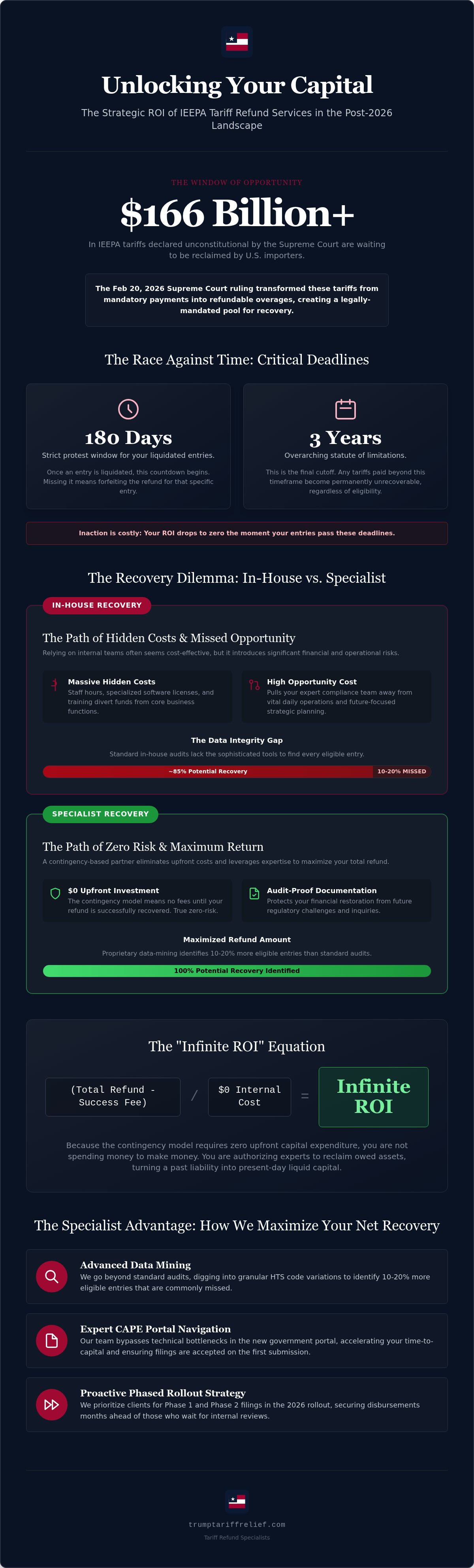
Calculating the ROI on tariff refund services requires a shift in how you view your corporate balance sheet. For most CFOs, a standard return on investment involves an upfront capital expenditure followed by a projected gain. In the specialized world of IEEPA recovery, the equation is fundamentally different: (Total Refund - Success Fee) / Internal Resource Cost. Because our model operates on a contingency basis, your upfront financial investment is effectively zero. This creates what we call "Infinite ROI." You aren't spending money to make money; you're simply authorizing a specialized team to reclaim capital that never should've left your accounts in the first place.
The 2026 landscape has transformed this from a speculative project into a high-priority financial recovery event. With the federal government currently holding over $166 billion in invalidated IEEPA duties, the potential for immediate working capital injection is massive. Turning a past expense into immediate liquidity isn't just a win for the logistics department; it's a net-positive financial move that strengthens your cash position without increasing debt or diluting equity.
Capital Reclamation vs. Traditional Cost Savings
Most supply chain initiatives focus on shaving pennies off future shipping costs or negotiating vendor contracts. While those are valuable, they don't compare to the immediate impact of reclaiming millions in overpaid duties. For manufacturers and retailers, these refunds act as non-dilutive capital. There's often a psychological barrier where businesses view these funds as "bonuses" or "found money." That's a dangerous perspective. These are owed assets that have been sitting in government accounts interest-free while your own business faced high capital costs. IEEPA ROI is the reclamation of overpaid duties with zero upfront liability.
To maximize this recovery, you must first understand what tariffs are and how the legal landscape has shifted their status from mandatory payments to refundable overages. We identify opportunities that standard brokers miss by digging into the granular data of every entry, ensuring every dollar is accounted for before the strict 180-day protest windows close.
The Role of the Supreme Court Ruling in ROI
The February 20, 2026, Supreme Court ruling changed the game for US importers. It transitioned the conversation from "can we get this back?" to "how fast can we file?" This ruling invalidated billions in previously collected duties, creating a legally mandated pool for recovery. However, the window isn't open forever. The 2026 rollout of the CAPE portal has introduced a phased system where eligibility depends on the liquidation status of your entries. If you aren't proactive, your ROI on tariff refund services drops to zero the moment your entries pass the statute of limitations. You can find a deeper breakdown of these legal shifts in our guide to Understanding the IEEPA Tariff Ruling for Importers. We've seen that businesses moving quickly in Phase 1 and Phase 2 are seeing the fastest time-to-capital, often receiving their disbursements months ahead of those who wait for internal legal reviews.
The Math of Contingency: Specialist vs. In-House Recovery
Many CFOs believe that tasking an internal trade compliance team with IEEPA recovery is the most cost-effective path. This assumption ignores the massive hidden costs of staff hours, software licenses, and the significant opportunity cost of pulling experts away from daily operations. When you calculate the true ROI on tariff refund services, you have to account for the "Data Integrity Gap." Specialist teams utilize proprietary data-mining tools that typically identify 10 to 20 percent more eligible entries than a standard in-house audit. While your team might catch the obvious entries, they often miss the nuanced HTS code variations that qualify for recovery under the 2026 Supreme Court ruling.
Customs brokers are essential for daily logistics, but they often decline complex IEEPA claims. These filings involve a level of litigation and regulatory depth that falls outside their standard scope of clearance work. By partnering with a specialist, you ensure that your recovery isn't just a side project. It becomes a dedicated mission supported by trade experts who understand the high stakes of the current trade landscape. We don't just file papers; we hunt for every dollar your business is legally owed.
Breaking Down the Contingency Fee Model
The success fee model is a strategic advantage for any capital-intensive business. It transforms a complex legal hurdle into a "No-Win, No-Fee" opportunity, aligning the consultant’s incentives perfectly with your bottom line. You don't face the mounting hourly rates typical of trade litigation attorneys; instead, you only pay a percentage of the actual capital reclaimed. This structure makes the ROI on tariff refund services incredibly attractive, as it requires zero upfront capital. It's a far more efficient route than navigating the CBP Duty Drawback Program or other government recovery schemes without specialized assistance.
The Resource Drain of Do-It-Yourself Filings
Navigating the CAPE portal and validating ACE data is an exhaustive process. Internal teams frequently run into technical "stuck" points that lead to CBP rejections or long reliquidation delays. In-house filing often results in lower recovery totals due to missed HTS codes. Beyond the risk of error, the sheer volume of documentation required can paralyze an internal department. Every hour your team spends on historical data is an hour they aren't spending on the critical Section 301 compliance tasks that impact your current imports. You can explore our full-service workflow and see how it works to keep your team focused on growth while we handle the heavy lifting of recovery.
Risk Mitigation as an ROI Multiplier
Securing a massive refund check is only half the battle. True ROI on tariff refund services is realized when that capital remains on your books, safe from future CBP clawbacks. Professional documentation serves as a critical shield, ensuring every claim is "audit-proof" before it ever reaches the government. When you handle filings internally, you risk triggering reliquidation reviews that can result in new duty assessments. Our experts validate every data point against historical ACE records to prevent these red flags, turning risk management into a direct multiplier of your final return.
Navigating the CAPE portal, launched on April 20, 2026, presents technical hurdles that often stall payments for months. Many importers find themselves "stuck" due to minor formatting errors or incomplete data sets. By utilizing The Step-by-Step IEEPA Refund Claim Process, you bypass these administrative bottlenecks. We ensure your submission is clean, compliant, and positioned for the fastest possible disbursement.
Understanding CAPE Attestation and Reliquidation Risk
Every time an importer of record files through the CAPE system, they must certify the accuracy of their entries. This attestation carries significant legal weight. If CBP discovers discrepancies during a post-refund audit, the financial penalties can quickly eclipse the original refund. We mitigate this through rigorous pre-filing validation. We don't just submit data; we verify the eligibility of every entry against the 2026 Supreme Court ruling parameters. This professional indemnity provides peace of mind that your financial restoration is permanent, not a temporary loan from the government.
Avoiding the 'Nonresident Importer' Trap
Business structures that utilize nonresident importer (NRI) status often face unique hurdles in the new portal. Payments frequently get stuck because the system struggles to verify foreign entities without specific administrative workarounds. Specialists know how to navigate these "trap" points to ensure capital flows to your accounts without delay. If you're unsure if your business structure qualifies, check our IEEPA Tariff Refund FAQ for specific eligibility criteria. Compliance serves as a secondary ROI. By cleaning up your historical trade data now, you establish higher documentation standards that protect you against future Section 301 Tariff Actions. The expertise gained during the IEEPA recovery process prepares your team for the increasingly complex regulatory environment of 2026 and beyond.
The Cost of Inaction: Deadlines and Time-to-Capital
In the high-stakes trade environment of 2026, time isn't just money; it's the ultimate gatekeeper of your capital. The ROI on tariff refund services hinges entirely on your ability to meet rigid regulatory windows. While the Supreme Court's February ruling opened a $166 billion pool for recovery, that door is already beginning to close for many. Importers must navigate a strict 180-day protest window following an entry's liquidation date. Once that window shuts, the statute of limitations effectively drops your potential recovery to zero. You can't afford a "wait and see" approach when the government is holding your interest-free loan.
The CAPE portal, which launched on April 20, 2026, operates on a first-in, first-out reality. As Phase 1 and Phase 2 filings flood the system, the queue for disbursement grows longer by the day. Businesses that filed early in the April and June rollouts are already seeing capital returned, while those stuck in internal reviews face months of additional waiting. Consider the opportunity cost. If your business is owed $500,000, receiving that capital today to offset the new Section 301 tariffs that took effect on July 24, 2026, is infinitely more valuable than receiving it a year from now. Waiting to file effectively erodes the ROI on tariff refund services by delaying the redeployment of these critical assets.
The 2026 Filing Calendar
The 2026 calendar is unforgiving for importers of Section 301 List 3 and List 4a entries. Because these entries have been liquidating on a rolling basis, the deadlines to file protests are scattered but final. Many businesses are shocked to discover that a significant portion of their 2024 and 2025 imports have already passed the point of no return. This makes the "wait and see" strategy the most expensive mistake an importer can make. You can track these specific expiration dates in our detailed guide on the Tariff Refund Statute of Limitations: The Critical Deadlines for IEEPA Claims.
Accelerating the Recovery Lifecycle
Professional recovery teams utilize automated data gathering from the ACE portal to shave months off the standard filing timeline. While an in-house team might spend weeks manually verifying HTS codes and liquidation dates, specialist workflows can complete a full assessment in days. This speed is vital for maximizing the present value of your recovery. Every month of delay represents a loss in present-value capital for the business. By streamlining the lifecycle from assessment to check-in-hand, you ensure your capital is working for you, not sitting in a government account. Stop letting the government hold your interest-free loan. Start your IEEPA assessment today to lock in your place in the CAPE portal queue.
Maximizing Your Net Recovery with Trump Tariff Relief
We don't just provide a service; we act as your high-performing partner in financial restoration. Our specialized focus on IEEPA and Section 301 recovery means we don't get distracted by general brokerage duties or administrative fluff. We manage the entire lifecycle of your claim, from the initial data mining to the final government filing. This "we-do-the-work" approach is the engine that drives a superior ROI on tariff refund services, allowing your executive team to stay focused on navigating the complex trade challenges of 2026. You shouldn't have to navigate a bureaucracy that's designed to keep your capital locked away.
Our contingency model is the ultimate CFO-friendly solution because it shifts the entire financial risk to our firm. If we don't recover your capital, you don't pay a cent. This removes the internal budget barriers that often stall recovery efforts in overstretched organizations. By quantifying your potential return through a Free Eligibility Assessment before you commit, we provide the transparency and data-backed confidence your board requires. We turn the "maybe" of recovery into a structured, legally mandated financial event.
The Trump Tariff Relief Difference
We are in the business of reclaiming your capital, winning back your margins, and restoring your competitive edge. Our trade experts advocate for you against the bureaucratic friction of the CAPE portal, ensuring that technical glitches or data mismatches don't become permanent financial losses. We understand the nuances of the 2026 Supreme Court ruling and how it applies to your specific industry. For a deeper look at how we categorize and secure these funds, read our Tariff Refund Assessment: A Guide to IEEPA Eligibility and Recovery.
Next Steps: Your 15-Minute Recovery Audit
Identifying your recovery potential doesn't require a massive internal project or weeks of data entry. Our 15-minute audit is designed for maximum speed and zero friction. To begin the process, you only need to provide access to your ACE portal data and entry summaries. We take it from there, performing a deep-dive analysis of your HTS codes and liquidation statuses to pinpoint exactly how much capital is sitting in government accounts. This is the most direct path to improving your ROI on tariff refund services without taxing your internal resources. Secure your free tariff eligibility assessment today and take the first step toward reclaiming what's rightfully yours.
Reclaim Your Capital Before the 2026 Deadlines Expire
The path to maximizing the ROI on tariff refund services is built on speed, data integrity, and specialized advocacy. As the 2026 trade landscape evolves, one reality remains clear: inaction is the most expensive strategy an importer can adopt. By leveraging a contingency-based recovery model, you eliminate financial risk while ensuring that every eligible HTS code is identified and validated through expert data mining. You only pay if we win, making this a net-positive financial move for your balance sheet.
Our team provides the comprehensive data validation and deep CAPE portal expertise required to turn historical overpayments into immediate working capital. We handle the legal heavy lifting and government filings so you don't have to tax your internal resources. The window to restore your bottom line is open, but it's closing with every liquidated entry that passes the statute of limitations. Take the assertive step to protect your financial interests today.
Claim Your Zero-Risk Tariff Recovery Assessment and start winning back what your business is legally owed. Your capital belongs in your accounts, not the government's.
Frequently Asked Questions
What is the typical success fee for tariff refund services?
Success fees are calculated as a percentage of the actual capital recovered from the government. This performance-based model ensures our incentives are perfectly aligned with your recovery total. Because it's a contingency arrangement, your business avoids the risk of paying for hourly legal work that might not result in a check. This structure is essential for maintaining a high ROI on tariff refund services for your organization.
How much money can my business realistically expect to recover?
Your recovery amount depends on the volume of Section 301 List 3 and List 4a goods imported during the period impacted by the February 2026 Supreme Court ruling. With $166 billion in total IEEPA tariffs slated for refund, many businesses discover six or seven-figure sums sitting in government accounts. A preliminary eligibility assessment is the most efficient way to quantify your specific share of these invalidated duties before the protest windows close.
Can my current customs broker handle IEEPA tariff refunds?
Most customs brokers focus on daily logistics and clearance rather than the high-level trade litigation and complex data mining required for IEEPA claims. These refunds involve legal challenges to federal authority that fall outside standard brokerage scopes. Utilizing a specialized recovery team ensures your claim is optimized with proprietary data-mining tools that standard brokers don't possess. We act as a powerful ally to navigate the bureaucracy that standard brokers often avoid.
Is there an upfront cost to start a tariff refund claim?
There is no upfront cost to begin your recovery process. Our model is strictly contingency-based, meaning you face zero financial risk at the start of the engagement. This structure is designed to maximize the ROI on tariff refund services by removing initial capital barriers. You only pay a success fee after we've successfully secured and restored the capital to your business accounts, ensuring a net-positive financial move.
What happens if our tariff refund claim is denied?
If a claim is denied, your business owes nothing under our contingency agreement. We absorb the administrative and data-processing costs of the filing, so the financial risk rests entirely with us. However, our rigorous pre-filing validation through the CAPE portal is designed to prevent denials. We verify every entry against the 2026 Supreme Court parameters to ensure your documentation is audit-proof and positioned for approval by CBP officials.
How long does it take to see the ROI from a tariff recovery service?
Disbursement timelines depend on the liquidation status of your entries and the current phase of the CAPE portal rollout. Entries in Phase 1 and Phase 2, which launched in April and June 2026, are seeing faster processing than older liquidated entries. Most businesses begin to see their capital restored within several months of a successful filing. Moving quickly ensures you're at the front of the queue as the government processes billions in claims.
Will filing for a refund trigger an audit of all our imports?
Filing for a legally mandated refund following a Supreme Court ruling is a standard financial reclamation, not a trigger for a full-scale audit. We mitigate risk by ensuring every entry is fully validated and audit-proof before submission. Our comprehensive documentation standards actually improve your trade compliance posture. This proactive approach protects your business while restoring capital that was collected under an unconstitutional framework.
What is the deadline for filing an IEEPA tariff refund claim in 2026?
Deadlines are entry-specific and occur exactly 180 days after each individual import entry liquidates. Because liquidations happen on a rolling basis throughout 2026, there isn't a single universal cutoff date for all claims. However, the opportunity for recovery is lost forever once an entry passes this 180-day protest window. You must act promptly to capture entries before they hit the 3-year statute of limitations and the capital becomes unrecoverable.
Ready to find out what your business may be owed?
Check My Eligibility